


115682414515
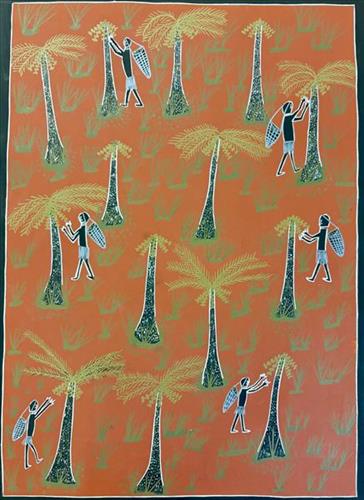
Collecting cycads
For Yolŋu collecting cycad nuts for damper is a deeply knowledgeable practice that brings together Country, seasonality, and intergenerational teaching. Cycad palms grow across Arnhem Land and knowing when and where to harvest is guided by close observation of the environment. Elders pass on this knowledge to younger generations through time spent on Country, showing not only how to gather the nuts, but how to do so respectfully, taking only what is needed and ensuring the plants continue to thrive.
Cycad nuts are highly nutritious but naturally toxic, so their preparation requires patience and skill. After harvesting, the nuts are carefully cracked and the kernels processed through repeated soaking and leaching in fresh or running water over many days. This slow process removes toxins and transforms the nuts into a safe flour. It is a powerful example of Yolŋu scientific knowledge developed over thousands of years, grounded in experimentation, memory, and care.
Once prepared, the cycad flour is mixed with water and shaped into damper, often cooked in the coals of a fire while families sit together, talk, and share stories. Eating cycad damper is more than nourishment. It is a reminder of self-sufficiency, cultural continuity, and the strength of Yolŋu food systems that have sustained people on Country long before introduced foods. The practice continues today as an expression of identity, resilience, and respect for ancestral ways of living well with the land.

222082414961

Cassowary
The Cassowary, an endangered species of flightless bird of the tropics. The distinctive casque (helmet) is thought to allow the bird to feel the low vibrating sound made by other cassowaries over long distances. They are solitary, the males nurture the eggs and young from 8-18 months. The cassowary are the forest gardeners, they play a role in maintaining the diversity of the forest.

222082414960

Major Mitchell’s Cockatoo
Medium sized cockatoo found inland arid areas. They live on seeds of grasses and herbaceous plants, bulbs, roots, insect larvae and fruits. Their population has declined because of land clearing and cereal crops which reduce food variety. Beautiful bird that has a name that brings thought of a terrible story of my Burrundji tribe being poisoned by Mitchell while surveying, as my family one of two girls to survive, being absorbed into the Burrundji tribe.

115682415009

JB Fisher – Narrgi’ṉarrgi (possum- sugar glider)
JB paints stories from his Dhuwa homeland in northeast Arnhem Land. Stories are passed on either paternally or maternally, and JB would have learnt these stories from his ancestors. The cross-hatching style is a traditional painting style of this area and can represent elements such as water, air and wind.
His paintings often feature totemic animals of the fresh waters of north east Arnhem Land. You can see honey bee, lizards and the sugar glider possum all near a waterhole

115682415008

JB Fisher – Mewal
This painting is about the story of the rock Mewal, that is the embodiment of the spirit man Mokuy who created the honey men/sugar bag tribe. In the story, Mokuy runs away from from a burning grass fire and to escape he turns into the special curved shape rock that is just outside Ramingining. In this painting people are singing and dancing to Mewal around a special tree. It is a ceremony day. People are also collecting Yams (Pitarro) a bush tucker vegetable that is black on the outside and white on the inside.
This is JB Fisher’s story from his country in the heritage listed Arafura Wetlands in North East Arnhem Land. He has inherited this story from his Father, and his Fathers Father, and this story goes back forever. As long as the Yolngu people have been here.

115682415007

JB Fisher – Mewal
This painting is about the story of the rock Mewal, that is the embodiment of the spirit man Mokuy who created the honey men/sugar bag tribe. In the story, Mokuy runs away from from a burning grass fire and to escape he turns into the special curved shape rock that is just outside Ramingining. In this painting people are singing and dancing to Mewal around a special tree. It is a ceremony day. People are also collecting Yams (Pitarro) a bush tucker vegetable that is black on the outside and white on the inside.
This is JB Fisher’s story from his country in the heritage listed Arafura Wetlands in North East Arnhem Land. He has inherited this story from his Father, and his Fathers Father, and this story goes back forever. As long as the Yolngu people have been here.

377810582415005

Wayuk (Waterlily)
Wayuk (Waterlily) Nymphaea violacea.
The stem of wayuk is a popular bushfood and the beautiful flower is enjoyed across Arnhem Land.
This fabric was created using the linocut printing technique. The lino tile has been carved by the artist in Maningrida, and has been printed by hand using a variety of colours and layers. The linocut technique ensures each textile piece is a one-off, limited edition piece. Bábbarra Women’s Centre supports the economic independence of Indigenous women in the Arnhem Land community of Maningrida, Northern Territory, Australia. Designs created by the women at Bábbarra reflect strong cultural knowledge, which is passed down to younger generations through their textile design practice.

221382415038

Handwoven Dillybag Earrings, Silver 925
Wagilak Yapa Watj (Wagilak Sisters) range –
exclusive jewellery from Indigenous women of Beswick. Developed in studio workshops with jeweller Kate Sale and weaver Fiona Gavino, traditional fibre artists are translating their skills into a series of fine woven wire earrings and pendants. Hand woven in sliver, gold and copper, traditional forms are transformed as delicate interpretations of string and dilly bags, baskets and mats.
Featuring sterling silver, 9ct gold and copper (all nickel-free work).

377810582415101

Mandjabu (Fish Trap)
Kuninjku people traditionally make two sorts of conical fish traps. One is called mandjabu and is made from a strong, durable vine called milil, and a smaller one is called manylik mandjabu, and made from the grass manylik. The mandjabuconical fish trap is bigger and stronger and used in tidal reaches of creeks to catch large fish. The smaller, lighter manyliktrap is used in freshwater flowing creeks to catch smaller fish and freshwater prawns. In earlier times, only men were involved in the construction of the large fish traps, but children would often crawl inside and assist.
To make mandjabu, weavers firstly harvest milil (burney vine, Malaisia scandens) and put it in water overnight to make it soft. Then they start weaving it; they make rings for the inside to keep the fish trap’s shape. People also make string from the bark of burdaga (kurrajong) to attach the bardainy (hibiscus) rings and to tie the conical end of the fish trap. It’s hard work and it can take three or four weeks to make a fish trap. People also use fish-net fences called kunkarlewabe. They would put the kunkarlewabe across rivers and creeks. In the middle they would place the mandjabu. They also used small things like sticks, rocks, mud and grass to block the fish from going through. This way we would catch fish such as saltwater barramundi rajarra, ngaldadmurrng (freshwater barramundi), small black freshwater catfish (buliya), bonefish (an-guwirrpiya), and sand bass (dalakan) in the mandjabu.