114182413396


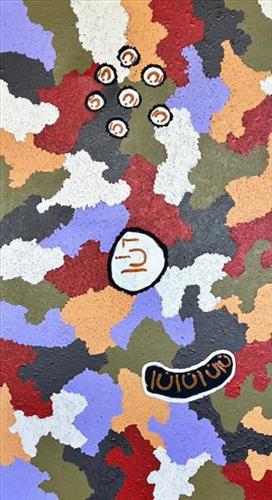
Kungkarrangkalpa (Seven Sisters)

‘Kungkarrangkalpa’ (The Seven Sisters or Pleaides) is significant Tjukurrpa (dreamtime). Its origins you may be familiar with in astronomy and its connection to ‘Wati Nyiru’ (Magic Man or Orion).  The roots of this dreaming stems across indigenous groups around the world. The Australian Aboriginal songline is one part to the whole dreaming which can be traced all around the world. The ladies of the Ngaanyatjarra Lands depict their significant chapter and understanding of the journey of the sisters. The different versions of this story depend on where you live and the significance’s of local Tjukurrpa places.

Nyiru fell in love with the sisters but he was of the wrong skin group to marry, but he still pursued them on their journey. The sisters travel across the land to escape Nyiru’s unwanted attentions, but he is persistent and always finds them. There are significant land forms which can be sited today that evidence this dreaming. As Nyiru is chasing the sisters he tries to catch them by using magic to turn into the most tempting kampurarrpa (bush tomato) and the most beautiful Yirli (wild fig tree), for them to eat and camp under. However, the sisters are knowledgeable of his magic and too clever for Nyiru who they outwit again and again. They go hungry and run through the night rather than be caught by him. As the journey continues, Nyiru gets so frustrated at the wit of the sisters that he uses his magic to make the oldest sister sick to try and get closer to her. The other sisters rescue the big sister and nurse her back to health. It is said he also captures the youngest sister, but with the help of the oldest sister, she escapes back to her sisters who are waiting for her. Eventually, the sisters fly into the sky to escape Nyiru, forming the constellation. Nyiru felt lonely, longing for the sisters who were so far away. Nyiru used his magic to go to the sky, forever in pursuit.
115682414711


Lidjilidji (Crimson finches)

This artwork represents totemic finches. These birds herald the beginning of the dry season and are associated with the Ganalbingu clan. Lidji Lidji are also represented in ceremonial song and dance.

115682415047


Warrnyu Dhawu (Flying Fox Story)

Back in the Creation time, Warrnyu (Flying Foxes) once lived, like men, in the cave at the place called Kurrki Warrnyu Yirri Djaringal (they also lived in caves called Wadatilmurr & Gurngurmirrngu). Warrnyu lived in these caves for many years and then one day Djanyarr (The Dog), an ancestral being in the form of a man, came along. He was looking around for a place to live. Djanyarr heard the sound of a Flying Fox screaming. He went down to the cliff and pushed the rock and the water came out at the Ganalbingu place called Gurrkawakarrmurr. He then went into the cave and into the sacred hole, frightening all the Flying Fox away. When he went into the hole he left his dilly bag in the tree and went out on the other side of the sacred cave and leaving his spear and woomera. He sat there for a long time. The Dog made three streams and the water went inside the cave. Two of these streams are good drinking water. In the middle it is a sacred water. No-one drinks from the middle of the stream. Children, men, women, young boys or girls are not allowed to drink from the middle of the stream. If they drink the water from the middle of the stream they will go grey too early.

At Kurrki Warrnyu Yirri Ngilaya Djaringal, the Flying Fox made himself into a young man… that’s what Aboriginal people do today. They have ceremonies and dances to make the young boys into men. The songs are called Yirrarwu, Gulumu, Rruburra and Burryun. Dhapi (initiation ceremony) happen today because the Warrnyu (Flying Fox) people performed them a long time ago before the Yolngu people. It was the Warrnyu people who first performed circumcision of the young boys to make them into men. It all happened at Kurrki Warrnyu Yirri Ngilaya Djaringal, this is how this place got its name.

Leaving behind the cave at Kurrki Warrnyu Yirri Djaringal, the Dog travelled west across the Arafura Swamp and came to Djalkulmurr (Mount Delight). From there he travelled north and came to Dunganda (a hill situated a few kilometres east of Ramingining). There he met a female Dog, then they both headed north and came to a place called Garanydjirrmurr where they spoke the Mildjingi language. From Garanydjirrmurr they changed their direction and went west through Guliny’barra, Burgumara and onto the plains. When they reached the plains they smelled something cooking, way up in the north – at Wessel Islands. The aroma they smelt was so enticing that they decided to go there. Lungurrma (the north-east wind) was carrying the smell. One Dog headed north again, but the other Dog decided not to go with him and went back the opposite way. The first Dog that went to Malwanatharra (Sandy Point) went into the sea following its nose to wherever the smell was coming from. It is believed that this Dog still lives in the sea…

220982415354


Elizabeth Ngwarraye Bonney – My Grandmothers Country

I still hunt my Grand Mothers country for goanna, bush medicine and yams.

I hunt all year round, hunting and walking through the country makes me happy.  When I look at the distant hills I can feel my grandmother.  Bush flowers are everywhere.

Painting and printing my grandmother’s country reminds about those times.

115682415115


Raypiny Dhawu (Fresh Water Story)

All Aboriginal people originate from a spiritual source, fixed in a particular place in their land or the sea. These ‘spiritual reservoirs’ are often in the form of special waterholes made by Wangarr (creative spirits) that were created long ago close to the beginning of time. These creator beings moved across the countryside, shaping the land and implanting in each tract of country, the spiritual life force for the people who were to own it. These creative spirits took many forms and when they gave the land to each group, they also gave songs, dances, ceremony, the associated laws and language.


The creation story for Ganalbingu people took place near the middle section of the Glyde River where it becomes the Goyder River. Their land, Ngaliyindi, sits astride the Arafura Swamp in Central Arnhem Land. Many Ganalbingu artists paint totemic species significant to their clan. These can include baru (crocodile), banda (long necked turtle), buliya (catfish), yalman (waterlilies), gumang (magpie geese), dakawa (fresh water yabby), ratjuk (barramundi), warrnyu (flying fox) and more.


115682415397


Baltji (Yam)

This painting depicts Baltji (Yam) which has been a reliable food source for Yolngu people for many centuries. Baltji can be found across the different landscapes of East Arnhem Land and are only harvested seasonally. 

115682415654


Raypiny Dhawu (Fresh Water Story)

All Aboriginal people originate from a spiritual source, fixed in a particular place in their land or the sea. These ‘spiritual reservoirs’ are often in the form of special waterholes made by Wangarr (creative spirits) that were created long ago close to the beginning of time. These creator beings moved across the countryside, shaping the land and implanting in each tract of country, the spiritual life force for the people who were to own it. These creative spirits took many forms and when they gave the land to each group, they also gave songs, dances, ceremony, the associated laws and language.


The creation story for Ganalbingu people took place near the middle section of the Glyde River where it becomes the Goyder River. Their land, Ngaliyindi, sits astride the Arafura Swamp in Central Arnhem Land. Many Ganalbingu artists paint totemic species significant to their clan. These can include baru (crocodile), banda (long necked turtle), buliya (catfish), yalman (waterlilies), gumang (magpie geese), dakawa (fresh water yabby), ratjuk (barramundi), warrnyu (flying fox) and more.


115682416075


Raypiny Dhawu (Fresh Water Story)

All Aboriginal people originate from a spiritual source, fixed in a particular place in their land or the sea. These ‘spiritual reservoirs’ are often in the form of special waterholes made by Wangarr (creative spirits) that were created long ago close to the beginning of time. These creator beings moved across the countryside, shaping the land and implanting in each tract of country, the spiritual life force for the people who were to own it. These creative spirits took many forms and when they gave the land to each group, they also gave songs, dances, ceremony, the associated laws and language.


The creation story for Ganalbingu people took place near the middle section of the Glyde River where it becomes the Goyder River. Their land, Ngaliyindi, sits astride the Arafura Swamp in Central Arnhem Land. Many Ganalbingu artists paint totemic species significant to their clan. These can include baru (crocodile), banda (long necked turtle), buliya (catfish), yalman (waterlilies), gumang (magpie geese), dakawa (fresh water yabby), ratjuk (barramundi), warrnyu (flying fox) and more.


115682416074


JB Fisher – Sugar bag (honey) Story

JB Fisher often paints subjects related to the Sugar Bag story, a story he has inherited. Sugarbags, or Gulka as it is locally known, are the native honeys found in the bush surrounding Ramingining. 

In this painting, JB paints the honeybees. 

Sugarbag story is related to the Mewal place, a significant area represented by the special shaped rock, situated in JB Fisher’s Father’s Country, just outside of Ramingining Community in north east Arnhem Land.