116482426068


My Country

In this painting, My Country, the yellow and white circles represent the sun and moon. The blue circles represent the waterhole where the Warlu (snake) lives. The green circle represents the wet season and how it brings new life to the land. The two camps on opposite sides of the river are the two different groups that share the waterhole and river. The cloud in the sky is a reflection of the warlu heading down the river . The warlu travels through the sky. On the land you can see the trees and spinifex and a burn off, and the places that have already been burnt off.

377815582426299


My Black Soil Country

“I paint it in different colours but it always goes back to my black soil Country. We’ve got a lot of black soil Country throughout our Country. Once you’re in it you can get stuck in it. I remember being stuck in black soil Country and had incidents even after being told not to go there. Because of me having encounters on black soil Country I can recollect my times on my Country. They would say, don’t go that way, that’s black soil Country! But sometimes there is only one road. It plays a big part in me, that’s what I think about in my Country, that black soil.”
 – Christine Farrer

This artwork celebrates Country — not only land, but a living place of spirit, story, memory and identity. Country is saltwater and desert, wind and rain, sandhills and tide, waterholes and mangroves, sky, animals, plants and ancestors. It is where families walk, hunt, fish, gather, camp and teach the next generations.

When the artist paints Country, they are sharing a map of home and belonging. Lines may follow the dunes and tidal creeks, dots may mark water places or bush foods, colours reflect the seasons — the deep blues of the sea, the soft greens after rain, the hot reds and warm sands of dry Country. Every artwork holds a story: places visited, footsteps of old people, language, knowledge and the feeling of being out bush.

The artist invites the viewer to see Country the way they do — alive, powerful and always connected to family, culture and community. Country is not separate from people; it is part of who they are. Painting it keeps that connection strong, honouring the past, carrying knowledge forward, and sharing it with others.

377815582426298


Desert to the Sea

This artwork reflects the artist’s connection to Bidyadanga, a place where the desert meets the sea. Through colour, pattern, and texture, the painting captures important themes that shape the identity of the community and Art Centre.

Bidyadanga sits on Karajarri Country, where desert Country meets saltwater Country. The community is home to Karajarri people and to desert families who travelled from the Great Sandy Desert to La Grange Mission in the 1960s and 70s, during a time when drought and changing conditions dried desert water sources. The first five language groups to build the community together were Nyangumarta, Mangala, Yulparija, Juwaliny and Karajarri. Today, Bidyadanga continues to grow, welcoming families from across the Kimberley, Pilbara and beyond, creating a strong and diverse cultural community.

Artists draw on stories of place, family, movement, and survival — caring for both land and sea, hunting and fishing, and living between two immense environments. Patterns, marks, and flowing forms echo desert dunes, waterholes, tidal flats, reefs, bushfoods, and sea life, honouring the knowledge held across generations.

In this work, the artist celebrates the beauty of Country and community, offering a glimpse into the rich histories, cultural strength, and enduring connection to land, sea, and way of life.

377815582426297


Desert to the Sea

This artwork reflects the artist’s connection to Bidyadanga, a place where the desert meets the sea. Through colour, pattern, and texture, the painting captures important themes that shape the identity of the community and Art Centre.

Bidyadanga sits on Karajarri Country, where desert Country meets saltwater Country. The community is home to Karajarri people and to desert families who travelled from the Great Sandy Desert to La Grange Mission in the 1960s and 70s, during a time when drought and changing conditions dried desert water sources. The first five language groups to build the community together were Nyangumarta, Mangala, Yulparija, Juwaliny and Karajarri. Today, Bidyadanga continues to grow, welcoming families from across the Kimberley, Pilbara and beyond, creating a strong and diverse cultural community.

Artists draw on stories of place, family, movement, and survival — caring for both land and sea, hunting and fishing, and living between two immense environments. Patterns, marks, and flowing forms echo desert dunes, waterholes, tidal flats, reefs, bushfoods, and sea life, honouring the knowledge held across generations.

In this work, the artist celebrates the beauty of Country and community, offering a glimpse into the rich histories, cultural strength, and enduring connection to land, sea, and way of life.

377815582426296


Sea Animals

This artwork invites the viewer into the world of salt-water Country — the sea animals, the tides, the reefs, the mangroves, the hunting, the gathering, and the guardianship of coast and sea. The artist portrays fish, turtles, rays, dolphins, dugongs, sharks, crustaceans and shellfish, weaving together the patterns of sea-grass, coral, tidal flats, beach and reef.

It tells of families fishing off the beach, children diving in shallow waves, spear hunting, crabbing and catching prawns. It also speaks of wildlife protection — respectful harvesting, ensuring sea animals remain healthy, sea-ranger work and cultural practice.

With flowing patterns, deep blues and turquoise, shell shapes, wave forms and animal tracks, the work echoes the movement of water, tides and life beneath the waves. The artist invites us to listen to the tide, recognise the connection between land, sea, animal and people, and remember that to harvest is also to care — leaving Country strong for those who come next.

377815582426295


My Black Soil Country

“I paint it in different colours but it always goes back to my black soil Country. We’ve got a lot of black soil Country throughout our Country. Once you’re in it you can get stuck in it. I remember being stuck in black soil Country and had incidents even after being told not to go there. Because of me having encounters on black soil Country I can recollect my times on my Country. They would say, don’t go that way, that’s black soil Country! But sometimes there is only one road. It plays a big part in me, that’s what I think about in my Country, that black soil.”
 – Christine Farrer

This artwork celebrates Country — not only land, but a living place of spirit, story, memory and identity. Country is saltwater and desert, wind and rain, sandhills and tide, waterholes and mangroves, sky, animals, plants and ancestors. It is where families walk, hunt, fish, gather, camp and teach the next generations.

When the artist paints Country, they are sharing a map of home and belonging. Lines may follow the dunes and tidal creeks, dots may mark water places or bush foods, colours reflect the seasons — the deep blues of the sea, the soft greens after rain, the hot reds and warm sands of dry Country. Every artwork holds a story: places visited, footsteps of old people, language, knowledge and the feeling of being out bush.

The artist invites the viewer to see Country the way they do — alive, powerful and always connected to family, culture and community. Country is not separate from people; it is part of who they are. Painting it keeps that connection strong, honouring the past, carrying knowledge forward, and sharing it with others.

377815582426294


Nyangumarta Warrarn (Country)

“Nyangumarta Country is home to the Nyangumarta people — from the desert to the seaside. Old people lived and walked on this land, and we as Nyangumarta still look after it today. We go out on Country, hunting and living from the traditional foods of the land.

Nyangumarta people travelled and lived between the desert and the sea. This painting tells a story from the Nyangumarta Dreaming — of a woman who walked with her child along this Country collecting seafood, mayi. They were both on the reef when the tide came in and drowned them. Today, two rocks remain out by the sea, marking their story.

We carry our culture, and most people tell stories through their painting — that’s how it’s always been. Passing knowledge down. Younger people might not see it now, but in the future, they might want to follow in their Elders’ footsteps — carrying on the skills, knowledge, and way of life. It can be anything: painting, hunting, becoming leaders.”
 – Venetta Yanawana

This artwork honours Nyangumarta Country — from the long sweep of Eighty Mile Beach and coastal flats to the rolling sand dunes and salt lakes of the Great Sandy Desert. It holds the movement between saltwater and desert: tides, reefs and mangroves to the west; dunes, claypans and waterholes to the east.

Lines flow like wind across spinifex and waves in the ocean; dots gather where waters sit after rain; colours shift from deep blues to desert reds and whites of saltpan. The painting also reflects the ongoing work of Nyangumarta families and rangers to look after Country — sea and land — guided by community plans and Indigenous Protected Area management.

377815582426238


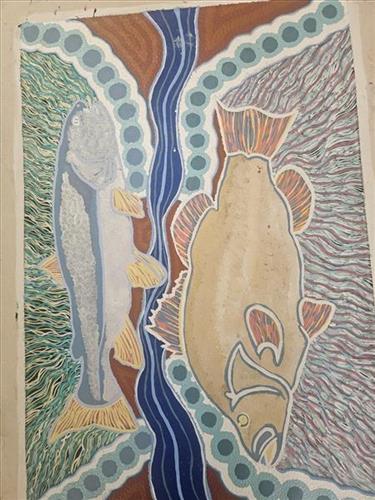
Sealife

“All the fish – barramundi, salmon, dugong, turtle and jellyfish. I paint what I see and eat. Fish of the sea. I paint the right season for them, so if something is in season, I paint it. The threadfin salmon and blue nose salmon come in wintertime. Barramundi is in the hot time, when the jellyfish come out. Dugong is after the rainy season.

I am a ranger and I look after the land and the sea. When it’s hot season, we see jellyfish on the sand and beach – that means it’s the right time for hunting turtles. They’re fat from eating the seagrass and jellyfish. When we see the yellow flowers (wattle) blooming, we know the barramundi are good for catching.

The barramundi stole the pearl shells from the desert and made the creek called Waru Creek, near 80 Mile Beach. There are old fishing camps down that way, and we go with the rangers to do salmon surveys and monitor how healthy they are. When you see the flying clouds and the full moon, it’s the right time for turtle nesting and turtle monitoring. In June and July, they lay their eggs.”
 – Elliot Hunter

Elliot is also a Nyangumarta Ranger, working to protect both land and sea. Nyangumarta Country stretches across the coastline and inland desert of the northwest, from 80 Mile Beach through the Great Sandy Desert. It is a vast landscape of red sand dunes, claypans, salt marshes, and long stretches of coastal waters rich with sea life. Fishing is not only part of Elliot’s everyday life but also an important cultural practice that connects him to Country and community. Through his paintings, he brings together his knowledge as a ranger and his lived experience of fishing, showing how the seasons guide when and what to hunt. His artworks celebrate the richness of sea life while sharing stories that have been passed down and lived on Country.

This artwork invites the viewer into the world of salt-water Country — the sea animals, the tides, the reefs, the mangroves, the hunting, the gathering, and the guardianship of coast and sea. The artist portrays fish, turtles, rays, dolphins, dugongs, sharks, crustaceans and shellfish, weaving together the patterns of sea-grass, coral, tidal flats, beach and reef.

It tells of families fishing off the beach, children diving in shallow waves, spear hunting, crabbing and catching prawns. It also speaks of wildlife protection — respectful harvesting, ensuring sea animals remain healthy, sea-ranger work and cultural practice.

With flowing patterns, deep blues and turquoise, shell shapes, wave forms and animal tracks, the work echoes the movement of water, tides and life beneath the waves. The artist invites us to listen to the tide, recognise the connection between land, sea, animal and people, and remember that to harvest is also to care — leaving Country strong for those who come next.

220982350120


Susan Ngwarraye Philomac – Spring Creek

Donkeys and horses would come and drink from the water at Spring Creek on my father’s country.  We would put a bucket in the sand we would filter the water so we could drink it.  When I was young girl we would go to Canteen Creek following the track along the hills, we would hunt turkey, emus and kangaroo and we would cut the bark and collect the sap from the sugar bag trees. `


Dimensions: 30 x 20cm Lino Print – Charcoal – S/H 300gsm

220982350119


Susan Ngwarraye Philomac – Spring Creek

Donkeys and horses would come and drink from the water at Spring Creek on my father’s country.  We would put a bucket in the sand we would filter the water so we could drink it.  When I was young girl we would go to Canteen Creek following the track along the hills, we would hunt turkey, emus and kangaroo and we would cut the bark and collect the sap from the sugar bag trees. `


Dimensions: 30 x 20cm Lino Print – Charcoal – S/H 300gsm