377815582426238
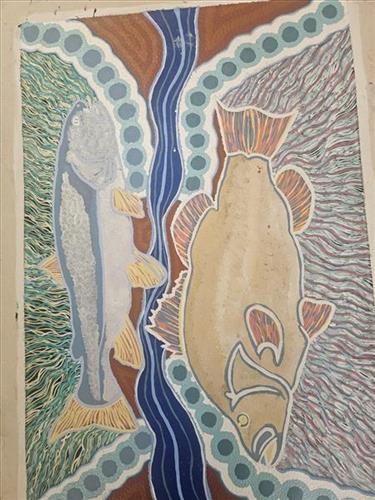
Sealife
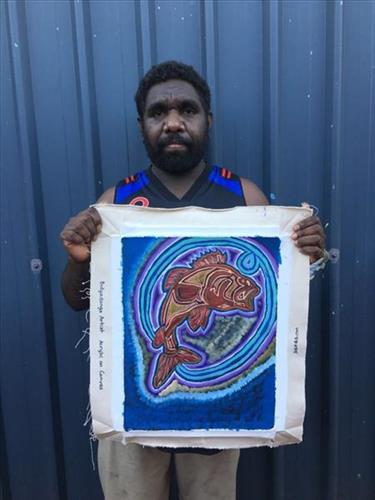
“All the fish – barramundi, salmon, dugong, turtle and jellyfish. I paint what I see and eat. Fish of the sea. I paint the right season for them, so if something is in season, I paint it. The threadfin salmon and blue nose salmon come in wintertime. Barramundi is in the hot time, when the jellyfish come out. Dugong is after the rainy season.
I am a ranger and I look after the land and the sea. When it’s hot season, we see jellyfish on the sand and beach – that means it’s the right time for hunting turtles. They’re fat from eating the seagrass and jellyfish. When we see the yellow flowers (wattle) blooming, we know the barramundi are good for catching.
The barramundi stole the pearl shells from the desert and made the creek called Waru Creek, near 80 Mile Beach. There are old fishing camps down that way, and we go with the rangers to do salmon surveys and monitor how healthy they are. When you see the flying clouds and the full moon, it’s the right time for turtle nesting and turtle monitoring. In June and July, they lay their eggs.”
– Elliot Hunter
Elliot is also a Nyangumarta Ranger, working to protect both land and sea. Nyangumarta Country stretches across the coastline and inland desert of the northwest, from 80 Mile Beach through the Great Sandy Desert. It is a vast landscape of red sand dunes, claypans, salt marshes, and long stretches of coastal waters rich with sea life. Fishing is not only part of Elliot’s everyday life but also an important cultural practice that connects him to Country and community. Through his paintings, he brings together his knowledge as a ranger and his lived experience of fishing, showing how the seasons guide when and what to hunt. His artworks celebrate the richness of sea life while sharing stories that have been passed down and lived on Country.
This artwork invites the viewer into the world of salt-water Country — the sea animals, the tides, the reefs, the mangroves, the hunting, the gathering, and the guardianship of coast and sea. The artist portrays fish, turtles, rays, dolphins, dugongs, sharks, crustaceans and shellfish, weaving together the patterns of sea-grass, coral, tidal flats, beach and reef.
It tells of families fishing off the beach, children diving in shallow waves, spear hunting, crabbing and catching prawns. It also speaks of wildlife protection — respectful harvesting, ensuring sea animals remain healthy, sea-ranger work and cultural practice.
With flowing patterns, deep blues and turquoise, shell shapes, wave forms and animal tracks, the work echoes the movement of water, tides and life beneath the waves. The artist invites us to listen to the tide, recognise the connection between land, sea, animal and people, and remember that to harvest is also to care — leaving Country strong for those who come next.