377815582444169


Kulyakartu

“I paint mainly about Kulyakartu Country and Kirriwirri Country. Both are in the Great Sandy Desert in the Pilbara. These places mean home to me — Ancestors’ homes, my family’s home, my nanna’s home. I paint because we don’t get out on this Country often and painting is a way of having a connection.

Our nanna never told us her life living out in the desert. It’s sandy, they have waterholes and gum trees. I feel at peace when I’m out there. A bit of rocky terrain out there where the waterholes are. Feeling, belonging.

I remember when we were out there and our grandfathers were telling us stories of when they were kids and when they would play around in the trees. Just sitting around the campfire and seeing their faces light up when telling their stories. I felt complete when her brothers shared it.”
 – Corina Jadai

This artwork shares the story of Kulyakartu, a vast and peaceful area north-east of the community, on the edge of Nyangumarta and Martu Country. Kulyakartu is a place of wide open skies, long claypans, sandhills and soft grasses that come alive after rain.

Families remember camping there, visiting waterholes, looking for goanna and bush foods, watching birds, and travelling with old people who knew every dune, track and soak. The painting celebrates the beauty and calm of Kulyakartu, often shown through soft lines and dots that follow the movement of water and sand. It honours the knowledge of where to find water, how to move across Country, and the deep belonging felt when returning to ancestral places.

Through this work, the artist invites viewers to feel that stillness and connection — the strength of Country, memory and family.
377815582444165


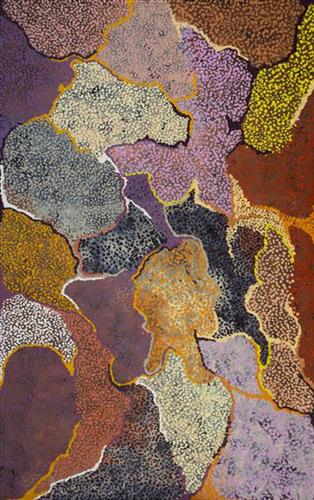
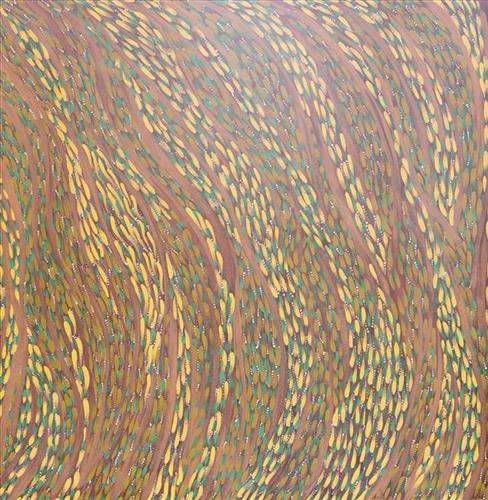
Seeds

“I paint with seeds because seeds is my thing. Seeds brings new life. Whether it’s from plants, animals or people. A lot of paintings and things were done by men only because back then, women were gathering food and caring for kids. I was inspired by my uncle who is an artist and I really wanted to paint but knew I had boundaries and that’s why I use seeds as my theme, because it’s bringing new life. And I won’t paint Dreamtime stories because I solely don’t own them. They’re to be passed down through families as storytelling. I’ll paint animals and plants that we traditionally eat and my black soil Country in my seeds style though. For example, I’ll do the goanna and paint the seeds around. I’m passing this style onto my daughters and all my children and their children so they can still hold onto the story but rebirth it in a new style, because there are some symbols and things that we are not allowed to paint because we’re women.”
 – Christine Farrer

This artwork celebrates Country — not only land, but a living place of spirit, story, memory and identity. Country is saltwater and desert, wind and rain, sandhills and tide, waterholes and mangroves, sky, animals, plants and ancestors. It is where families walk, hunt, fish, gather, camp and teach the next generations.

When the artist paints Country, they are sharing a map of home and belonging. Lines may follow the dunes and tidal creeks, dots may mark water places or bush foods, colours reflect the seasons — the deep blues of the sea, the soft greens after rain, the hot reds and warm sands of dry Country. Every artwork holds a story: places visited, footsteps of old people, language, knowledge and the feeling of being out bush.

The artist invites the viewer to see Country the way they do — alive, powerful and always connected to family, culture and community. Country is not separate from people; it is part of who they are. Painting it keeps that connection strong, honouring the past, carrying knowledge forward, and sharing it with others.

377815582405659


Feeding Season

“Bardi people learn to live off the land and the sea. We use certain plants to indicate which animals are good for eating. For example, the wattle flower tells us the mullet are good to eat; their fat and their eggs are best when the wattle is flowering. We need to know which plants create spears and which roots paralyse the fish so we can catch them. We use the land to help us hunt the sea. My paintings are all about how we use the land to hunt the sea. All the colours I use have meaning.”
 – Jaymee-Lee Chaquebor

Jaymee-Lee’s paintings are deeply rooted in Bardi culture, storytelling, and the connection between land and sea. Each artwork reflects knowledge passed down by Elders, showing how Bardi people use Country to guide hunting and fishing practices. Her works feature culturally significant animals and bushfoods — moonga (sugar bag), goordaarlga (white currant), goodoo (mud clam), ambarn (manta ray), big mullet (loongoorl, baitfish), jooloo (Spanish flag), budumbud (blue bone), and stingray — representing survival, hunting, and seasonal knowledge. The colour choices carry meaning: black represents the strength of rocks and sea shadows, while gold reflects sunlight on the water. Pink and earthy tones mirror fish flesh, sand, and tidal pool reflections.


Dimensions: 1

377815582435051


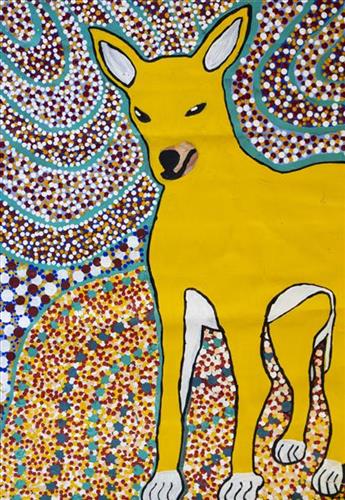
Wartij Warrarn (Dingo Country)

“A dingo walking around the Country. Colourful dots represent wildflowers. The dingo travels around the countryside, passing desert country, wildflower country, waterholes and springs.”
 – Augustine Junior Badal


377815582435054


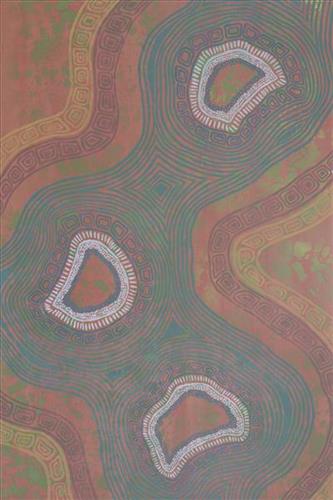
Canning Stock Route Area

“This painting is about waterholes in the desert where the old people used to walk from waterhole to waterhole in the Canning Stock Route area. All the colours represent the different wildflowers and the brown is the sand dunes. The circles represent different waterholes.”
 – Bibianna Tumbler

This artwork reflects the histories and journeys along the Canning Stock Route, a place where desert families walked, camped, hunted and gathered long before the line of wells was made. For Bidyadanga artists whose families travelled this Country, the Stock Route is remembered not as a road, but as a pathway of life — water soaks, claypans, sandhills, stories and camps passed down through generations.

The painting holds memories of living waterholes (jila), spinifex plains and salt lakes, places where families met, rested, shared food and continued on. It also speaks to the changes brought with the drovers — movement from desert to mission, cultural resilience, and the strength of families who carried language, story and law across the land.

Patterns, dots and flowing lines reflect walking tracks, dunes, waters and landmarks across Nyangumarta, Mangala and Martu Country. In this work, the artist honours the old people who travelled with nothing but knowledge, and celebrates their legacy — the strength of culture that continues today.

377815582435053


Bush Medicine

“This is a painting about bush medicine. It’s been boiled up. You boil it up and it turns into a burgundy sort of colour. Smells like eucalyptus. It is used for sores, rash, any skin condition. It’s a white gum tree.”
– Georgina Walbidi

This artwork honours the plants and practices of bush medicine — the healing Country provides, the old-people’s knowledge, and the living connection between land and body.

The artist reflects on the medicines found across Country: bark that soothes, leaves for infusions, roots dug after the rains, plants that grow in shade, and wood burnt down to ash for healing. These works often come from memories of learning and walking with elders — watching, smelling, collecting, and preparing medicine with care.

It reminds us that caring for Country is caring for ourselves. Gathering medicine is a cultural act — a moment of respect, listening, and moving gently on Country. This knowledge has been passed down across generations and must continue to be held, practised, and shared.

The painting invites the viewer into gratitude — for the plants, for the Country, for the knowledge keepers, and for the ongoing practice of looking after all life

377815582418477


Kulyakartu

“I paint about Kulyukartu. It’s my grandmother’s Country. I love painting about that Country. I went on a trip doing fire burning, cleaning the waterholes, and walking around looking where my grandmothers carved the rocks and things. I went with my mum Emily, and SJ (Nuriah Jadai). You turn before 80 Mile Beach and just go straight.

I feel good when I’m there — it feels like home when I paint it. I learnt to paint from my grandfather (Wokka Taylor, dec.). When we went to 33 (Kunawarritji, Well 33) and back to Punmu, we were just watching them. He told me to get a brush, and then he told me to start painting. I think him and Dunjan (Thelma Judson) were painting a big one, and I came to help him. He told me, ‘One day you should go to Kulyukartu,’ and so I went there.”
 – Kiarah Mandijalu-Jadai

This artwork shares the story of Kulyakartu, a vast and peaceful area north-east of the community, on the edge of Nyangumarta and Martu Country. Kulyakartu is a place of wide open skies, long claypans, sandhills and soft grasses that come alive after rain.

Families remember camping there, visiting waterholes, looking for goanna and bush foods, watching birds, and travelling with old people who knew every dune, track and soak. The painting celebrates the beauty and calm of Kulyakartu, often shown through soft lines and dots that follow the movement of water and sand. It honours the knowledge of where to find water, how to move across Country, and the deep belonging felt when returning to ancestral places.

Through this work, the artist invites viewers to feel that stillness and connection — the strength of Country, memory and family.


Dimensions: 46 x 61cm

377815582429120


Nyangumarta Warrarn (Country)

“This painting represents the rocky outcrop and all the different areas of claypans, and the dark area represents all the jurnga (sands) in the cool time, warri. All the light yellowish colour represents the paru (spinifex).

I like to go out working with the rangers and all the elders. I go out Country with them and they show me all the places, all mapped out with GPS. We mark out all the other places for next time. Sometimes I go out in the ranger’s vehicle and walk around the Country and look around for goanna holes. We try to keep an eye on the animals, look out for all the bilby and skinks and everything with the Nyangumarta Rangers. I go in my spare time because I’m busy you know, I’m busy with my artwork and council meetings.

In the cool dry time, when it’s a little bit warm and cool in the morning, that’s when we do the fire patch burning. When we doing it also depends on the wind, the warngal, which way it’s blowing. We do that because it’s a big part of controlled fires. Wild fires, we don’t want them, they destroy the animals and their living area, destroy the Country. We do it too for the regrowth. When I went back to Country a couple of weeks ago, all the burned up area had a little bit of regrowth after a little bit of rain.”
 – Edward Badal

This artwork honours Nyangumarta Country — from the long sweep of Eighty Mile Beach and coastal flats to the rolling sand dunes and salt lakes of the Great Sandy Desert. It holds the movement between saltwater and desert: tides, reefs and mangroves to the west; dunes, claypans and waterholes to the east.

Lines flow like wind across spinifex and waves in the ocean; dots gather where waters sit after rain; colours shift from deep blues to desert reds and whites of saltpan. The painting also reflects the ongoing work of Nyangumarta families and rangers to look after Country — sea and land — guided by community plans and Indigenous Protected Area management.

377815582429119


Kulyakartu

“This painting is about all the rocks and kurru (creeks) all around Kulyakartu and Kirriwirri. We went camping there for two weeks, we went to Wirnpa first and then to Kirriwirri. We camped in the nice flat ground in the open when we got to Kulyakartu. We visited the waterholes and soaks, cleaned them out, and made sure there were no dead animals. It was typical ranger work — making sure the animals and Country were surviving. We listened to Muuki and my grandfather talk about how they walked around trying to find waterholes, how my grandfather finally came to Bidyadanga, and how he met my grandmother.

I painted these paintings at home in Bidyadanga, near the ocean. The paintings are of Kulyakartu, which is in the Great Sandy Desert. There is a lot of spinifex, sandhills, wildlife, and little flowers like frangipanis — blue, red, and pink flowers just along the road when you’re driving.

When I’m not in the desert, I feel like I want to paint about it, and painting makes me feel like I want to be there. I think about Muuki and his brothers’ wishes for us to see the Country and be there. It’s important to paint about the Country because our Elders looked after the Country long before us.

When you look out of a plane, you can see lots of different colours, but I chose blues and greens because that’s how I want to express how I see the landscape. When people see my paintings, they might say, ‘That could be the ocean,’ but I say, ‘No, that’s Kulyakartu, the desert.’ Blues and greens make me feel comfortable. For me, I like to keep colours separate and not mix them together.”
 – Chloe Jadai

This artwork shares the story of Kulyakartu, a vast and peaceful area north-east of the community, on the edge of Nyangumarta and Martu Country. Kulyakartu is a place of wide open skies, long claypans, sandhills and soft grasses that come alive after rain.

Families remember camping there, visiting waterholes, looking for goanna and bush foods, watching birds, and travelling with old people who knew every dune, track and soak. The painting celebrates the beauty and calm of Kulyakartu, often shown through soft lines and dots that follow the movement of water and sand. It honours the knowledge of where to find water, how to move across Country, and the deep belonging felt when returning to ancestral places.

Through this work, the artist invites viewers to feel that stillness and connection — the strength of Country, memory and family.

377815582418473


Canning Stock Route Area

“This painting is about waterholes in the desert where the old people used to walk from waterhole to waterhole in the Canning Stock Route area. All the colours represent the different wildflowers and the brown is the sand dunes. The circles represent different waterholes.”
 – Bibianna Tumbler

This artwork reflects the histories and journeys along the Canning Stock Route, a place where desert families walked, camped, hunted and gathered long before the line of wells was made. For Bidyadanga artists whose families travelled this Country, the Stock Route is remembered not as a road, but as a pathway of life — water soaks, claypans, sandhills, stories and camps passed down through generations.

The painting holds memories of living waterholes (jila), spinifex plains and salt lakes, places where families met, rested, shared food and continued on. It also speaks to the changes brought with the drovers — movement from desert to mission, cultural resilience, and the strength of families who carried language, story and law across the land.

Patterns, dots and flowing lines reflect walking tracks, dunes, waters and landmarks across Nyangumarta, Mangala and Martu Country. In this work, the artist honours the old people who travelled with nothing but knowledge, and celebrates their legacy — the strength of culture that continues today.


Dimensions: 46 x 61cm