377815582429119
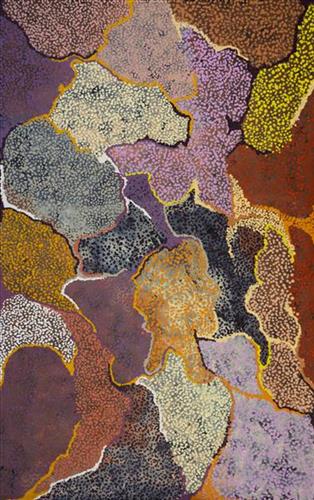
Kulyakartu
“This painting is about all the rocks and kurru (creeks) all around Kulyakartu and Kirriwirri. We went camping there for two weeks, we went to Wirnpa first and then to Kirriwirri. We camped in the nice flat ground in the open when we got to Kulyakartu. We visited the waterholes and soaks, cleaned them out, and made sure there were no dead animals. It was typical ranger work — making sure the animals and Country were surviving. We listened to Muuki and my grandfather talk about how they walked around trying to find waterholes, how my grandfather finally came to Bidyadanga, and how he met my grandmother.
I painted these paintings at home in Bidyadanga, near the ocean. The paintings are of Kulyakartu, which is in the Great Sandy Desert. There is a lot of spinifex, sandhills, wildlife, and little flowers like frangipanis — blue, red, and pink flowers just along the road when you’re driving.
When I’m not in the desert, I feel like I want to paint about it, and painting makes me feel like I want to be there. I think about Muuki and his brothers’ wishes for us to see the Country and be there. It’s important to paint about the Country because our Elders looked after the Country long before us.
When you look out of a plane, you can see lots of different colours, but I chose blues and greens because that’s how I want to express how I see the landscape. When people see my paintings, they might say, ‘That could be the ocean,’ but I say, ‘No, that’s Kulyakartu, the desert.’ Blues and greens make me feel comfortable. For me, I like to keep colours separate and not mix them together.”
– Chloe Jadai
This artwork shares the story of Kulyakartu, a vast and peaceful area north-east of the community, on the edge of Nyangumarta and Martu Country. Kulyakartu is a place of wide open skies, long claypans, sandhills and soft grasses that come alive after rain.
Families remember camping there, visiting waterholes, looking for goanna and bush foods, watching birds, and travelling with old people who knew every dune, track and soak. The painting celebrates the beauty and calm of Kulyakartu, often shown through soft lines and dots that follow the movement of water and sand. It honours the knowledge of where to find water, how to move across Country, and the deep belonging felt when returning to ancestral places.
Through this work, the artist invites viewers to feel that stillness and connection — the strength of Country, memory and family.