111582428781


Kiriwirri

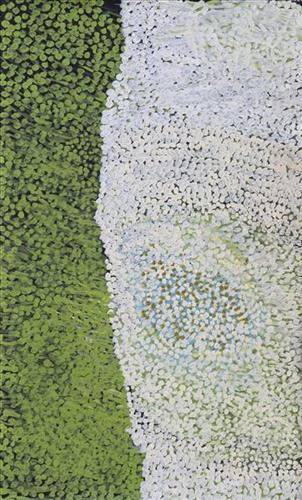
Kiriwirri is a soak located in the Percival Lakes region of Western Australia’s Great Sandy Desert. The site was a popular camping area during the pujiman (traditional, desert dwelling) era due to its reliable water source and the abundance of minyarra (bush onion) found in the area. Kiriwirri is also a site visited by the Wati Kujarra (Two Goanna Men), ancestral beings responsible for the creation of many land features in Martu Country and beyond in a key Jukurrpa (Dreaming) narrative. The Wati Kujarra existed as half men, half goanna who travelled, hunted, and burned Country together.

During the pujiman period, Martu would traverse very large distances annually in small family groups, moving seasonally from water source to water source, and hunting and gathering bush tucker as they went. At this time, knowledge of water sources was critical for survival, and today Martu Country is still defined in terms of the location and type of water. Each of the hundreds of claypans, rockholes, waterholes, soaks and springs found in the Martu desert homelands is known by name, location, quality and seasonal availability through real life experience and the recounting of Jukurrpa narratives. 

Soaks, or soakwaters, derive their name from the manner in which their waters generally seep into the sand from below stores, sometimes as part of an ephemeral river or creek. Soaks were an especially important source of water during the pujiman era, being the most dependable water source in times of drought. Water was obtained from soaks by scooping away the sand with a piti (timber bowls used for carrying food and water) until clear water gathered at the base of the hole, sometimes at a depth of several metres. 

111582428778


Bush Tucker

Depicted in this work are traditional types of bush tucker, their habitats, and their related hunting and gathering methods. During the pujiman (traditional, desert dwelling) period, Martu would traverse very large distances annually in small family groups, moving seasonally from water source to water source, and hunting and gathering bush tucker as they went. Whilst desert life has moved away from mobile hunter-gatherer subsistence throughout the course of the twentieth century, bush tucker continues to be a significant component of the modern Martu diet. Hunting and gathering bush tucker remains equally valuable as an important cultural practice that is passed on intergenerationally. Though hunting and gathering implements have been modernised, methods of harvesting, tracking and the use of fire burning to drive animals from their retreats are still commonly practiced today. 

Typically, animals hunted for their kuwiyi (meat) include kirti-kirti (euro kangaroo) and marlu (plains kangaroo), parnajarrpa (sand goanna), kipara (Australian bustard, bush turkey) and karlaya (emu). Lunki (witchetty grub) and wuukurta (honey ants) are dug from tree and bush trunks, or from underground nests. Popular mayi (plant food) includes minyarra (bush onion), collected from small, grass like plants; root vegetables dug from underground such as kulyu and mata (types of bush potato); and seeds such as kalaru (samphire, salt bush), yuwinyji, and marnkalpa (spinifex species). Jawirli (quondong), wamurla (bush tomatoes), jinyjiwirrily (wild gooseberry), ngaputa (melon), and karlkula (bush banana) are some of the most popular bush fruits. These are often collected in the wantajarra (cool season) and tuulpara (spring) months, along with juri (sweet) botanical gums and wama (nectar), obtained from various plant species. 

Traditional tools used for hunting and gathering bush tucker were carved from wanari (mulga), mulunturu (desert oak), yurungkura (river red gum) and mijarrpa (bloodwoods), and included kurlata (spears), jurna (hitting stick), karli (boomerangs), wana (digging-sticks), piti (timber bowls used for carrying food and water), and jiwa (grinding stones for grinding seeds into flour). While carved objects retain enormous social and ceremonial importance in Martu life, they are no longer used for hunting and gathering.

220982428830


Maisie Petyarre Bundey – Artna Tyap (Bush Tucker)

Maisie paints the bush tucker found in her country, the area that surrounds Boundary Bore in the Utopia homelands. She paints bush plums, bush bananas, bush potatoes and bush medicine plants. The main motif which recurs often in Maisie artworks is a full coolamon.
 
When she paints she always speaks of gathering and hunting on her country – long way from here, long time ago, filling up coolamons with bush potato, bush banana, goanna and porcupine. Maisie always says her family are happy ones and healthy ones.
 

221382429068


Handwoven Dillybag Earrings, Copper/Silver

Wagilak Yapa Watj (Wagilak Sisters) range –
exclusive jewellery from Indigenous women of Beswick. Developed in studio workshops with jeweller Kate Sale and weaver Fiona Gavino, traditional fibre artists are translating their skills into a series of fine woven wire earrings and pendants. Hand woven in sliver, gold and copper, traditional forms are transformed as delicate interpretations of string and dilly bags, baskets and mats.

Featuring sterling silver, 9ct gold and copper (all nickel-free work).

221382429049


Handwoven Dillybag Earrings, Silver 925

Wagilak Yapa Watj (Wagilak Sisters) range –
exclusive jewellery from Indigenous women of Beswick. Developed in studio workshops with jeweller Kate Sale and weaver Fiona Gavino, traditional fibre artists are translating their skills into a series of fine woven wire earrings and pendants. Hand woven in sliver, gold and copper, traditional forms are transformed as delicate interpretations of string and dilly bags, baskets and mats.

Featuring sterling silver, 9ct gold and copper (all nickel-free work).

221382429047


Handwoven Stringbag Earrings, Silver 925

Wagilak Yapa Watj (Wagilak Sisters) range –
exclusive jewellery from Indigenous women of Beswick. Developed in studio workshops with jeweller Kate Sale and weaver Fiona Gavino, traditional fibre artists are translating their skills into a series of fine woven wire earrings and pendants. Hand woven in sliver, gold and copper, traditional forms are transformed as delicate interpretations of string and dilly bags, baskets and mats.

Featuring sterling silver, 9ct gold and copper (all nickel-free work).

221382429046


Handwoven Dillybag Earrings, Silver 925

Wagilak Yapa Watj (Wagilak Sisters) range –
exclusive jewellery from Indigenous women of Beswick. Developed in studio workshops with jeweller Kate Sale and weaver Fiona Gavino, traditional fibre artists are translating their skills into a series of fine woven wire earrings and pendants. Hand woven in sliver, gold and copper, traditional forms are transformed as delicate interpretations of string and dilly bags, baskets and mats.

Featuring sterling silver, 9ct gold and copper (all nickel-free work).

221382429045


Handwoven Dillybag Earrings, Silver 925

Wagilak Yapa Watj (Wagilak Sisters) range –
exclusive jewellery from Indigenous women of Beswick. Developed in studio workshops with jeweller Kate Sale and weaver Fiona Gavino, traditional fibre artists are translating their skills into a series of fine woven wire earrings and pendants. Hand woven in sliver, gold and copper, traditional forms are transformed as delicate interpretations of string and dilly bags, baskets and mats.

Featuring sterling silver, 9ct gold and copper (all nickel-free work).

221382429044


Handwoven Dillybag Earrings, Silver 925

Wagilak Yapa Watj (Wagilak Sisters) range –
exclusive jewellery from Indigenous women of Beswick. Developed in studio workshops with jeweller Kate Sale and weaver Fiona Gavino, traditional fibre artists are translating their skills into a series of fine woven wire earrings and pendants. Hand woven in sliver, gold and copper, traditional forms are transformed as delicate interpretations of string and dilly bags, baskets and mats.

Featuring sterling silver, 9ct gold and copper (all nickel-free work).

221382429043


Handwoven Dillybag Earrings, Silver 925

Wagilak Yapa Watj (Wagilak Sisters) range –
exclusive jewellery from Indigenous women of Beswick. Developed in studio workshops with jeweller Kate Sale and weaver Fiona Gavino, traditional fibre artists are translating their skills into a series of fine woven wire earrings and pendants. Hand woven in sliver, gold and copper, traditional forms are transformed as delicate interpretations of string and dilly bags, baskets and mats.

Featuring sterling silver, 9ct gold and copper (all nickel-free work).