111982428283


Nawarlah – Brown River Stingray

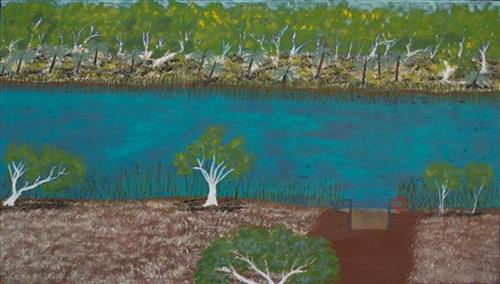
We hunt the Nawarlah (Brown River Stingray) during the wet season.  There is a plant with a yellow flower that tells us that it is the right time.  We know it will be fat. 

It is well known that Aboriginal art often depicts images of sacred totems or dreamings of Aboriginal culture. However, the world of the non-sacred also provides a rich source of subject matter for Aboriginal art. Much of the rock art of western Arnhem Land for example features secular topics such as common food animals and plants, depicted because of their economic importance but also merely because of their existence in the environment.

111982428281


Mimih Spirit

The mimih spirit exists in a realm that runs parallel to and mirrors many facets of human life, demonstrating the deep sense of time and place understood by Aboriginal and Torres Strait Islander people. Such spirits feature importantly in relation to Aboriginal spirituality, cosmology, social and moral tales as well as ritual. As is true with the multiple mediums employed by artists of West Arnhem Land, the development of artistic style and form is in line with an awareness by the artist that the work produced is predominantly made for a broader audience. Whether shown in a national or international context these works communicate and exist in a particular space that is cross-cultural and simultaneously particular to the Arnhem region.

The mimih sits within a complex pedagogical and religious body of knowledge which links Kuninjku people to their distinctive escarpment homelands. Young Kuninjku artists, or apprentices, employ the mimih as an important exercise for the practice of the rarrk technique, as it could be achieved on a smaller surface area before being attempted in larger scale on pieces of bark. The mimih serves a purpose for those young artists first learning to carve in a social space of sharing and innovating. The initial mimih manifestation was a large form that almost mirrored the anatomy of a human and at this stage the sculptures have been likened to mokuy carvings visible in eastern Arnhem Land. Contemporaneously, mimih are depicted in a refined, slender, even emaciated form with a broad range of facial expressions giving both individual character to, and denoting the potential volatility and humour that mimih spirits are notable for in their interaction with bininj (humans). The sculptures are frequently carved from the thin trunks of softwoods such as kapok (bombax ceiba or cottonwood) kurrajong, beach hibiscus or leichardt and are painted with earth pigments for their colouring and design.

A leading figure engaging the spirit in visual storytelling was Crusoe Kuningbal, a Kuninjku man, who while traveling was familiarised with carving styles from the east of Arnhem at the mission in Milingimbi pre-dating World War II. The connection and development of art forms informed by cross cultural dialogues within northern Aboriginal language groups is notable. The mimih became a valued inclusion in performance and public ceremony by Kuninjku people like Kuningbal. At times these ceremonies were performed for extended language groups in the local region. 

Now a familiar and broadly depicted figure of iconography, it is important to acknowledge the development of this quite recent sculptural tradition. The depiction of this particular spirit being, once used as an addition to the sharing of song cycles and ceremony, has since been elevated to a prominent form and subject of contemporary sculpture. Variation in the creation of mimih acts as an indication of the individualism of each artist and their stylistic markers. Additionally significant to note is that in the space of the past thirty years the mimih has begun being produced by multiple language groups residing in the Maningrida area including the traditional owners of Maningrida, the Ndjébbana, speaking Kunibidji as well as Gurrgoni people who have strong ties to Kuninjku. 

________
*Maningrida Arts & Culture acknowledge the work of many academic and non-academic voices when writing on this topic, it is important to note Luke Taylor, who’s broad research has informed this text.
220982428479


Maisie Petyarre Bundey – Anhelengkw (Emu) Dreaming

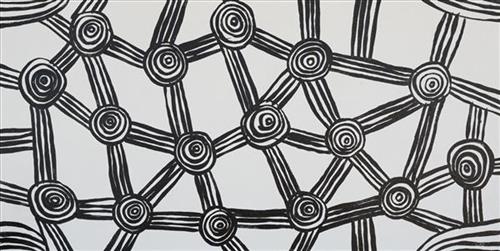
Anhelengkw (emu) dreaming is the breast body painting depicting the story of the mother emu who runs away and leaves the father emu to look after the eggs until they hatch, he then raises the chicks.

This story is passed down through Maisie’s family and celebrated in dance.

116482428534


Letting Go

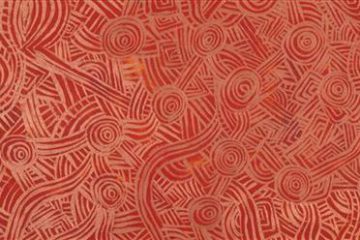
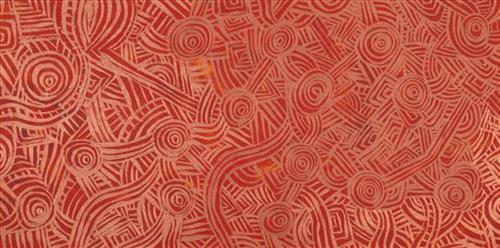
This painting represents the warmth and love I have for a lady I was proud to call my mother. After losing her, I as an artist felt myself being motivated to do a series of paintings to deal with my grief and the void she has left in my heart and life itself. The earlier pieces in the series used dark colours to represent the devastation and overwhelming grief of losing my mum (Aunty). I realised this painting is me slowly moving through the grief and beginning to find light again. This is my journey as an artist, using my painting to navigate the process that we all go through in life called grief. After working on this piece I realised that the colours I have used in the background represent the warmth and love my mum had for her family and those around her. The copper represents my Mum’s love and respect for her Country and many trips she enjoyed travelling with loved ones out bush.

116482428517


Pilbara Wildflower’s & Sturt Peas

Summer time season brings beauty to the Pilbara as nature takes it course. Our country, the Pilbara, has its own garden through the spinifex hills and also along the river beds.

116482428538


Pilbara Wildflowers

These are the Pilbara wildflowers that grow on the ground. They have a beautiful colours blending into the Country during flower season.

116482428537


Deep Reach Millstream

This part of the river is very sacred to the Yinjibarndi Tribe where some of our people were taken

116482428532


Family Connections (Milly)

These are the Pilbara wildflower’s that grow on the ground. Their seeds spread in the Country ready for the next year.

116482428528


Pilbara Wildflowers and Seeds (Justina)

These are the Pilbara wildflower’s that grow on the ground. Their seeds spread in the Country ready for the next year.

116482428523


Emu Seeds

In this painting I have depicted the pods of a shrub which is common in the Pilbara area. It is a smallish bush which comes into seed in September, when the Emu is visible in the Milky Way. This is the time the emu chicks hatch and it is one of their main sources of food. When the pod opens the parent emus feed the little black seeds to their chicks. The seed pod, which is about the size and the shape of a cockroach, turns from orange to yellow, so when all the bushes are in pod at different stages, there is a brilliant display of orange and yellow colours throughout the country. The official name of this annual shrub is Senna notabilis, but, due to the oblong, flat shape and the glossy golden brown colour of its pods, it is known commonly as Cockroach Bush. It has a little round fruit, a berry, that starts of green and turns red when it is ripe, but it’s poisonous. The shrub starts off as a light green colour and then, as it matures, it gets darker. The flowers are a yellowy orange and they, too, get darker with a bit of black as they are fading away.