116482397841


Marni

The Pilbara is a land of many beautiful colours. Its beauty blends into the mother earth and against the red, purple hills in the distance. In time and season, the yellow wattles, mulla mulla and Sturt Pea bloom and the country comes alive with the wildflowers watered by the rain and heavy dew during the night. The land and our country also tells a wonderful story about our ancestors. They walk and lived on the land always gathering food such as fish from the river, hunting kangaroos, tracking goannas and also gathering bush fruits and medicine. ***this artwork is stretched on Belgian linen. An additional freight charge applies as it cannot be sent unstretched/rolled.


Dimensions: 90 x 150cm

115682416536


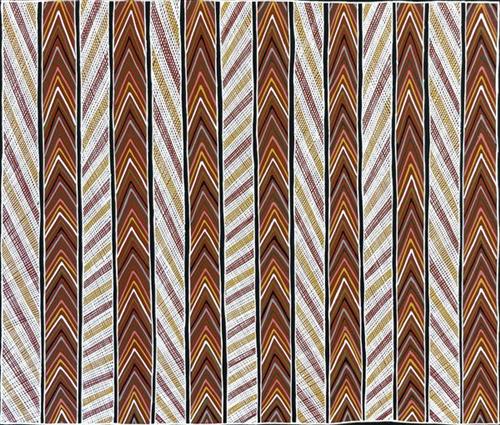
Lungurrma (North-east Wind)

Lungurrma (North-east Wind) heralds the new season when seas are calm and new growth starts. The months for this type of wind are October to December. There are big clouds without thunder or rain. The triangular patterning represents monsoon clouds ‘standing up’ on the northern horizon. The Lunggurrma design belongs to the Yirritja moiety clans linked to this design are known as the ‘line of clouds’ clans


Dimensions: 50 x 60cm

377815582418473


Canning Stock Route Area

“This painting is about waterholes in the desert where the old people used to walk from waterhole to waterhole in the Canning Stock Route area. All the colours represent the different wildflowers and the brown is the sand dunes. The circles represent different waterholes.”
 – Bibianna Tumbler

This artwork reflects the histories and journeys along the Canning Stock Route, a place where desert families walked, camped, hunted and gathered long before the line of wells was made. For Bidyadanga artists whose families travelled this Country, the Stock Route is remembered not as a road, but as a pathway of life — water soaks, claypans, sandhills, stories and camps passed down through generations.

The painting holds memories of living waterholes (jila), spinifex plains and salt lakes, places where families met, rested, shared food and continued on. It also speaks to the changes brought with the drovers — movement from desert to mission, cultural resilience, and the strength of families who carried language, story and law across the land.

Patterns, dots and flowing lines reflect walking tracks, dunes, waters and landmarks across Nyangumarta, Mangala and Martu Country. In this work, the artist honours the old people who travelled with nothing but knowledge, and celebrates their legacy — the strength of culture that continues today.


Dimensions: 46 x 61cm

116482419431


Wild Flowers Along the Riverbank

This painting is about the river on my Country and the wildflowers that grow along its banks. The river rises and the flowers bloom bright against the earth, showing their strength as they return each season. The patterns and lines illustrate the patterns along the waters edge. When I paint I think about being the beauty of the landscape and my family connection to Country. These freshwater places are important to us.

Dimensions: 61 x 91cm

116482427570


Pilbara Country

Pilbara is the country where we the Yindjibarndi people live and share many of our cultural stories and history that have been passed onto us by our ancestors, of how they used to walk through the flat country we call the Table Lands, visiting family members at nearby stations.

Our Country has so much to offer. Bush foods and medicine as well as animals such as kangaroo, emu, goanna and turkey. When the rains come our rivers are full and we all love to go out and spend the day fishing. We are also close to the ocean so we often go fishing there as well. During the holidays many of our families go bush to enjoy what the Country offers. The beauty of our Country we see through our eyes like the wildflowers blooming as nature takes its course. Our Country is still full of riches it always gives me joy to be a part of it. We are connected to our land. It is a part of who we are. 

116482427568


Pilbara Country

The colours in the back ground represent the Pilbara landscape with a hint of colour piercing through representing the scattered wildflowers found all across the country side.The white circles on top represent man made structures from roadhouses, bridges, pipelines to small communities and towns whilst leaving gaps to represent the long stretches of countryside.

111582427527


Untitled

“When Martu paint, it’s like a map. Martu draw story on the ground and on the canvas, and all the circle and line there are the hunting areas and different waters and tracks where people used to walk, and [some you] can’t cross, like boundaries. So nowadays you see a colourful painting and wonder what it is, but that’s how Martu tell story long ago. It’s not just a lovely painting, it’s a story and a songline and a history and everything that goes with it.” 

– Ngalangka Nola Taylor and Joshua Booth

This work portrays an area of Country that can be interpreted in multiple ways. Firstly, the image may be read as an aerial representation of a particular location known to the artist- either land that they or their family travelled, from the pujiman (traditional, desert dwelling) era to now. During the pujiman period, Martu would traverse very large distances annually in small family groups, moving seasonally from water source to water source, and hunting and gathering bush tucker as they went. At this time, one’s survival depended on their intimate knowledge of the location of resources; thus physical elements of Country, such as sources of kapi (water), tali (sandhills), different varieties of warta (trees, vegetation), ngarrini (camps), and jina (tracks) are typically recorded with the use of a use of a system of iconographic forms universally shared across the desert. 

An additional layer of meaning in the work relates to more intangible concepts; life cycles based around kalyu (rain, water) and waru (fire) are also often evident. A thousands of year old practice, fire burning continues to be carried out as both an aid for hunting and a means of land management today. As the Martu travelled and hunted they would burn tracts of land, ensuring plant and animal biodiversity and reducing the risk of unmanageable, spontaneous bush fires. The patchwork nature of regrowth is evident in many landscape works, with each of the five distinctive phases of fire burning visually described with respect to the cycle of burning and regrowth.  

Finally, metaphysical information relating to a location may also be recorded; Jukurrpa (Dreaming) narratives chronicle the creation of physical landmarks, and can be referenced through depictions of ceremonial sites, songlines, and markers left in the land. Very often, however, information relating to Jukurrpa is censored by omission, or alternatively painted over with dotted patterns.

111582427524


Untitled

This work portrays an area known to the artist, painted here from memory. During the pujiman (traditional, desert dwelling) era one’s survival depended on their intimate knowledge of the location of resources; thus physical elements of Country, such as sources of kapi (water), tali (sandhills), and different varieties of warta (trees, vegetation) were carefully observed and remembered. Today, this relationship with Country remains equally strong, despite the movement of Martu out of the desert and into remote Aboriginal communities, towns and cities.

Also visible may be traces of life cycles based around kalyu (rain, water) and waru (fire). A thousands of year old practice, fire burning continues to be carried out as both an aid for hunting and a means of land management today. As the Martu travelled and hunted they would burn tracts of land, ensuring plant and animal biodiversity and reducing the risk of unmanageable, spontaneous bush fires. The patchwork nature of regrowth is visible in many landscape works, with each of the five distinctive phases of fire burning visually described with respect to the cycle of burning and regrowth.  

Finally, metaphysical information relating to a location may also be recorded; Jukurrpa (Dreaming) narratives chronicle the creation of physical landmarks, and can be referenced through depictions of ceremonial sites, songlines, and markers left in the land. 

111582427519


Untitled

“When Martu paint, it’s like a map. Martu draw story on the ground and on the canvas, and all the circle and line there are the hunting areas and different waters and tracks where people used to walk, and [some you] can’t cross, like boundaries. So nowadays you see a colourful painting and wonder what it is, but that’s how Martu tell story long ago. It’s not just a lovely painting, it’s a story and a songline and a history and everything that goes with it.” 

– Ngalangka Nola Taylor and Joshua Booth

This work portrays an area of Country that can be interpreted in multiple ways. Firstly, the image may be read as an aerial representation of a particular location known to the artist- either land that they or their family travelled, from the pujiman (traditional, desert dwelling) era to now. During the pujiman period, Martu would traverse very large distances annually in small family groups, moving seasonally from water source to water source, and hunting and gathering bush tucker as they went. At this time, one’s survival depended on their intimate knowledge of the location of resources; thus physical elements of Country, such as sources of kapi (water), tali (sandhills), different varieties of warta (trees, vegetation), ngarrini (camps), and jina (tracks) are typically recorded with the use of a use of a system of iconographic forms universally shared across the desert. 

An additional layer of meaning in the work relates to more intangible concepts; life cycles based around kalyu (rain, water) and waru (fire) are also often evident. A thousands of year old practice, fire burning continues to be carried out as both an aid for hunting and a means of land management today. As the Martu travelled and hunted they would burn tracts of land, ensuring plant and animal biodiversity and reducing the risk of unmanageable, spontaneous bush fires. The patchwork nature of regrowth is evident in many landscape works, with each of the five distinctive phases of fire burning visually described with respect to the cycle of burning and regrowth.  

Finally, metaphysical information relating to a location may also be recorded; Jukurrpa (Dreaming) narratives chronicle the creation of physical landmarks, and can be referenced through depictions of ceremonial sites, songlines, and markers left in the land. Very often, however, information relating to Jukurrpa is censored by omission, or alternatively painted over with dotted patterns.

111582427511


Untitled

“When Martu paint, it’s like a map. Martu draw story on the ground and on the canvas, and all the circle and line there are the hunting areas and different waters and tracks where people used to walk, and [some you] can’t cross, like boundaries. So nowadays you see a colourful painting and wonder what it is, but that’s how Martu tell story long ago. It’s not just a lovely painting, it’s a story and a songline and a history and everything that goes with it.” 

– Ngalangka Nola Taylor and Joshua Booth

This work portrays an area of Country that can be interpreted in multiple ways. Firstly, the image may be read as an aerial representation of a particular location known to the artist- either land that they or their family travelled, from the pujiman (traditional, desert dwelling) era to now. During the pujiman period, Martu would traverse very large distances annually in small family groups, moving seasonally from water source to water source, and hunting and gathering bush tucker as they went. At this time, one’s survival depended on their intimate knowledge of the location of resources; thus physical elements of Country, such as sources of kapi (water), tali (sandhills), different varieties of warta (trees, vegetation), ngarrini (camps), and jina (tracks) are typically recorded with the use of a use of a system of iconographic forms universally shared across the desert. 

An additional layer of meaning in the work relates to more intangible concepts; life cycles based around kalyu (rain, water) and waru (fire) are also often evident. A thousands of year old practice, fire burning continues to be carried out as both an aid for hunting and a means of land management today. As the Martu travelled and hunted they would burn tracts of land, ensuring plant and animal biodiversity and reducing the risk of unmanageable, spontaneous bush fires. The patchwork nature of regrowth is evident in many landscape works, with each of the five distinctive phases of fire burning visually described with respect to the cycle of burning and regrowth.  

Finally, metaphysical information relating to a location may also be recorded; Jukurrpa (Dreaming) narratives chronicle the creation of physical landmarks, and can be referenced through depictions of ceremonial sites, songlines, and markers left in the land. Very often, however, information relating to Jukurrpa is censored by omission, or alternatively painted over with dotted patterns.