220982417840


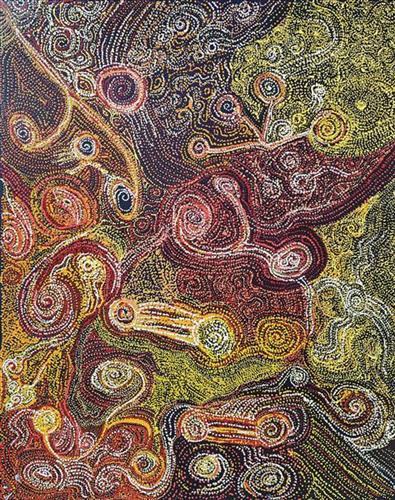
Julieanne Ngwarraye Morton – Alpeyt Alpeyt (Flowers Blooming)

Walking across my land to look for bush flowers and goanna. I bring home to make medicine for my family and cook the goanna for dinner.  Goanna is my favourite to eat.


Dimensions: 30 x 30 cm Lino Print S/H 250gsm

220982417839


Julieanne Ngwarraye Morton – Alpeyt Alpeyt (Flowers Blooming)

Walking across my land to look for bush flowers and goanna. I bring home to make medicine for my family and cook the goanna for dinner.  Goanna is my favourite to eat.


Dimensions: 30 x 30 cm Lino Print S/H 250gsm

220982417838


Julieanne Ngwarraye Morton – Alpeyt Alpeyt (Flowers Blooming)

Walking across my land to look for bush flowers and goanna. I bring home to make medicine for my family and cook the goanna for dinner.  Goanna is my favourite to eat.


Dimensions: 30 x 30 cm Lino Print S/H 250gsm

220982417836


Julieanne Ngwarraye Morton – Alpeyt Alpeyt (Flowers Blooming)

Walking across my land to look for bush flowers and goanna. I bring home to make medicine for my family and cook the goanna for dinner.  Goanna is my favourite to eat.


Dimensions: 30 x 30 cm Lino Print S/H 250gsm

114182418274


Wati kutjara – The goanna men

This is the story of two powerful magicians who came to the Ngaanyatjarra Lands from far away to the west;

‘These two men are always together, always camping together. They do all sorts of tricks when they travel across the lands as they stop from place to place. When they reached ‘Wirtapi Wara’ (Long Black or Blackstone Range) they argued about which way to go around. One went around the south side and the other the north side.

At a distance it seemed they didn’t recognise each other or perhaps they were just pretending not to recognise each other! It is also said that at Papulankutja they tricked each other by changing their appearance at the same time so they had no chance to recognise each other. The name Papulankutja comes from the Ngaanyatjarra word meaning, ‘to stare without recognising each other’.


Dimensions: 122 x 156cm

116182419400


Looking around for waterholes – Mabel Watson

This painting tells the story of the artist’s family — her grandmother and aunty — walking across Country in search of waterholes and bush tucker. It captures an important part of life in the old days, when people travelled with deep knowledge of the land, following the signs of water and seasonal foods.

In the painting, the ‘U’ shapes represent the people sitting on the ground. Beside them are digging sticks and coolamons, traditional tools used by women for digging and carrying bush tucker and water. The wavy lines trace the paths of creeks and watercourses, while the circles mark the waterholes found along the way.


Dimensions: 305 x 305 mm

116182419284


Women digging for water – Mabel Watson

This painting shows women sitting down together, gathering water and digging for honey ants and bush tucker. The scene reflects the way women would come together on Country — yarning, working, and sharing knowledge as they went about their daily tasks.

The story comes from the olden days, a long time ago, out on the artist’s father’s Country, on the other side of Yuendumu. It shows the deep connection between women, the land, and the resources that sustained their families.


Dimensions: 310 x 610 mm

116182419283


Emu Dreaming

Emu looking around for water. This is a Dreaming story from my father’s country, other side of Yuendumu. Past Mandarin Station, through there and other side. Emu looking round for water, they are three waterholes. I’ve painted the country side after big rain, flowers everywhere. The emu is looking for yellow fruit to eat, with seed. The snake is in the waterholes.


Dimensions: 410 x 410 mm

116182419280


Four Dreamings, Carbiene McDonald

‘This is Petermann Range near Kaltukatjara – that’s Docker River [Community]. Puta Puta, Tjunti, Muliati. This is my father’s Country’.

Carbiene’s father was Snowy McDonald. He, like many other Pintupi-Pitjantjatjara people eventually moved east and north to refuges such as the Lutheran Mission at Ernabella, and Areyonga, during difficult drought times about 60-70 years ago. Some even ended up in Papunya once it opened as a Government Reserve in the early 1960s, as was the case of Carbiene’s father.

The shapes Carbiene paints represent an abstracted form of a series of important waterholes through the Petermann Ranges. Some of these sacred places now also have small Family Outstations or Homelands established nearby. For example, Tjunti is the name of a family outstation named for a soakage where the Hull River cuts through the Petermann Ranges. This is where Lasseter took refuge during his ill-fated expedition in search of gold. The cave he was found in near Tjunti is called Kuḻpi Tjuntinya (now commonly called Lasseter’s Cave in English). 

The Petermann Ranges have now been designated an area of Conservation significance and the government work closely with local families in managing the area.

Carbiene is a Papunya Tjupi artist, having joined Papunya Tjupi Art Centre in 2018 and launching his career along with a cohort of emerging young male artists. Papunya is 250km West of Alice Springs, and when Carbiene visits Alice Springs he paints with Tangentyere Artists. Tangentyere Artists and Papunya Tjupi have a good working relationship, with several artists from each art centre coming from the same families. Tangentyere Artists’ figurative painter Betty Conway is Carbiene’s Aunty and Carbiene stops at Betty’s when in town.


Dimensions: 560 x 760 mm

111982419598


Kunkurra (The Spiralling Wind)

‘Kunkurra’, the spiralling wind is associated with several sites in the Kardbam clan estate. On one level, this painting can be interpreted as a depiction of the kinds of mini-cyclones common during the wet season in Arnhem Land, where the artist lives. In this painting, Kunkurra also relates specifically to a site called Bilwoyinj, near Mankorlod.

At this site, two of the most important Kuninjku creation beings, a father and son known as na-korrkko, are believed to have hunted and eaten a goanna. They left some of the goanna fat behind at the site, which turned into the rock that still stands there today. The word Bilwoyinj, which is the name of this site, also refers to the fat of the goanna. Bilwoyinj site is also a ceremonial ground for a ceremony called Yabbaduruwa, a major ceremony owned by the Yirridja patrimoiety. The Yabbaduruwa ceremony is primarily concerned with initiation, land ownership and promoting the cyclical regeneration of the human and natural worlds.


Dimensions: 68 x 12cm