111582430008


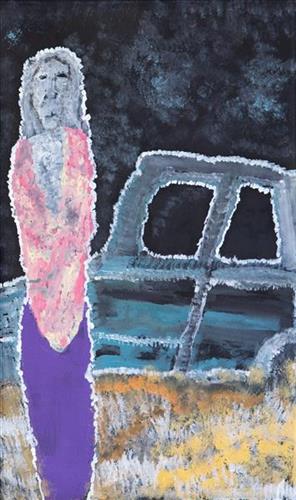
Hunting Wanti With Car

How did you get to this style of painting?

“Do you mean, what have I done with my life? (chuckles to herself) To me these paintings are a sense of energy. So if I see someone and they’re happy, I paint a happy vibe. Cos their spirit is happy. And sometimes it’s hard because on the outside they’re real happy but on the inside they’re real sad. Sometimes you do stuff (like a painting) and it adds up later on. But I still don’t know what it means and don’t know where my style comes from because it’s both the path I walk on and the cracks in the dirt. It’s like looking at a landscape but I haven’t been there yet. Maybe I’ll get there one day. I believe things happen for a reason.”

– Sylvia Wilson

116482429971


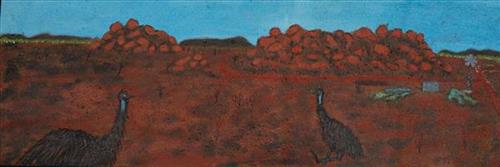
Cherritta Station 1960’s

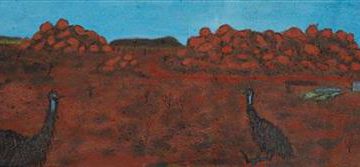
This is a painting of the first location of Cherritta Station until the water ran out. On the other side of hill is where some old building infrastructure still laying on the ground today. Two emus approaching for water after fire been through that area.

116482429957


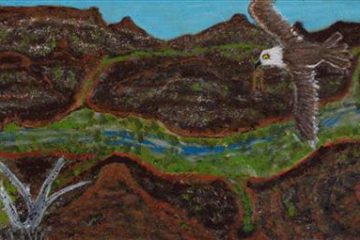
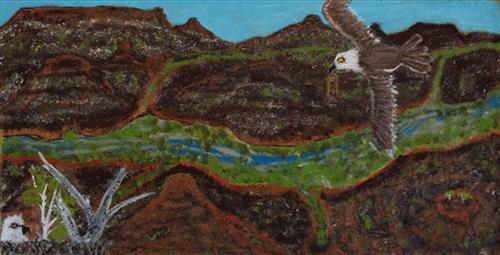
Eagle’s Nest at Fortesque River

This is the country along the Fortesque River. The waterholes attract many different birds. This painting depicts an eagle flying in to feed it’s chick.

111582430063


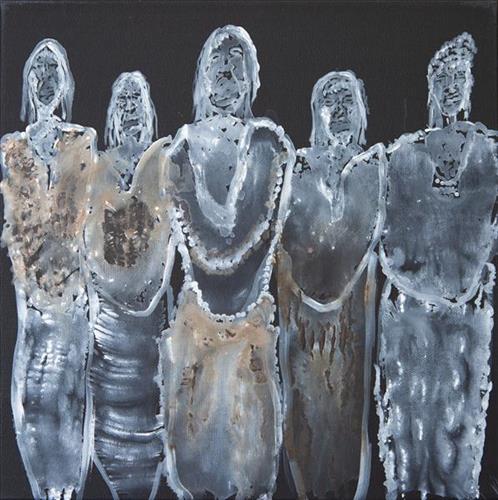
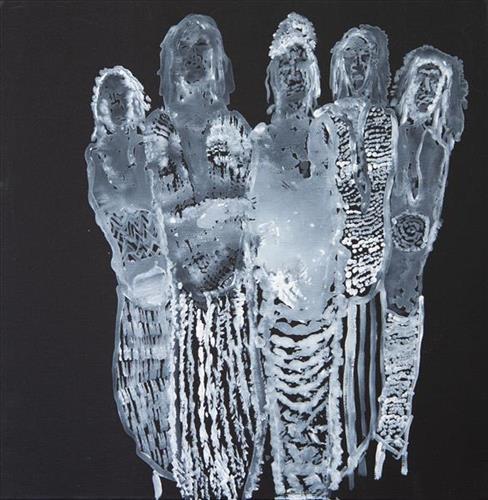
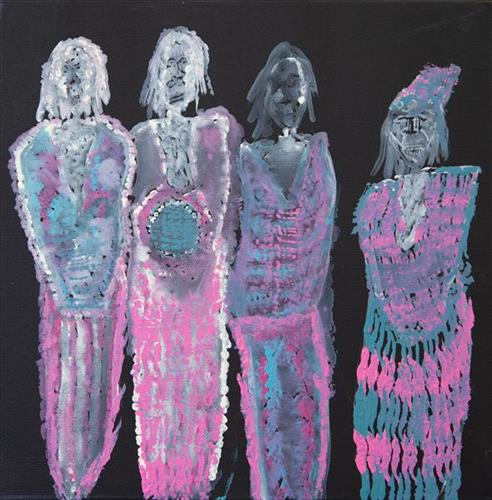
Wanti Yuu (Women, Yeah!)

“Wanti Yuu (Woman Yeah!) is a story of resilience and of women coming together. It is about the strength of the women in our community who put themselves last and take on a lot. She [Wanti Yuu] is someone who looks after her family, putting the grand kids and everyone around her first. The word Matriarch comes to mind. They are the matriarch of the family. The Boss Lady. Always helping everyone else out and leaving herself to the end. She paints, she teaches us her knowledge, like basket weaving and honey ant collecting. She is the top lore woman and her story of Pujiman (traditional, desert dwelling) is so important. She is a leader of the Martu women and a senior artist. That’s all I can say about these women. These women; you give her the bread if you know what I mean. It’s a true story. Anything in my pockets. Because when you look at her, her stance, her energy and her vibe, you can feel it. You don’t muck around with Wanti Yuu.”

-Silvia Wilson

Wanti Yuu celebrates women’s resilience, matriarchal relationships, and Sylvia’s place in this story.

As Sylvia explains, the work is both a depiction of, and attribute to, the women in her life. “I follow my great grandmother’s guidance and direction in life. These women in my life carry so much on their shoulders, as well as the responsibility and future of our culture.”


111582430062


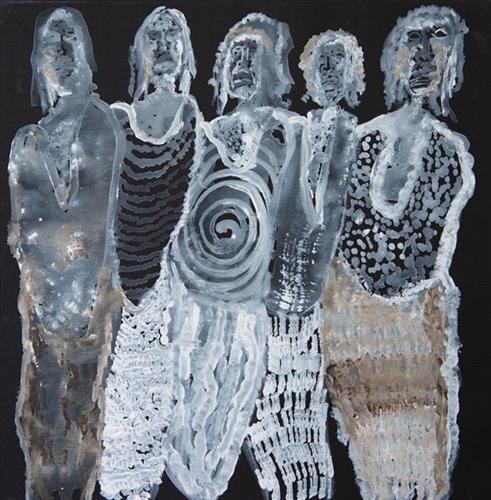
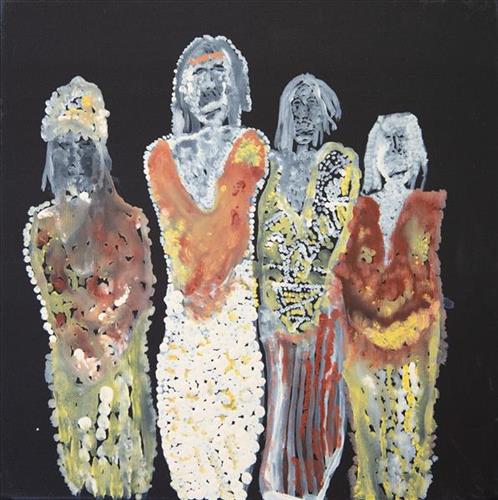
Wanti Yuu (Women, Yeah!)

“Wanti Yuu (Woman Yeah!) is a story of resilience and of women coming together. It is about the strength of the women in our community who put themselves last and take on a lot. She [Wanti Yuu] is someone who looks after her family, putting the grand kids and everyone around her first. The word Matriarch comes to mind. They are the matriarch of the family. The Boss Lady. Always helping everyone else out and leaving herself to the end. She paints, she teaches us her knowledge, like basket weaving and honey ant collecting. She is the top lore woman and her story of Pujiman (traditional, desert dwelling) is so important. She is a leader of the Martu women and a senior artist. That’s all I can say about these women. These women; you give her the bread if you know what I mean. It’s a true story. Anything in my pockets. Because when you look at her, her stance, her energy and her vibe, you can feel it. You don’t muck around with Wanti Yuu.”

-Silvia Wilson

Wanti Yuu celebrates women’s resilience, matriarchal relationships, and Sylvia’s place in this story.

As Sylvia explains, the work is both a depiction of, and attribute to, the women in her life. “I follow my great grandmother’s guidance and direction in life. These women in my life carry so much on their shoulders, as well as the responsibility and future of our culture.”


111582430061


Wanti Yuu (Women, Yeah!)

“Wanti Yuu (Woman Yeah!) is a story of resilience and of women coming together. It is about the strength of the women in our community who put themselves last and take on a lot. She [Wanti Yuu] is someone who looks after her family, putting the grand kids and everyone around her first. The word Matriarch comes to mind. They are the matriarch of the family. The Boss Lady. Always helping everyone else out and leaving herself to the end. She paints, she teaches us her knowledge, like basket weaving and honey ant collecting. She is the top lore woman and her story of Pujiman (traditional, desert dwelling) is so important. She is a leader of the Martu women and a senior artist. That’s all I can say about these women. These women; you give her the bread if you know what I mean. It’s a true story. Anything in my pockets. Because when you look at her, her stance, her energy and her vibe, you can feel it. You don’t muck around with Wanti Yuu.”

-Silvia Wilson

Wanti Yuu celebrates women’s resilience, matriarchal relationships, and Sylvia’s place in this story.

As Sylvia explains, the work is both a depiction of, and attribute to, the women in her life. “I follow my great grandmother’s guidance and direction in life. These women in my life carry so much on their shoulders, as well as the responsibility and future of our culture.”


111582430059


Wanti Yuu (Women, Yeah!)

“Wanti Yuu (Woman Yeah!) is a story of resilience and of women coming together. It is about the strength of the women in our community who put themselves last and take on a lot. She [Wanti Yuu] is someone who looks after her family, putting the grand kids and everyone around her first. The word Matriarch comes to mind. They are the matriarch of the family. The Boss Lady. Always helping everyone else out and leaving herself to the end. She paints, she teaches us her knowledge, like basket weaving and honey ant collecting. She is the top lore woman and her story of Pujiman (traditional, desert dwelling) is so important. She is a leader of the Martu women and a senior artist. That’s all I can say about these women. These women; you give her the bread if you know what I mean. It’s a true story. Anything in my pockets. Because when you look at her, her stance, her energy and her vibe, you can feel it. You don’t muck around with Wanti Yuu.”

-Silvia Wilson

Wanti Yuu celebrates women’s resilience, matriarchal relationships, and Sylvia’s place in this story.

As Sylvia explains, the work is both a depiction of, and attribute to, the women in her life. “I follow my great grandmother’s guidance and direction in life. These women in my life carry so much on their shoulders, as well as the responsibility and future of our culture.”


111582430058


Wanti Yuu (Women, Yeah!)

“Wanti Yuu (Woman Yeah!) is a story of resilience and of women coming together. It is about the strength of the women in our community who put themselves last and take on a lot. She [Wanti Yuu] is someone who looks after her family, putting the grand kids and everyone around her first. The word Matriarch comes to mind. They are the matriarch of the family. The Boss Lady. Always helping everyone else out and leaving herself to the end. She paints, she teaches us her knowledge, like basket weaving and honey ant collecting. She is the top lore woman and her story of Pujiman (traditional, desert dwelling) is so important. She is a leader of the Martu women and a senior artist. That’s all I can say about these women. These women; you give her the bread if you know what I mean. It’s a true story. Anything in my pockets. Because when you look at her, her stance, her energy and her vibe, you can feel it. You don’t muck around with Wanti Yuu.”

-Silvia Wilson

Wanti Yuu celebrates women’s resilience, matriarchal relationships, and Sylvia’s place in this story.

As Sylvia explains, the work is both a depiction of, and attribute to, the women in her life. “I follow my great grandmother’s guidance and direction in life. These women in my life carry so much on their shoulders, as well as the responsibility and future of our culture.”


111582430057


Untitled

Martumili Artists work with over three hundred artists from remote Martu Aboriginal communities, including Punmu, Parnngurr, Kunawarritji, Jigalong, Irrungadji (Nullagine), and Warralong, as well as from the Parnpajinya (Newman) gallery and studio spaces. Known for their diverse, energetic, and unmediated painting styles, their works reflect the dramatic geography and scale of their homelands. Each artist, however, brings a unique approach to their craft.

Younger Martu artists often start painting alongside their parents, grandparents, and extended family, which fosters an organic learning process. This not only involves mastering painting techniques but also understanding specific locations, family histories, traditional ways of life, bush tucker, and Jukurrpa (Dreaming). Over time, with encouragement from their peers, they develop their own distinct styles and explore unique painting techniques and subject matter. In this work the artist brings a contemporary, evolving perspective to their work.

111582430056


Tuwa (sandhills)

“I do tuwa (sandhill) in my own style because that’s our Country. That’s a sandhill, that’s the Dreaming- the Jukurrpa. That’s our culture.

They stay there and we go through the sandhills at Puntawarri in the car. We go first tuwa, then the second tuwa, looking for the waterholes. Go up, up, up- ‘nother tuwa, ‘nother tuwa.

Long time [ago] in Puntawarri, when I was a little girl [with] my Nana and Pop [Dadda Samson (dec.) and Yanjimi Peter Rowlands (dec.)] we went climbing up the sandhill. And when I went up my Nana and Pop were at the bottom under a tree and I came down running then rolling, rolling right down to the ground! But I was ok- he right!”

– Judith Anya Samson

Puntawarri is an important cultural area located on the middle stretches of the Canning Stock Route and east of the Jigalong Mission (now Jigalong Aboriginal community), where Anya grew up with her grandmother and renowned Martumili Artist, Dadda Samson (dec.). Puntawarri is also the site of an abandoned community, a waterhole, creek and lake. Puntawarri’s close proximity to Jigalong Mission made it a popular site for Martu to visit during the ‘mission days’. While growing up at Jigalong Mission in the 1960’s, Dadda would return to Puntawarri every weekend to hunt and camp. 

For many Martu, like Anya’s family, Jigalong Mission was the site where their pujiman (traditional, desert dwelling) lifestyle came to an end from the late 1940s as they transitioned to a life as stockmen and women working in cattle stations in the Pilbara region and beyond. In the wake of the extreme and prolonged drought of the 1960s, the last of the remaining pujimanpa (desert dwellers) were forced to move to missions like Jigalong, where a supply of food and water was assured. There, many Martu were reunited with family members that had already moved in from the desert.

The traditional lands of the Martu people encompass the Great Sandy Desert and Rudall River regions of Western Australia, an enormous tract dominated by distinctive red tali, or tuwa (sandhills). These sandhills present an unforgiving landscape; sparse vegetation covers a seemingly never ending expanse of dunes, and yet these lands and the location of resources within them was known intimately by its pujiman inhabitants.