111582429993


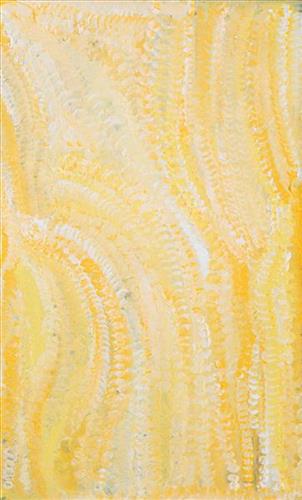
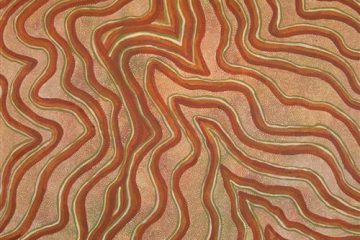
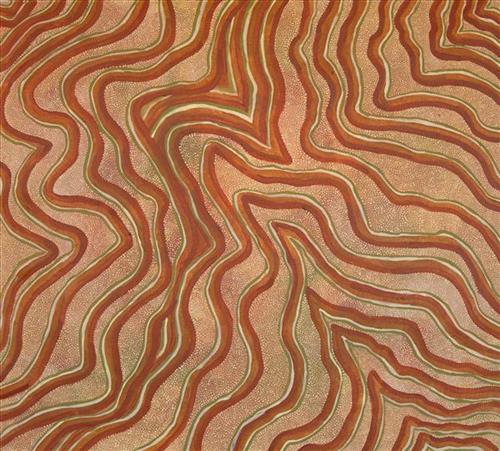
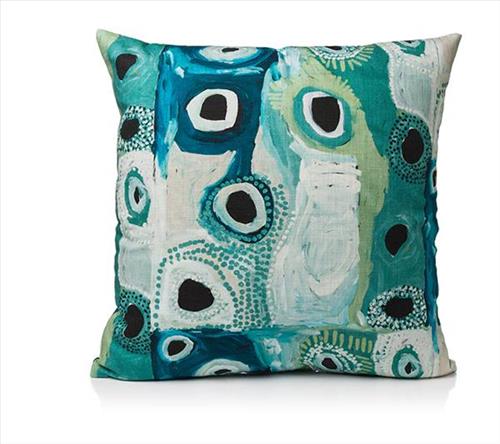
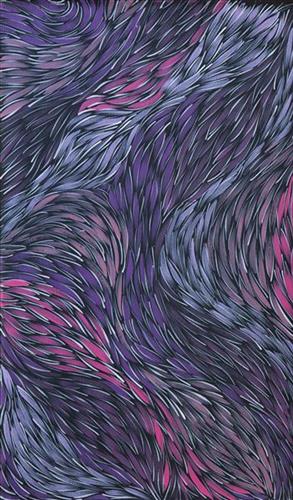
Water Flow

“When I paint with these colours and in this style, it reminds me of when I was back in Bidgydanga, watching the water and currents flow.”

– Ciarn Dean-Bullen


“When Martu paint, it’s like a map. Martu draw story on the ground and on the canvas, and all the circle and line there are the hunting areas and different waters and tracks where people used to walk, and [some you] can’t cross, like boundaries. So nowadays you see a colourful painting and wonder what it is, but that’s how Martu tell story long ago. It’s not just a lovely painting, it’s a story and a songline and a history and everything that goes with it.” 

– Ngalangka Nola Taylor and Joshua Booth

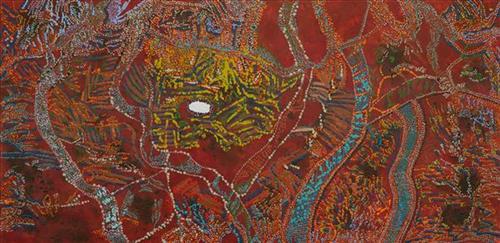
This work portrays an area of Country that can be interpreted in multiple ways. Firstly, the image may be read as an aerial representation of a particular location known to the artist- either land that they or their family travelled, from the pujiman (traditional, desert dwelling) era to now. During the pujiman period, Martu would traverse very large distances annually in small family groups, moving seasonally from water source to water source, and hunting and gathering bush tucker as they went. At this time, one’s survival depended on their intimate knowledge of the location of resources; thus physical elements of Country, such as sources of kapi (water), tali (sandhills), different varieties of warta (trees, vegetation), ngarrini (camps), and jina (tracks) are typically recorded with the use of a use of a system of iconographic forms universally shared across the desert. 

An additional layer of meaning in the work relates to more intangible concepts; life cycles based around kalyu (rain, water) and waru (fire) are also often evident. A thousands of year old practice, fire burning continues to be carried out as both an aid for hunting and a means of land management today. As the Martu travelled and hunted they would burn tracts of land, ensuring plant and animal biodiversity and reducing the risk of unmanageable, spontaneous bush fires. The patchwork nature of regrowth is evident in many landscape works, with each of the five distinctive phases of fire burning visually described with respect to the cycle of burning and regrowth.  

Finally, metaphysical information relating to a location may also be recorded; Jukurrpa (Dreaming) narratives chronicle the creation of physical landmarks, and can be referenced through depictions of ceremonial sites, songlines, and markers left in the land. Very often, however, information relating to Jukurrpa is censored by omission, or alternatively painted over with dotted patterns.
111582429992


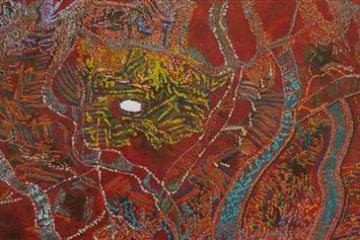
Lalapakujarra

Lalapakujarra is a creek located along the Karlamilyi River (Rudall River). According to two of the central Martu Jukurrpa (Dreaming) narratives, the Karlamilyi River and its surrounds were created by the ancestral beings Jila Kujarra (Two Snakes) and the Wati Kujarra (Two Goanna Men) as they travelled across the lands.

Jila Kujarra is one of the key Jukurrpa narratives for the Martu. Though the story belongs to Warnman people, it is shared across the Western Desert with several other language groups. The narrative centres on the travels of two snakes as they are pursued by the Niminjarra, spiritual ancestors of the Warnman people.

111582429990


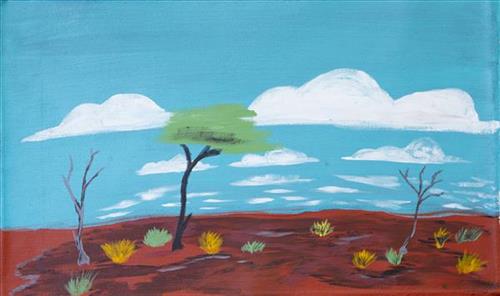
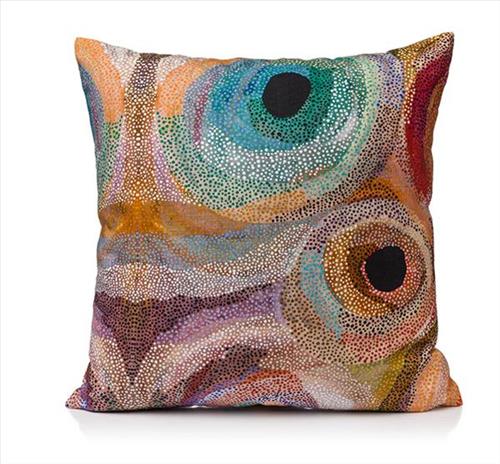
Untitled

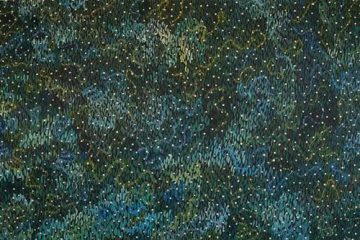
This work portrays an area known to the artist, painted here from memory. During the pujiman (traditional, desert dwelling) era one’s survival depended on their intimate knowledge of the location of resources; thus physical elements of Country, such as sources of kapi (water), tali (sandhills), and different varieties of warta (trees, vegetation) were carefully observed and remembered. Today, this relationship with Country remains equally strong, despite the movement of Martu out of the desert and into remote Aboriginal communities, towns and cities.

Also visible may be traces of life cycles based around kalyu (rain, water) and waru (fire). A thousands of year old practice, fire burning continues to be carried out as both an aid for hunting and a means of land management today. As the Martu travelled and hunted they would burn tracts of land, ensuring plant and animal biodiversity and reducing the risk of unmanageable, spontaneous bush fires. The patchwork nature of regrowth is visible in many landscape works, with each of the five distinctive phases of fire burning visually described with respect to the cycle of burning and regrowth.  

Finally, metaphysical information relating to a location may also be recorded; Jukurrpa (Dreaming) narratives chronicle the creation of physical landmarks, and can be referenced through depictions of ceremonial sites, songlines, and markers left in the land. 

116482429968


Wet Season

This painting is inspired by the wet season in the Pilbara which is basically after cyclone season for me when we have plenty of rain filling the rivers and bringing life back to the country.

116482429963


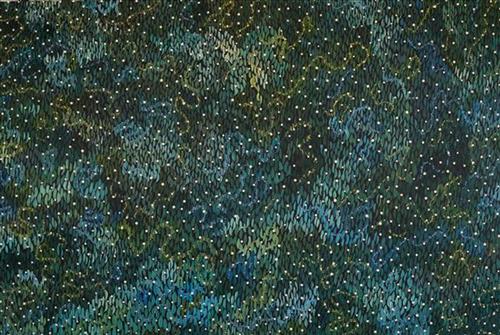
Pilbara Hills and Spinifex Country

In our country we have spinifex covered hills of all different shapes and sizes. When driving through country at different times the colours change and some of the hills look like velvet in the evening and morning light.

11154009492


Status: Stock


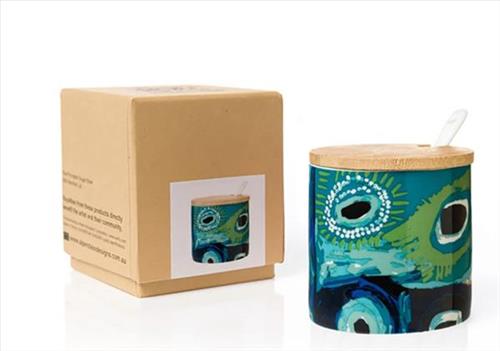
sugar bowls – 3 designs

– Fine Porcelain Sugar Bowl with Bamboo Lid
– Includes White Porcelain Spoon.
– Dimensions: 8.5cm diameter. Height: 8cm (including lid).
– Box dimensions: 9.5cm x 9.5cm x 10.5cm
– Presented in a gift box featuring information about the artist and artwork.

11154009491


Status: Stock


Cushion Cover – 3 designs

Cushion Cover brings beautiful art to life in the comfort of your own home. This Australian-made cushion cover is designed to provide a unique, vibrant touch to any space. Make your home the envy of others with this stunning piece!

Details:
– Dimensions (approx): 45cm x 45cm 
– Zip Closure.
– Print on both sides of the cushion.
– Please note that artwork/placement varies between cushions so each panel/cushion is a little bit different.
– Cushion insert not included. Insert recommended 51cm x 51cm.
– Information about artist and artwork included.

111982418992


Coil Basket

Coil basketry is a well-established fibre art form in the Maningrida region, especially for women from the Kuninjku, Rembarrnga, Ndjebbana and Nakkara language groups. 

Artists make coiled baskets of many shapes and sizes, ranging from small round baskets to large oval baby baskets, and made mostly from pandanus fibre that is dyed with natural pigments. Bundles of fibre are formed into coils which are covered and stitched together with strands of fibre threaded onto a needle. Artists combine colours and patterns to obtain intricate new graphic patterns.

These techniques are believed to have been introduced to Arnhem Land by Greta Matthews, a missionary on Goulburn Island in the 1920s. She had probably learnt coil basketry from Aboriginal people in the south-east of Australia, possibly the Murray River people such as the Yorta Yorta or the coastal Ngarrindjeri. 

The coiling technique spread quickly from Goulburn Island to people on mainland Arnhem Land. 


111982419599


Bark Painting

Bark paintings have a long cultural tradition, believed to extend back many thousands of years. In northern Australia, the walls of bark shelters in the Kimberley and Arnhem Land may well have been painted to convey and illustrate stories in the same way that rock shelters were. Bark painters in the Maningrida region invoke customary practices and experiment with visual forms. Their paintings merge the natural and spiritual worlds, the secular and sacred, and embody and evoke ancestral presence.The subject matter of some works on bark express or focus on djang, the power of country itself; others the ancestral activities that created it or inhabit it: the powerful Rainbow Serpent Ngalyod, female water spirits including Yawkyawk and jin-Merdewa, and spirit beings such as Namorrorddo and Wangarra. Some paintings feature geometric designs inspired by body painting. Spirit figures such as the long thin Mimih spirits said to live in the rock country are also frequently depicted, as are animals hunted as game, including kangaroo and barramundi. 

The process of making a bark painting begins with the artist choosing a suitable tree (stringybark gum tree, Eucalyptus tetrodonta), in the wet season when the sap is rising and the bark is fairly supple and easy to grip. After finding a section of bark that is free of knots and termite damage, cuts are made top and bottom and, after some encouragement by tugging and prying, a hollow open cylinder of bark is removed. The rough outer bark is stripped off and the bark sheet is trimmed and placed over a fire, inner side downwards, to drive out moisture, including the sap. The bark sheet, pliable from its steaming session, is next placed on the ground and trodden on to flatten it out. Heavy weights are placed on it as it cools to ensure that it doesn’t curl or warp.

Artists use a rich palette of colours derived from natural pigments that can be sourced from their clan estates. The reds, purples, pinks and yellows come from ochres (forms of iron oxide or limonite). Black generally comes from charcoal, and white is from pipeclay. All of these earth pigments are strongly associated with djang. The pipeclay used to create the brilliant white paint, for example, is said to be the faeces of the powerful Rainbow Serpent (Ngalyod in the Kuninjku language) and the spirit essence of the Mardayin ceremony.

Sometimes natural fixatives are mixed in to bind the pigments: wax, yolk of eggs, resins and the sap of orchid plants. Today PVA glue is more commonly used as a binding agent for the pigments. The tool that an artist uses to apply colour to the bark depends on the style of painting and available resources. It may be a feather, or a brush made from a few strands of straight human hair. Cyperus javanicus, a tough sedge grass, may be used to make the slim reed brush required to execute the fine rarrk designs.