221382434971


Djaykuŋ and Jalagoh

Djilpin Arts is a not for profit Aboriginal Corporation that promotes the maintenance, development and transmission of traditional cultural knowledge systems.

For two decades, Djilpin Arts has been working on country with kin and culture, across generations. Our activities are rich in spirit, bringing, healing to the community and linking traditional knowledge with modern enterprise. Our Centre features galleries, museum collection and award winning accommodation for visitors.

Meet local people and artists, learn about traditional life and culture, browse and buy artworks, stay with us and experience seasonal cultural events, tours and immersions.

All artworks are made by local artists living in the community. Artwork reflects the traditional songs and stories that have been passed down through the generations with a contemporary edge: from paintings, prints, fibre art, carvings and dijeridu together to contemporary design prducts and fine woven wire jewellery.

221382434969


Flying Fox

Djilpin Arts is a not for profit Aboriginal Corporation that promotes the maintenance, development and transmission of traditional cultural knowledge systems.

For two decades, Djilpin Arts has been working on country with kin and culture, across generations. Our activities are rich in spirit, bringing, healing to the community and linking traditional knowledge with modern enterprise. Our Centre features galleries, museum collection and award winning accommodation for visitors.

Meet local people and artists, learn about traditional life and culture, browse and buy artworks, stay with us and experience seasonal cultural events, tours and immersions.

All artworks are made by local artists living in the community. Artwork reflects the traditional songs and stories that have been passed down through the generations with a contemporary edge: from paintings, prints, fibre art, carvings and dijeridu together to contemporary design prducts and fine woven wire jewellery.

377815582435051


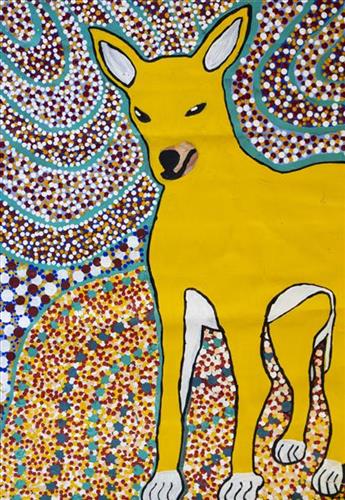
Wartij Warrarn (Dingo Country)

“A dingo walking around the Country. Colourful dots represent wildflowers. The dingo travels around the countryside, passing desert country, wildflower country, waterholes and springs.”
 – Augustine Junior Badal


377815582435054


Canning Stock Route Area

“This painting is about waterholes in the desert where the old people used to walk from waterhole to waterhole in the Canning Stock Route area. All the colours represent the different wildflowers and the brown is the sand dunes. The circles represent different waterholes.”
 – Bibianna Tumbler

This artwork reflects the histories and journeys along the Canning Stock Route, a place where desert families walked, camped, hunted and gathered long before the line of wells was made. For Bidyadanga artists whose families travelled this Country, the Stock Route is remembered not as a road, but as a pathway of life — water soaks, claypans, sandhills, stories and camps passed down through generations.

The painting holds memories of living waterholes (jila), spinifex plains and salt lakes, places where families met, rested, shared food and continued on. It also speaks to the changes brought with the drovers — movement from desert to mission, cultural resilience, and the strength of families who carried language, story and law across the land.

Patterns, dots and flowing lines reflect walking tracks, dunes, waters and landmarks across Nyangumarta, Mangala and Martu Country. In this work, the artist honours the old people who travelled with nothing but knowledge, and celebrates their legacy — the strength of culture that continues today.

377815582435053


Bush Medicine

“This is a painting about bush medicine. It’s been boiled up. You boil it up and it turns into a burgundy sort of colour. Smells like eucalyptus. It is used for sores, rash, any skin condition. It’s a white gum tree.”
– Georgina Walbidi

This artwork honours the plants and practices of bush medicine — the healing Country provides, the old-people’s knowledge, and the living connection between land and body.

The artist reflects on the medicines found across Country: bark that soothes, leaves for infusions, roots dug after the rains, plants that grow in shade, and wood burnt down to ash for healing. These works often come from memories of learning and walking with elders — watching, smelling, collecting, and preparing medicine with care.

It reminds us that caring for Country is caring for ourselves. Gathering medicine is a cultural act — a moment of respect, listening, and moving gently on Country. This knowledge has been passed down across generations and must continue to be held, practised, and shared.

The painting invites the viewer into gratitude — for the plants, for the Country, for the knowledge keepers, and for the ongoing practice of looking after all life

111582435423


Punmu

“This area here is our Country. It’s our Country right here. We returned to our Country with a Toyota and a grader that made the road. A grader right up to here. Punmu is a good place. It’s a happy place to live. My spirit feels good living here. In pujiman (traditional, desert dwelling) time we lived in this area now. I’m happy with this life now, happy because I feel grounded by my Country. It’s important to hold onto the legacy of the ancestors. It’s up to the young people to carry it on now. For the ancestors past and present.”

– Minyawe Miller as translated by Kanyirninpa Jukurrpa


Punmu refers to a region and an Aboriginal community within its vicinity, located 670km North-East of Newman. Created during the return to Country movement of the 1980s, with the recognition of Martu land rights and native title, the community was named after a nearby Jukurrpa (Dreaming) story.

Punmu Aboriginal community sits on the edge of a large salt lake known as Nyayartakujarra, or Lake Dora. The lake runs south into Karlamilyi River (Rudall River). Surrounding Punmu are numerous fresh water soaks and the red tali (sandhills) typical of the area. The most frequently visited yinta (permanent springs) around Punmu include Wirlarra, Rawa, Yilyara, Jila-jila and Tuu-tuu.

The Country around Punmu features in several Jukurrpa stories. Of particular importance is the story of the Jila Kujarra (Two Snakes), one of the key Jukurrpa narratives for the Martu. Though the story belongs to Warnman people, it is shared across the Western Desert with several other language groups. The narrative centres on the travels of two snakes as they are pursued by the Niminjarra, spiritual ancestors of the Warnman people. 

Before transforming themselves into snakes, the Jila Kujarra were young brothers. As snakes, they began travelling home to their mother, but were intercepted by the Niminjarra, who tracked the Jila Kujarra to Paji, east of Nyayartakujarra (Lake Dora). Though the Jila Kujarra eluded their pursuers here by escaping under the lake at Paji, they were soon after speared and injured by two Pukurti (initiates with bundled hair) at Nyayartakujarra, who returned with the Niminjarra to cook the snakes at the site of Kumpupirntily (Kumpupintily, Lake Disappointment). As the Niminjarra cut down the length of the Jila Kujarra, the snake’s bladders were pierced, causing an explosion of scalding hot urine in which the Niminjarra all perished and became black rocks at the site. The spirits of the Jila Kujarra returned to their mother at Nyayartakujarra, where the mother and her sons entered the ground below Nyayartakujarra and remain to this day.

111582435422


Punmu

“This area here is our Country. It’s our Country right here. We returned to our Country with a Toyota and a grader that made the road. A grader right up to here. Punmu is a good place. It’s a happy place to live. My spirit feels good living here. In pujiman (traditional, desert dwelling) time we lived in this area now. I’m happy with this life now, happy because I feel grounded by my Country. It’s important to hold onto the legacy of the ancestors. It’s up to the young people to carry it on now. For the ancestors past and present.”

– Minyawe Miller as translated by Kanyirninpa Jukurrpa


Punmu refers to a region and an Aboriginal community within its vicinity, located 670km North-East of Newman. Created during the return to Country movement of the 1980s, with the recognition of Martu land rights and native title, the community was named after a nearby Jukurrpa (Dreaming) story.

Punmu Aboriginal community sits on the edge of a large salt lake known as Nyayartakujarra, or Lake Dora. The lake runs south into Karlamilyi River (Rudall River). Surrounding Punmu are numerous fresh water soaks and the red tali (sandhills) typical of the area. The most frequently visited yinta (permanent springs) around Punmu include Wirlarra, Rawa, Yilyara, Jila-jila and Tuu-tuu.

The Country around Punmu features in several Jukurrpa stories. Of particular importance is the story of the Jila Kujarra (Two Snakes), one of the key Jukurrpa narratives for the Martu. Though the story belongs to Warnman people, it is shared across the Western Desert with several other language groups. The narrative centres on the travels of two snakes as they are pursued by the Niminjarra, spiritual ancestors of the Warnman people. 

Before transforming themselves into snakes, the Jila Kujarra were young brothers. As snakes, they began travelling home to their mother, but were intercepted by the Niminjarra, who tracked the Jila Kujarra to Paji, east of Nyayartakujarra (Lake Dora). Though the Jila Kujarra eluded their pursuers here by escaping under the lake at Paji, they were soon after speared and injured by two Pukurti (initiates with bundled hair) at Nyayartakujarra, who returned with the Niminjarra to cook the snakes at the site of Kumpupirntily (Kumpupintily, Lake Disappointment). As the Niminjarra cut down the length of the Jila Kujarra, the snake’s bladders were pierced, causing an explosion of scalding hot urine in which the Niminjarra all perished and became black rocks at the site. The spirits of the Jila Kujarra returned to their mother at Nyayartakujarra, where the mother and her sons entered the ground below Nyayartakujarra and remain to this day.

111582435421


Yalta

Yalta is a waterhole located between the Great Sandy Desert’s Percival Lakes region and Kunawarritji Aboriginal community. This site was visited by the Ngayurnangalku (cannibals) during the Jukurrpa (Dreaming). These fearsome ancestral cannibal beings are said to resemble people in their appearance, except for their fangs and long curved knife like fingernails they use to catch and hold their human victims. The Ngayurnangalku continue to live beneath the crust of Kumpupirntily (Kumpupintily, Lake Disappointment), south east of Yalta.

The term Jukurrpa is often translated in English as the ‘dreaming’, or ‘dreamtime’. It refers generally to the period in which the world was created by ancestral beings, who assumed both human and nonhuman forms. These beings shaped what had been a formless landscape; creating waters, plants, animals, and people. At the same time they provided cultural protocols for the people they created, as well as rules for interacting with the natural environment. At their journey’s end, the ancestral beings transformed themselves into important waters, hills, rocks, and even constellations. 

111582435420


Punmu

“This area here is our Country. It’s our Country right here. We returned to our Country with a Toyota and a grader that made the road. A grader right up to here. Punmu is a good place. It’s a happy place to live. My spirit feels good living here. In pujiman (traditional, desert dwelling) time we lived in this area now. I’m happy with this life now, happy because I feel grounded by my Country. It’s important to hold onto the legacy of the ancestors. It’s up to the young people to carry it on now. For the ancestors past and present.”

– Minyawe Miller as translated by Kanyirninpa Jukurrpa


Punmu refers to a region and an Aboriginal community within its vicinity, located 670km North-East of Newman. Created during the return to Country movement of the 1980s, with the recognition of Martu land rights and native title, the community was named after a nearby Jukurrpa (Dreaming) story.

Punmu Aboriginal community sits on the edge of a large salt lake known as Nyayartakujarra, or Lake Dora. The lake runs south into Karlamilyi River (Rudall River). Surrounding Punmu are numerous fresh water soaks and the red tali (sandhills) typical of the area. The most frequently visited yinta (permanent springs) around Punmu include Wirlarra, Rawa, Yilyara, Jila-jila and Tuu-tuu.

The Country around Punmu features in several Jukurrpa stories. Of particular importance is the story of the Jila Kujarra (Two Snakes), one of the key Jukurrpa narratives for the Martu. Though the story belongs to Warnman people, it is shared across the Western Desert with several other language groups. The narrative centres on the travels of two snakes as they are pursued by the Niminjarra, spiritual ancestors of the Warnman people. 

Before transforming themselves into snakes, the Jila Kujarra were young brothers. As snakes, they began travelling home to their mother, but were intercepted by the Niminjarra, who tracked the Jila Kujarra to Paji, east of Nyayartakujarra (Lake Dora). Though the Jila Kujarra eluded their pursuers here by escaping under the lake at Paji, they were soon after speared and injured by two Pukurti (initiates with bundled hair) at Nyayartakujarra, who returned with the Niminjarra to cook the snakes at the site of Kumpupirntily (Kumpupintily, Lake Disappointment). As the Niminjarra cut down the length of the Jila Kujarra, the snake’s bladders were pierced, causing an explosion of scalding hot urine in which the Niminjarra all perished and became black rocks at the site. The spirits of the Jila Kujarra returned to their mother at Nyayartakujarra, where the mother and her sons entered the ground below Nyayartakujarra and remain to this day.

111582435419


Jartuti

“Jartuti water place east of Parnngurr. In pujiman (traditional, desert dwelling) days old people walked and hunted there, we went there recently with KJ (Kanyirninpa Jukurrpa) ranger mob, lovely place.” 

 – Beverley Rogers

Jartuti is a water source located close to Parnngurr Aboriginal Community (otherwise known as Cotton Creek), and is part of Beverley’s father’s ngurra (home Country, camp). The site is near to the home of the jangara (cannibal devil), spiritual beings from the Jukurrpa (Dreaming) era.