111982443453


Derrko (Dragonfly)

Derrko is the word used for dragonfly across inland central Arnhem Land by Kune, Kuninjku and Rembarrnga language speakers. The appearance of dragonflies throughout the region usually signals a seasonal shift, marking the approach of the dry season, and end of the humid wet season.

111982443452


Rajarra (Barramundi)

Rajarra (barramundi in Burarra language), is an important food source in this region. These fish are caught throughout the artist’s clan estate, either in fishtraps woven from pandanus or sedge grass, or else hunted with spears and fishing lines in billabongs and streams where they shelter from the sun under fallen logs or amongst the leaves of water plants.

Bark paintings have a long cultural tradition, believed to extend back many thousands of years. In northern Australia, the walls of bark shelters in the Kimberley and Arnhem Land may well have been painted to convey and illustrate stories in the same way that rock shelters were. Bark painters in the Maningrida region invoke customary practices and experiment with visual forms. Their paintings merge the natural and spiritual worlds, the secular and sacred, and embody and evoke ancestral presence.The subject matter of some works on bark express or focus on djang, the power of country itself; others the ancestral activities that created it or inhabit it: the powerful Rainbow Serpent Ngalyod, female water spirits including Yawkyawk and jin-Merdewa, and spirit beings such as Namorrorddo and Wangarra. Some paintings feature geometric designs inspired by body painting. Spirit figures such as the long thin Mimih spirits said to live in the rock country are also frequently depicted, as are animals hunted as game, including kangaroo and barramundi. 

The process of making a bark painting begins with the artist choosing a suitable tree (stringybark gum tree, Eucalyptus tetrodonta), in the wet season when the sap is rising and the bark is fairly supple and easy to grip. After finding a section of bark that is free of knots and termite damage, cuts are made top and bottom and, after some encouragement by tugging and prying, a hollow open cylinder of bark is removed. The rough outer bark is stripped off and the bark sheet is trimmed and placed over a fire, inner side downwards, to drive out moisture, including the sap. The bark sheet, pliable from its steaming session, is next placed on the ground and trodden on to flatten it out. Heavy weights are placed on it as it cools to ensure that it doesn’t curl or warp.

Artists use a rich palette of colours derived from natural pigments that can be sourced from their clan estates. The reds, purples, pinks and yellows come from ochres (forms of iron oxide or limonite). Black generally comes from charcoal, and white is from pipeclay. All of these earth pigments are strongly associated with djang. The pipeclay used to create the brilliant white paint, for example, is said to be the faeces of the powerful Rainbow Serpent (Ngalyod in the Kuninjku language) and the spirit essence of the Mardayin ceremony.

Sometimes natural fixatives are mixed in to bind the pigments: wax, yolk of eggs, resins and the sap of orchid plants. Today PVA glue is more commonly used as a binding agent for the pigments. The tool that an artist uses to apply colour to the bark depends on the style of painting and available resources. It may be a feather, or a brush made from a few strands of straight human hair. Cyperus javanicus, a tough sedge grass, may be used to make the slim reed brush required to execute the fine rarrk designs. 
111982443451


Rajarra (Barramundi)

Rajarra (barramundi in Burarra language), is an important food source in this region. These fish are caught throughout the artist’s clan estate, either in fishtraps woven from pandanus or sedge grass, or else hunted with spears and fishing lines in billabongs and streams where they shelter from the sun under fallen logs or amongst the leaves of water plants.

Bark paintings have a long cultural tradition, believed to extend back many thousands of years. In northern Australia, the walls of bark shelters in the Kimberley and Arnhem Land may well have been painted to convey and illustrate stories in the same way that rock shelters were. Bark painters in the Maningrida region invoke customary practices and experiment with visual forms. Their paintings merge the natural and spiritual worlds, the secular and sacred, and embody and evoke ancestral presence.The subject matter of some works on bark express or focus on djang, the power of country itself; others the ancestral activities that created it or inhabit it: the powerful Rainbow Serpent Ngalyod, female water spirits including Yawkyawk and jin-Merdewa, and spirit beings such as Namorrorddo and Wangarra. Some paintings feature geometric designs inspired by body painting. Spirit figures such as the long thin Mimih spirits said to live in the rock country are also frequently depicted, as are animals hunted as game, including kangaroo and barramundi. 

The process of making a bark painting begins with the artist choosing a suitable tree (stringybark gum tree, Eucalyptus tetrodonta), in the wet season when the sap is rising and the bark is fairly supple and easy to grip. After finding a section of bark that is free of knots and termite damage, cuts are made top and bottom and, after some encouragement by tugging and prying, a hollow open cylinder of bark is removed. The rough outer bark is stripped off and the bark sheet is trimmed and placed over a fire, inner side downwards, to drive out moisture, including the sap. The bark sheet, pliable from its steaming session, is next placed on the ground and trodden on to flatten it out. Heavy weights are placed on it as it cools to ensure that it doesn’t curl or warp.

Artists use a rich palette of colours derived from natural pigments that can be sourced from their clan estates. The reds, purples, pinks and yellows come from ochres (forms of iron oxide or limonite). Black generally comes from charcoal, and white is from pipeclay. All of these earth pigments are strongly associated with djang. The pipeclay used to create the brilliant white paint, for example, is said to be the faeces of the powerful Rainbow Serpent (Ngalyod in the Kuninjku language) and the spirit essence of the Mardayin ceremony.

Sometimes natural fixatives are mixed in to bind the pigments: wax, yolk of eggs, resins and the sap of orchid plants. Today PVA glue is more commonly used as a binding agent for the pigments. The tool that an artist uses to apply colour to the bark depends on the style of painting and available resources. It may be a feather, or a brush made from a few strands of straight human hair. Cyperus javanicus, a tough sedge grass, may be used to make the slim reed brush required to execute the fine rarrk designs. 
111982443450


Jinimbu (Spanish Mackeral)

Bark paintings have a long cultural tradition, believed to extend back many thousands of years. In northern Australia, the walls of bark shelters in the Kimberley and Arnhem Land may well have been painted to convey and illustrate stories in the same way that rock shelters were. Bark painters in the Maningrida region invoke customary practices and experiment with visual forms. Their paintings merge the natural and spiritual worlds, the secular and sacred, and embody and evoke ancestral presence.The subject matter of some works on bark express or focus on djang, the power of country itself; others the ancestral activities that created it or inhabit it: the powerful Rainbow Serpent Ngalyod, female water spirits including Yawkyawk and jin-Merdewa, and spirit beings such as Namorrorddo and Wangarra. Some paintings feature geometric designs inspired by body painting. Spirit figures such as the long thin Mimih spirits said to live in the rock country are also frequently depicted, as are animals hunted as game, including kangaroo and barramundi. 

The process of making a bark painting begins with the artist choosing a suitable tree (stringybark gum tree, Eucalyptus tetrodonta), in the wet season when the sap is rising and the bark is fairly supple and easy to grip. After finding a section of bark that is free of knots and termite damage, cuts are made top and bottom and, after some encouragement by tugging and prying, a hollow open cylinder of bark is removed. The rough outer bark is stripped off and the bark sheet is trimmed and placed over a fire, inner side downwards, to drive out moisture, including the sap. The bark sheet, pliable from its steaming session, is next placed on the ground and trodden on to flatten it out. Heavy weights are placed on it as it cools to ensure that it doesn’t curl or warp.

Artists use a rich palette of colours derived from natural pigments that can be sourced from their clan estates. The reds, purples, pinks and yellows come from ochres (forms of iron oxide or limonite). Black generally comes from charcoal, and white is from pipeclay. All of these earth pigments are strongly associated with djang. The pipeclay used to create the brilliant white paint, for example, is said to be the faeces of the powerful Rainbow Serpent (Ngalyod in the Kuninjku language) and the spirit essence of the Mardayin ceremony.

Sometimes natural fixatives are mixed in to bind the pigments: wax, yolk of eggs, resins and the sap of orchid plants. Today PVA glue is more commonly used as a binding agent for the pigments. The tool that an artist uses to apply colour to the bark depends on the style of painting and available resources. It may be a feather, or a brush made from a few strands of straight human hair. Cyperus javanicus, a tough sedge grass, may be used to make the slim reed brush required to execute the fine rarrk designs. 
111582386687


3 Pools

“It’s north of here. It might be Nyiyaparli country but we’re caretakers.

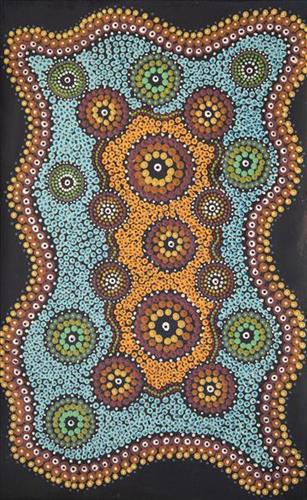
I haven’t been out for a long time. It’s painted from memory. It’s a beautiful swimming spot, good for a BBQ and picnic. It’s beautiful when it’s summertime, you get the big gumtrees from the shade. The pools are like a step, one down to the other. When it’s really flowing you can’t see the different pools.

I paint it as I see it. Even when I go out to Jigalong I’m always looking at the bush. Mainly looking for something to eat, but I can still see the Country. It’s close to my heart that I try to use the colours of Country to portray what I’m seeing.

The rainbow serpent, Jila (snake) came [here] from Yindjibarndi Country. This one is part of a series [along with] Kalgan’s Pool. The story is he came all the way through and out to Lake Dora. On that lake there, pretty much in the middle is a freshwater spring. And that’s where he lives, out there. Even out at Kalgan’s Pool, there’s a resident jila out there. I’ve seen him a couple of times, a huge olive python.”

– Sonny (Albert) Pilkington


Three Pools is a small cascading waterfall nestled in the Pilbara found a few hours north of Newman, where Sonny resides. This place is connected to the Rainbow Serpent Jukurrpa from Yindjibarndi Country of the North Western part of the Pilbara region.

The term Jukurrpa is often translated in English as the ‘dreaming’, or ‘dreamtime’. It refers generally to the period in which the world was created by ancestral beings, who assumed both human and nonhuman forms. These beings shaped what had been a formless landscape; creating waters, plants, animals, and people.

The Western Desert term jila is used interchangeably to describe springs considered to be ‘living’ waters and snakes, both of which play a central role in Martu culture and Jukurrpa (Dreaming). Of the many permanent springs in Martu Country, very few are ‘living waters’; waters inhabited by jila (powerful ancestral beings). Before they became snakes, these beings were men who made rain, formed the land and introduced cultural practices like ceremonies and ritual songs. Some of the men travelled the desert together, visiting one another, but they all ended their journeys at their chosen spring alone, transformed into a snake.

221382441928


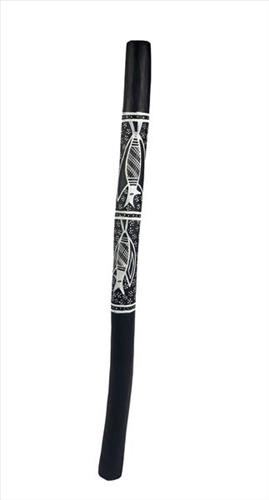
Didjeridu (Flying Fox)

Didjeridus from this region are made in the West Arnhem style. Called Mago, they’re different and special and follow the tradition made famous by Beswick’s Mago Master, elder David Blanasi.

Ghunmarn didjeridus are sourced on country, and hand cut from Woolybutt trees. Artists travel considerable distances on foot to find the right woolybutt tree naturally hollowed out by termites. Good instruments are hand-cut and taken back to camp to be worked, shaped, sanded, tuned and then finally painted.

These are top quality musical instruments, highly regarded worldwide, and still used in ceremony and performance today. Featuring traditional designs handed painted with a Jarlk grass brush.


Most Ghunamrn didjeridus are high pitch D, low pitch D, F, C or G. The longer the dij the lower the pitch, a shorter didj will give a higher sound.