115682188252


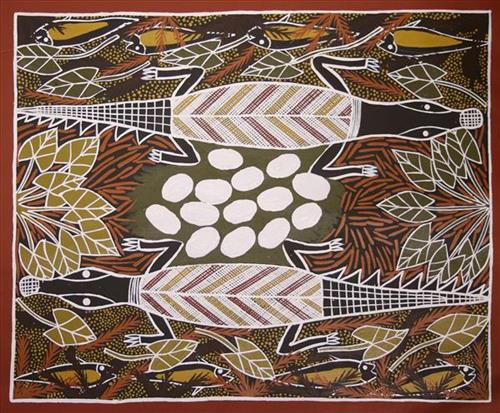
Baru Dhawu (Crocodile Story)

Baru (the crocodile man), was from the Gumatj clan. People usually call him Gurdu Gurdu or Baru which means crocodile. He lived his life at a place called Yirrkala. Living near him were other people, and when Baru didn’t have enough to eat he began to kill and eat these other people. After a while others noticed that some people were missing. When Baru went to the toilet, the people could smell this strong smell, so they knew that he ate the other people. Some men went to get help and they took message sticks to the other tribes. Some were sending smoke signals. When they came to Baru’s camp they started to spear him in the left side of his ribs. He dropped into the fire and burnt his left hand and maybe his right hand. He then ran into the bush and yelled to his countrymen – the animals, birds and fish that live on the land and in the sea. He stopped and he named the tribes and clans and also the places until he came to a place called Gamarru/Guyurru. There he took a rest and said to himself “This is where I stop and call this place Gamarru/Guyurru”. Baru, still in pain from the fire, then jumped into the water and turned himself into a crocodile. The fire left scars on his back. Baru paintings belong to Gumatj and Warrawarra and also the Marpi clan. This painting is used at death ceremonies or initiations and it normally is painted on the belly, which means the person the design is painted on is part of Gurdu Gurdu (the crocodile people).
115682188539


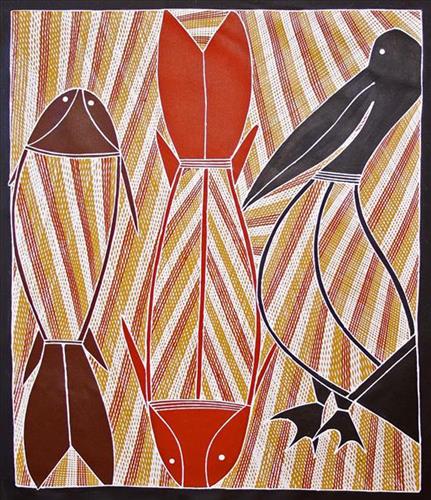
Catfish and Pelican

Aboriginal art in Ramingining, Central Arnhem Land is commonly illustrated through designs and images of animals, plants, and landscape. These motifs commonly reflect the artists ancestral inheritance and their dreamings and are referred to as totems.

For this painting, JB has Catfish and a Pelican.

377810582189127


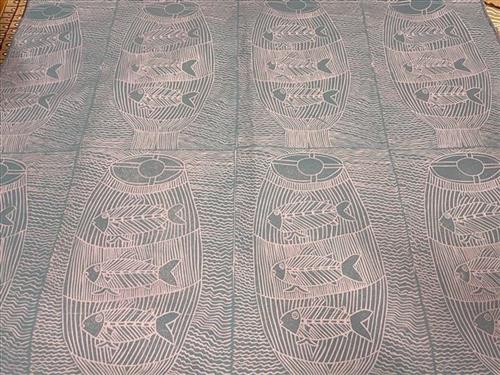
Au-gujechiya (fishtrap)

A detailed linocut design portraying a large Au-gujechiya (fishtrap) with an-maka (cowtail stingray), rajarra (barramundi) and other fish inside. 

Elizabeth is from the Burrarra language group and her homeland is Gupanga, Arnhem Land.  

377810582189128


Marebu

Deborah Wurrkidj is a Kuninjku artist from the Kurulk clan whose country lies around the outstation of Mumeka in central Arnhem Land. She is an accomplished artist working across mediums including painting, sculpture, weaving and textile design. For this design, Deborah Wurrkidj has depicted Marebu (woven pandanus mats).

Works in fibre from the Maningrida region are widely recognised as some of the finest in Australia. Artists confidently push the boundaries of fibre craft and cultural expression, adapting traditional techniques and forms to produce strikingly inventive and aesthetically exquisite artworks.

Artists weave many different kinds of mats. Conical mats were traditionally used to shield babies from mosquitoes. Long flat mats were used for blocking creeks so that fish would be diverted into fish traps. A small triangular mat made of pandanus fibre used to be worn by women during ceremonial gatherings, tied around their back and covering them at the front. Mats are also used for wrapping and rinsing food in water.

Artists usually use kundayarr, pandanus spiralis, to weave decorative round or oblong mats, as well as the less common triangular and conical shapes. Weaving is physically hard work, now done only by women. They colour the pandanus using natural dyes made from the roots, leaves or flowers of plants within the weaver’s clan estate.

The radial woven patterns of the finest round mats appear to vibrate with colour, sometimes regarded as an aesthetic manifestation of deep cultural meaning, as there is a significant spiritual dimension to pandanus mats.

377810582189122


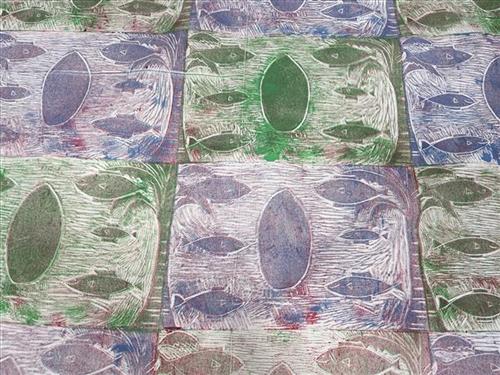
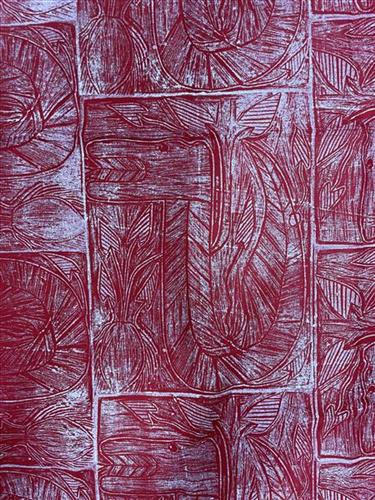
Yokkarra (fish), Ngaduna (palm tree) & Barruar (Seagull egg)

‘Hi it’s me Marilyn! I’m the age of 52. I like working at the women centre and doing lino printing but I prefer screen printing. I have one design, that’s lorrkkon (hollow log). My great grandfather used to make lorrkkon and do bark paining. I never met him but I heard a lot of stories about him. My mother used to tell me history stories. When I was 16 my parents passed away. I’m was on my own but now I’ve got my own family and my partner who helps me. I’ve got 6 grandchildren.

My homeland is Entrance island, Haulround island and Juda point. I really like Haulround island and that’s where we collect barruar (seagull egg). Entrance island is my favourite camping area, I go across with boat. Balanda (non-Aboriginal or European people) can’t go into those islands or Juda point without permission from me.

Come and chat to me if you want to go to any of those places. We have a sacred totem ngaduma (palm tree) at those places and if people destroy it, we will have a strong wind and maybe a cyclone.’

Marilyn James 2021

377810582189121


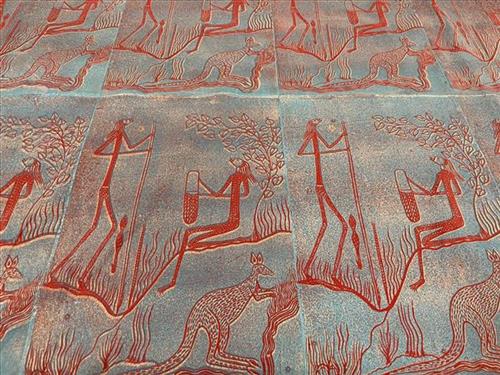
Mimih Dancing and Kangaroo

This is an artwork about a dancing Mimih. It’s based on a song line from Korlobididah. My fathers eldest brother used to sing this song line and Unkle Dennis he was a dancer. My real father, Jacky was a dancer as well and he was from Korlobididah.


377810582189119


Ngalyod

Ngalyod (Rainbow serpent)

Rainbow spirit coming from billabong.

Rainbow serpent dreaming.  Coming from billabong, that place we call billabong where that ngalyod (rainbow serpent) lives.

All that wayuk (waterlily), all them kundalk (grass) and pandanus, making skirt.

That’s the story now. – Jennifer Wurrkidj


.Rainbow serpent, daughter of the Mother One Rainbow Yingarna. The rainbow serpent is a central figure in traditional Bininj religion. She is the creator of places and is active during the wet season and is asssociated with rain and bodies of water. Rainbow serpents live in deep waterholes and rivers. Marrkidjbu are able to discern their presence and control them.’

Source – https://www.njamed.com/

115682189529


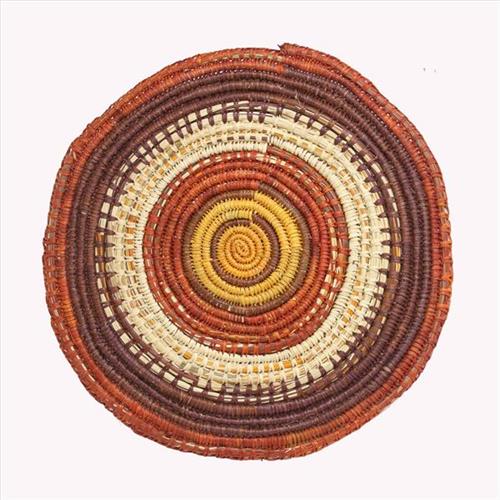
Woven Mat

Traditionally, Nganiyal (conical mats) were used as an insect screen when erected, and as a sitting mat when folded. They are used in Ceremony as well as a functional item. 

Nowadays, artists weave many different shapes including flat, round and oblong. 

115682189231


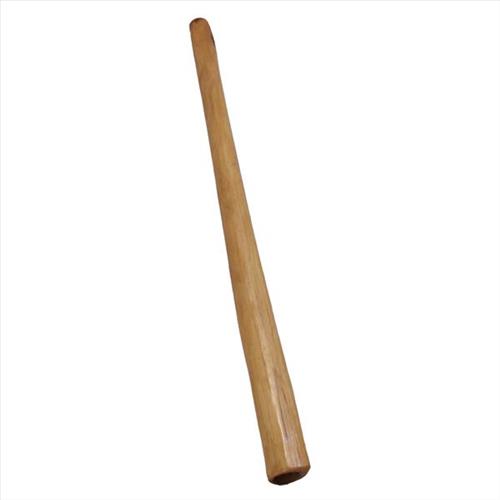
Yidaki

Yidaki have been used instrumentally throughout ceremonial practices for millennia. Made from the Gadayka (Stringy Bark) or Gunurru trees that have been hollowed out by white ants and then cut to size and cleaned out to give the desired sound. 

These are used for Bungguls (ceremonies), at Dhapi (initiation) and Maradjirri (exchange rituals).