220282367557
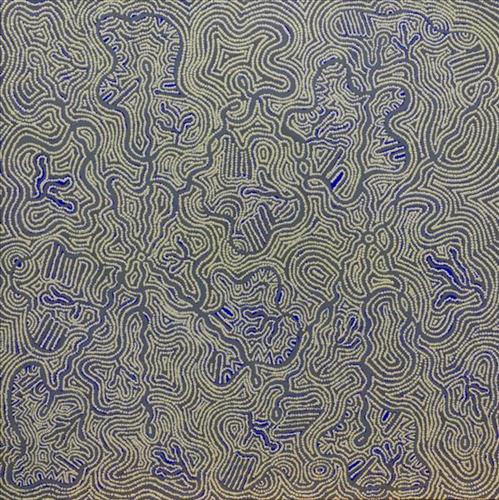
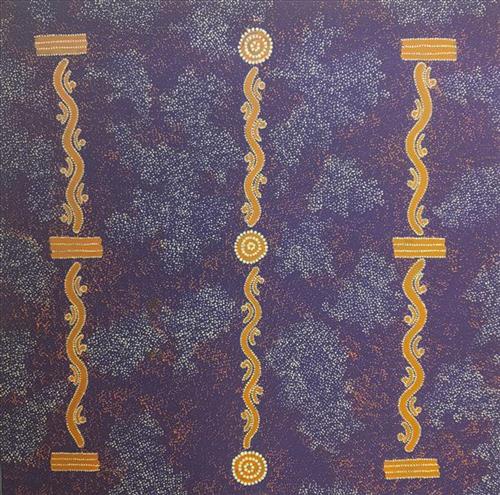
Yalka at Karinyarra
This is the story of the Napaltjarri women digging for yalka (bush onion) in Karinyarra (Mount Wedge) country. Karinyarra is a two-hour drive from Haasts Bluff and is the country of Japaltjarri men and Napaltjiarri women. The circle shapes depict the women digging for bush onion, the hills are the curved lines and the rivers are the lines. There are camels walking around in this country. Bush onion is used for eating and for making a drinking bush medicine. There is bush onion growing all year round, one can find them around the rockholes. The yalka is harvested by using a stick and digging it into the ground to make it soft, then the yalka can be taken out by hand.
“This is my grandfather’s Dreaming. He is my mother’s father and this Dreaming is from her line. Here, women are digging for bush onion around the river in Karinyarra – north of Papunya. The lines in my paintings show the rivers. The circular shapes are the woman digging for the bush onion around the rockholes.”
220282368283
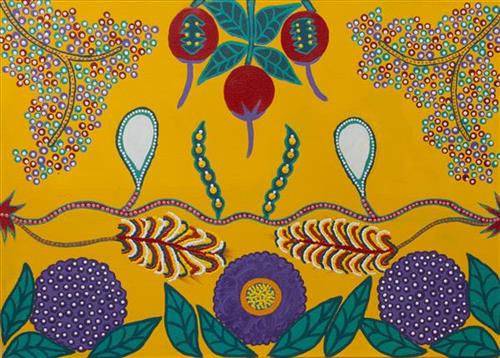
Kantawara
“The yellow means kantawara. Kantawara is like ochre, theres a red, white, and yellow. You can smash it and put water on it and its like a paint for rock painting. Ochre is the red (yulpa). Kantawara is the yellow one used for painting up for woman’s corroboree dancing Yawulyu, they use two colours, white and yellow. The white is used for Sorry Business, when people passed away. That’s why I put the yellow, the painting represents my mother’s grandfather, his name was Nyunana Tjakamarra Kantawarra. He’s part of this Country, Winparrku and Yaya-yii. That’s the Country I represent with the yellow colour of my painting. You can also see bush foods. Purple one is bush coconut, wanpanpi. You can’t just eat it because it has a hard shell. When you get it from the tree you have to hit it with a rock to open it up to see what kind is inside, then you can eat it. Red ones are akatjiri, bush sultana. when it’s dry it’s like a sultana, when it’s there in a tree it tastes like a cherry tomato. When you eat lots of akatjiri that means cleaning the stomach, good for the stomach. Those green seed pods are pangkuna, bush bean. They have stringy leaves and a long curvy pod. Inside there’s the round bean, the pangkuna bush bean with the seed, you can eat that one when you cook the whole pod by laying it in the fire for a few minutes and then taking it out.” – Joyce Dixon
220282368219
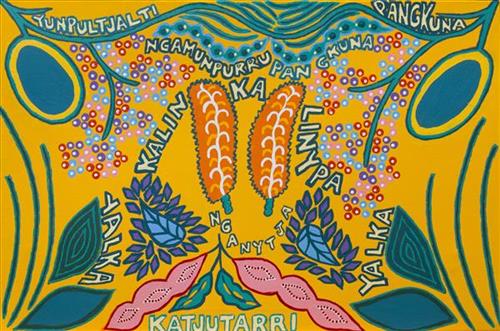
Katjutarri
“I did this yellow paint in the background to represent dry land. You can see there’s lots of blooming flowers and bush tucker. It’s a special time, lots of fruit. It’s in my Grandmother’s Country Kuna Tjarrayi (koona – charray). In Granite. West of Yeundemeu. My grandmother’s name was Yawinytji Napanangka Powlson. Her father was a Walrpiri man, came from North to Haasts Bluff and then moved to Papunya. Haasts Bluff was a missionary place and they made a new settlement in Papunya because there was no water. My mother was born in Haasts Bluff, her name was Maryanne Nakamarra. My grandmother was the wife of Johnny Wararrngula, famous artist from Papunya Tula. That’s where dot painting started, in Papunya community many years back. My grandmother’s father’s name was Yulpu-Lyurru Yupu Tjapangati.” – Joyce Dixon
225482368224
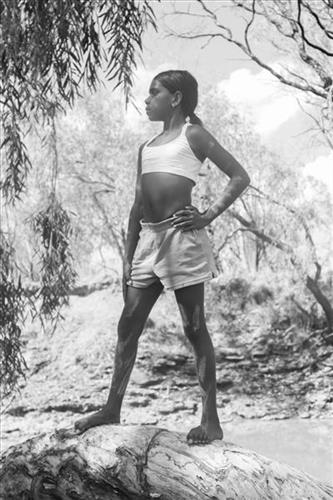
Karla
“Karla” is a part of a series of pictures that were taken during a photo workshop at Mowanjum Art Centre. Lydia worked on shooting portraits of family and friends. The pendant to “Karla” is “Pannesh”.
220282370397
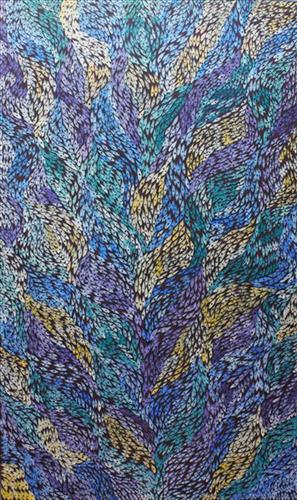
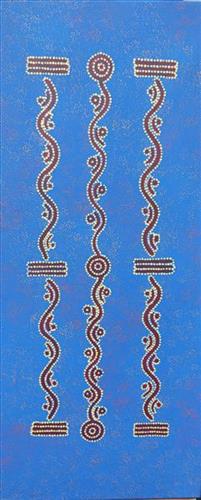
Yalka at Karrkurutinytja (Bush onion Dreaming at Lake Macdonald)
Daphne was passed down the right to paint the Yalka Tjukurrpa at Karrkurutinytja (Bush onion dreaming at Lake Macdonald) from her grandmother, Narputta Nangala Jugadai. Narputta, who was a founding member of Ikuntji art centre and a prolific painter, was born close to this sight.
Daphne says,
“My grandmother, Narputta used to make that painting. She told me that story. I used to work here (Ikuntji Women’s Centre) as a cook. I came to learn here. I saw my grandma painting. I learnt from her. She told me that story…Yalka…Bush food…For a long time those old ladies have been looking for Yalka, digging for Yalka, taking the fruit, cooking it in the fire. We cook them just a little bit, like Maku (witchetty grub). I have been looking for that Yalka with my grandmother.”
Yalka Tjukurrpa, as told by Narputta,
“Creek bed at Karrkurutinytja. Two old women, two Nungurrayi, came across from Pulpa and started Gathering bush onions, putting them into coolamons. They went on a journey west. They approached a group of men and watched them, whilst hiding in the bushed at Pimarrpa (Soakage near Kiwirrkura). There was another lady, Alkiljarra Nakamarra, who came along on their tracks. She saw them where they had gathered bush onions. She became upset that they’d gathered them all up and there were none left. The Nakamarra started walking and came across the creek, where she started collecing mungilpa (a staple seed food for the Pintupi people). She came across two Tjangalas (Mungilnga and Tiwilgna). Next to them was a rockhole and Atjakalya Nakamarra, who was making damper for them. Mungilnga had the smaller damper. The two Tjangalas ate their damper then she flew off and became a rock there at Kurultu.”
220982370277
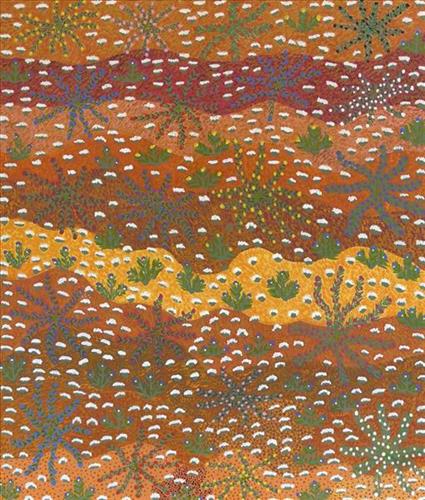
Lulu Pitjara Teece – My Fathers Seed Dreaming
Before my father died, he told me and my sister, that if we ever painted, he wanted us to paint his dreaming. His dreaming is the seed dreaming, from his country. I paint that story, it’s important. That’s why I always paint the seed dreaming.
I have a strong passion for making bush medicine, and I provide the community with traditional bush medicine to treat their ailments.
My paintings are a strong depiction of my connection to culture, family and country.

377814682370402
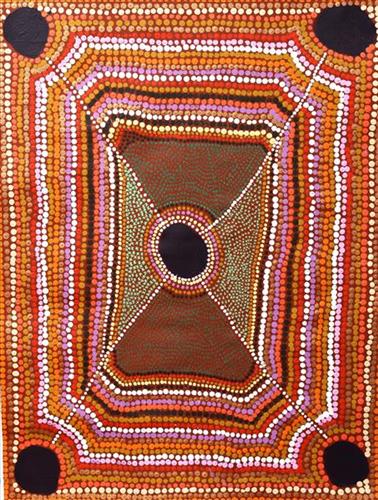
Galtharra
220282371107
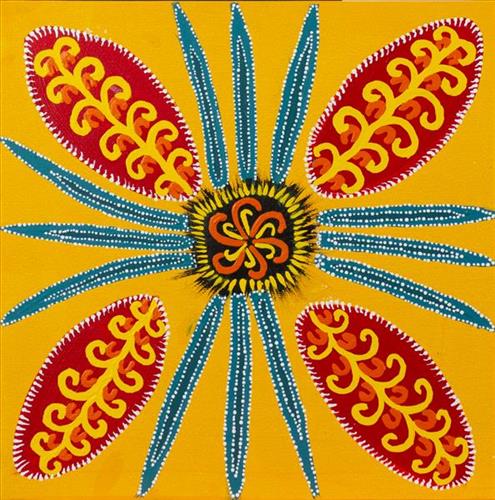
Kaliny-kalinypa
“Seeing from above, zoomed in, leaves and outside is kaliny-kalinypa, inside is the flower blooming. A long time ago people used to travel on a hot day, they would see all these grevillea on the road, they would tap it on their lips and suck it or chew on it for the moisture, and to salivate.” – Joyce Dixon