220282371098


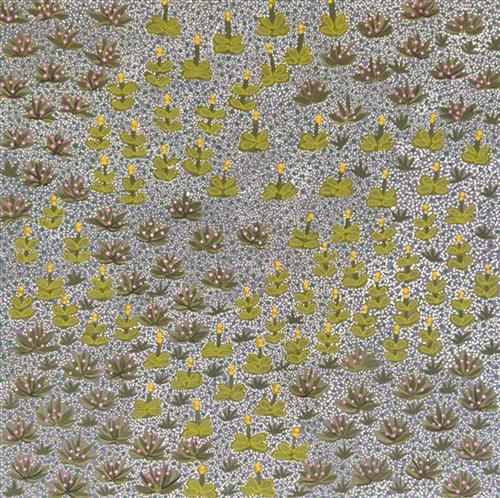
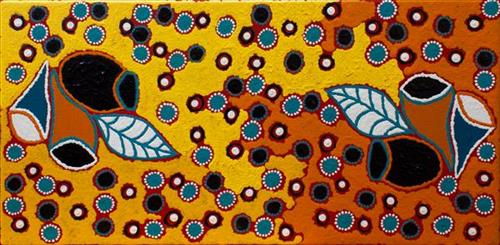
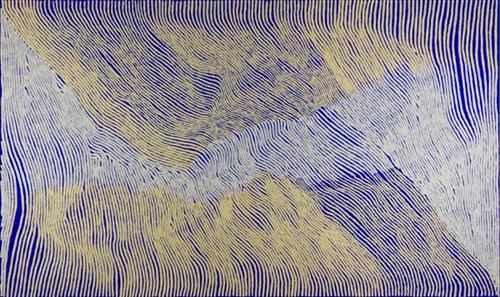
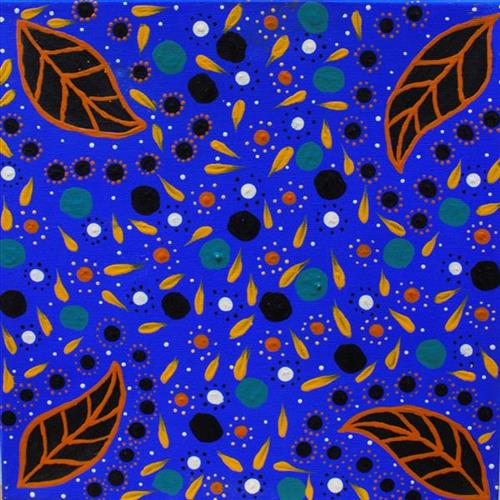
Yawalyurru (Bush Blueberries)

“These are the wavy leaves, yawalyurru leaves. All the circles are the bush blueberries, yawalyurru. The blue background is like the afternoon sky. I am painting my Grandmother’s Country, Watiyawanu area. My Great Great Grandfather, his name was Ngiwangu Tjampitjintpa, he had lots of wives. Big family tree. Ngiwangu had children. There names are Ngatawina Ruby Nangala, Yunurrkumpu Paddy Tjangala Turner, Wiyipa Tjangala Peterson, Mulyupurrku Tjangala Peterson, Nguri Tjangala Marshall. Ngiwangu is Walpiri man come from North, Tjantuwaritji Watiyawaru-one, East of Mt Theo and Mount Patricia.” – Joyce Dixon

220982370925


Latoya Ngwarraye Petrick – Bushflowers

These bush flowers grow seasonally in Alyawarr country, some of which are also used in bush medicine remedies.

I have just started painting, my grandmother Elizabeth Ngwarraye Bonney has been teaching me, she tells me all about the bush flowers.

The community of Ampilatwatja made a conscious decision not to paint altyerr (dreaming stories). The artists paint their country where those stories sit.

220282371099


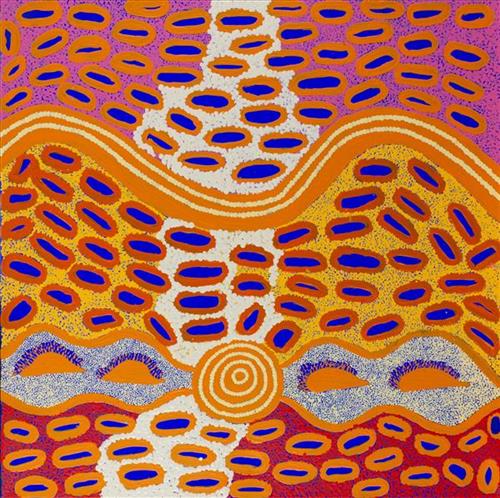
Claypan at Karrinyarra

This work shows a claypan at Karrinyarra after rain with bush onion (yalka) growing. Karrinyarra is two hours’ drive from Haasts Bluff and is the country of the Napaltjarri women and Japaltjarri men. After rain, bush onion (yalka) plants will grow on the claypan. Bush onion is used for food and bush medicine. Bush onions grow all year round and can be found near rockholes and water sources. Women harvest yalka by digging in the ground with a stick until it is soft, then pulling out the onion.

220282371097


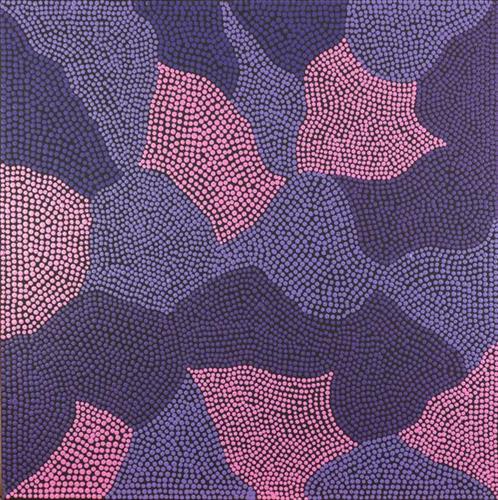
Arrngali (Bush Cherry)

“You can find this arrngali in tali area. It’s bush cherry, the arrngali. You can eat it. The leaves are greeny-blue, it’s got a stick on it. You can cut the sticks and put them in boiling water, the colour is like blackcurrent juice, you can drink that when it’s warm, it’s a good medicine for drinking. For anything, and for the diabetic. That’s what the arrngali is used for. The black and white in the painting is what the inside of the arrngali looks like, the white is the seed, the black part is the cherry. It’s like looking at the cross section. The background is red sand, tali.” – Joyce Dixon

220282371096


Bush Tucker

“The background is the outback red sand. It’s my mother’s father’s Country in Yaya-yii. West of Papunya and east of Mount Leibig. Where that creek runs along. The painting talks about inside and outside of bush tucker. The white is bush banana, Ipalu, there’s the two oval shape, one is outside (plain, green), Ipalu, and the inside part (white). There’s Pangkuna. They have stringy leaves and a long curvy pod. Inside there’s the round bean, the pangkuna bush bean with the seed, you can eat that one when you cook the whole pod by laying it in the fire for a few minutes and then taking it out. There’s the three round circles, the akatjiri. When it’s green, you can’t eat that. Only when it’s yellow or brown. Brown tastes like sultana. Yellow taste like cherry tomato. And the tree, it’s got blue leaves, but it’s green leaves in real life. It’s called yawalyurru. It’s got a seed on it, it’s like a blueberry. There’s the yellow heart shape, it’s a pura, it tastes like rockmelon. Inside there’s black seeds. It’s like a pawpaw, you cut the seed, clean it and eat it. But it tastes like rockmelon. The orange, it’s kaliny-kalinypa. I zoomed it in to explain it, its like a grevillia. Long time ago people used to travel on a hot day, they would see all these grevillia on the road, they would tap it on the lips and suck it or chew it for the moisture, and to salivate. The round brown shape with the long leaves is yalka, bush onion. Long time ago people used to go collect yalka, bush onion. It’s found near the lakes, that’s where they grow. The two colours is the opened yalka, inside. The round circles is the bush coconut, wanpanpi. When you go hunting you can collect these, it’s in a tree like a gum tree. They use  that tree for Sorry Business. As you can see the orange and dark/light blue with the leave is arrngali, bush cherry. It’s got seeds on it. It’s in three colours, when it’s black you can eat it, but red is not ready yet.” – Joyce Dixon
220282371434


Camels at Kungkayunti

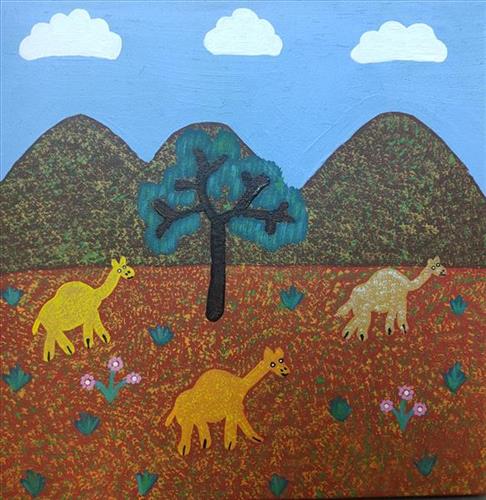
This painting shows camels at Kungkayunti (Brown’s Bore), Benita’s country about an hour and a half west of Ikuntji. They are travelling between the sandhills and the great desert oaks.

220282372364


Kuruyultu

In this painting Eunice depicts her grandmother’s father’s Tjukurrpa (Dreaming). It shows the country at Kuruyultu, near Tjukurrla in Western Australia.

Eunice Napanangka Jack, her grandmother, says about the artwork:

‘This is my country. I can’t remember how it all happened, because it happened before I was born. I have a scar on my back from it. My grandfather speared a wallaby at Kuruyultu. That night he ate that wallaby. At the same time my mother could feel me moving inside her. She was heavily pregnant with me. That next morning, after my grandfather had speared the wallaby, killed it and eaten it, I was born. I was born at Kuruyultu, near the rockhole there. I can’t remember my grandfather or my grandmother. I was still a little baby. We left that place, Kuruyultu. My father, my mother, my big sister and my father’s brother, we all left together and went to Haasts Bluff. I grew up in Haasts Bluff. I have been back to Kuruyultu for visits but I never lived there again in my country. I think about it every day. Only my father knows all the stories for that country and he painted them too… all the men’s stories. I know the story of the wallaby mother and daughter which left me with a birthmark. That’s what I paint: the wallaby mother and daughter.’


220282372331


Claypan at Karrinyarra

This work shows a claypan at Karrinyarra after rain with bush onion (yalka) growing. Karrinyarra is two hours’ drive from Haasts Bluff and is the country of the Napaltjarri women and Japaltjarri men. After rain, bush onion (yalka) plants will grow on the claypan. Bush onion is used for food and bush medicine. Bush onions grow all year round and can be found near rockholes and water sources. Women harvest yalka by digging in the ground with a stick until it is soft, then pulling out the onion.

220282372327


Two Tjangalas

“Two Tjangalas who travelled from North to South, from Tjantuwari Watiyawanu-one to Mount Leibig Watiyawanu-two. The Tjantuwari Watiyawanu-one place is east of Mt Theo/Mt Patricia. They travelled from North, came to Tjantuwari Watiyawanu-one to Mount Leibig, Watiyawanu-two. Came and collected all the seeds. As you can see the people sitting, and the circle, means that’s where their main place and the camp is, The Tjantuwari Watiyawanu-one. You can see the tracks from the two tjanagalas travelling North. The second circle is the main community, the camp, the place, Mount Leibig Watiyawanu-two. They have been collecting seeds. They remain there in Watiyawanu-two, Mount Leibig, as two trees. The wavy blue is the creeks, they have been traveling a long distance, through Tali, Karru, Puli, Tjata, Tjanpi, Watiya, everything. Seeing places. Traveling. And they stopped and ended up in Watiyawanu-two, Mount Leibig. Two Tjangalas.” – Joyce Dixon

220282372333


Tjilkamala – Porcupine rockhole

This is the story of Tjilkamala – the porcupine man. He is travelling around Talaalpi, west of Kintore and is looking for ants. He digs for them in the ground and creates holes. Meanwhile tracking behind him are women out hunting, hoping to make the porcupine their tucker for the evening. These holes fill with water after the rain and with the morning dew. Over many years they have become rockholes.
This work is the story of Alice’s personal Tjukurrpa (Dreaming) – the Porcupine. The setting is the rockholes in and around the swamp of Talaalpi in Western Australia.