220982298233


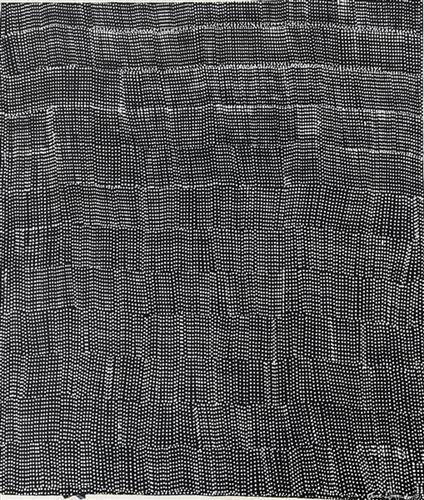
Julieanne Ngwarraye Morton – Alpeyt Alpeyt (Flowers Blooming)

Walking across my land to look for bush flowers and goanna. I bring home to make medicine for my family and cook the goanna for dinner.  Goanna is my favourite to eat.


Dimensions: 56 x 76 cm Acrylic on 300GSM S/H Paper

220982341297


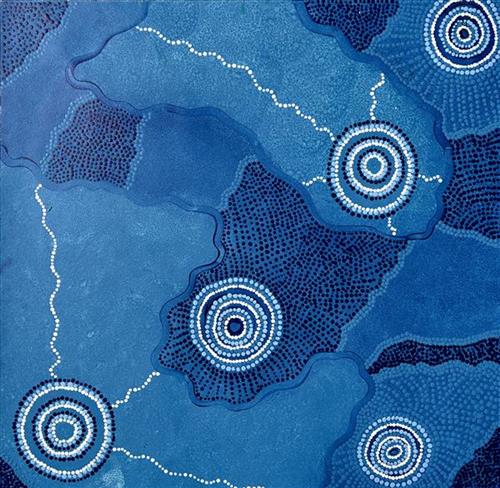
View Of Country

This shows the layered landscape of Alyawarr, Central Australia. Knowing your country is an important part of living in a remote community like Ampilatwatja.

Knowing when and where to go hunting and gathering, knowing where there is ‘soakage’ (where you can dig for water), travelling with family for ceremonies, and maintaining a connection with the land.

“This is my country, my view of country.”

The community of Ampilatwatja made a conscious decision not to paint altyerr (dreaming stories). The artists paint their country where those stories sit.


Dimensions: 61 x 61 cm Acrylic on Linen

377814682357744


Milky Way

The old people talk about the Milky Way, there’s different stories, Mayalarri Seven Sisters and the Jarnkurna emu. In the Milky Way, you can see a Jarnkurna emu. When the Milky Way turns up in the cold season, it means it’s time for nesting and they lay their eggs.  The man Emu sits on the eggs and raise the chicks until they are independent and then he runs away from them.

There is a large petroglyph of the Jarnkurna Emu at the Murujuga, Burrup

Minkala, the Great Spirit, lifted the Mayalarri into the sparkling night sky. then came the Marrga, singing the Burndud  (sacred song). Their voices were so powerful that two of the Mayalarri were drawn down from the sky, into the sea near Murujuga. They were the Bunggaliyarra.


Dimensions: 80cm x 70cm

220982386498


Jacinta Pula Morrison – View of Country

This painting shows the layered landscape of Alyawarr, Central Australia. Knowing your country is an important part of living in a remote community like Ampilatwatja. Knowing when and where to go hunting and gathering, knowing where there is ‘soakage’ (where you can dig for water), travelling with family for ceremonies, and maintaining a connection with the land.

“This is my country, my view of country.”

The community of Ampilatwatja made a conscious decision not to paint altyerr (dreaming stories). The artists paint their country where those stories sit.


Dimensions: 61 x 61 cm Acrylic on Linen

220982394009


Robina Pitjara Jones – My Country

This is my country out in Utopia an outstation called Soapy Bore it’s  my Father’s country, there’s  big soakage, hills, bush medicine and bush tucker. All my family paint, my grandmother, my mother and aunties. I like to paint, I think about my country, the colours and my family who have gone.

The community of Ampilatwatja made a conscious decision not to paint altyerr (dreaming stories). The artists paint their country where those stories sit.


Dimensions: 91 x 91 cm Acrylic on Linen

377815582394728


Fishing at Japulu

“I paint about fish, stingray and crab. I paint any kind of fish.  I use blue, green, white and purple to represent the water. We catch fish to cook up and eat. When we get fish, we also share it with families. People are happy to receive it and to eat it. One time I caught a big salmon at Japulu beach, straight down from Bidyadanga. That was the biggest fish I ever caught. I cooked it up on the fire.”

– Tamara Hunter

Japulu beach got its name from the old priest at La Grange Mission because he used to walk down there. It is close to Bidyadanga Community and is an easy walk or drive away. The beach is a special place for fishing, swimming, and spending time with family. For Tamara, it carries good memories of catching and cooking fish, and it inspires the sea life she paints in her artworks.


Dimensions: 46 x 61cm

377815582394727


Sea Life

“All the fish – barramundi, salmon, dugong, turtle and jellyfish. I paint what I see and eat. Fish of the sea. I paint the right season for them, so if something is in season, I paint it. The threadfin salmon and blue nose salmon come in wintertime. Barramundi is in the hot time, when the jellyfish come out. Dugong is after the rainy season.

I am a ranger and I look after the land and the sea. When it’s hot season, we see jellyfish on the sand and beach – that means it’s the right time for hunting turtles. They’re fat from eating the seagrass and jellyfish. When we see the yellow flowers (wattle) blooming, we know the barramundi are good for catching.

The barramundi stole the pearl shells from the desert and made the creek called Waru Creek, near 80 Mile Beach. There are old fishing camps down that way, and we go with the rangers to do salmon surveys and monitor how healthy they are. When you see the flying clouds and the full moon, it’s the right time for turtle nesting and turtle monitoring. In June and July, they lay their eggs.”

– Elliot Hunter

Elliot is also a Nyangumarta Ranger, working to protect both land and sea. Nyangumarta Country stretches across the coastline and inland desert of the northwest, from 80 Mile Beach through the Great Sandy Desert. It is a vast landscape of red sand dunes, claypans, salt marshes, and long stretches of coastal waters rich with sealife. Fishing is not only part of Elliot’s everyday life but also an important cultural practice that connects him to Country and community. Through his paintings, he brings together his knowledge as a ranger and his lived experience of fishing, showing how the seasons guide when and what to hunt. His artworks celebrate the richness of sea life while sharing stories that have been passed down.


Dimensions: 46 x 61cm

221382395331


Handwoven Stringbag Earrings, Silver 925

Wagilak Yapa Watj (Wagilak Sisters) range –
exclusive jewellery from Indigenous women of Beswick. Developed in studio workshops with jeweller Kate Sale and weaver Fiona Gavino, traditional fibre artists are translating their skills into a series of fine woven wire earrings and pendants. Hand woven in sliver, gold and copper, traditional forms are transformed as delicate interpretations of string and dilly bags, baskets and mats.

Featuring sterling silver, 9ct gold and copper (all nickel-free work).


Dimensions: 6cm x 3cm

111582396162


Linyji (Claypan)

“This linyji (claypan) story, it’s about when the old people used to be living in the desert, a long, long time ago- thousands of years ago. They used to make a hole in the linyjii for the wilyki (seed), using the wind to separate the seed [from the husk; winnowing]. Also, when we used to be sick, old people used to wet the parna (sand/soil/earth) with the kapi (water), [then] mix it and use on burns. For headaches, they put it on the kata (head). Like a Band-Aid, or Panadol – pujiman (traditional, desert dwelling) way!“

– Kuru Gladys Bidu

This work depicts a linyji (claypan) within the artists’ ngurra (home Country, camp), typically represented with circular forms. Claypans were visited more often during the wet seasons as they filled with water. As Kuru here describes, besides being a valuable water source, claypans were also ingeniously utilized for the removal of husks from seeds before consumption. Additionally, the clay itself was applied topically for its healing properties, aiding in the treatment of burns and soothing headaches.

During the pujiman (traditional, desert dwelling) period, knowledge of water sources was critical for survival, and today Martu Country is still defined in terms of the location and type of water. Each of the hundreds of claypans, rockholes, waterholes, soaks and springs found in the Martu desert homelands is known through real life experience and the recounting of Jukurrpa (Dreaming) narratives by name, location, quality and seasonal availability. This encyclopedic knowledge extends even to the nature and movement of arterial waterways, and sustained Martu as they travelled across their Country, hunting and gathering, visiting family, and fulfilling ceremonial obligations. They would traverse very large distances annually, visiting specific areas in the dry and wet season depending on the availability of water and the corresponding cycles of plant and animal life on which hunting and gathering bush tucker was reliant.


Dimensions: 36 x 76 cm