115682370485


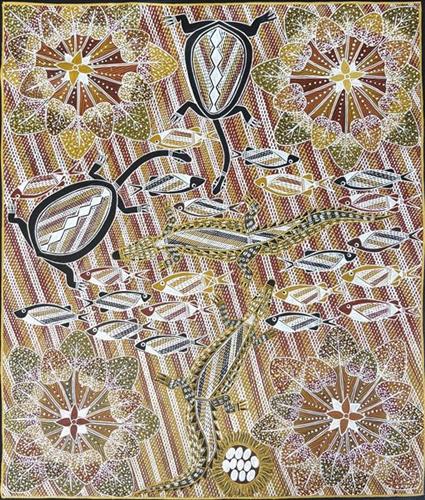
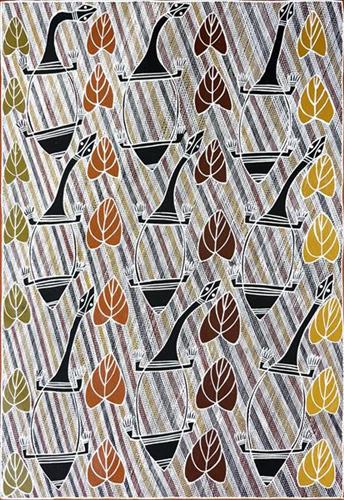
Ganalbingu – Banda (Long Necked Turtle)

The long necked turtle is a dreaming totem for the freshwater people, the Ganalbingu, whose country includes the World Heritage listed, Arafura Wetlands in Central Arnhem Land, Northern Territory

The Yolngu (people) of Arnhem Land originate from a spiritual source, fixed in a particular place in their land or the sea. These ‘Spiritual Reservoirs’ are often in the form of special waterholes made by Wangga (Creator Beings), long ago close to the beginning of time. These creator beings moved across the country side, shaping the land and implanting in each tract of country, the spiritual life force for the people who were to own it.

These creator spirits took many forms. When they gave the land to each group they also gave songs, dances, ceremony, the associated laws and language. The Creation story for Ganalbingu people took place near the middle section of the Glyde River where it becomes the Goyder River. Their land, Ngaliyindi, sits astride the Arafura Swamp in Central Arnhem Land. Some of their major Creative Beings include Banda (freshwater long neck turtle) and Yalman (water lilies).

220982370924


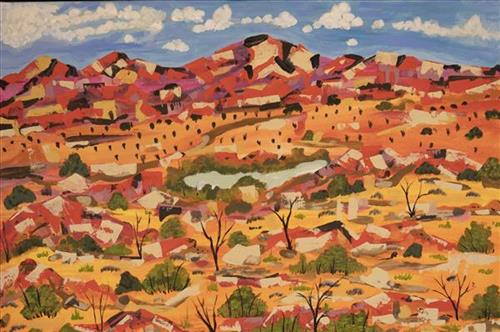
Elizabeth Ngwarraye Bonney – After the Bushfire

This is the soakage (place to dig to find water) after the bushfire, made by a lightning strike. It burnt the grass down, then the rain came and the grass grows sweet and new. The kangaroos come out for the new grass, so we can go hunting for kangaroos and goannas, it is easy hunting because the land is bare of bush and we can see them

220982370915


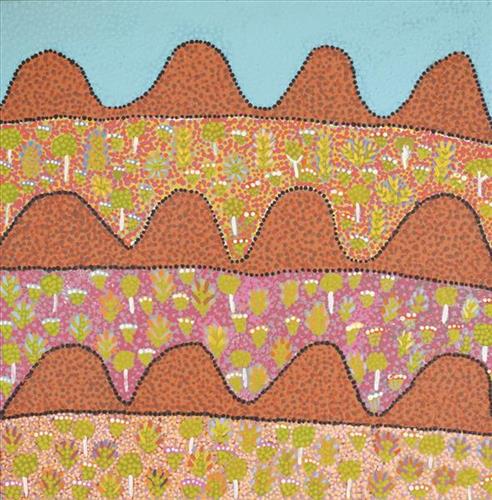
My Country after Apangw (Big Rain)

“This is country after we’ve had apangw (big rain). The new grasses are coming up and the water is flowing.”

Kwatcha (water) is a valuable and a much revered resource when living out in the desert. The earth responds with vibrant joyful greens after just one downpour. All life out here celebrates to the music of rain.

The community of Ampilatwatja made a conscious decision not to paint altyerr (dreaming stories). The artists paint their country where those stories sit.

220282371101


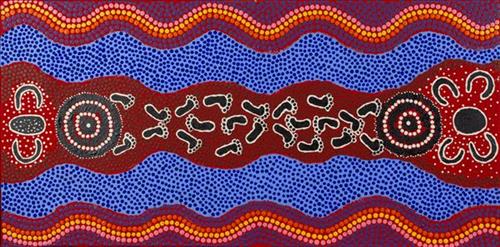
Two Tjangalas

“Two Tjangalas who travelled from North to South, from Tjantuwari Watiyawanu-one to Mount Leibig Watiyawanu-two. The Tjantuwari Watiyawanu-one place is east of Mt Theo/Mt Patricia. They travelled from North, came to Tjantuwari Watiyawanu-one to Mount Leibig, Watiyawanu-two. Came and collected all the seeds. As you can see the people sitting, and the circle, means that’s where their main place and the camp is, The Tjantuwari Watiyawanu-one. You can see the tracks from the two tjanagalas travelling North. The second circle, with the two people, is the main community, the camp, the place, Mount Leibig Watiyawanu-two. They have been collecting seeds. They remain there in Watiyawanu-two, Mount Leibig, as two trees. The wavy blue is the creeks, they have been travelling a long distance, through Tali, Karru, Puli, Tjata, Tjanpi, Watiya, everything. Seeing places. Travelling. And they stopped and ended up in Watiyawanu-two, Mount Leibig. Two Tjangalas.” – Joyce Dixon

115682371033


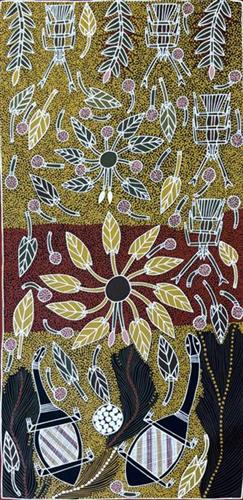
Raypiny Dhawu (Fresh Water Story)

All Aboriginal people originate from a spiritual source, fixed in a particular place in their land or the sea. These ‘spiritual reservoirs’ are often in the form of special waterholes made by Wangarr (creative spirits) that were created long ago close to the beginning of time. These creator beings moved across the countryside, shaping the land and implanting in each tract of country, the spiritual life force for the people who were to own it. These creative spirits took many forms and when they gave the land to each group, they also gave songs, dances, ceremony, the associated laws and language.


The creation story for Ganalbingu people took place near the middle section of the Glyde River where it becomes the Goyder River. Their land, Ngaliyindi, sits astride the Arafura Swamp in Central Arnhem Land. Many Ganalbingu artists paint totemic species significant to their clan. These can include baru (crocodile), banda (long necked turtle), buliya (catfish), yalman (waterlilies), gumang (magpie geese), dakawa (fresh water yabby), ratjuk (barramundi), warrnyu (flying fox) and more.


115682370990


Raypiny Dhawu (Fresh Water Story)

All Aboriginal people originate from a spiritual source, fixed in a particular place in their land or the sea. These ‘spiritual reservoirs’ are often in the form of special waterholes made by Wangarr (creative spirits) that were created long ago close to the beginning of time. These creator beings moved across the countryside, shaping the land and implanting in each tract of country, the spiritual life force for the people who were to own it. These creative spirits took many forms and when they gave the land to each group, they also gave songs, dances, ceremony, the associated laws and language.


The creation story for Ganalbingu people took place near the middle section of the Glyde River where it becomes the Goyder River. Their land, Ngaliyindi, sits astride the Arafura Swamp in Central Arnhem Land. Many Ganalbingu artists paint totemic species significant to their clan. These can include baru (crocodile), banda (long necked turtle), buliya (catfish), yalman (waterlilies), gumang (magpie geese), dakawa (fresh water yabby), ratjuk (barramundi), warrnyu (flying fox) and more.


115682372319


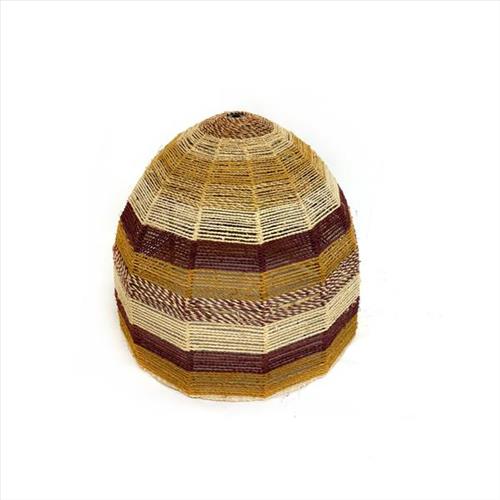
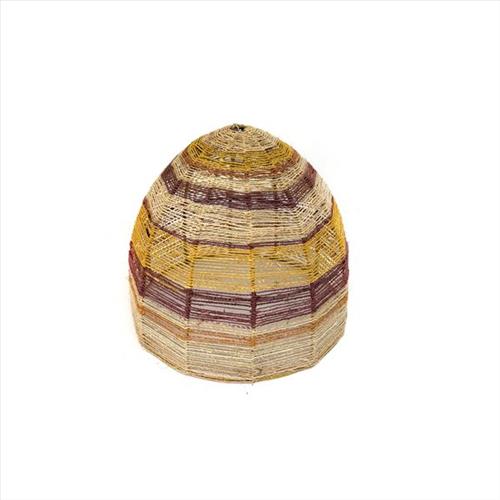
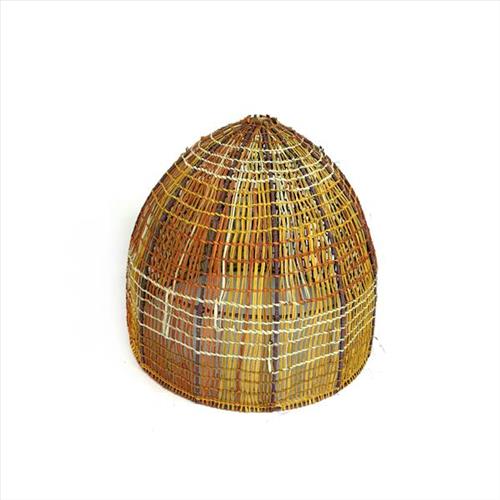
Koskela Lampshade

This beautiful lampshade is made with traditional Bush string made from the fibres between the bark and the trunk of the kurrajong tree. Once harvested from the jungle the fibres are dyed with roots, barks, leaves or fruits making the natural dyes. They are then rolled into this strong symmetrical handmade string and woven and knotted using techniques which originally bound together traditional Yolngu objects such as string bags and fishing nets and traps and used to make handles for carrying woven bags or used in ceremonial objects.

The weavers of Ramingining in Northeast Arnhem Land usually create traditional ceremonial and ritual objects working together as a group to harvest materials and develop work yet each with their own contemporary colourful and unique designs. This is one of the first times they have embraced making objects which are not traditional Yolngu objects and the strength of their identity as late career Yolngu Artists is distilled in these lampshades.

Exquisite craftsmanship manually transferred from Grandmothers, Mothers and Aunties is used to create these stunning lampshades which look amazing with lighting projecting the rhythms and patterns or without lighting to appreciate the colour, the intricacies and detail of the design.

115682372187


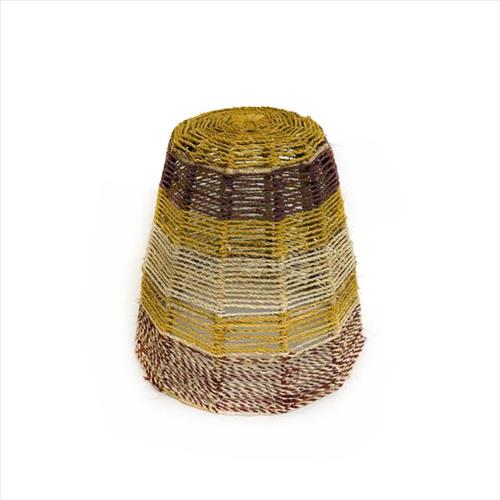
Koskela Lampshade

This beautiful lampshade is made with traditional Bush string made from the fibres between the bark and the trunk of the kurrajong tree. Once harvested from the jungle the fibres are dyed with roots, barks, leaves or fruits making the natural dyes. They are then rolled into this strong symmetrical handmade string and woven and knotted using techniques which originally bound together traditional Yolngu objects such as string bags and fishing nets and traps and used to make handles for carrying woven bags or used in ceremonial objects.

The weavers of Ramingining in Northeast Arnhem Land usually create traditional ceremonial and ritual objects working together as a group to harvest materials and develop work yet each with their own contemporary colourful and unique designs. This is one of the first times they have embraced making objects which are not traditional Yolngu objects and the strength of their identity as late career Yolngu Artists is distilled in these lampshades.

Exquisite craftsmanship manually transferred from Grandmothers, Mothers and Aunties is used to create these stunning lampshades which look amazing with lighting projecting the rhythms and patterns or without lighting to appreciate the colour, the intricacies and detail of the design.

115682372173


Koskela Lampshade

This beautiful lampshade is made with traditional Bush string made from the fibres between the bark and the trunk of the kurrajong tree. Once harvested from the jungle the fibres are dyed with roots, barks, leaves or fruits making the natural dyes. They are then rolled into this strong symmetrical handmade string and woven and knotted using techniques which originally bound together traditional Yolngu objects such as string bags and fishing nets and traps and used to make handles for carrying woven bags or used in ceremonial objects.

The weavers of Ramingining in Northeast Arnhem Land usually create traditional ceremonial and ritual objects working together as a group to harvest materials and develop work yet each with their own contemporary colourful and unique designs. This is one of the first times they have embraced making objects which are not traditional Yolngu objects and the strength of their identity as late career Yolngu Artists is distilled in these lampshades.

Exquisite craftsmanship manually transferred from Grandmothers, Mothers and Aunties is used to create these stunning lampshades which look amazing with lighting projecting the rhythms and patterns or without lighting to appreciate the colour, the intricacies and detail of the design.

115682372172


Koskela Lampshade

This beautiful lampshade is made with pandanus. Once harvested from the jungle, the fibres are dyed with roots, barks, leaves or fruits making the natural dyes. 

The weavers of Ramingining in Northeast Arnhem Land usually create traditional ceremonial and ritual objects working together as a group to harvest materials and develop work yet each with their own contemporary colourful and unique designs. This is one of the first times they have embraced making objects which are not traditional Yolngu objects and the strength of their identity as late career Yolngu Artists is distilled in these lampshades.

Exquisite craftsmanship manually transferred from Grandmothers, Mothers and Aunties is used to create these stunning lampshades which look amazing with lighting projecting the rhythms and patterns or without lighting to appreciate the colour, the intricacies and detail of the design.