221382406857


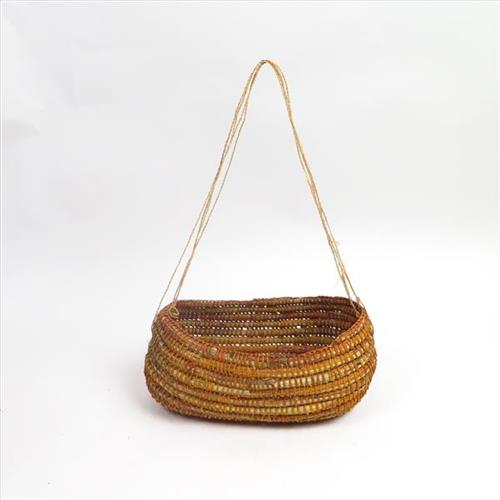
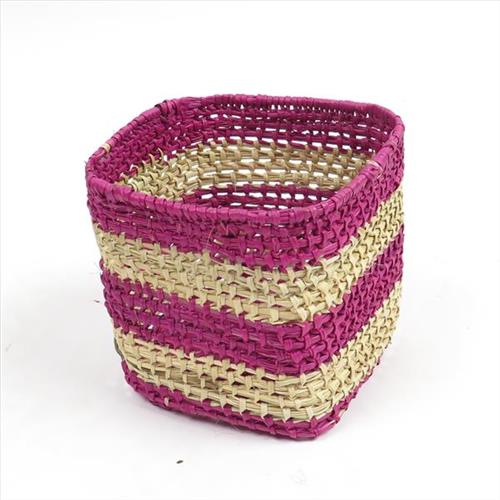
Woven basket


Pandanus fibre art is labour intensive requiring a high level of care and fine needlework. Finished works are both functional and beautiful. Women collect pandanus by pulling from the top of a pandanus tree, stripping then dying the leaves using natural bush colour.

221382406856


Bush Utensil Holder


Pandanus fibre art is labour intensive requiring a high level of care and fine needlework. Finished works are both functional and beautiful. Women collect pandanus by pulling from the top of a pandanus tree, stripping then dying the leaves using natural bush colour.

221382406855


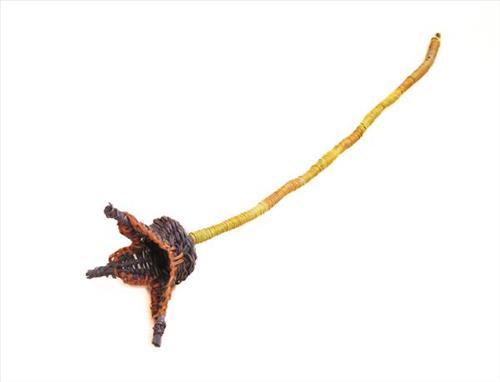
Woven flower


Pandanus fibre art is labour intensive requiring a high level of care and fine needlework. Finished works are both functional and beautiful. Women collect pandanus by pulling from the top of a pandanus tree, stripping then dying the leaves using natural bush colour.

221382406851


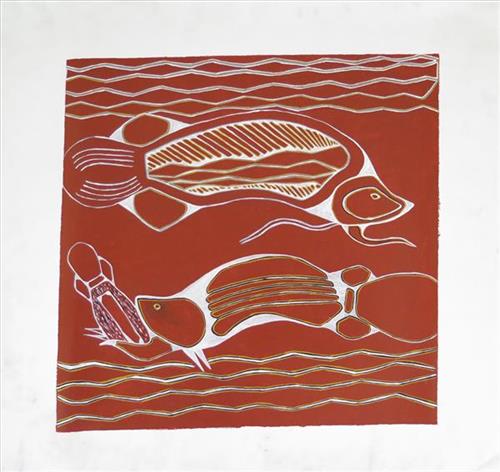
Freshwater barramundi and saltwater barramundi

Djilpin Arts is a not for profit Aboriginal Corporation that promotes the maintenance, development and transmission of traditional cultural knowledge systems.

For two decades, Djilpin Arts has been working on country with kin and culture, across generations. Our activities are rich in spirit, bringing, healing to the community and linking traditional knowledge with modern enterprise. Our Centre features galleries, museum collection and award winning accommodation for visitors.

Meet local people and artists, learn about traditional life and culture, browse and buy artworks, stay with us and experience seasonal cultural events, tours and immersions.

All artworks are made by local artists living in the community. Artwork reflects the traditional songs and stories that have been passed down through the generations with a contemporary edge: from paintings, prints, fibre art, carvings and dijeridu together to contemporary design prducts and fine woven wire jewellery.
221382406848


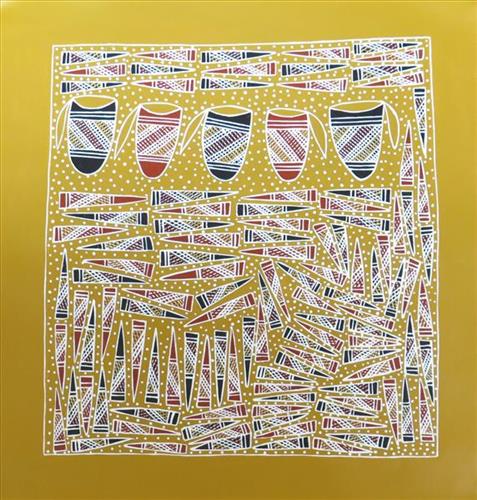
Dimbuka and stone spears

This painting represents five dimbuka dilly bags surrounded by many stone spears. It is a Wägilak story.

Djilpin Arts is a not for profit Aboriginal Corporation that promotes the maintenance, development and transmission of traditional cultural knowledge systems.

For two decades, Djilpin Arts has been working on country with kin and culture, across generations. Our activities are rich in spirit, bringing, healing to the community and linking traditional knowledge with modern enterprise. Our Centre features galleries, museum collection and award winning accommodation for visitors.

Meet local people and artists, learn about traditional life and culture, browse and buy artworks, stay with us and experience seasonal cultural events, tours and immersions.

All artworks are made by local artists living in the community. Artwork reflects the traditional songs and stories that have been passed down through the generations with a contemporary edge: from paintings, prints, fibre art, carvings and dijeridu together to contemporary design prducts and fine woven wire jewellery.
221382406842


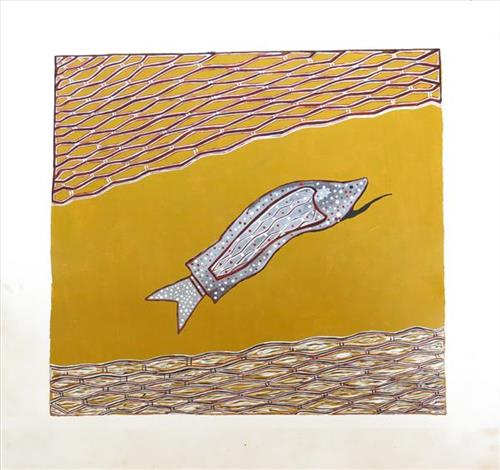
Barramundi between saltwater and reshwater

The painting represents a barramundi in the sand between the rough saltwater at the bottom and the quieter, more clear freshwater at the top. This barramundi travels to the saltwater for food and then returns to the freshwater afterwards.

Djilpin Arts is a not for profit Aboriginal Corporation that promotes the maintenance, development and transmission of traditional cultural knowledge systems.

For two decades, Djilpin Arts has been working on country with kin and culture, across generations. Our activities are rich in spirit, bringing, healing to the community and linking traditional knowledge with modern enterprise. Our Centre features galleries, museum collection and award winning accommodation for visitors.

Meet local people and artists, learn about traditional life and culture, browse and buy artworks, stay with us and experience seasonal cultural events, tours and immersions.

All artworks are made by local artists living in the community. Artwork reflects the traditional songs and stories that have been passed down through the generations with a contemporary edge: from paintings, prints, fibre art, carvings and dijeridu together to contemporary design prducts and fine woven wire jewellery.
This painting represents five dimbuka dilly bags surrounded by many stone spears. It is a Wägilak story.

Djilpin Arts is a not for profit Aboriginal Corporation that promotes the maintenance, development and transmission of traditional cultural knowledge systems.

For two decades, Djilpin Arts has been working on country with kin and culture, across generations. Our activities are rich in spirit, bringing, healing to the community and linking traditional knowledge with modern enterprise. Our Centre features galleries, museum collection and award winning accommodation for visitors.

Meet local people and artists, learn about traditional life and culture, browse and buy artworks, stay with us and experience seasonal cultural events, tours and immersions.

All artworks are made by local artists living in the community. Artwork reflects the traditional songs and stories that have been passed down through the generations with a contemporary edge: from paintings, prints, fibre art, carvings and dijeridu together to contemporary design prducts and fine woven wire jewellery.
115682406824


Bäru Dhäwu (Crocodile Story)

Bäru (the crocodile man), was from the Gumatj clan. People usually call him Gurdu Gurdu or Bäru which means crocodile. He lived his life at a place called Yirrkala. Living near him were other people, and when Bäru didn’t have enough to eat he began to kill and eat these other people. After a while others noticed that some people were missing. When Bäru went to the toilet, the people could smell this strong smell, so they knew that he ate the other people. Some men went to get help and they took message sticks to the other tribes. Some were sending smoke signals. When they came to Bäru’s camp they started to spear him in the left side of his ribs. He dropped into the fire and burnt his left hand and maybe his right hand. He then ran into the bush and yelled to his countrymen – the animals, birds and fish that live on the land and in the sea. He stopped and he named the tribes and clans and also the places until he came to a place called Gamarru/Guyurru. There he took a rest and said to himself “This is where I stop and call this place Gamarru/Guyurru”. Bäru, still in pain from the fire, then jumped into the water and turned himself into a crocodile. The fire left scars on his back. Bäru paintings belong to Gumatj and Warrawarra and also the Marpi clan. This painting is used at death ceremonies or initiations and it normally is painted on the belly, which means the person the design is painted on is part of Gurdu Gurdu (the crocodile people).

115682406818


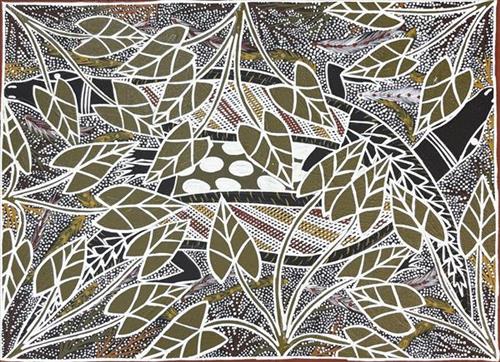
Lorrpu ga Marrngu in the Mayku tree

This painting depicts Lurrpu (Sulphur-crested cockatoo) and Marrngu (possum) in a Mayku Tree (Paper Bark Tree) and is a song line for the Gupapuyngu people. In the song line the Lurrpu feed on nuts and seeds of the Mayku Tree across the vast landscapes of Arnhem Land.

377815582407063


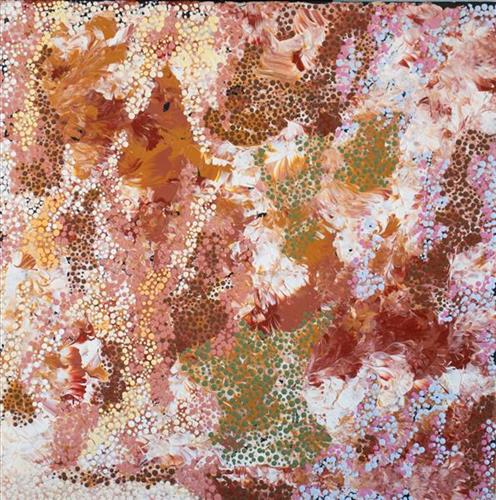
Country

“My mother’s, my great-grandmother’s and my grandfather’s Country. When we go out on Country, you can feel Country — and Country feels you. I feel blessed for such a beautiful Country. It’s emotional, hearing stories about my old people.

I love painting desert colours because that’s where our old people were walking around and were born — hunting and camping. I feel good painting Country. I like hearing the stories and painting about it.”
– Jessica Jadai

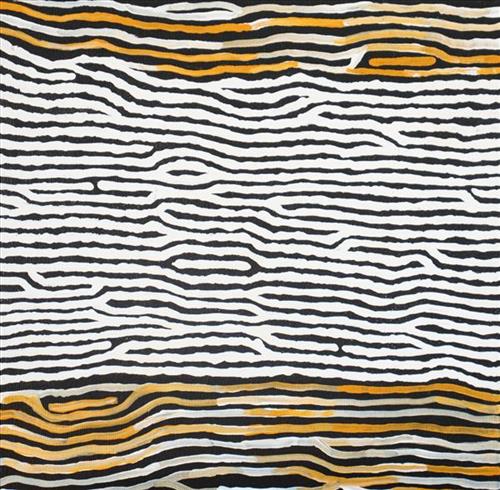
This artwork shares the story of Kulyakartu, a vast and peaceful area north-east of the community, on the edge of Nyangumarta and Martu Country. Kulyakartu is a place of wide open skies, long claypans, sandhills and soft grasses that come alive after rain.

Families remember camping there, visiting waterholes, looking for goanna and bush foods, watching birds, and travelling with old people who knew every dune, track and soak. The painting celebrates the beauty and calm of Kulyakartu, often shown through soft lines and dots that follow the movement of water and sand. It honours the knowledge of where to find water, how to move across Country, and the deep belonging felt when returning to ancestral places.

Through this work, the artist invites viewers to feel that stillness and connection — the strength of Country, memory and family.

This artwork honours Mangala Country and the families who carry its stories — walking, camping, hunting and gathering across desert edges, river systems and claypans. It remembers old people moving between soaks and sandhills, and later travelling to La Grange Mission (now Bidyadanga), keeping language, law and family strong.

Patterns trace tracks of animals and people; dots and lines follow water after rain; maps, camps, soaks and sandhills. The work also reflects the way caring for Country continues today — through ranger work and community leadership that bring together cultural knowledge and science to look after land and water.

377815582407056


Mangala Country

“Mangala Country is in the Great Sandy Desert area, stretching to the river near and along the Liveringa River, and into the other part of the Martuwarra, near Udialla. The white in the painting represents the sacredness of my Mangala Country. I never met my grandfather, Mr Jadai — my mother’s father — but I’ve heard many stories of him. Even though he’s not with us in the physical, I can feel him and all my Mangala family when I go out on Country and when I paint our Mangala Country.”
 – Nuriah Jadai

This artwork honours Mangala Country and the families who carry its stories — walking, camping, hunting and gathering across desert edges, river systems and claypans. It remembers old people moving between soaks and sandhills, and later travelling to La Grange Mission (now Bidyadanga), keeping language, law and family strong.

Patterns trace tracks of animals and people; dots and lines follow water after rain; maps, camps, soaks and sandhills. The work also reflects the way caring for Country continues today — through ranger work and community leadership that bring together cultural knowledge and science to look after land and water.