114182412947


Rosie – Winboll Rockhole


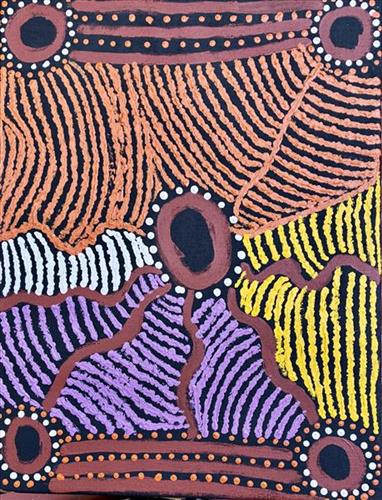
Rosie paints the land that birthed her: the sacred Winboll Rockhole, a place cradled on the far western side of Mantamaru (Jameson) a place where ancient waters sleep beneath the earth and stories from time immemorial breathe through the stones.

Rosie brings to life the rhythm of her birthplace, a land where sunlight dances upon the rocks and whispers of ancestors float on the wind. Her work is a glimpse into the heart of Winboll Rockhole, a land woven with mystery.


Dimensions: 38 x 38cm

114182412943


Rosie – Winboll Rockhole

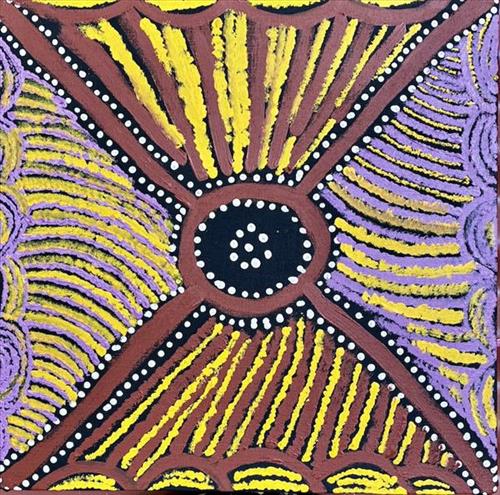
Rosie paints the land that birthed her: the sacred Winboll Rockhole, a place cradled on the far western side of Mantamaru (Jameson) a place where ancient waters sleep beneath the earth and stories from time immemorial breathe through the stones.

Rosie brings to life the rhythm of her birthplace, a land where sunlight dances upon the rocks and whispers of ancestors float on the wind. Her work is a glimpse into the heart of Winboll Rockhole, a land woven with mystery.


Dimensions: 38 x 38cm

114182413392


Kungkarrangkalpa (Seven Sisters)

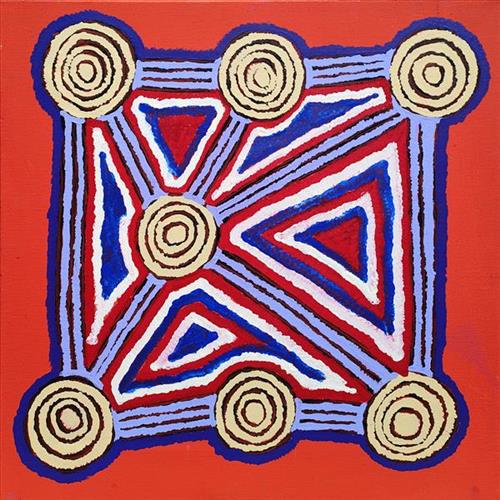
‘Kungkarrangkalpa’ (The Seven Sisters or Pleaides) is significant Tjukurrpa (dreamtime). Its origins you may be familiar with in astronomy and its connection to ‘Wati Nyiru’ (Magic Man or Orion).  The roots of this dreaming stems across indigenous groups around the world. The Australian Aboriginal songline is one part to the whole dreaming which can be traced all around the world. The ladies of the Ngaanyatjarra Lands depict their significant chapter and understanding of the journey of the sisters. The different versions of this story depend on where you live and the significance’s of local Tjukurrpa places.

Nyiru fell in love with the sisters but he was of the wrong skin group to marry, but he still pursued them on their journey. The sisters travel across the land to escape Nyiru’s unwanted attentions, but he is persistent and always finds them. There are significant land forms which can be sited today that evidence this dreaming. As Nyiru is chasing the sisters he tries to catch them by using magic to turn into the most tempting kampurarrpa (bush tomato) and the most beautiful Yirli (wild fig tree), for them to eat and camp under. However, the sisters are knowledgeable of his magic and too clever for Nyiru who they outwit again and again. They go hungry and run through the night rather than be caught by him. As the journey continues, Nyiru gets so frustrated at the wit of the sisters that he uses his magic to make the oldest sister sick to try and get closer to her. The other sisters rescue the big sister and nurse her back to health. It is said he also captures the youngest sister, but with the help of the oldest sister, she escapes back to her sisters who are waiting for her. Eventually, the sisters fly into the sky to escape Nyiru, forming the constellation. Nyiru felt lonely, longing for the sisters who were so far away. Nyiru used his magic to go to the sky, forever in pursuit.

Kakalyalya (white cockatoo)


Dimensions: 61 x 61cm

114182418271


Kungkarrangkalpa (Seven Sisters)

‘Kungkarrangkalpa’ (The Seven Sisters or Pleaides) is significant Tjukurrpa (dreamtime). Its origins you may be familiar with in astronomy and its connection to ‘Wati Nyiru’ (Magic Man or Orion).  The roots of this dreaming stems across indigenous groups around the world. The Australian Aboriginal songline is one part to the whole dreaming which can be traced all around the world. The ladies of the Ngaanyatjarra Lands depict their significant chapter and understanding of the journey of the sisters. The different versions of this story depend on where you live and the significance’s of local Tjukurrpa places.

Nyiru fell in love with the sisters but he was of the wrong skin group to marry, but he still pursued them on their journey. The sisters travel across the land to escape Nyiru’s unwanted attentions, but he is persistent and always finds them. There are significant land forms which can be sited today that evidence this dreaming. As Nyiru is chasing the sisters he tries to catch them by using magic to turn into the most tempting kampurarrpa (bush tomato) and the most beautiful Yirli (wild fig tree), for them to eat and camp under. However, the sisters are knowledgeable of his magic and too clever for Nyiru who they outwit again and again. They go hungry and run through the night rather than be caught by him. As the journey continues, Nyiru gets so frustrated at the wit of the sisters that he uses his magic to make the oldest sister sick to try and get closer to her. The other sisters rescue the big sister and nurse her back to health. It is said he also captures the youngest sister, but with the help of the oldest sister, she escapes back to her sisters who are waiting for her. Eventually, the sisters fly into the sky to escape Nyiru, forming the constellation. Nyiru felt lonely, longing for the sisters who were so far away. Nyiru used his magic to go to the sky, forever in pursuit.


Dimensions: 61 x 61cm

377815582418498


Kulyakartu

“I paint about Kulyukartu. It’s my grandmother’s Country. I love painting about that Country. I went on a trip doing fire burning, cleaning the waterholes, and walking around looking where my grandmothers carved the rocks and things. I went with my mum Emily, and SJ (Nuriah Jadai). You turn before 80 Mile Beach and just go straight.

I feel good when I’m there — it feels like home when I paint it. I learnt to paint from my grandfather (Wokka Taylor, dec.). When we went to 33 (Kunawarritji, Well 33) and back to Punmu, we were just watching them. He told me to get a brush, and then he told me to start painting. I think him and Dunjan (Thelma Judson) were painting a big one, and I came to help him. He told me, ‘One day you should go to Kulyukartu,’ and so I went there.”
 – Kiarah Mandijalu-Jadai

This artwork shares the story of Kulyakartu, a vast and peaceful area north-east of the community, on the edge of Nyangumarta and Martu Country. Kulyakartu is a place of wide open skies, long claypans, sandhills and soft grasses that come alive after rain.

Families remember camping there, visiting waterholes, looking for goanna and bush foods, watching birds, and travelling with old people who knew every dune, track and soak. The painting celebrates the beauty and calm of Kulyakartu, often shown through soft lines and dots that follow the movement of water and sand. It honours the knowledge of where to find water, how to move across Country, and the deep belonging felt when returning to ancestral places.

Through this work, the artist invites viewers to feel that stillness and connection — the strength of Country, memory and family.


Dimensions: 36 x 46cm

377815582418496


Desert to the Sea

“I paint from the desert to the sea. I like doing the little details like the plants. I paint my Grandfather’s and Father’s Country – Nyangumarta and Kulyakartu. I’ve been to both places. I used to go out on the weekend with my dad and grandmother and grandfather to go hunting on Nyangumarta Country. Last year I went out to Kulyakartu with my grandfather, on his Country to see where he, his family and extended family used to walk in the desert. I love being out on Country. When I get the chance, it makes me feel good.”
 – Augustine Junior Badal

This artwork reflects the artist’s connection to Bidyadanga, a place where the desert meets the sea. Through colour, pattern, and texture, the painting captures important themes that shape the identity of the community and Art Centre.

Bidyadanga sits on Karajarri Country, where desert Country meets saltwater Country. The community is home to Karajarri people and to desert families who travelled from the Great Sandy Desert to La Grange Mission in the 1960s and 70s, during a time when drought and changing conditions dried desert water sources. The first five language groups to build the community together were Nyangumarta, Mangala, Yulparija, Juwaliny and Karajarri. Today, Bidyadanga continues to grow, welcoming families from across the Kimberley, Pilbara and beyond, creating a strong and diverse cultural community.

Artists draw on stories of place, family, movement, and survival — caring for both land and sea, hunting and fishing, and living between two immense environments. Patterns, marks, and flowing forms echo desert dunes, waterholes, tidal flats, reefs, bushfoods, and sea life, honouring the knowledge held across generations.

In this work, the artist celebrates the beauty of Country and community, offering a glimpse into the rich histories, cultural strength, and enduring connection to land, sea, and way of life.


Dimensions: 36 x 46cm

377815582418489


Canning Stock Route Area

“This painting is about waterholes in the desert where the old people used to walk from waterhole to waterhole in the Canning Stock Route area. All the colours represent the different wildflowers and the brown is the sand dunes. The circles represent different waterholes.”
 – Bibianna Tumbler

This artwork reflects the histories and journeys along the Canning Stock Route, a place where desert families walked, camped, hunted and gathered long before the line of wells was made. For Bidyadanga artists whose families travelled this Country, the Stock Route is remembered not as a road, but as a pathway of life — water soaks, claypans, sandhills, stories and camps passed down through generations.

The painting holds memories of living waterholes (jila), spinifex plains and salt lakes, places where families met, rested, shared food and continued on. It also speaks to the changes brought with the drovers — movement from desert to mission, cultural resilience, and the strength of families who carried language, story and law across the land.

Patterns, dots and flowing lines reflect walking tracks, dunes, waters and landmarks across Nyangumarta, Mangala and Martu Country. In this work, the artist honours the old people who travelled with nothing but knowledge, and celebrates their legacy — the strength of culture that continues today.


Dimensions: 46 x 76cm

377815582418487


Nyangumarta Warrarn (Country)

“This painting represents the rocky outcrop and all the different areas of claypans, and the dark area represents all the jurnga (sands) in the cool time, warri. All the light yellowish colour represents the paru (spinifex).

I like to go out working with the rangers and all the elders. I go out Country with them and they show me all the places, all mapped out with GPS. We mark out all the other places for next time. Sometimes I go out in the ranger’s vehicle and walk around the Country and look around for goanna holes. We try to keep an eye on the animals, look out for all the bilby and skinks and everything with the Nyangumarta Rangers. I go in my spare time because I’m busy you know, I’m busy with my artwork and council meetings.

In the cool dry time, when it’s a little bit warm and cool in the morning, that’s when we do the fire patch burning. When we doing it also depends on the wind, the warngal, which way it’s blowing. We do that because it’s a big part of controlled fires. Wild fires, we don’t want them, they destroy the animals and their living area, destroy the Country. We do it too for the regrowth. When I went back to Country a couple of weeks ago, all the burned up area had a little bit of regrowth after a little bit of rain.”
 – Edward Badal

This artwork honours Nyangumarta Country — from the long sweep of Eighty Mile Beach and coastal flats to the rolling sand dunes and salt lakes of the Great Sandy Desert. It holds the movement between saltwater and desert: tides, reefs and mangroves to the west; dunes, claypans and waterholes to the east.

Lines flow like wind across spinifex and waves in the ocean; dots gather where waters sit after rain; colours shift from deep blues to desert reds and whites of saltpan. The painting also reflects the ongoing work of Nyangumarta families and rangers to look after Country — sea and land — guided by community plans and Indigenous Protected Area management.


Dimensions: 36 x 76cm

377815582418486


Dry Season

“This painting is about the dry, when spinifex, the native plants and the Country gets dry. When the rain comes it makes the Country green again. Some animals love dry season for hunting. Sometimes we go hunting for animals for our families.”
 – Edward Badal

This artwork reflects the changing seasons across Country, showing how life shifts with the dry and wet. In Bidyadanga and the surrounding desert and coastal lands, the rhythm of the year guides movement, gathering, hunting, and time spent with family on Country.

As the dry season arrives, the land opens up again — red dunes, salt flats, and long beaches shining in the heat. Winds change, tides get bigger, and rangers burn Country to look after it, clearing grass, making space for new growth, and keeping the land healthy. Bush turkeys, goannas, fish, stingray, turtle, and shellfish are hunted, and families camp, share stories, and travel between desert and coast.

When the wet season return, big clouds roll in, storms build over the sea, and lightning cracks across the land. Country comes alive — water fills the waterholes and claypans, flowers and grasses grow, and birds, bush foods, and animals become abundant.

Through colour, pattern, and rhythm, the artist captures the cycle of seasons and the knowledge passed down — knowing when to gather certain foods, when animals are fat, when storms are coming, and how to care for Country through fire and everyday living. The work celebrates the constant relationship between people, weather, land, and sea, honouring the strength and continuity of cultural life.


Dimensions: 36 x 76cm

377815582418481


Seasons

Tracey Thomas

Seasons or Spinifex – Tracey Thomas

“Yellow is for the fruits when they’re ripe, and blue is for the water.
This time I’m going to do one for the hot time – like red and orangey colour for the burning.”

– Tracey Thomas

This artwork reflects the changing seasons across Country, showing how life shifts with the dry and wet. In Bidyadanga and the surrounding desert and coastal lands, the rhythm of the year guides movement, gathering, hunting, and time spent with family on Country.

As the dry season arrives, the land opens up again — red dunes, salt flats, and long beaches shining in the heat. Winds change, tides get bigger, and rangers burn Country to look after it, clearing grass, making space for new growth, and keeping the land healthy. Bush turkeys, goannas, fish, stingray, turtle, and shellfish are hunted, and families camp, share stories, and travel between desert and coast.

When the wet season return, big clouds roll in, storms build over the sea, and lightning cracks across the land. Country comes alive — water fills the waterholes and claypans, flowers and grasses grow, and birds, bush foods, and animals become abundant.

Through colour, pattern, and rhythm, the artist captures the cycle of seasons and the knowledge passed down — knowing when to gather certain foods, when animals are fat, when storms are coming, and how to care for Country through fire and everyday living. The work celebrates the constant relationship between people, weather, land, and sea, honouring the strength and continuity of cultural life.


Dimensions: 36 x 76cm