115682367206


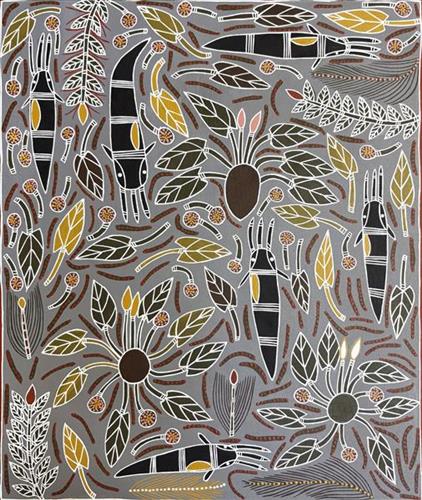
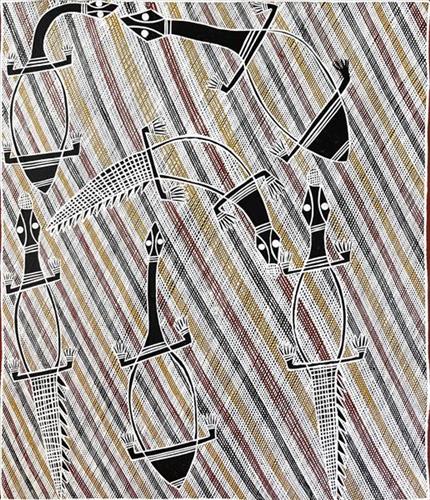
Ganalbingu – Banda (Long Necked Turtle)

The long necked turtle is a dreaming totem for the freshwater people, the Ganalbingu, whose country includes the World Heritage listed, Arafura Wetlands in Central Arnhem Land, Northern Territory

The Yolngu (people) of Arnhem Land originate from a spiritual source, fixed in a particular place in their land or the sea. These ‘Spiritual Reservoirs’ are often in the form of special waterholes made by Wangga (Creator Beings), long ago close to the beginning of time. These creator beings moved across the country side, shaping the land and implanting in each tract of country, the spiritual life force for the people who were to own it.

These creator spirits took many forms. When they gave the land to each group they also gave songs, dances, ceremony, the associated laws and language. The Creation story for Ganalbingu people took place near the middle section of the Glyde River where it becomes the Goyder River. Their land, Ngaliyindi, sits astride the Arafura Swamp in Central Arnhem Land. Some of their major Creative Beings include Banda (freshwater long neck turtle) and Yalman (water lilies).

220982367568


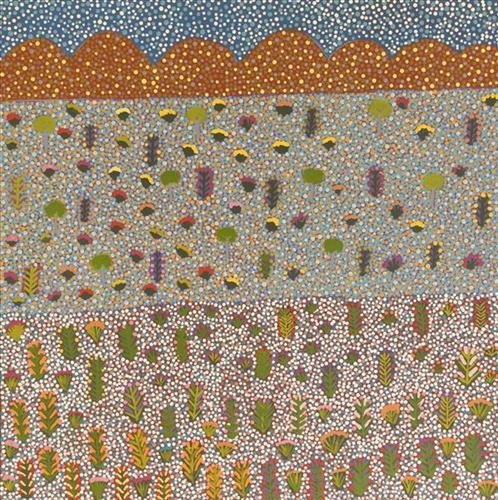
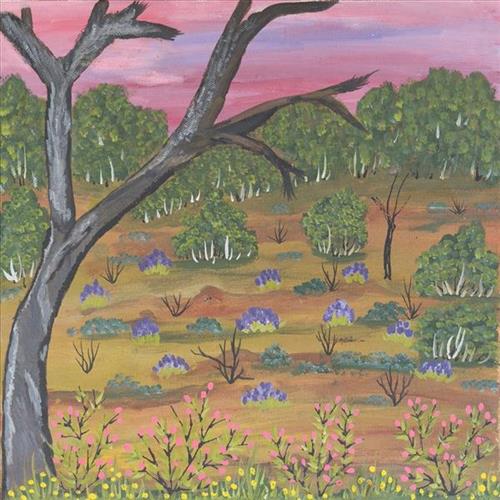
Elizabeth Ngwarraye Bonney – After the Bushfire

This is the soakage (place to dig to find water) after the bushfire, made by a lightning strike. It burnt the grass down, then the rain came and the grass grows sweet and new. The kangaroos come out for the new grass, so we can go hunting for kangaroos and goannas, it is easy hunting because the land is bare of bush and we can see them

115682367479


Raypiny Dhawu (Fresh Water Story)

All Aboriginal people originate from a spiritual source, fixed in a particular place in their land or the sea. These ‘spiritual reservoirs’ are often in the form of special waterholes made by Wangarr (creative spirits) that were created long ago close to the beginning of time. These creator beings moved across the countryside, shaping the land and implanting in each tract of country, the spiritual life force for the people who were to own it. These creative spirits took many forms and when they gave the land to each group, they also gave songs, dances, ceremony, the associated laws and language.


The creation story for Ganalbingu people took place near the middle section of the Glyde River where it becomes the Goyder River. Their land, Ngaliyindi, sits astride the Arafura Swamp in Central Arnhem Land. Many Ganalbingu artists paint totemic species significant to their clan. These can include baru (crocodile), banda (long necked turtle), buliya (catfish), yalman (waterlilies), gumang (magpie geese), dakawa (fresh water yabby), ratjuk (barramundi), warrnyu (flying fox) and more.


115682367477


Warrnyu Dhawu (Flying Fox Story)

Back in the Creation time, Warrnyu (Flying Foxes) once lived, like men, in the cave at the place called Kurrki Warrnyu Yirri Djaringal (they also lived in caves called Wadatilmurr & Gurngurmirrngu). Warrnyu lived in these caves for many years and then one day Djanyarr (The Dog), an ancestral being in the form of a man, came along. He was looking around for a place to live. Djanyarr heard the sound of a Flying Fox screaming. He went down to the cliff and pushed the rock and the water came out at the Ganalbingu place called Gurrkawakarrmurr. He then went into the cave and into the sacred hole, frightening all the Flying Fox away. When he went into the hole he left his dilly bag in the tree and went out on the other side of the sacred cave and leaving his spear and woomera. He sat there for a long time. The Dog made three streams and the water went inside the cave. Two of these streams are good drinking water. In the middle it is a sacred water. No-one drinks from the middle of the stream. Children, men, women, young boys or girls are not allowed to drink from the middle of the stream. If they drink the water from the middle of the stream they will go grey too early.

At Kurrki Warrnyu Yirri Ngilaya Djaringal, the Flying Fox made himself into a young man… that’s what Aboriginal people do today. They have ceremonies and dances to make the young boys into men. The songs are called Yirrarwu, Gulumu, Rruburra and Burryun. Dhapi (initiation ceremony) happen today because the Warrnyu (Flying Fox) people performed them a long time ago before the Yolngu people. It was the Warrnyu people who first performed circumcision of the young boys to make them into men. It all happened at Kurrki Warrnyu Yirri Ngilaya Djaringal, this is how this place got its name.

Leaving behind the cave at Kurrki Warrnyu Yirri Djaringal, the Dog travelled west across the Arafura Swamp and came to Djalkulmurr (Mount Delight). From there he travelled north and came to Dunganda (a hill situated a few kilometres east of Ramingining). There he met a female Dog, then they both headed north and came to a place called Garanydjirrmurr where they spoke the Mildjingi language. From Garanydjirrmurr they changed their direction and went west through Guliny’barra, Burgumara and onto the plains. When they reached the plains they smelled something cooking, way up in the north – at Wessel Islands. The aroma they smelt was so enticing that they decided to go there. Lungurrma (the north-east wind) was carrying the smell. One Dog headed north again, but the other Dog decided not to go with him and went back the opposite way. The first Dog that went to Malwanatharra (Sandy Point) went into the sea following its nose to wherever the smell was coming from. It is believed that this Dog still lives in the sea…

220982367724


My Country after Apangw (Big Rain)

“This is country after we’ve had apangw (big rain). The new grasses are coming up and the water is flowing.”

Kwatcha (water) is a valuable and a much revered resource when living out in the desert. The earth responds with vibrant joyful greens after just one downpour. All life out here celebrates to the music of rain.

The community of Ampilatwatja made a conscious decision not to paint altyerr (dreaming stories). The artists paint their country where those stories sit.

115682367647


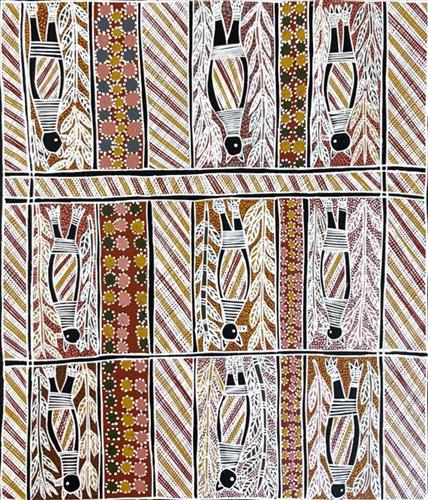
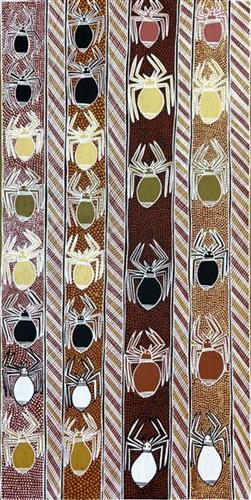
Karr (spiders)

Yolngu often reflect traditional ceremonial and artistic activities which continue to be practised across the country carrying the spiritual forces of the ancestral beings from one generation to the next. In each artwork intricate cross-hatched images unify figurative elements to tell of a world of ancestral transformations. 

This artwork features dancing spiders.

377810582368124


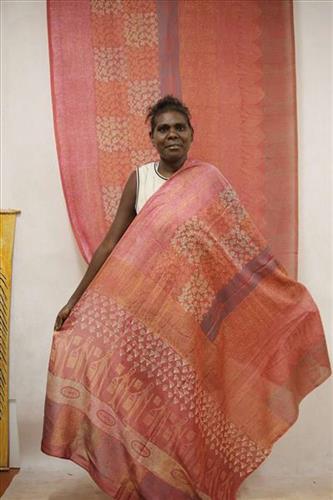
Yawkyawk (Mermaid) la Manjelk (Rain) Sari

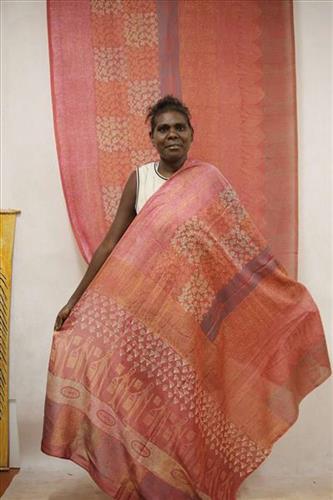
A beautiful pink discharge dyed cotton silk sari featuring woodblock designs created in 2023 – 2025.

Co-created by Bábbarra Women’s Centre, Maningrida and Tharangini Studio, India.

Marebu (floor mat)  by Raylene Bonson

Manjelk (Rain) by Helen Lanyinwanga

Kundalk (grass) by Deborah Wurrkidj

Yawyyawk (young woman spirit) by Deborah Wurrkidj

Printed in India by Tharangini Studio – Bangalore. This is a limited edition cotton yardage created due to workshops in India in January 2023. As part of their visit to India to open their exhibition, Jarracharra (dry season wind), Janet Marawarr and Deborah Wurrkidj visited Tharangini Studio, Bangalore’s oldest heritage textile studio. Established in 1977, Tharangini is woman-owned and specialises in organic, sustainable woodblock printed textiles. Tharangini’s skilled artisans worked closely with Babbarra in 2022 to hand-carve some of Babbarra’s old linocut designs into woodblocks. This initiative was supported by Kinaway Chamber of Commerce, Victoria and Bawinanga Aboriginal Corporation.

Karri-djarrk-durrkmirri means we work together in the Indigenous language of Kuninjku.

Supported by the Australian Government’s Centre for Australia India Relations, this exhibition has been two years in the making. It honours the rich textile traditions of the Indo-pacific Region and tells women’s cultural and ancestral stories in a new way.

80 woodblocks were carved in India based on the lino designs made by generations of Babbarra Women’s Centre artists. They were then printed and embroidered in India in a slow and considered process of briefing and consultation.

Many hands have brought the djang (dreaming) stories of the Maningrida and Djelk region of Arnhem Land alive. Exhibition curators and printers, Anshu Arora and Prithi Pais said:

‘The act of printing is one of careful consideration. It drew us deeper into the meaning and history that saturates every motif. Their deep connection to their landscape opens up a space for reflection in the context of our world today.’

This exhibition honours the cultural heritage of the Indo-pacific region. It celebrates Bábbarra Women’s Centre as they continue to innovate and tell their personal stories through rich textile traditions.

I’m excited to see my Lino design made into a woodblock. We are going to spend Saturday printing with Tharangini Studio. We are going to learn woodblock printing. I’ve been working Bábbarra Women’s Centre for 37 years since it started. I’ve been printing Lino on fabric.’ Janet Marawarr 2023

‘Tomorrow we do printing Yawkyawk (mermaid spirit) and Ngalyod (rainbow serpent). My design is together with my sister. Together, we started working at the Women’s Centre and Maningrida Arts and Culture, taught by our mother and grandmother. My sister is a sick one and she pass on her story to me – Ngalyod (rainbow serpent). I help my sister, I help carry the knowledge for her. That’s why we both have designs being made into woodblock.’ Deborah Wurrkidj 2022
 

377810582368122


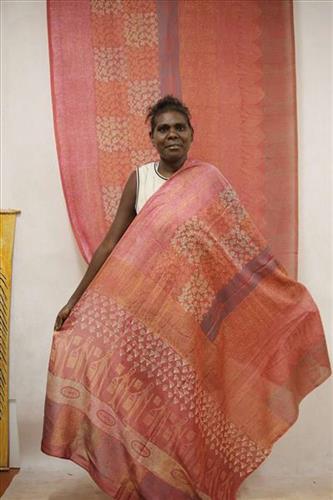
Yawkyawk (Mermaid) la Manjelk (Rain) Sari

A beautiful pink discharge dyed cotton silk sari featuring woodblock designs created in 2023 – 2025.

Co-created by Bábbarra Women’s Centre, Maningrida and Tharangini Studio, India.

Marebu (floor mat)  by Raylene Bonson

Manjelk (Rain) by Helen Lanyinwanga

Kundalk (grass) by Deborah Wurrkidj

Yawyyawk (young woman spirit) by Deborah Wurrkidj

Printed in India by Tharangini Studio – Bangalore. This is a limited edition cotton yardage created due to workshops in India in January 2023. As part of their visit to India to open their exhibition, Jarracharra (dry season wind), Janet Marawarr and Deborah Wurrkidj visited Tharangini Studio, Bangalore’s oldest heritage textile studio. Established in 1977, Tharangini is woman-owned and specialises in organic, sustainable woodblock printed textiles. Tharangini’s skilled artisans worked closely with Babbarra in 2022 to hand-carve some of Babbarra’s old linocut designs into woodblocks. This initiative was supported by Kinaway Chamber of Commerce, Victoria and Bawinanga Aboriginal Corporation.

Karri-djarrk-durrkmirri means we work together in the Indigenous language of Kuninjku.

Supported by the Australian Government’s Centre for Australia India Relations, this exhibition has been two years in the making. It honours the rich textile traditions of the Indo-pacific Region and tells women’s cultural and ancestral stories in a new way.

80 woodblocks were carved in India based on the lino designs made by generations of Babbarra Women’s Centre artists. They were then printed and embroidered in India in a slow and considered process of briefing and consultation.

Many hands have brought the djang (dreaming) stories of the Maningrida and Djelk region of Arnhem Land alive. Exhibition curators and printers, Anshu Arora and Prithi Pais said:

‘The act of printing is one of careful consideration. It drew us deeper into the meaning and history that saturates every motif. Their deep connection to their landscape opens up a space for reflection in the context of our world today.’

This exhibition honours the cultural heritage of the Indo-pacific region. It celebrates Bábbarra Women’s Centre as they continue to innovate and tell their personal stories through rich textile traditions.

I’m excited to see my Lino design made into a woodblock. We are going to spend Saturday printing with Tharangini Studio. We are going to learn woodblock printing. I’ve been working Bábbarra Women’s Centre for 37 years since it started. I’ve been printing Lino on fabric.’ Janet Marawarr 2023

‘Tomorrow we do printing Yawkyawk (mermaid spirit) and Ngalyod (rainbow serpent). My design is together with my sister. Together, we started working at the Women’s Centre and Maningrida Arts and Culture, taught by our mother and grandmother. My sister is a sick one and she pass on her story to me – Ngalyod (rainbow serpent). I help my sister, I help carry the knowledge for her. That’s why we both have designs being made into woodblock.’ Deborah Wurrkidj 2022
 

377810582368121


Yawkyawk (Mermaid) la Manjelk (Rain) Sari

A beautiful pink discharge dyed cotton silk sari featuring woodblock designs created in 2023 – 2025.

Co-created by Bábbarra Women’s Centre, Maningrida and Tharangini Studio, India.

Marebu (floor mat)  by Raylene Bonson

Manjelk (Rain) by Helen Lanyinwanga

Kundalk (grass) by Deborah Wurrkidj

Yawyyawk (young woman spirit) by Deborah Wurrkidj

Printed in India by Tharangini Studio – Bangalore. This is a limited edition cotton yardage created due to workshops in India in January 2023. As part of their visit to India to open their exhibition, Jarracharra (dry season wind), Janet Marawarr and Deborah Wurrkidj visited Tharangini Studio, Bangalore’s oldest heritage textile studio. Established in 1977, Tharangini is woman-owned and specialises in organic, sustainable woodblock printed textiles. Tharangini’s skilled artisans worked closely with Babbarra in 2022 to hand-carve some of Babbarra’s old linocut designs into woodblocks. This initiative was supported by Kinaway Chamber of Commerce, Victoria and Bawinanga Aboriginal Corporation.

Karri-djarrk-durrkmirri means we work together in the Indigenous language of Kuninjku.

Supported by the Australian Government’s Centre for Australia India Relations, this exhibition has been two years in the making. It honours the rich textile traditions of the Indo-pacific Region and tells women’s cultural and ancestral stories in a new way.

80 woodblocks were carved in India based on the lino designs made by generations of Babbarra Women’s Centre artists. They were then printed and embroidered in India in a slow and considered process of briefing and consultation.

Many hands have brought the djang (dreaming) stories of the Maningrida and Djelk region of Arnhem Land alive. Exhibition curators and printers, Anshu Arora and Prithi Pais said:

‘The act of printing is one of careful consideration. It drew us deeper into the meaning and history that saturates every motif. Their deep connection to their landscape opens up a space for reflection in the context of our world today.’

This exhibition honours the cultural heritage of the Indo-pacific region. It celebrates Bábbarra Women’s Centre as they continue to innovate and tell their personal stories through rich textile traditions.

I’m excited to see my Lino design made into a woodblock. We are going to spend Saturday printing with Tharangini Studio. We are going to learn woodblock printing. I’ve been working Bábbarra Women’s Centre for 37 years since it started. I’ve been printing Lino on fabric.’ Janet Marawarr 2023

‘Tomorrow we do printing Yawkyawk (mermaid spirit) and Ngalyod (rainbow serpent). My design is together with my sister. Together, we started working at the Women’s Centre and Maningrida Arts and Culture, taught by our mother and grandmother. My sister is a sick one and she pass on her story to me – Ngalyod (rainbow serpent). I help my sister, I help carry the knowledge for her. That’s why we both have designs being made into woodblock.’ Deborah Wurrkidj 2022
377810582368120


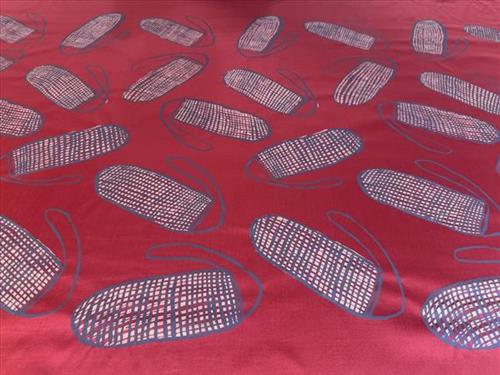
Kunmadj – Dora Diaguma

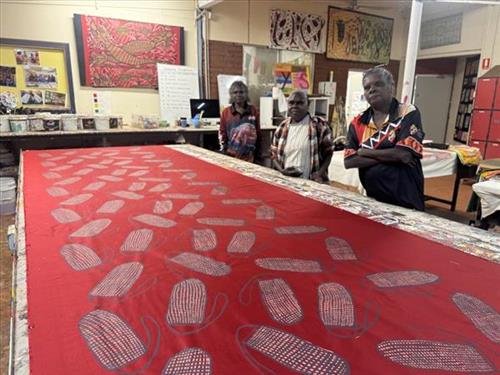
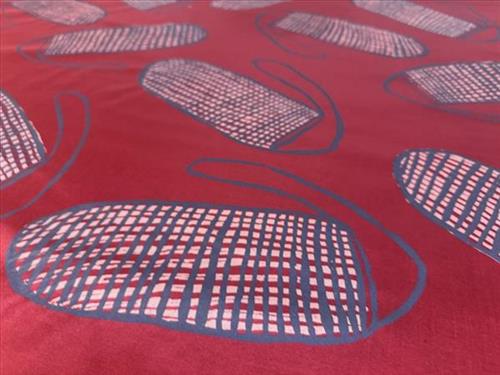
Dora has depicted kunmadj (dillybag), which is a large woven collecting basket. These large bags are often made from the burney vine (Malaisia scandens), a strong, pliable plant that grows along the ground and into the canopy of monsoon vine thickets. The bags are used to collect heavy foods, such as fish caught in conical fish traps or yams. They can also be made from kun-dayarr (Pandanus spiralis), a palm that grows in many areas of Arnhem Land. Tightly woven dillybags are used to collect sugarbag, the native honey.

As well as being of practical use, dillybags are of cultural significance to Arnhem Land people. They are totemic objects associated with particular sites in the landscape.