377810582366538


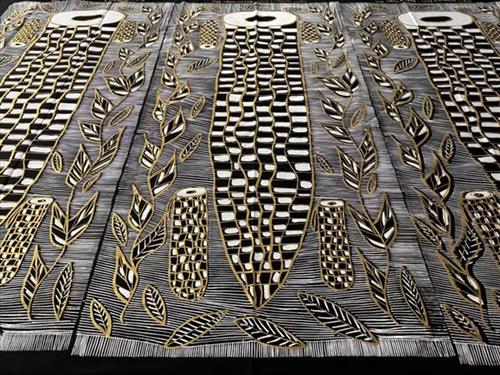
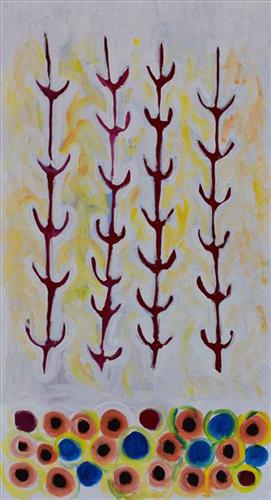
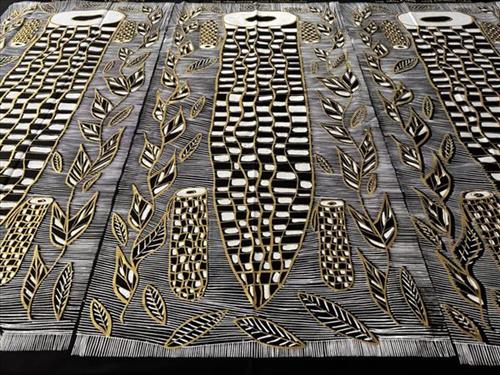
Kunbowinjku (Fresh Water) 2022

Kunbowinjku (fresh water)

A new design made in 2022 featuring a mandjabu (fish trap), kunmadj (dilly bag) and fresh water. 

‘This design is kunbowinjku – which is fresh water, kunronj. This is a mandjabu – fish trap which is floating in a creek. Fish will go in like yabby, long neck turtle and barramundi. This is a Kuninjku style of fish trap used for hunting. My father is from my Kuninjku side and he used this kind of trap. My mum is from my Kunibidji – Ndjebenna language side. This mandjabu is made from manylik grass.’

Raylene Bonson

377810582366536


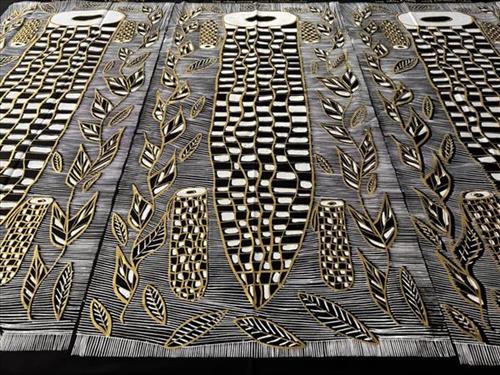
Kunbowinjku (Fresh Water) 2022

Kunbowinjku (fresh water)

A new design made in 2022 featuring a mandjabu (fish trap), kunmadj (dilly bag) and fresh water. 

‘This design is kunbowinjku – which is fresh water, kunronj. This is a mandjabu – fish trap which is floating in a creek. Fish will go in like yabby, long neck turtle and barramundi. This is a Kuninjku style of fish trap used for hunting. My father is from my Kuninjku side and he used this kind of trap. My mum is from my Kunibidji – Ndjebenna language side. This mandjabu is made from manylik grass.’

Raylene Bonson

377810582366533


Kunbowinjku (Fresh Water) 2022

Kunbowinjku (fresh water)

A new design made in 2022 featuring a mandjabu (fish trap), kunmadj (dilly bag) and fresh water. 

‘This design is kunbowinjku – which is fresh water, kunronj. This is a mandjabu – fish trap which is floating in a creek. Fish will go in like yabby, long neck turtle and barramundi. This is a Kuninjku style of fish trap used for hunting. My father is from my Kuninjku side and he used this kind of trap. My mum is from my Kunibidji – Ndjebenna language side. This mandjabu is made from manylik grass.’

Raylene Bonson

112482109946


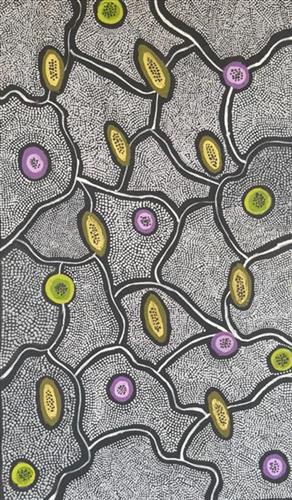
Bush Potato Dreaming – Yarla Jukurrpa

This dreaming tells about bush yams or potatoes. The trees are green all year round. When the flowers are on the tree the women know that the potatoes are ready to dig for. The women look for long, thin cracks along the ground, made from the vines of the potato plant. The women dig where the cracks are. The potatoes are deep in the ground, sometimes more than one meter deep. The women gather them in wooden dishes, called parraja in Warlpiri. Bush potatoes are cooked on the coals, and have a sweet taste.

220982296567


Ntang (Edible Seeds)

Ntang are edible native seeds. The seeds are collected under trees by laying a tarp on the ground and hitting the tree continuously until most of the seeds have fallen. Once the seeds are collected they are then ground with a mortar and grinding stone.

A number of these grinding stones have been in families for generations. Once seeds are ground, water is added and mixed until a damper-like substance is formed and placed under the coals until cooked.

114182322470


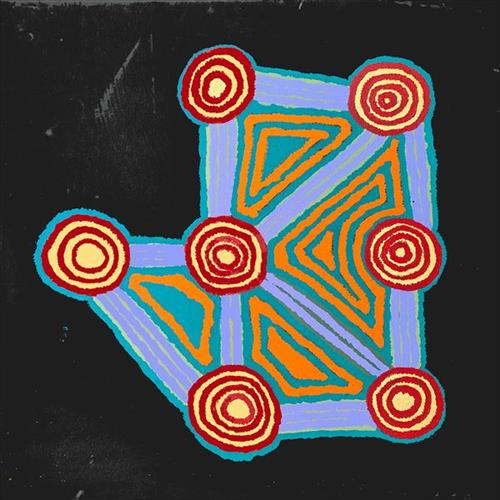
Kungkarrangkalpa (Seven Sisters)

‘Kungkarrangkalpa’ (The Seven Sisters or Pleaides) is significant Tjukurrpa (dreamtime). Its origins you may be familiar with in astronomy and its connection to ‘Wati Nyiru’ (Magic Man or Orion).  The roots of this dreaming stems across indigenous groups around the world. The Australian Aboriginal songline is one part to the whole dreaming which can be traced all around the world. The ladies of the Ngaanyatjarra Lands depict their significant chapter and understanding of the journey of the sisters. The different versions of this story depend on where you live and the significance’s of local Tjukurrpa places.

Nyiru fell in love with the sisters but he was of the wrong skin group to marry, but he still pursued them on their journey. The sisters travel across the land to escape Nyiru’s unwanted attentions, but he is persistent and always finds them. There are significant land forms which can be sited today that evidence this dreaming. As Nyiru is chasing the sisters he tries to catch them by using magic to turn into the most tempting kampurarrpa (bush tomato) and the most beautiful Yirli (wild fig tree), for them to eat and camp under. However, the sisters are knowledgeable of his magic and too clever for Nyiru who they outwit again and again. They go hungry and run through the night rather than be caught by him. As the journey continues, Nyiru gets so frustrated at the wit of the sisters that he uses his magic to make the oldest sister sick to try and get closer to her. The other sisters rescue the big sister and nurse her back to health. It is said he also captures the youngest sister, but with the help of the oldest sister, she escapes back to her sisters who are waiting for her. Eventually, the sisters fly into the sky to escape Nyiru, forming the constellation. Nyiru felt lonely, longing for the sisters who were so far away. Nyiru used his magic to go to the sky, forever in pursuit.

220982331852


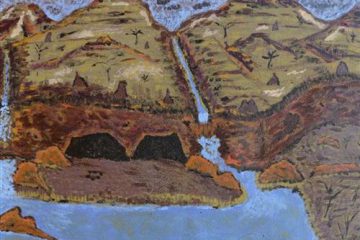
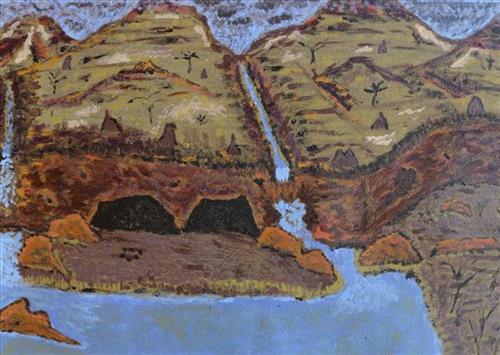
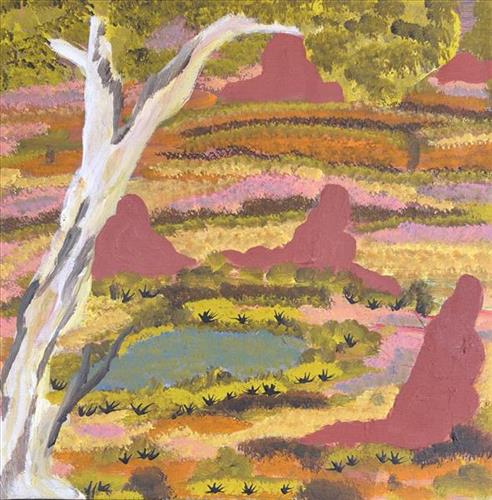
View Of Country

This shows the layered landscape of Alyawarr, Central Australia. Knowing your country is an important part of living in a remote community like Ampilatwatja.

Knowing when and where to go hunting and gathering, knowing where there is ‘soakage’ (where you can dig for water), travelling with family for ceremonies, and maintaining a connection with the land.

“This is my country, my view of country.”

The community of Ampilatwatja made a conscious decision not to paint altyerr (dreaming stories). The artists paint their country where those stories sit.


377810382342982


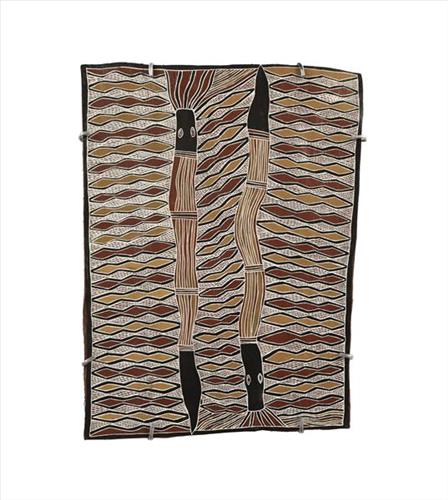
Mundukul/Burrut’tji – Lightning Snake

Baraltja is the residence of Burrut’tji (also known as Mundukul) the lightning serpent. It is an area of flood plains that drain into northern Blue Mud Bay. It is on country belonging to the Maḏarrpa and denotes an area of special qualities pertaining to fertility and the mixing of waters.

From Maḏarrpa (and Dhalwaŋu clan) land freshwater spreads onto the Baraltja flood plains with the onset of the Wet. A tidal creek into the Bay flows with the freshwater flushing the brackish mix into the sea over an ever shifting sandbar (the snake manifest). The deep hole that he lives in is Lorr.

The lightning snake, Burrut’tji sits in the mouth of a mangrove creek known as Baraltja. He is sometimes manifest as a sandbar here. As he tastes the flushed monsoonal rainwater he stands on his tail and spits lightning to the sky, communicating with other ancestral Yirritja moiety lightning snakes to the South and North. Although in the Dry Season there is no physical connection through water between these two rivers – in the Wet the inundation allows the possibility of water flowing from Gangan to emerge at Baraltja. This area is sung and painted by both clans because of the spiritual connection echoed by the physical reality. 

The same can be said for the other who faces towards the south towards another Maḏarrpa area called Guminiyawiny, Numbulwar way, producing storm fronts  and boomerang shaped jet streams with its message.  These events  are sung with the aid of Napunda the boomerang shaped click sticks that are represented by the same shapes of the jet-steams that feather the storms front. Songs associated with Baraltja are normally intoned at the completion of men’s ceremony for the Maḏarrpa and associate clans.

So as a harpoon travels or does lightning the estates are connected spiritually in a multi directional way – both to and from, a cyclic phenomenon which is chronicled in the sacred songs that narrate these Ancestral actions over land, through the sea and ether.

It is worth noting that Yolŋu ‘science’ portrays this energy burst as coming up from the land which is now recognised by Western science as the precursor to downward lightning ‘strikes’.


220982357993


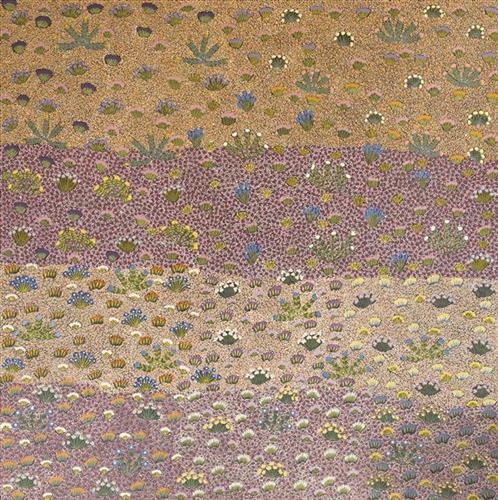
Jessie Ngwarraye Ross – My Country

Jessie’s landscapes beautifully communicate the rich knowledge she possesses of medicinal plants and country, the heart of her culture.
Jessie’s has painted her country, Ampilatwatja. The brightly coloured flowers and small bushes are bush medicine and are still used within the community.


Jessie’s predominant theme in her paintings is ‘strong bush medicine’, demonstrating a deep connection to her country. Her work pays homage to the significance and use of traditional bush medicine, allowing an insight into her community. Yet underneath the iridescent surface, there is an underlying sense that there is more to this landscape than meets the eye. In keeping with the religious laws, Jessie reveals only a small amount of knowledge to the uninitiated.

The community of Ampilatwatja made a conscious decision not to paint altyerr (dreaming stories). The artists paint their country where those stories sit.