377810582305016


Yawkyawk

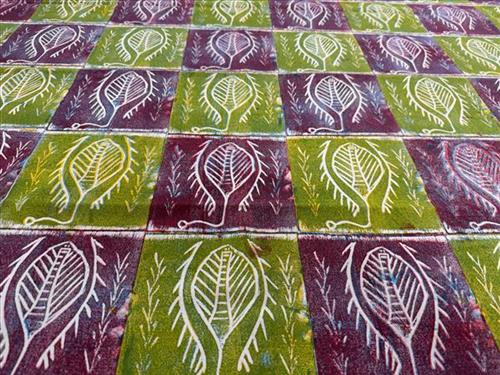
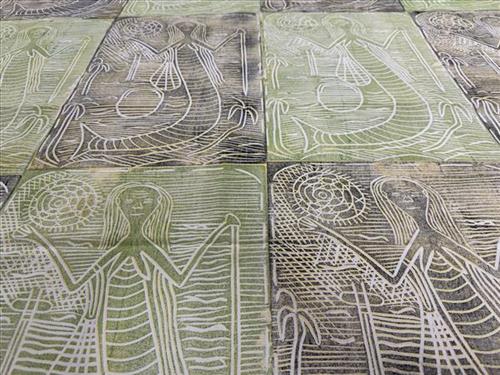
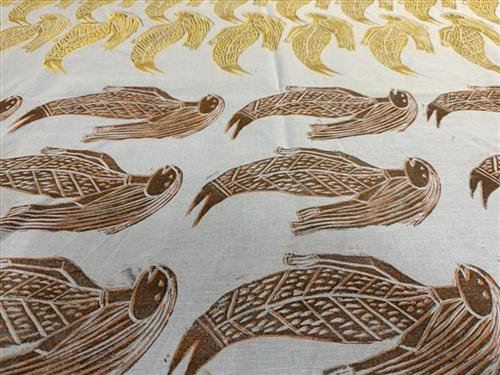
‘Yawkyawk swim underneath the rock. They always stay there. When the sun comes out they come out from underneath the river, make themselves warm. They sit and they look around. When they sit, they cry to themselves. Ngaldjorlhbo (mother of everything) she created them – yawkyawk and the other one [Ngalng].

The Mimih one is a long way from the stone country. He is from my uncles country Bardijokhang. My uncle is the famous artist Crusoe Kurddal and he carves and paints Mimih.  

‘Sometimes yawkyawk sit inside the rock. Sometimes they go out to find the manme (food) and the mankung (sugarbag). Also they can sing inside the rock cave. Sometimes yawkyawk will see the big rain. When the big rain comes they start looking and when the rain comes they go inside and hide themselves.’

Some yawkyawk stay on the dry land in a special place inland from Bardijolhwang.

Some of the stones get stuck on the breasts of the yawkyawk.

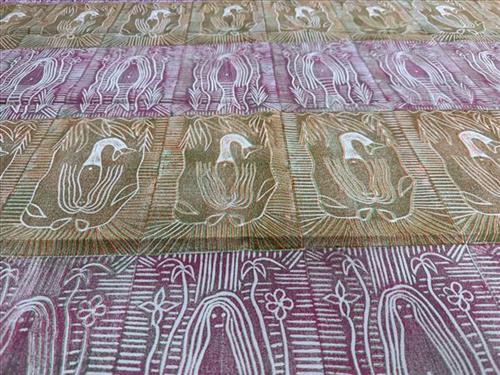
There are two yawkyawk in this artwork. One, the wet season yawkyawk has a round face and long hair. The dry season yawkyawk has short hair. There are lots of different yawkyawk in the water.

In my fabric they are all coming together with the grass trees and leaves and the blowing wind. Some of the leaves will fall onto the water. All the round shapes are kunred (rocky country) with dry grass.

This country is called Gamadery (sp), which is located near Mankorlod and Korlobididah, Arnhem Land.’ 

Janet Marawarr 2022

377810582305015


Yawkyawk

‘Yawkyawk swim underneath the rock. They always stay there. When the sun comes out they come out from underneath the river, make themselves warm. They sit and they look around. When they sit, they cry to themselves. Ngaldjorlhbo (mother of everything) she created them – yawkyawk and the other one [Ngalng].

The Mimih one is a long way from the stone country. He is from my uncles country Bardijokhang. My uncle is the famous artist Crusoe Kurddal and he carves and paints Mimih.  

‘Sometimes yawkyawk sit inside the rock. Sometimes they go out to find the manme (food) and the mankung (sugarbag). Also they can sing inside the rock cave. Sometimes yawkyawk will see the big rain. When the big rain comes they start looking and when the rain comes they go inside and hide themselves.’

Some yawkyawk stay on the dry land in a special place inland from Bardijolhwang.

Some of the stones get stuck on the breasts of the yawkyawk.

There are two yawkyawk in this artwork. One, the wet season yawkyawk has a round face and long hair. The dry season yawkyawk has short hair. There are lots of different yawkyawk in the water.

In my fabric they are all coming together with the grass trees and leaves and the blowing wind. Some of the leaves will fall onto the water. All the round shapes are kunred (rocky country) with dry grass.

This country is called Gamadery (sp), which is located near Mankorlod and Korlobididah, Arnhem Land.’ 

Janet Marawarr 2022
377810582305013


Karrbarda (Long Yam)

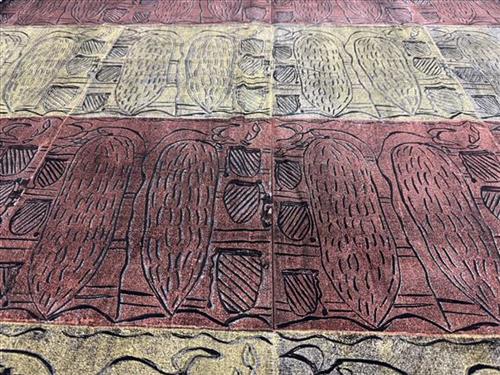
“This design is about collecting karrbarda (yams). The old people use these kungarrndutj (digging sticks) to dig the yams from under the ground. They carry the kunmatj (dilly bags) on their heads for collecting bush food. These yams are purple on the saltwater side of country and inland they are white.” – Deborah Wurrkidj

Deborah Wurrkidj is a Kuninjku artist from the Kurulk clan whose country lies around the outstation of Mumeka in central Arnhem Land. In this design, she has depicted Kun-madj (dilly bag) and karrbarda (long yam). Women dig up long yams with kungarrndutj (digging sticks) and they are then cooked in the ashes of the fire to be eaten.

Kun-madj, or dilly bag, is a large woven collecting basket. These large bags are often made from the vine ‘Malasia scandens’, a strong pliable plant that grows along the floor and into the canopy of monsoon vine thickets. The bags are used to collect heavy foods, such as fish caught in conical fish traps or large collections of yams. They can also be made from Pandanus spiralis, a plant that grows in many areas of Arnhem Land.

377810582305011


Jin-merduwa (mermaid)

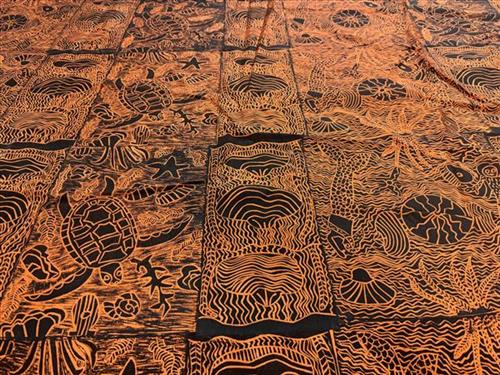
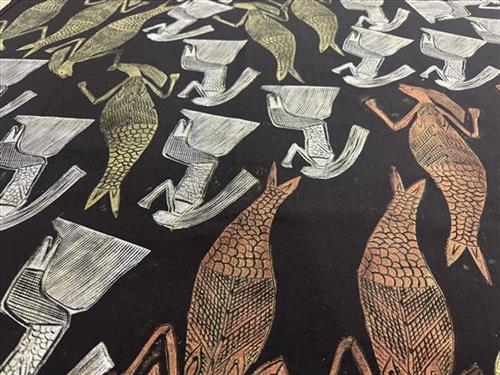
A beautiful, one-off, linocut, hand printed design by Elizabeth Wullunmingu depicting the story of Jin-merduwa.  Sometimes she also includes her Garriwa turtle print. 

My niece, Stephanie James, is singing a song called Diyama, and it is about Jin-merduwa. She is in the Ripple Effect Band. They are now famous in Maningrida and everywhere. Her great grandmother told her about the Jin-merduwa living at Gupanga.  I heard the story before Stephanie.  Now I hear her singing the story about that place.  I am very proud of her. We have the same country.  Our stories match.  She is singing the story, and I am making artwork about the story. 

My lino print shows the Jin-merduwa who live at Gupanga. Gupanga is located at the mouth of the Blyth River.  It is a saltwater place.  There must be more than one Jin-merduwa living there?  They eat fish, shellfish and seaweed.  Sometimes they travel to the end of the river to find food in the ocean, but they don’t go far and always swim back to their home.

Gupanga is a beautiful place.  The sand is golden, there are mangroves, and the water is cloudy.  It is good hunting in that area.  When we lived there, we got lots of barramundi, mud crabs, shellfish, everything!

This is a bit of a dangerous story.  I can’t say too much about this sacred place. The Rangers help to look after this place, but they also know they must be careful.   

Kuninjku people call mermaids yawkyawk.  Yawkyawk are freshwater.  In my language, Burarra, we call mermaids Jin-merduwa.  Jin-merduwa are a bit different to yawkyawk but are also a type of mermaid.

I love to make lino print fabric showing Jin-merduwa. I like using bright colours, but sometimes I print using black and white.

Ripple Effect Band – Diyama Song

 https://rippleeffectband.bandcamp.com/track/diyama

This song was written by Stephanie James in her language of Burarra. It is about the mermaids that live in the river in her country of Kupanga.


Her father sings the Kun-borrk traditional music from the Diyama song cycle to link his daughter’s music to the past.

Credits

from Wárrwarra, released July 5, 2018
Written by Stephanie James, D. Maxwell (father for Stephanie)
Produced by Paul Mac, Jodie Kell, Clint Bracknell
Audio Engineer: Campbell Barnes
Guitar: Jodie Kell, Jolene Lawrence
Bass guitar: Tara Rostron
Drums: Jolene Lawrence
Keys: Patricia Gibson
Lead Vocals: Stephanie James
Back up Vocals: Jodie Kell
Diyama vocals: D. Maxwell

A beautiful, one-off, linocut, hand printed design by Elizabeth Wullunmingu depicting the story of Jin-merduwa.  Sometimes she also includes her turtle print. 

377813282305079


Pandanus Basket

Baskets are made from natural, locally sourced materials from the Kakadu/West Arnhem Region. Weavers gather fresh kunngobarn (pandanus), from the young leaves in the middle of the palm using a hooked stick called a manmarli, once harvested in large quantities. Kunggobarn is then striped into two, split into fine strands and dried. Once dried, the pandanus is then ready for dying.

Natural dyes are also collected out on Country in various times of the year dependent on weather systems. In Kakadu and West Arnhem Land there are six seasons, Kudjewk (Monsoon season, Dec – March), Bangkerreng (‘Knock ‘em down’ storm season, April), Yekke (Cooler (but still humid) season, May-June), Wurrkeng (Cold weather season, June-Aug), Kurrung (Hot dry weather, Aug-Oct) and Kunumeleng (Pre-monsoon storm season, Oct-Dec). These dyes are dependent on these seasons and fruit, blossom or grow specifically in these times, for example Windilk (seeds from Haemodorum coccineum plant), only grows in Kudjewk, much like Rosella, only grows in Yekke.

Manbedde – Grey/Black (Petalostigma pubescens, leaves)

Windilk – Purple/Pink (Haemodorum coccineum, seeds)

Kunggobarn – Green (Pandanus, the growing shoots) 

Wirdilwirdil – Brown (Haemadorum brevicauli grass, red bulb)

Mandjurndum – Yellow/Orange (Coelospermum reticulatus, yellow roots)

Once the pandanus is dyed with the above, the huge, timely process to weaving a basket can begin. Weaving and collecting is usually seen as ‘Women’s business’, as most always, it will be women harvesting and weaving. During weaving, time passes by over cups of tea, daluk (women) having a yarn and the ancient tradition of weaving that naturally gets passed onto wurdurd (children), surrounding daluk. 


377810582305039


Lady Dreaming

‘Lady Dreaming is near the three palm trees, Ngarndúma on the Arnhem highway. One of the mermaids is called Jilapara and the other is Lilima – they are two sisters. My husbands grandmother knows this story. She’s like djomi but different. This one is big and fat, djomi is small. they all make babies. This one – the long one came all the way from Ramingining. They were travelling and they are there forever. It’s an old fashioned story, we can talk about it.’ Verity Bangarra 2023

377810582305037


Lady Dreaming

‘Lady Dreaming is near the three palm trees, Ngarndúma on the Arnhem highway. One of the mermaids is called Jilapara and the other is Lilima – they are two sisters. My husbands grandmother knows this story. She’s like djomi but different. This one is big and fat, djomi is small. they all make babies. This one – the long one came all the way from Ramingining. They were travelling and they are there forever. It’s an old fashioned story, we can talk about it.’ Verity Bangarra 2023

377810582305036


Marebu

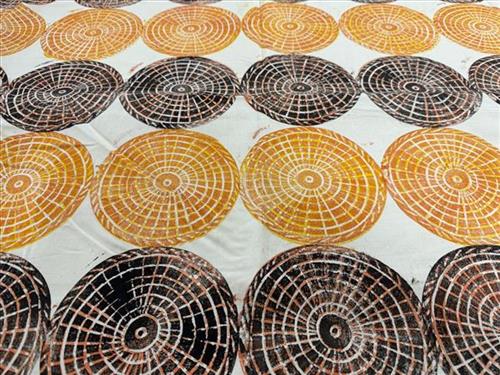
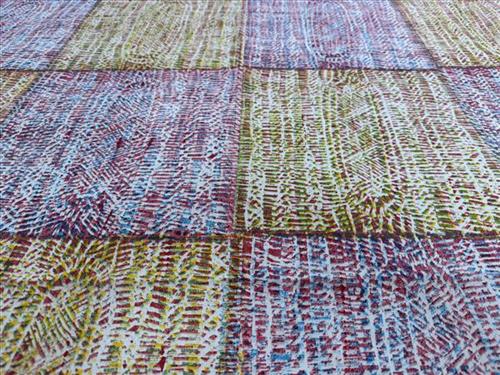
Deborah Wurrkidj is a Kuninjku artist from the Kurulk clan whose country lies around the outstation of Mumeka in central Arnhem Land. She is an accomplished artist working across mediums including painting, sculpture, weaving and textile design. For this design, Deborah Wurrkidj has depicted Marebu (woven pandanus mats).

Works in fibre from the Maningrida region are widely recognised as some of the finest in Australia. Artists confidently push the boundaries of fibre craft and cultural expression, adapting traditional techniques and forms to produce strikingly inventive and aesthetically exquisite artworks.

Artists weave many different kinds of mats. Conical mats were traditionally used to shield babies from mosquitoes. Long flat mats were used for blocking creeks so that fish would be diverted into fish traps. A small triangular mat made of pandanus fibre used to be worn by women during ceremonial gatherings, tied around their back and covering them at the front. Mats are also used for wrapping and rinsing food in water.

Artists usually use kundayarr, pandanus spiralis, to weave decorative round or oblong mats, as well as the less common triangular and conical shapes. Weaving is physically hard work, now done only by women. They colour the pandanus using natural dyes made from the roots, leaves or flowers of plants within the weaver’s clan estate.

The radial woven patterns of the finest round mats appear to vibrate with colour, sometimes regarded as an aesthetic manifestation of deep cultural meaning, as there is a significant spiritual dimension to pandanus mats.