221382282681


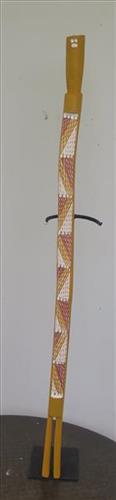
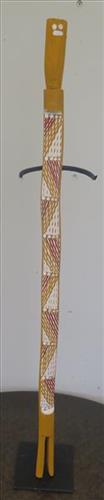
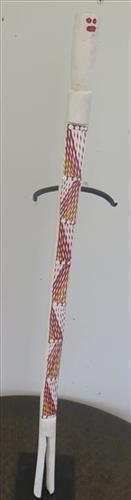
Mimi Spirit

“Mimi go through rock country. Hide in cracks. May be cheeky. Mimi look after and renew country.”

This stunning Mimi Spirit has been hand crafted from native beach hibiscus sourced in Darwin. Carved using a mix of sharp hand tools it has then been finished in modern acrylic paints.

Painting has been completed using a handmade Jarlk grass reed brush harvested from local billabongs and wet areas. Raark or fine line work has been completed using this brush and is in Yirritja style. This style consists of multiple lines before alternating colour.

221382283480


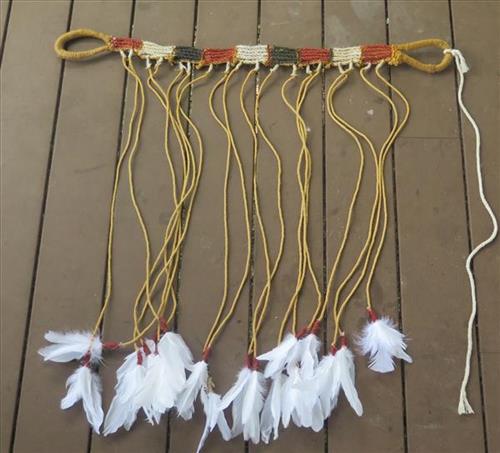
Dance Belt

Dance belts are an important cultural component of ceremony. This belt has been made from a mix of bush string, double twisted to form the belt component, along with cotton string for the dangling components. White cockatoo feathers are used at the end of the dangle.

Bush String is incredibly labour intensive to construct. Artists collect Anputput (Kurrajong, pronounced “but but”), and then steam the logs in a fire. Bark is peeled off and the outer darker skin discarded. The softer inner fibre is mashed and separated into usable strips which has a lace-like visual look. From here the strips are rolled – usually on a leg or thigh – and spun into the string form. This alone is very time consuming as the artist needs to create the material from which she weaves. For thicker ropes, this process is repeated so each strand is actually constructed from two pre-constructed strands (four or even more strands in total).

At this point, with a functional material to start with, the artist begins to construct the belt; wrapping, weaving and tying. Raw rope can be colour dyed, or painted using ochre or modern acrylic paint. White cockatoo feathers are often used, along with biddih, or sugar bag bee wax.

221382283465


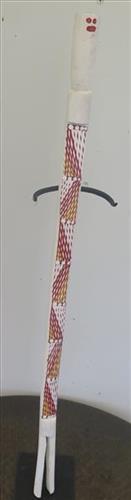
Mimi Spirit

“Mimi go through rock country. Hide in cracks. May be cheeky. Mimi look after and renew country.”

This stunning Mimi Spirit has been hand crafted from native beach hibiscus sourced in Darwin. Carved using a mix of sharp hand tools it has then been finished in modern acrylic paints.

Painting has been completed using a handmade Jarlk grass reed brush harvested from local billabongs and wet areas. Raark or fine line work has been completed using this brush and is in Yirritja style. This style consists of multiple lines before alternating colour.

221382283460


Mimi Spirit

“Mimi go through rock country. Hide in cracks. May be cheeky. Mimi look after and renew country.”

This stunning Mimi Spirit has been hand crafted from native beach hibiscus sourced in Darwin. Carved using a mix of sharp hand tools it has then been finished in modern acrylic paints.

Painting has been completed using a handmade Jarlk grass reed brush harvested from local billabongs and wet areas. Raark or fine line work has been completed using this brush and is in Yirritja style. This style consists of multiple lines before alternating colour.

221382283450


Mimi Spirit

“Mimi go through rock country. Hide in cracks. May be cheeky. Mimi look after and renew country.”

This stunning Mimi Spirit has been hand crafted from native beach hibiscus sourced in Darwin. Carved using a mix of sharp hand tools it has then been finished in modern acrylic paints.

Painting has been completed using a handmade Jarlk grass reed brush harvested from local billabongs and wet areas. Raark or fine line work has been completed using this brush and is in Yirritja style. This style consists of multiple lines before alternating colour.

221382293453


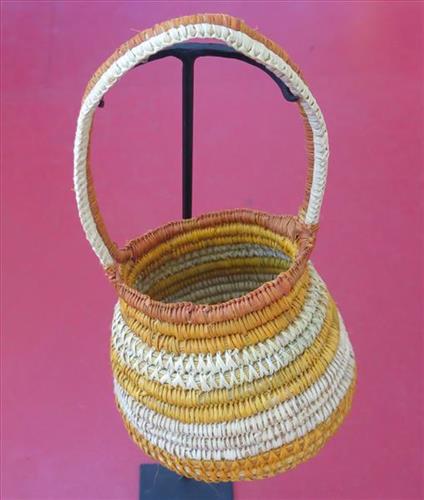
Woven Basket with Handle

Fibre Art is an ancient Aboriginal women’s craft that is still made today using the same techniques as their ancestors. Making fibre art is labour intensive and much care and fine needlework is required to ensure the finished object is both functional and beautiful. Fibre art from the Ghunmarn Culture Centre includes dilly bags, floor mats, bush fans, woven creatures found in the landscape, plants such as yams (bush potato), baskets, place mats, and spirit figures such as mermaids and Mukuy’s. Natural pandanus fibre (Mukarra), is used to make much of the fibre art produced by the artists of Djilpin Arts. Women collect the pandaus by pulling from the top of the pandanus tree, then stripping and drying the leaves before they are dyed with natural bush colour collected from the Beswick surrounds.

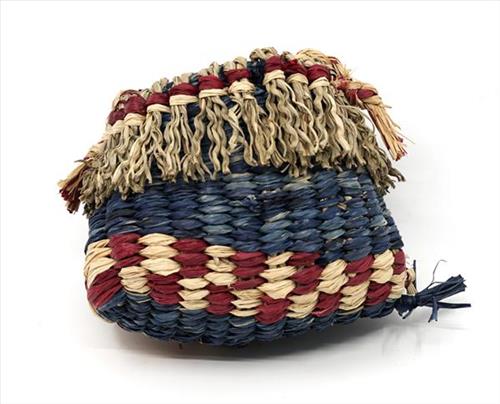
359709482301454


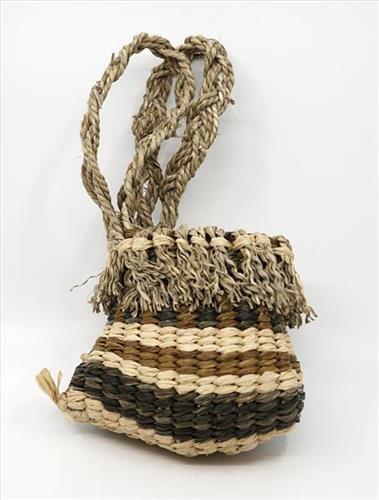
Bag

Art Centre notes: The basket/bag is made of natural raffia/sea chord.

It is made using a traditional ‘one twist’ method. The dyes are commercial and colour fast.

Size of bowl:  12cm x 10cm

Length of strap: 50cm

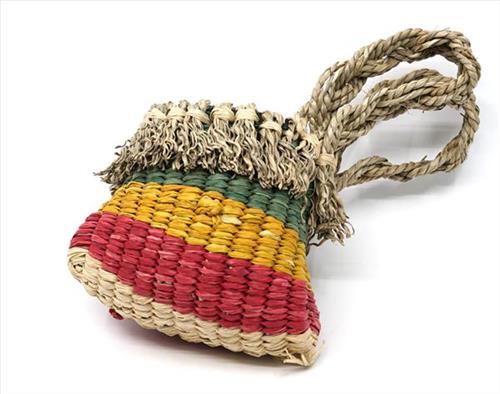
359709482301453


Basket

Art Centre notes:

The basket is made of natural raffia/sea chord. It is made using a traditional ‘one twist’ method.

The dyes are commercial and colour fast.

Size of bowl: 11cm x 10cm

Length of strap: 11cm

359709482301446


Basket

Art Centre notes:

The basket is made of natural raffia/sea chord. It is made using a traditional ‘one twist’ method. The dyes are commercial and colour fast.

Size of bowl: 11cm x 9xm Length of strap: 15cm

111582301529


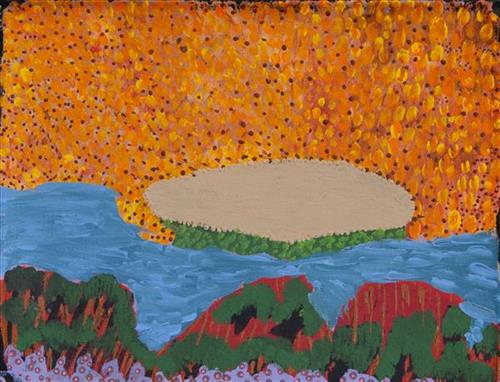
Old Jigalong

“This one here. Yeah. That’s Jigalong. I’ve been there. I was working there. That’s good, this one here. Stories, yeah? This one here. I was painting in Jigalong. This one’s the cars. The cars. And the houses in Jigalong. And then the sandhills, lakes. That’s the lake [points to top right-hand corner]. The lake here and the green trees, and the sandhills. We going out working, you know? We going out working to Jigalong. All the ladies, we go out. All the ladies. Yeah that’s the one, all the ladies. We work choppers. Yeah I’ve been there in Jigalong with my mum and dad long time. And the cars. We go out in that. We go out working. We just work around Jigalong, the ladies.”

– Helen Dale Samson

Jigalong Aboriginal Community, the largest of the Martu communities, is located on the western edge of the Little Sandy Desert, not far from the town of Newman. Jigalong was established in 1907 as the site for a maintenance and rations store for workmen constructing the Rabbit Proof Fence, and converted to a camel breeding site in the 1930’s before finally becoming a Christian mission under the Apostolic Church in 1947. The land was returned to the Martu in 1974. 

For many Martu, Jigalong Mission was the site where their pujiman (traditional, desert dwelling) lifestyle came to an end from the late 1940s as they transitioned to a life as stockmen and women working in cattle stations in the Pilbara region and beyond. In the wake of the extreme and prolonged drought of the 1960s, the last of the remaining pujimanpa (desert dwellers) were forced to move to missions like Jigalong, where a supply of food and water was assured. There, many Martu were reunited with family members that had already moved in from the desert. 

Old Jigalong is where the camp on Jigalong Station was situated before the present Community was built. Dale grew up here, but would frequently camp with her family on Country during weekends. Helen Dale continues to live in Jigalong today.