377810582273091


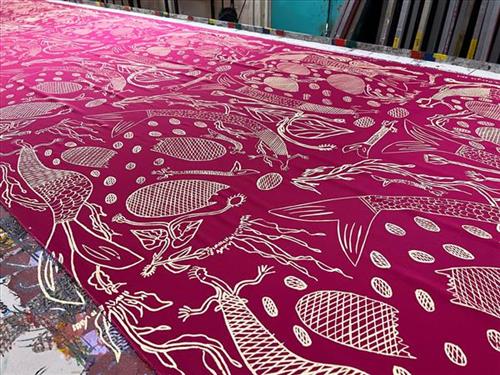
Lorrkon

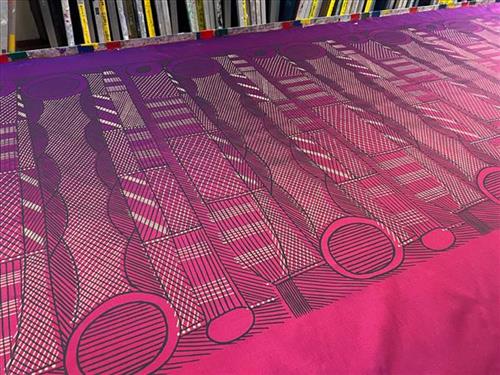
Jennifer Wurrkidj

TITLE                         Lorrkon (Hollow funeral log)

YEAR                          2010

MEDIUM                     Screen print

DETAILS                    2 screen design, 1000 x 420mm

Before, a long time ago, when old people would die they would put their bones inside the lorrkkon and leave it outside. It is part of ceremony. The old people remembering and thinking about that person who passed away, there is lots of talking about where that lorrkkon needs to go.

My father, James Iyuna, taught me how to paint, to paint that rarrk. That memory is from him, he taught my sister Deborah and me. This story is from him, this design. When he was painting and drawing we would watch and we would learn.

Jennifer Wurrkidj

Jennifer is a Kuninjku artist from the Kurulk clan whose country lies around the outstation of Mumeka in central Arnhem Land. She has depicted lorrkkon (hollow-log coffin), kun-karninj (digging stick) and mandjabu (fishtrap) in this design.

The Lorrkkon or hollow-log coffin ceremony is the final ceremony in a sequence of mortuary rituals celebrated by the people of Arnhem Land. This ceremony might take place many years after the person has died, and involves the placing of the deceased’s bones into a hollow log that is decorated with painted clan designs and ceremonially placed into the ground where it slowly decays over many years.

The lorrkkon (hollow-log coffin) is made from the trunk of a termite-hollowed manbuluduk (stringybark tree, Eucalyptus tetradonta) and is decorated with totemic emblems. The western Arnhem Land version of the Lorrkkon ceremony involves the singing of sacred songs to the accompaniment of karlikarli, a pair of sacred boomerangs used as rhythm instruments. During the final evening of the ceremony, dancers decorate themselves with kapok down or, today, cotton wool, and conduct much of the final segments of the ceremony in the secrecy of a restricted men’s camp. The complete ceremony may stretch over a period of two weeks, but on the last night the bones of the deceased, which have been kept in a bark container, or today wrapped in cloth and kept in a suitcase, are taken out, and are painted with red ochre and placed inside the hollow-log coffin.

At first light on the final morning of the Lorrkkon ceremony, the men appear, coming out of their secret bush camp carrying the lorrkkon towards the women’s camp. The two groups call to each other using distinct ceremonial calls. The women have prepared a hole for the lorrkkon to be placed into, and when it is stood upright, women in particular kinship relationships to the deceased dance around the lorrkkon in a jumping/shuffling motion. It is then often covered with a tarpaulin and left to slowly decay.
377810582273050


Djomi (Fresh Water Spirit)

This design depicts the story of the artist’s ancestral dreaming, the Djomi fresh water spirit mermaid.

The Djomi figure is a mermaid like spirit with fish tail that lives in the fresh water stream that flows out to the sea cliff near Maningrida. Djomi is a known to be a very powerful fertility symbol.

‘If you go there you can get pregnant easily. Djomi has babies, and they can give others babies too. The Djomi spirit is so powerful, that women can end up with multiple babies at once, twins or sometimes even more. The Djomi spirits lay eggs near the sacred freshwater stream in Maningrida. Inside the eggs are human babies as well as young Djomi.

Men do not go near that swamp, because Djomi is so powerful that men might get pregnant there too. So men, they are too scared of that Djomi. When we visit the Djomi freshwater spring, we can hear young Djomi crying. They sound like normal babies crying, those Djomi spirits. They are looking for a mother.

This Djomi is my dreaming, I got permission from my djunguys to paint this Djomi design. For me I always ask my djunguy permission to paint, because that is our cultural way.

This design also depicts the fresh water lily leaves, and seaweed from the base of the sea floor.

116482273277


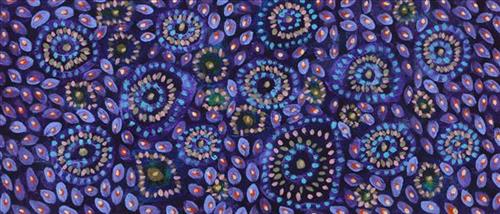
Waterholes

This painting shows the many waterholes you find in the Pilbara region. Some are well known, others are hidden amongst the hills.

116482273317


Walking the Land

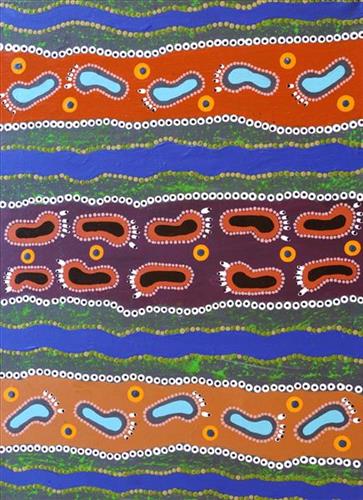
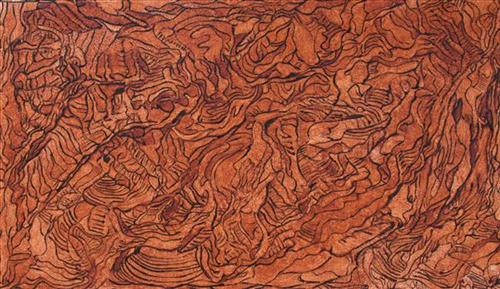
These are the tracks of my ancestors who walked the land long before us. We now walk where they walked.

116482273315


Emu Seeds

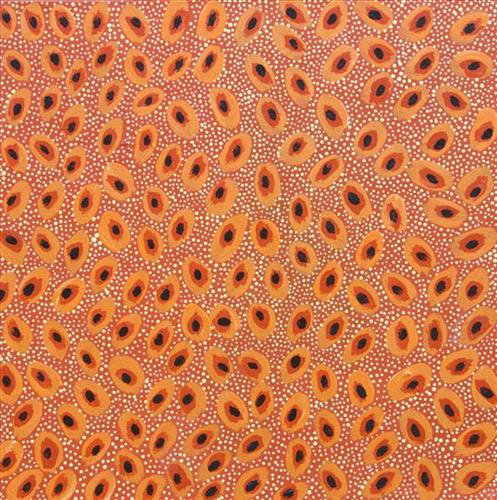
In this painting I have depicted the pods of a shrub which is common in the Pilbara area. It is a smallish bush which comes into seed in September, when the Emu is visible in the Milky Way. This is the time the emu chicks hatch and it is one of their main sources of food. When the pod opens the parent emus feed the little black seeds to their chicks. The seed pod, which is about the size and the shape of a cockroach, turns from orange to yellow, so when all the bushes are in pod at different stages, there is a brilliant display of orange and yellow colours throughout the country. The official name of this annual shrub is Senna notabilis, but, due to the oblong, flat shape and the glossy golden brown colour of its pods, it is known commonly as Cockroach Bush. It has a little round fruit, a berry, that starts of green and turns red when it is ripe, but it’s poisonous. The shrub starts off as a light green colour and then, as it matures, it gets darker. The flowers are a yellowy orange and they, too, get darker with a bit of black as they are fading away.

116482273304


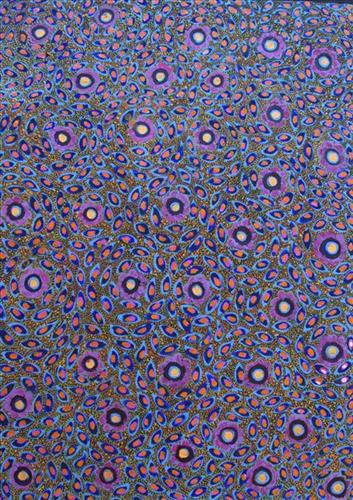
Wildflowers Mulla Mulla

This is the Fortescue Mulla Mulla or ‘Gumbarli’ in Yindjibarndi language. The flower is a purplish colour. It’s not a bush medicine, just a flower that grows in the country, in lines along the roads and everywhere. In this painting, the seeds of the Mulla Mulla are all blowing out. Once the leaves and petals have fallen off, the seeds are blown all through the land to bring flowers again the next year.

111982273296


Mako (didjeridu)

Arnhem Land and the Top End of the Northern Territory is the traditional home of the didjeridu, a rhythmic wind instrument used by Aboriginal people of the region. Its use spread globally in part because the instrument was adopted by world music enthusiasts, and the profile of the instrument reached new heights through Aboriginal rock bands from Arnhem Land, such as Yothu Yindi. It’s an instrument that is now played around the world, in genres ranging from classical to hip hop.

The didjeridu has come to mean many different things to people who have a reason for playing it around the world. In Maningrida it remains primarily an instrument of song accompaniment used in public ceremony. The manner of playing provides an instant recognition to listeners of both language and regional stylistic affiliation. In the wake of the development of new non-Aboriginal ‘world’ styles of playing the instrument, Arnhem Land styles of playing take on new meaning as markers of the cultural and historical origins of the didjeridu.

All of the language groups of the Maningrida region have their own musical genres and song series in which the didjeridu is used as an instrument of accompaniment. Traditionally, it is primarily a secular instrument used in song genres that are performed for two main types of public ceremony: the music of diplomacy (exchange) ceremonies and of funerals and some mortuary rituals. The didjeridu is generally not used as a solo instrument and nor is it used in the most secret and sacred ceremonies still practiced in the western and central Arnhem Land region.

Aboriginal people living today in the rocky escarpment country of western Arnhem Land say that humans were first shown and taught to play the didjeridu by spirit beings who live among the dark caves and crevices of the stone country. These beings are known as mimih and are said to be tall and slender with necks so fragile they are easily snapped by the gentlest of breezes. Because of this, mimih live inside their own worlds within the rock. Mimih are credited with teaching Aboriginal people of the stone country about the foundations of stone country culture, including how to play the didjeridu. Many of the stone country language groups today describe their song and dance genres as mimih.

Researchers of Arnhem Land rock art have identified depictions of the didjeridu as belonging to the most recent phase of rock art, commencing around 1500 years ago.

Aboriginal names

Maningrida is a highly multilingual community and the linguistic diversity of western Arnhem Land is reflected in the various names used for the didjeridu. Here are the names for the instrument in the languages of the Maningrida region:

  • Ndjébbana (the language of the Kunibídji people) – ngalidjbinja
  • Kunwinjku, Kune, Kuninjku – mako [mago]
  • Rembarrnga – liddung, djalubbu
  • Burarra, Gun-nartpa – ngorla
  • Dangbon, Dalabon – morlo
  • Djinang, Wurlaki – wuyimbarl
  • Nakkara – ngunebobanja
  • Gurrgoni – mudburuja
  • Gundjeihmi (and also Kune) – morle

Process

The didjeridu-maker looks through bushland for a tree of the right species with the right diameter trunk. Most didjeridus in the Maningrida region are made from young trunks of the stringybark tree (Eucalyptus tetradonta) or the Darwin Woollybutt (Eucalyptus miniata).

The trunk needs to have been lived in and hollowed out by termites. To listen for hollowness, a tree with potential is stripped of a small patch of bark and the timber is tapped. The sound produced indicates the quality of the instrument the trunk will become. Having selected a good tree, the artist fells it and cleans out the hollow inside of the trunk, usually by ramming out any termite debris with a stick or pole. He strips all the bark off the outside, and smooths both ends. Traditionally, dark wax resin (cerumen or, in Kunwinjku and Rembarrnga languages, birdi) from native bees is applied to the mouthpiece. This substance sets hard but always becomes soft and pliable under pressure, enabling an airtight seal when playing.

Styles

In the Maningrida region, didjeridus are made to accompany songs in either of two styles: the bunggurl style of the language groups of eastern Arnhem Land (such as Bararra) or the kun-borrk style of language groups in the west of Arnhem Land (including Kunwinjku). People of central and south-western Arnhem Land whose country borders east and west (Rembarrnga and Kune), perform both styles.

Didjeridus of the region range in length from just under one metre to two metres. A less flared and longer didjeridu (1.5–2m) makes it easier to produce the characteristic hooted overblown tone that is used in bunggurl-style music. Longer didjeridus have a deeper tone than shorter didjeridus, and more resonance. To play them, you vibrate your lips at a lower frequency than you need to for a shorter didjeridu.

The decoration applied to the instrument can indicate its intended use. Rembarrnga artist Bob Burruwal often uses a design called bedjekbedjek. This is the same design used in body painting for the public diplomacy ceremonies of the Rembarrnga (and many other kun-borrk dance performances). Burruwal slaps wet white ochre over the surface of the instrument with his hands or with a bunch of leaves dipped in the ochre.


111982273294


Mako (didjeridu)

Arnhem Land and the Top End of the Northern Territory is the traditional home of the didjeridu, a rhythmic wind instrument used by Aboriginal people of the region. Its use spread globally in part because the instrument was adopted by world music enthusiasts, and the profile of the instrument reached new heights through Aboriginal rock bands from Arnhem Land, such as Yothu Yindi. It’s an instrument that is now played around the world, in genres ranging from classical to hip hop.

The didjeridu has come to mean many different things to people who have a reason for playing it around the world. In Maningrida it remains primarily an instrument of song accompaniment used in public ceremony. The manner of playing provides an instant recognition to listeners of both language and regional stylistic affiliation. In the wake of the development of new non-Aboriginal ‘world’ styles of playing the instrument, Arnhem Land styles of playing take on new meaning as markers of the cultural and historical origins of the didjeridu.

All of the language groups of the Maningrida region have their own musical genres and song series in which the didjeridu is used as an instrument of accompaniment. Traditionally, it is primarily a secular instrument used in song genres that are performed for two main types of public ceremony: the music of diplomacy (exchange) ceremonies and of funerals and some mortuary rituals. The didjeridu is generally not used as a solo instrument and nor is it used in the most secret and sacred ceremonies still practiced in the western and central Arnhem Land region.

Aboriginal people living today in the rocky escarpment country of western Arnhem Land say that humans were first shown and taught to play the didjeridu by spirit beings who live among the dark caves and crevices of the stone country. These beings are known as mimih and are said to be tall and slender with necks so fragile they are easily snapped by the gentlest of breezes. Because of this, mimih live inside their own worlds within the rock. Mimih are credited with teaching Aboriginal people of the stone country about the foundations of stone country culture, including how to play the didjeridu. Many of the stone country language groups today describe their song and dance genres as mimih.

Researchers of Arnhem Land rock art have identified depictions of the didjeridu as belonging to the most recent phase of rock art, commencing around 1500 years ago.

Aboriginal names

Maningrida is a highly multilingual community and the linguistic diversity of western Arnhem Land is reflected in the various names used for the didjeridu. Here are the names for the instrument in the languages of the Maningrida region:

  • Ndjébbana (the language of the Kunibídji people) – ngalidjbinja
  • Kunwinjku, Kune, Kuninjku – mako [mago]
  • Rembarrnga – liddung, djalubbu
  • Burarra, Gun-nartpa – ngorla
  • Dangbon, Dalabon – morlo
  • Djinang, Wurlaki – wuyimbarl
  • Nakkara – ngunebobanja
  • Gurrgoni – mudburuja
  • Gundjeihmi (and also Kune) – morle

Process

The didjeridu-maker looks through bushland for a tree of the right species with the right diameter trunk. Most didjeridus in the Maningrida region are made from young trunks of the stringybark tree (Eucalyptus tetradonta) or the Darwin Woollybutt (Eucalyptus miniata).

The trunk needs to have been lived in and hollowed out by termites. To listen for hollowness, a tree with potential is stripped of a small patch of bark and the timber is tapped. The sound produced indicates the quality of the instrument the trunk will become. Having selected a good tree, the artist fells it and cleans out the hollow inside of the trunk, usually by ramming out any termite debris with a stick or pole. He strips all the bark off the outside, and smooths both ends. Traditionally, dark wax resin (cerumen or, in Kunwinjku and Rembarrnga languages, birdi) from native bees is applied to the mouthpiece. This substance sets hard but always becomes soft and pliable under pressure, enabling an airtight seal when playing.

Styles

In the Maningrida region, didjeridus are made to accompany songs in either of two styles: the bunggurl style of the language groups of eastern Arnhem Land (such as Bararra) or the kun-borrk style of language groups in the west of Arnhem Land (including Kunwinjku). People of central and south-western Arnhem Land whose country borders east and west (Rembarrnga and Kune), perform both styles.

Didjeridus of the region range in length from just under one metre to two metres. A less flared and longer didjeridu (1.5–2m) makes it easier to produce the characteristic hooted overblown tone that is used in bunggurl-style music. Longer didjeridus have a deeper tone than shorter didjeridus, and more resonance. To play them, you vibrate your lips at a lower frequency than you need to for a shorter didjeridu.

The decoration applied to the instrument can indicate its intended use. Rembarrnga artist Bob Burruwal often uses a design called bedjekbedjek. This is the same design used in body painting for the public diplomacy ceremonies of the Rembarrnga (and many other kun-borrk dance performances). Burruwal slaps wet white ochre over the surface of the instrument with his hands or with a bunch of leaves dipped in the ochre.


111982273293


Mako (didjeridu)

Arnhem Land and the Top End of the Northern Territory is the traditional home of the didjeridu, a rhythmic wind instrument used by Aboriginal people of the region. Its use spread globally in part because the instrument was adopted by world music enthusiasts, and the profile of the instrument reached new heights through Aboriginal rock bands from Arnhem Land, such as Yothu Yindi. It’s an instrument that is now played around the world, in genres ranging from classical to hip hop.

The didjeridu has come to mean many different things to people who have a reason for playing it around the world. In Maningrida it remains primarily an instrument of song accompaniment used in public ceremony. The manner of playing provides an instant recognition to listeners of both language and regional stylistic affiliation. In the wake of the development of new non-Aboriginal ‘world’ styles of playing the instrument, Arnhem Land styles of playing take on new meaning as markers of the cultural and historical origins of the didjeridu.

All of the language groups of the Maningrida region have their own musical genres and song series in which the didjeridu is used as an instrument of accompaniment. Traditionally, it is primarily a secular instrument used in song genres that are performed for two main types of public ceremony: the music of diplomacy (exchange) ceremonies and of funerals and some mortuary rituals. The didjeridu is generally not used as a solo instrument and nor is it used in the most secret and sacred ceremonies still practiced in the western and central Arnhem Land region.

Aboriginal people living today in the rocky escarpment country of western Arnhem Land say that humans were first shown and taught to play the didjeridu by spirit beings who live among the dark caves and crevices of the stone country. These beings are known as mimih and are said to be tall and slender with necks so fragile they are easily snapped by the gentlest of breezes. Because of this, mimih live inside their own worlds within the rock. Mimih are credited with teaching Aboriginal people of the stone country about the foundations of stone country culture, including how to play the didjeridu. Many of the stone country language groups today describe their song and dance genres as mimih.

Researchers of Arnhem Land rock art have identified depictions of the didjeridu as belonging to the most recent phase of rock art, commencing around 1500 years ago.

Aboriginal names

Maningrida is a highly multilingual community and the linguistic diversity of western Arnhem Land is reflected in the various names used for the didjeridu. Here are the names for the instrument in the languages of the Maningrida region:

  • Ndjébbana (the language of the Kunibídji people) – ngalidjbinja
  • Kunwinjku, Kune, Kuninjku – mako [mago]
  • Rembarrnga – liddung, djalubbu
  • Burarra, Gun-nartpa – ngorla
  • Dangbon, Dalabon – morlo
  • Djinang, Wurlaki – wuyimbarl
  • Nakkara – ngunebobanja
  • Gurrgoni – mudburuja
  • Gundjeihmi (and also Kune) – morle

Process

The didjeridu-maker looks through bushland for a tree of the right species with the right diameter trunk. Most didjeridus in the Maningrida region are made from young trunks of the stringybark tree (Eucalyptus tetradonta) or the Darwin Woollybutt (Eucalyptus miniata).

The trunk needs to have been lived in and hollowed out by termites. To listen for hollowness, a tree with potential is stripped of a small patch of bark and the timber is tapped. The sound produced indicates the quality of the instrument the trunk will become. Having selected a good tree, the artist fells it and cleans out the hollow inside of the trunk, usually by ramming out any termite debris with a stick or pole. He strips all the bark off the outside, and smooths both ends. Traditionally, dark wax resin (cerumen or, in Kunwinjku and Rembarrnga languages, birdi) from native bees is applied to the mouthpiece. This substance sets hard but always becomes soft and pliable under pressure, enabling an airtight seal when playing.

Styles

In the Maningrida region, didjeridus are made to accompany songs in either of two styles: the bunggurl style of the language groups of eastern Arnhem Land (such as Bararra) or the kun-borrk style of language groups in the west of Arnhem Land (including Kunwinjku). People of central and south-western Arnhem Land whose country borders east and west (Rembarrnga and Kune), perform both styles.

Didjeridus of the region range in length from just under one metre to two metres. A less flared and longer didjeridu (1.5–2m) makes it easier to produce the characteristic hooted overblown tone that is used in bunggurl-style music. Longer didjeridus have a deeper tone than shorter didjeridus, and more resonance. To play them, you vibrate your lips at a lower frequency than you need to for a shorter didjeridu.

The decoration applied to the instrument can indicate its intended use. Rembarrnga artist Bob Burruwal often uses a design called bedjekbedjek. This is the same design used in body painting for the public diplomacy ceremonies of the Rembarrnga (and many other kun-borrk dance performances). Burruwal slaps wet white ochre over the surface of the instrument with his hands or with a bunch of leaves dipped in the ochre.


116482273292


Rugged Country of the Pilbara

During dry summer months our country looks so dry, but the beauty of the red earth, the spinifex and dry grass make it beautiful.