110682269331


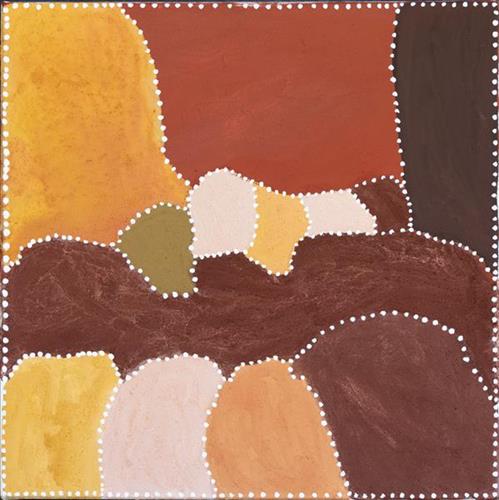
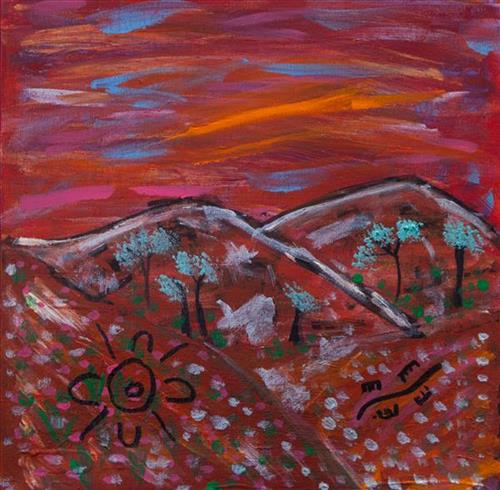
Jarlaloo Country

Jarlaloo is Patrick’s country. It lies south of Warmun and north of Purnululu (Bungle Bungles). Patrick knows this country inside out, as he walked and mustered cattle all throughout this country with his father, George Mung Mung. Jarlaloo is the Gija name for the Ord River, where it runs into Stony Creek. There are a lot of doworrolji in this country – doworrolji are rocks heaped up into ridges.

110682269330


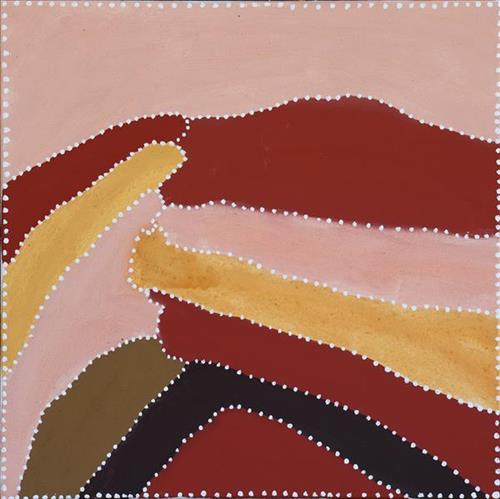
Jarlaloo Country

Jarlaloo is Patrick’s country. It lies south of Warmun and north of Purnululu (Bungle Bungles). Patrick knows this country inside out, as he walked and mustered cattle all throughout this country with his father, George Mung Mung. Jarlaloo is the Gija name for the Ord River, where it runs into Stony Creek. There are a lot of doworrolji in this country – doworrolji are rocks heaped up into ridges.

115682270876


Bathi (Pandanus Basket)

Bathi are woven from the split leaves of the Screw Palm (Pandanus Spiralis). Coil weaving was introduced to Arnhem Land in the 1930s. It was adapted from techniques used by Indigenous women throughout South East Australia.

115682270875


Woven Mat

Traditionally, Nganiyal (conical mats) were used as an insect screen when erected, and as a sitting mat when folded. They are used in Ceremony as well as a functional item. 

Nowadays, artists weave many different shapes including flat, round and oblong. 

377810582270867


Hand Print Tea Towels – Set of three

A Bábbarra Designs Xmas special! 100% Linen hand printed tea towels – comes in a set of three. 

The team at Bábbarra Women’s Centre have printed a range of archived screen-print designs onto 100% linen tea towels in time for Xmas!

*Please note that your set of three tea towels will be selected by our team and may be different to the listed image. 

Being handmade there may be some print variations, making each item unique.

Bábbarra Women’s Centre supports the economic independence of Indigenous women in the Arnhem Land community of Maningrida, Northern Territory, Australia. Designs created by the women at Bábbarra reflect strong cultural knowledge, which is passed down to younger generations through their textile design practice.

377810582270866


Hand Print Tea Towels – Set of three

A Bábbarra Designs Xmas special! 100% Linen hand printed tea towels – comes in a set of three. 

The team at Bábbarra Women’s Centre have printed a range of archived screen-print designs onto 100% linen tea towels in time for Xmas!

*Please note that your set of three tea towels will be selected by our team and may be different to the listed image. 

Being handmade there may be some print variations, making each item unique.

Bábbarra Women’s Centre supports the economic independence of Indigenous women in the Arnhem Land community of Maningrida, Northern Territory, Australia. Designs created by the women at Bábbarra reflect strong cultural knowledge, which is passed down to younger generations through their textile design practice.

115682270863


Bathi (Pandanus Basket)

Bathi are woven from the split leaves of the Screw Palm (Pandanus Spiralis). Coil weaving was introduced to Arnhem Land in the 1930s. It was adapted from techniques used by Indigenous women throughout South East Australia.

115682270862


Woven Mat

Traditionally, Nganiyal (conical mats) were used as an insect screen when erected, and as a sitting mat when folded. They are used in Ceremony as well as a functional item. 

Nowadays, artists weave many different shapes including flat, round and oblong. 

111582270979


Hunting Goanna

“When Martu paint, it’s like a map. Martu draw story on the ground and on the canvas, and all the circle and line there are the hunting areas and different waters and tracks where people used to walk, and [some you] can’t cross, like boundaries. So nowadays you see a colourful painting and wonder what it is, but that’s how Martu tell story long ago. It’s not just a lovely painting, it’s a story and a songline and a history and everything that goes with it.” 

– Ngalangka Nola Taylor and Joshua Booth

This work portrays an area of Country that can be interpreted in multiple ways. Firstly, the image may be read as an aerial representation of a particular location known to the artist- either land that they or their family travelled, from the pujiman (traditional, desert dwelling) era to now. During the pujiman period, Martu would traverse very large distances annually in small family groups, moving seasonally from water source to water source, and hunting and gathering bush tucker as they went. At this time, one’s survival depended on their intimate knowledge of the location of resources; thus physical elements of Country, such as sources of kapi (water), tali (sandhills), different varieties of warta (trees, vegetation), ngarrini (camps), and jina (tracks) are typically recorded with the use of a use of a system of iconographic forms universally shared across the desert. 

An additional layer of meaning in the work relates to more intangible concepts; life cycles based around kalyu (rain, water) and waru (fire) are also often evident. A thousands of year old practice, fire burning continues to be carried out as both an aid for hunting and a means of land management today. As the Martu travelled and hunted they would burn tracts of land, ensuring plant and animal biodiversity and reducing the risk of unmanageable, spontaneous bush fires. The patchwork nature of regrowth is evident in many landscape works, with each of the five distinctive phases of fire burning visually described with respect to the cycle of burning and regrowth.  

Finally, metaphysical information relating to a location may also be recorded; Jukurrpa (Dreaming) narratives chronicle the creation of physical landmarks, and can be referenced through depictions of ceremonial sites, songlines, and markers left in the land. Very often, however, information relating to Jukurrpa is censored by omission, or alternatively painted over with dotted patterns.