Mulana Earth large hoop earrings – red
Handmade by Ally using coloured raffia
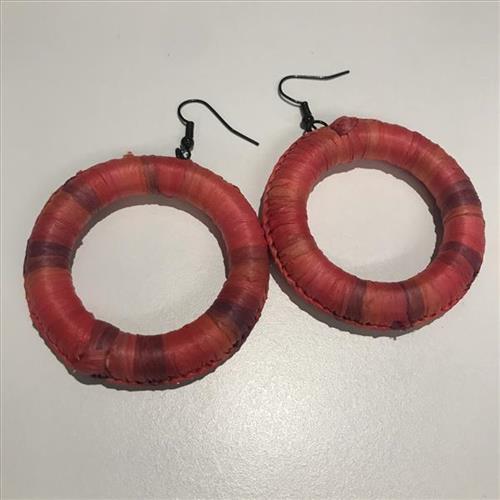
Handmade by Ally using coloured raffia
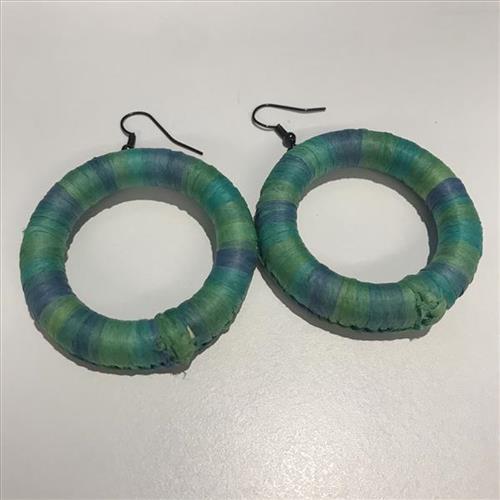
Handmade by Ally using coloured raffia

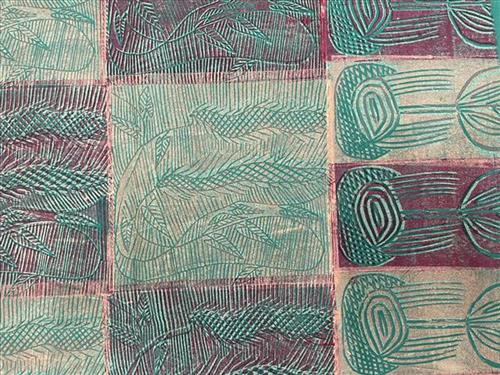
“This design is about collecting karrbarda (yams). The old people use these kungarrndutj (digging sticks) to dig the yams from under the ground. They carry the kunmatj (dilly bags) on their heads for collecting bush food. These yams are purple on the saltwater side of country and inland they are white.” – Deborah Wurrkidj
Deborah Wurrkidj is a Kuninjku artist from the Kurulk clan whose country lies around the outstation of Mumeka in central Arnhem Land. In this design, she has depicted Kun-madj (dilly bag) and karrbarda (long yam). Women dig up long yams with kungarrndutj (digging sticks) and they are then cooked in the ashes of the fire to be eaten.
Kun-madj, or dilly bag, is a large woven collecting basket. These large bags are often made from the vine ‘Malasia scandens’, a strong pliable plant that grows along the floor and into the canopy of monsoon vine thickets. The bags are used to collect heavy foods, such as fish caught in conical fish traps or large collections of yams. They can also be made from Pandanus spiralis, a plant that grows in many areas of Arnhem Land.

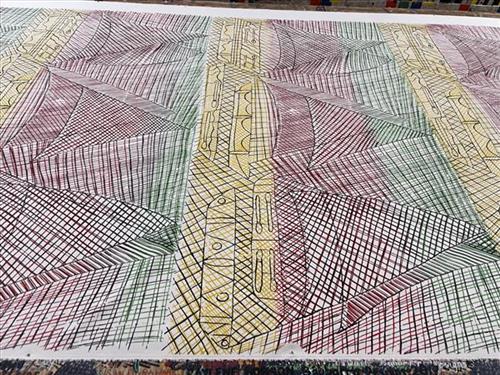
“Wubbunj is our traditional canoe. This design is the old history story of how people came to live in this place we call Maningrida. Two old people were staying on the other side of the saltwater, in Narlarrambarr area. The old people slept in a paper bark shelter and hunted on the water using their canoe.
A long time ago our people carved these canoes from the big paperbark trees. They had paddles with one person at the front, one at back, and other kids and passengers in the middle. Kunkot (paper bark) was used to make the sails which they would stand up and catch the wind.
One day these old people saw a new boat in their waters, which belonged to the Makassans (Indonesians). Those two old men saw the big Makassan boat coming in, and decided to paddle their canoe from Narlarrambarr to the other side (modern day Maningrida). We were scared of the Makassans, they gave us tobacco and tea, but they took many of our women.
When those two old people tasted that water at Maningrida from the Djomi spring, it was sweet freshwater and they decided to stay here. People here had no clothes in those time, we were just wearing string morkoi (loin cloths). Seven tribes were here then, but now in Maningrida there are lots more languages.” – Raylene Bonson

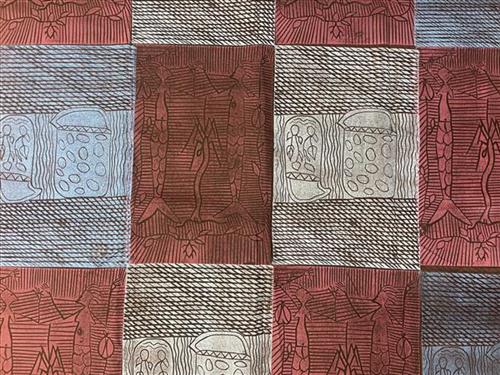
This design depicts the story of the artist’s ancestral dreaming, the Djomi fresh water spirit mermaid.
The Djomi figure is a mermaid like spirit with fish tail that lives in the fresh water stream that flows out to the sea cliff near Maningrida. Djomi is a known to be a very powerful fertility symbol.
‘If you go there you can get pregnant easily. Djomi has babies, and they can give others babies too. The Djomi spirit is so powerful, that women can end up with multiple babies at once, twins or sometimes even more. The Djomi spirits lay eggs near the sacred freshwater stream in Maningrida. Inside the eggs are human babies as well as young Djomi.
Men do not go near that swamp, because Djomi is so powerful that men might get pregnant there too. So men, they are too scared of that Djomi. When we visit the Djomi freshwater spring, we can hear young Djomi crying. They sound like normal babies crying, those Djomi spirits. They are looking for a mother.
This Djomi is my dreaming, I got permission from my djunguys to paint this Djomi design. For me I always ask my djunguy permission to paint, because that is our cultural way.
This design also depicts the fresh water lily leaves, and seaweed from the base of the sea floor.
Traditionally, Nganiyal (conical mats) were used as an insect screen when erected, and as a sitting mat when folded. They are used in Ceremony as well as a functional item.
Nowadays, artists weave many different shapes including flat, round and oblong.
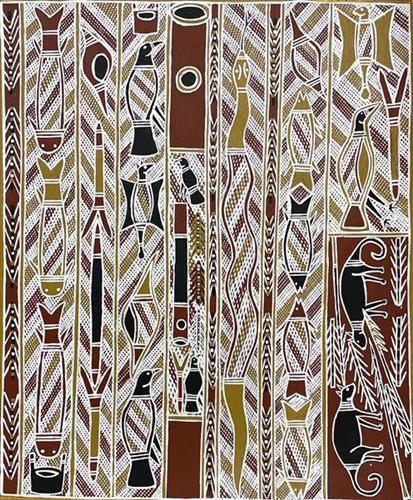
Baḏurru (Milky Way) dhäwu (story) is a significant creation story for the Ḻiyagalawumirr people. It is an account of two spirit beings in the form of miyalk (female) native cats (quolls) who attacked their husband, a glider possum. The glider possum, along with his tribesmen, attacked the native cats, spearing them to their death. The spirits of the native cats left their bodies and took form of goya (fish) in a nearby stream. The glider possums tribes men captured and ate the goya using a batjbarra (traditional fishtrap), discarding of their bones on the ground around them. In order to send the souls of the spirit beings off peacefully, Wäk (crow man) gathered the goya remains and placed them into the dupun (hollow log) before performing Baḏurru buŋngul (dance). At the completion of the buŋgul, Wäk and his tribesmen carried the dupun in to the sky where they scattered the bones of the spirit beings across the heavens, forming the creation of the Milky Way. The black hole on the dupun represents the black void beside the Milky Way, in which the dupun entered heavens.
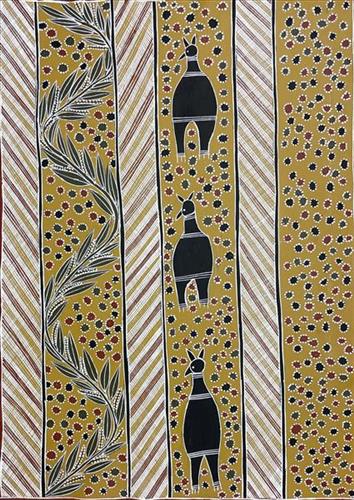
Back in the Creation time, Warrnyu (Flying Foxes) once lived, like men, in the cave at the place called Kurrki Warrnyu Yirri Djaringal (they also lived in caves called Wadatilmurr & Gurngurmirrngu). Warrnyu lived in these caves for many years and then one day Djanyarr (The Dog), an ancestral being in the form of a man, came along. He was looking around for a place to live. Djanyarr heard the sound of a Flying Fox screaming. He went down to the cliff and pushed the rock and the water came out at the Ganalbingu place called Gurrkawakarrmurr. He then went into the cave and into the sacred hole, frightening all the Flying Fox away. When he went into the hole he left his dilly bag in the tree and went out on the other side of the sacred cave and leaving his spear and woomera. He sat there for a long time. The Dog made three streams and the water went inside the cave. Two of these streams are good drinking water. In the middle it is a sacred water. No-one drinks from the middle of the stream. Children, men, women, young boys or girls are not allowed to drink from the middle of the stream. If they drink the water from the middle of the stream they will go grey too early.
At Kurrki Warrnyu Yirri Ngilaya Djaringal, the Flying Fox made himself into a young man… that’s what Aboriginal people do today. They have ceremonies and dances to make the young boys into men. The songs are called Yirrarwu, Gulumu, Rruburra and Burryun. Dhapi (initiation ceremony) happen today because the Warrnyu (Flying Fox) people performed them a long time ago before the Yolgnu people. It was the Warrnyu people who first performed circumcision of the young boys to make them into men. It all happened at Kurrki Warrnyu Yirri Ngilaya Djaringal, this is how this place got its name.
Leaving behind the cave at Kurrki Warrnyu Yirri Djaringal, the Dog travelled west across the Arafura Swamp and came to Djalkulmurr (Mount Delight). From there he travelled north and came to Dunganda (a hill situated a few kilometres east of Ramingining). There he met a female Dog, then they both headed north and came to a place called Garanydjirrmurr where they spoke the Mildjingi language. From Garanydjirrmurr they changed their direction and went west through Guliny’barra, Burgumara and onto the plains. When they reached the plains they smelled something cooking, way up in the north – at Wessel Islands. The aroma they smelt was so enticing that they decided to go there. Lungurrma (the north-east wind) was carrying the smell. One Dog headed north again, but the other Dog decided not to go with him and went back the opposite way. The first Dog that went to Malwanatharra (Sandy Point) went into the sea following its nose to wherever the smell was coming from. It is believed that this Dog still lives in the sea…

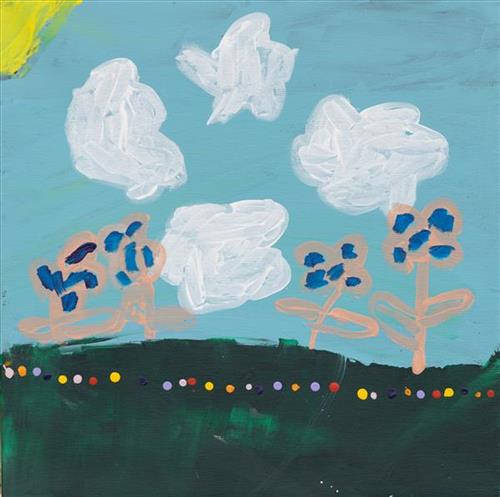
“I been do four clouds and four flowers”
– Sheeniah Jones
Jigalong Aboriginal Community, the largest of the Martu communities, is located on the western edge of the Little Sandy Desert, not far from the town of Newman. Jigalong was established in 1907 as the site for a maintenance and rations store for workmen constructing the Rabbit Proof Fence, and was converted into a camel breeding site in the 1930’s before finally becoming a Christian mission under the Apostolic Church in 1947. Old Jigalong is where the camp on Jigalong Station was situated before the present Community was built. Jigalong and its surrounding land was returned to the Martu in 1974.
For many Martu, Jigalong Mission was the site where their pujiman (traditional, desert dwelling) lifestyle came to an end from the late 1940s. From this time, they mostly transitioned to a life as stockmen and women working in cattle stations in the Pilbara region and beyond. In the wake of the extreme and prolonged drought of the 1960s, the last of the remaining pujimanpa (desert dwellers) were forced to move to missions like Jigalong, where a supply of food and water was assured. There, many were reunited with family members that had already moved in from the desert.

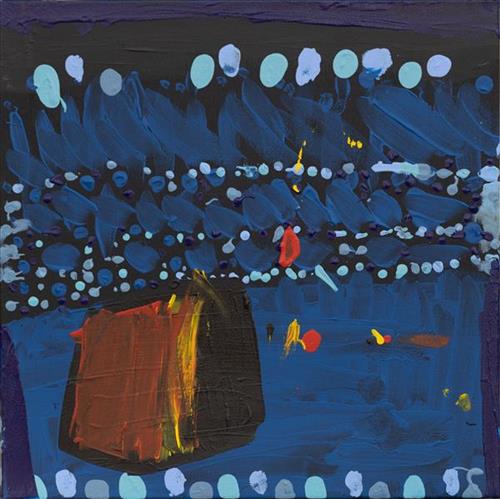
“Newman is going to be rainy for a couple of days. The storm from Port Hedland is coming to Newman.”
– Akeelah Ashwin
Tropical Cyclone Ilsa , the first in the Western Region for the 1999-2000 season, formed to the northeast of Cocos Islands on 11 December 1999. It was tracked for a period of almost nine days and its development was impeded by vertical windshear for a large part of its lifetime. After a long track eastwards across the Indian Ocean it eventually crossed the WA coastline along the Eighty Mile Beach during the early afternoon of 17 December. During the lifetime of Ilsa , Tropical Cyclone John formed in the Timor Sea and crossed the Pilbara coast on the morning of 15 December.