


110664981013

Old man on the hill
Peggy Patrick has painted a Dream time story of a old man standing on top of a hill singing out for his dogs. Below this hill is where they killed a Kangaroo. This hill stands near Clifton Hole an also across the highway from Lissadel station turnoff.

110664981137

BINKANY (SUGAR LEAF) – YVONNE MARTIN
This painting represents the sugar leaf dreaming that is based in the ngarankarni (dreaming) times. Along the Great Northern Highway, situated on the rugged ranges north of Doon Doon – The Sugar leaf dreaming can easily be seen. The large white circle within the painting represents the sugar of were it lays and was also turned into large white sand, Yvonne says that this special place cannot be accessed by road. The story about the sugar leaf is that the old people used it as a washing detergent to wash camp ovens.

110681249871

Untitled

110681414703

Untitled

110681613518

Darradjan (Springvale Station)
The black is the road that goes from Bedford Downs to Darradjan. And the hills in the painting are called Dayralingin.
This is a good place for hunting, the footprints of Kangaroo, Echidna and Dog, can be found here.
111581685111
Untitled
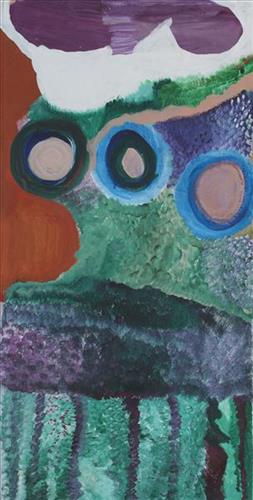
This is Wurta Amy French’s Country- her ‘ngurra’ (home Country, camp). People identify with their ngurra in terms of specific rights and responsibilities, and the possession of intimate knowledge of the physical and cultural properties of one’s Country. Painting ngurra, and in so doing sharing the Jukurrpa (Dreaming) stories and physical characteristics of that place, has today become an important means of cultural maintenance.
Wurta’s ngurra encompasses the Country that she and her family walked in the pujiman (traditional, desert-dwelling) era. At this time Wurta travelled nomadically with her own and other family groups. The Country they traversed encompassed an enormous tract of land, all around the Karlamily (Rudall River) region and through to Tiwa (Canning Stock Route Well 26) .
Wurta was born at Wantili (Warntili, Canning Stock Route Well 25). She grew up, walked and hunted primarily around water sources Pangkartal, Yalpalpa, Walirrlirri, Yanytikuji, Wartararra, Tintinmarran, Pimurlu, Raarki (Canning Stock Route Well 27), and Tiwa. Her family continued to live nomadically before eventually deciding to move to Jigalong Mission along with many other relatives following an extreme and prolonged drought in the 1960s.
Portrayed in this work are features of Wurta’s ngurra, such as the hills, gorges and valleys, warta (trees, vegetation), and the individually named water sources she and her family camped at. Rock holes, waterholes, soaks and springs were all extremely important sites for Martu people during the pujiman period, and are generally depicted with circular forms.
The encyclopaedic knowledge of the location, quality and seasonal availability of the hundreds of water bodies found in one’s Country sustained Martu as they travelled across their Country, hunting and gathering, visiting family, and fulfilling ceremonial obligations. They would traverse very large distances annually, visiting specific areas in the dry and wet season depending on the availability of water and the corresponding cycles of plant and animal life on which hunting and gathering bush tucker was reliant. As they travelled and hunted they would also burn areas of Country, generating a greater diversity of plant and animal life.

110681903687

Untitled

110681988092

Untitled

110682078336


Argyle Diamond Mine Rehab
This painting is about the closure of Aryle mine – the right hand side depicts the devastation caused by the mine site, and the left hand side depicts how we would would like it to be rehabilitated for our future generations. The current rehabilitation project started in 2020 and we can see some positive changes. However know that our land will never be the same again.