111982128747


Mimih Spirit

The mimih spirit exists in a realm that runs parallel to and mirrors many facets of human life, also demonstrating the deep sense of time and place understood by Aboriginal and Torres Strait Islander people. Such spirits feature importantly in relation to Aboriginal spirituality, cosmology, social and moral tales as well as ritual. As is true with the multiple mediums employed by artists of West Arnhem Land, the development of artistic style and form is in line with an awareness by the artist that the work produced is predominantly made for a broader audience. Whether show in a national or international context these works communicate and exist in a particular space that is cross-cultural and simultaneously so particular to the Arnhem region.


The mimih sits within a complex and important pedagogical and religious body of knowledge which links Kuninjku people to their distinctive escarpment homelands. Young Kuninjku artists, or apprentices, employ the mimih as an important exercise for the practice of the rarrk technique, as it could be achieved on a smaller surface area before, being attempted in larger scale, on pieces of bark. The mimih serves a purpose for those young artists first learning to carve in a social space of sharing and innovating. The initial mimih manifestation was a large form that almost mirrored the anatomy of a human and at this stage the sculptures have been likened to morkuy carvings visible in eastern Arnhem Land. Contemporaneously, mimih are depicted in a refined, slender, even emaciated form with a broad range of facial expressions giving both individual character to, and denoting the potential volatility and humour that mimih spirits are notable for in their interaction with bininj (humans). The sculptures are frequently carved from the thin trunks of softwoods such as kapok (bombax ceiba or cottonwood) kurrajong, beach hibiscus or leichardt and are painted with earth pigments for their colouring and design.

A leading figure engaging the spirit in visual storytelling was Crusoe Kuningbal, a Kuninjku man, who while traveling was familiarised with carving styles from the east of Arnhem at the mission in Milingimbi pre-dating World War II. This showing a notable connection and interaction of different language groups across such space. As well as travel and the development of art forms being informed by cross cultural dialogues within northern Aboriginal language groups. The mimih became a valued inclusion in performance and public ceremony by Kuninjku people like Kuningbal. At times these ceremonies were performed for extended language groups in the local region.


Now a familiar and broadly depicted figure of iconography, it is important to acknowledge the development of this quite recent sculptural tradition. The depiction of this particular spirit being, once used as an addition to the sharing of song cycles and ceremony, has since been elevated to a prominent form and subject of contemporary sculpture. Variation in the creation of
mimih acts as an indication of the individualism of each artist and their stylistic markers. Additionally significant to note is that in the space of the past thirty years the mimih has begun being produced by multiple language groups residing in the Maningrida area including the traditional owners of Maningrida, the Ndjébbana, speaking Kunibidji as well as Gurrgoni people who have strong ties to Kuninjku.

________
*Maningrida Arts & Culture acknowledge the work of many academic and non-academic voices when writing on this topic, it is important to note Luke Taylor, who’s broad research has informed this text.
111982128670


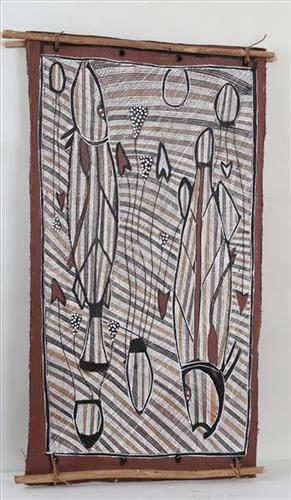
Ngaldadmurrng

This is a painting of ngaldadmurrng ‘Saratoga fish’ (Scleropages jardini) sometimes also called the Northern Spotted Barramundi.

Saratoga are commonly found in creeks, rivers and billabongs around the artist’s clan estate. The animal depicted is on one level easy to recognise and it’s meaning is easily accessible. On a deeper level the animal is depicted with intense rarrk ‘cross hatched’ infill, which creates a reference to Mardayin ceremonial mysticism. 

Saratoga makes their nests on the bottom of riverbeds in the sand by digging with their tails and fins and lay eggs into these depressions. During mortuary rituals the Kuninjku imitate these nests in sand sculpture. At the end of funerals all those who have attended the funeral are required to stand in the ‘saratoga’s nests’ and they are doused with water to be cleansed from the polluting effects of the deceased. A large meteorite crater near Mumeka in the Liverpool River district is said to be the nest of the saratoga which now stands in the landscape as djang ‘a sacred site’. 

In painting this image Marawarr is continuing a long tradition of figurative artistic practice carried out by Arnhem Land.


111982128668


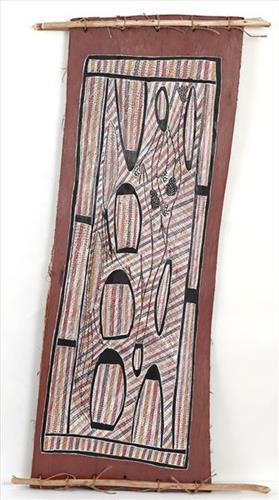
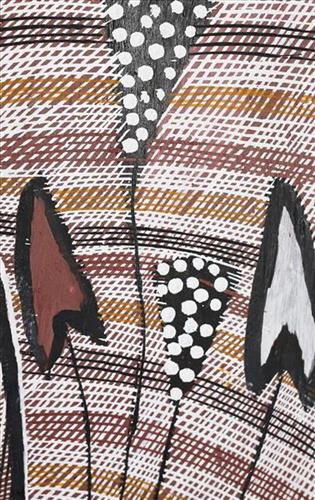
Kun-madj – large dillybag vine

Kun-madj, or dilly bag, is a large woven collecting basket. These large bags are often made from the vine ‘Malasia scandens’, a strong pliable plant which grows along the floor and into the canopy of monsoon vine thickets. The bags are used to collect any kind of large numbers of heavy foods such as fish caught in conical fish traps or large collections of yams.

They can also be made from Pandanus spiralis, a plant which grows in many areas of Arnhem Land. These dilly bags are a tightly woven collecting basket, very finely made. These dilly bags are often used to collect sugarbag, the native honey

As well as being of practical use, dilly bags are also of religious significance to Arnhem Land people. Dilly bags are said to be totemic objects and associated with particular sites in the landscape.

111982128655


Ngaldadmurrng

This is a painting of ngaldadmurrng ‘Saratoga fish’ (Scleropages jardini) sometimes also called the Northern Spotted Barramundi.

Saratoga are commonly found in creeks, rivers and billabongs around the artist’s clan estate. The animal depicted is on one level easy to recognise and it’s meaning is easily accessible. On a deeper level the animal is depicted with intense rarrk ‘cross hatched’ infill, which creates a reference to Mardayin ceremonial mysticism. 

Saratoga makes their nests on the bottom of riverbeds in the sand by digging with their tails and fins and lay eggs into these depressions. During mortuary rituals the Kuninjku imitate these nests in sand sculpture. At the end of funerals all those who have attended the funeral are required to stand in the ‘saratoga’s nests’ and they are doused with water to be cleansed from the polluting effects of the deceased. A large meteorite crater near Mumeka in the Liverpool River district is said to be the nest of the saratoga which now stands in the landscape as djang ‘a sacred site’. 

In painting this image Marawarr is continuing a long tradition of figurative artistic practice carried out by Arnhem Land.


111982128635


Barnda – long neck turtle

In the mythology or dreaming history of the Ganalbingu and Gurrgurrdjunggu peoples, two sisters who were the human forms of barnda ‘the Long-neck Turtle’ (Chelodina rugosa) came travelling a long distance from the east towards Ganalbingu country in Central Arnhem Land. They travelled through Martay country arriving at a place called Ji-malawa, the site today of a homeland/outstation community in the Blyth River district. At this place they turned their speech to the Burarra language and named sites as they travelled. The two Barnda sisters continued their journey to Gamardi, a site in Djinang country and they again changed their language to a dialect of Djinang called Wulagi.

Barnda is also Bulunbulun’s personal ‘Dreaming’ given to him by his father who was walking in the swamp at the time of the artist’s birth. 

While discussing the painting’s imagery, Bulunbulun explained that some components were the domain of ‘inside’ or secret ceremonial meaning and therefore he could only describe the ‘outside’ or public aspects of them.

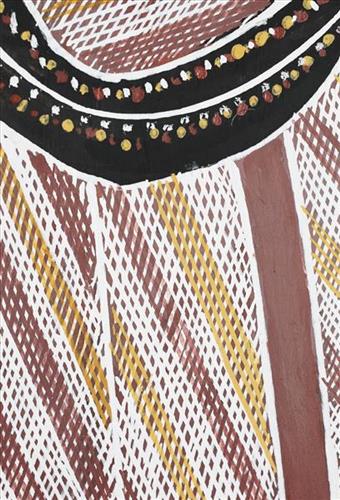
In the painting Bulunbulun depicts the passage of the barnda through the country and the locations where the long neck turtle stopped to create features in the landscape in the Dreamtime. The two black circular forms are ngambul ‘a waterhole’ formed by barnda. The two horizontal bands of rarrk ‘crosshatching’ in the midlle and upper section of the painting are marwurru ‘a paperbark log’ over which barnda walked along the journey. The large areas of rarrk represent gurrwiling ‘the swamp’ created by barnda. The vertical swaying lines are gunbuluru and wuye different types of reeds that are so sharp that they can cut one legs when walking through the swamp. At the top of the painting above the head of the image of the turtle is a band of rarrk, which represents the view of the plain country and swamp from a hill.


111982128634


Waterholes (Kubumi)

Kubumi is a sacred site on the Mann River. This is its story, as told by a ritual manager of the site, Lulu Laradjbi, with the authority of her husband Mick Kubarkku, a land owner of that country.

Ngalyod the Rainbow Serpent pierced the rock at a place called Bolerrhlerrh and journeyed downstream from there to Ngalmalanj. The camping place Kubumi is downstream from there but at Ngalmalanj the serpent was blocked. It pushed down into the riverbed, pushed into the earth, sinking down forever. Now it lives under the rocky riverbed. That site continues downstream. Upstream is the site Molerrhlerrh, which has a waterfall and a big waterhole. There the serpent moved inside, downstream, to the lower region.

During the dry season at Kubumi, the Mann River shrinks to a series of deep waterholes, exposing the tunnels through the rocky outcrop that interconnect the pools.

111982128633


Kunkurra (The Spiralling Wind)

‘Kunkurra’, the spiralling wind is associated with several sites in the Kardbam clan estate. On one level, this painting can be interpreted as a depiction of the kinds of mini-cyclones common during the wet season in Arnhem Land, where the artist lives. In this painting, Kunkurra also relates specifically to a site called Bilwoyinj, near Mankorlod.

At this site, two of the most important Kuninjku creation beings, a father and son known as na-korrkko, are believed to have hunted and eaten a goanna. They left some of the goanna fat behind at the site, which turned into the rock that still stands there today. The word Bilwoyinj, which is the name of this site, also refers to the fat of the goanna. Bilwoyinj site is also a ceremonial ground for a ceremony called Yabbaduruwa, a major ceremony owned by the Yirridja patrimoiety. The Yabbaduruwa ceremony is primarily concerned with initiation, land ownership and promoting the cyclical regeneration of the human and natural worlds.

111982128632


Kun-madj – large dillybag vine

Kun-madj, or dilly bag, is a large woven collecting basket. These large bags are often made from the vine ‘Malasia scandens’, a strong pliable plant which grows along the floor and into the canopy of monsoon vine thickets. The bags are used to collect any kind of large numbers of heavy foods such as fish caught in conical fish traps or large collections of yams.

They can also be made from Pandanus spiralis, a plant which grows in many areas of Arnhem Land. These dilly bags are a tightly woven collecting basket, very finely made. These dilly bags are often used to collect sugarbag, the native honey

As well as being of practical use, dilly bags are also of religious significance to Arnhem Land people. Dilly bags are said to be totemic objects and associated with particular sites in the landscape.

111982128631


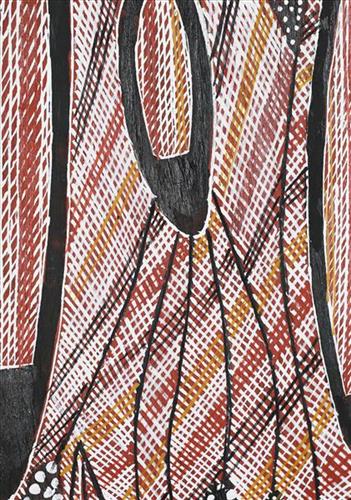
Ngalyod (Rainbow Serpent)

The rainbow serpent is a powerful mythological figure for all Aboriginal people throughout Australia. Characteristics of the rainbow serpent vary greatly from group to group and also depending on the site. Often viewed as a female generative figure, the rainbow serpent can sometimes also be male. She has both powers of creation and destruction and is most strongly associated with rain, monsoon seasons and of course the colour seen in rainbows which arc across the sky like a giant serpent. For Aboriginal people in Northern Australia, the rainbow serpent is said to be active during the wet season.

Known as Ngalyod in the Kuninjku language of western central Arnhem Land, the rainbow serpent is mostly associated with bodies of water such as billabongs, creeks, rivers and waterfalls where she resides. Therefore she is responsible for the production of most water plants such as water lilies, water vines, algae and palms, which grow near water. The roar of waterfalls in the escarpment country is said to be her voice. Large holes in stony banks of rivers and cliff faces are said to be her tracks. She is held in awe because of her apparent ability to renew her life by shedding her skin and emerging anew. Aboriginal myths about the rainbow serpent often describe her as a fearful creature that swallows humans only to regurgitate them, transformed by her blood. The white ochre used by artists to create the brilliant white paint for bark paintings, body decoration and in the past, rock art, is said to be the faeces of the rainbow serpent.

Aboriginal people today respect and care take sacred sites where the rainbow serpent is said to reside. Often certain activities are forbidden at these places for fear that the wrath of the great snake will cause sickness, accidents and even tempests. This is not always the case however and there are many rainbow serpent sites today where people may enter to hunt, fish or swim. By painting this figure on bark today, Aboriginal people are carrying on the longest uninterrupted mythological tradition in the world, which has been the subject of art and ceremony for possibly thousands of years.

111582102091


Kintyre

“Young and old gotta do ‘im togther- old people gotta learn the young fellas about that place. Country. Martumili (belonging to Martu).”

 – Wokka Taylor

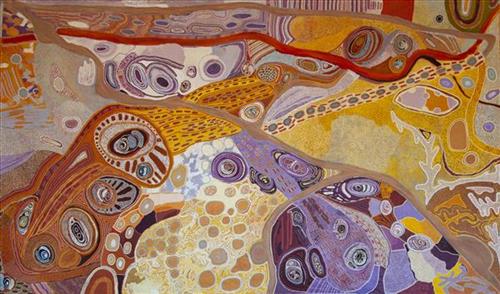
Produced to be a part of FORM’s Tracks We Share project, Martu artists embarked the creation of a large-scale collaborative painting depicting the Country and stories of Kintyre. Martu filmmaker and FORM project officer Curtis Taylor, FORM project officer Greg Taylor/Annie McLoughlin and Martumili staff and artists travelled to Parnngurr to attend an intense period of art making and conversation. Under the tutelage and direction from their elders, young artists laid the groundwork for the painting, with elders adding layers of details and knowledge to these foundations. Created by 23 artists over 18 months, the resulting artwork brings together stories of jukurrpa (dreaming), pre-colonial Martu life, personal histories, and contemporary mining interference with the important site of Kintyre, located within the heart of Martu Country- Karlamilyi national park.

Martu artists were part of the Western Desert Lands Aboriginal Corporation (WDLAC) 2021 AGM in Newman and unveiled the 5x3metre collaborative ‘Kintyre’ artwork to Martu Native Title holders and their families.  This was part of the Martu discussion about making a native title claim over Karlamilyi National park. Martu used the ‘Kintyre’ artwork to tell stories of great cultural importance and personal significance about this ngurra (Country, homeland), and to tell WDLAC to keep going with its work on getting this country back into Martu hands. The following day, Martu Elders and leaders showed and explained the ‘Kintyre’ work to WA Minister for Aboriginal Affairs, Hon Stephen Dawson.  Martu and WDLAC signed a shared statement of intent with the Minister, binding the Government and Martu to work together for Martu native title over Karlamilyi, as well as housing and community development reforms for Punmu, Kunawarritji and Parnngurr.

Kintyre is a claypan located just north of the Karlamilyi (Rudall River) region. During the pujiman (traditional, desert dwelling) era, the site was a popular camping ground in the wantajarra (wet season), when the claypan filled with kapi (water). Today Kintyre is best known for its substantial uranium deposits, and the area has been developed for mining. Protest from traditional land owners in combination with a declining uranium market have resulted in the project being put on hold for the time being.