377810582171234


Bawaliba and Ngalyod (Rainbow Serpent)

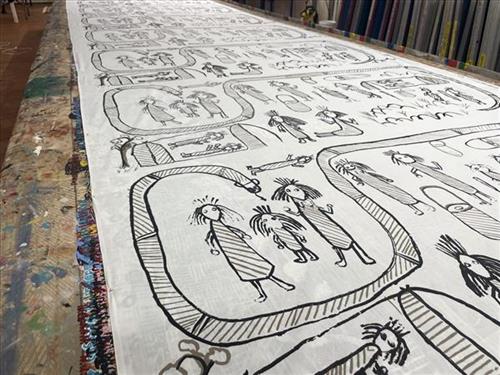
‘My Kikka (mother), when she was alive, she would tell me these stories. I was just a  little girl and she would tell us the stories in her language Gurrgoni.

In the camps there were boy and girl Bawaliba, and old Bawaliba too. They loved to  dance by the firelight, keeping rhythm with a stick. They had lots of hair, they were  really tall and skinny, with spots on their bodies. The Bawaliba lived a long time in  peace. They were the only spirits on their country and so they were never disturbed.

One day, a long time ago, the Bawaliba were out hunting and they saw a large  snake- they didn’t know then but she was the Rainbow Serpent. They were really  scared, they had never seen that. creature before. She was really beautiful- like a  normal king brown snake but with a rainbow from the sky on her back. The rainbow  serpent was really hungry, and she could smell the Bawaliba from a long way away.  She was out looking for food.  The Bawaliba tried to stop Ngalyod coming for them but she was just too quick. She  snuck up behind the Bawaliba and before they could get away she ate them up.  When she was really full and couldn’t eat anymore Bawaliba she changed the rest of  them into stone. Still til this day, the Bawaliba stay on that same country as stones.’ Lucy Yarawanga

377810582169839


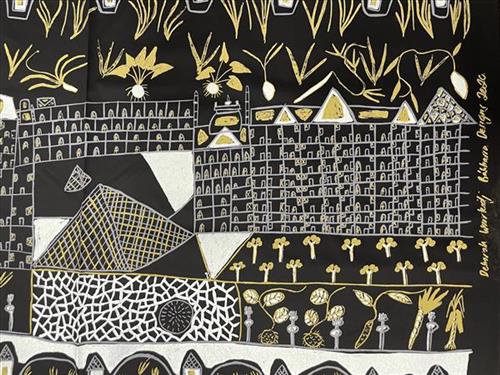
Kunred Kodbarre (The Louvre)

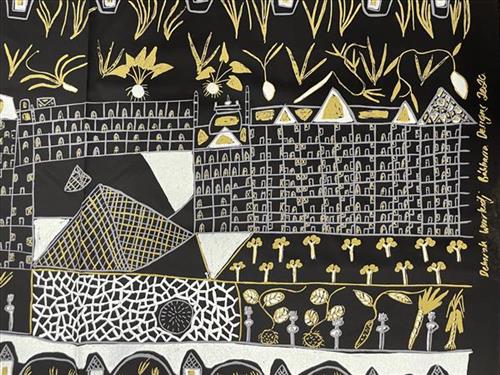
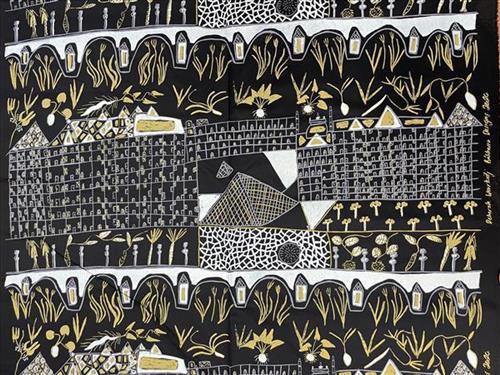
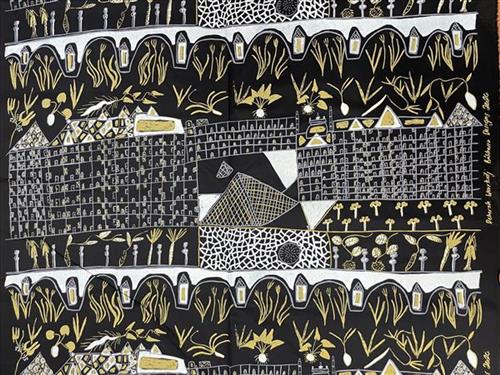
“This design is new and tells a different story of when I went to Paris. This building in the middle of my design is the Louvre. We went and saw that big building made of glass, and there were lots of people walking around. In Paris, there is a big creek made from bricks, with water flowing through the city. I have painted it here too, with the light poles next to it. There are so many tall buildings in Paris. When I see this design, I remember everything about my trip to Paris. For this design I had the idea of putting our Aboriginal bush tucker around the Louvre, so the plants here are kundayarr (pandanus), wayuk (water lily) and karrbarda (long yam). I painted some French trees too’.

In 2019 five artists from Babbarra Women’s Centre travelled to France for the opening of their exhibition Jarracharra: Dry Season Wind. Deborah Wurrkidj, Jennifer Wurrkidj, Janet Marawarr, Jacinta Lami Lami and Elizabeth Kala Kala danced at the opening of the exhibition to a packed embassy gallery, and hosted various public panels including at the Musee du Quai Branly. The artists featured in Vogue magazine, wearing garments featuring their own printed designs on the balcony of the Ambassador to France, with a panoramic view of the Eiffel Tower in the background.

Inspired by the same voyage, on return to Maningrida Deborah Wurrkidj wove a sculpture of the Eiffel Tower out of naturally dyed pandanus, titled Ngaye ngawam nganang kunred  kukimukken, kubba nakornamkuyeng karri (I travelled a long way away, to that place with the tall tower). The work was a finalist in the prestigious 2020 Telstra National Aboriginal & Torres Strait Islander Art Awards (NATSIAA).

377810582169837


Kunred Kodbarre (The Louvre)

“This design is new and tells a different story of when I went to Paris. This building in the middle of my design is the Louvre. We went and saw that big building made of glass, and there were lots of people walking around. In Paris, there is a big creek made from bricks, with water flowing through the city. I have painted it here too, with the light poles next to it. There are so many tall buildings in Paris. When I see this design, I remember everything about my trip to Paris. For this design I had the idea of putting our Aboriginal bush tucker around the Louvre, so the plants here are kundayarr (pandanus), wayuk (water lily) and karrbarda (long yam). I painted some French trees too’.

In 2019 five artists from Babbarra Women’s Centre travelled to France for the opening of their exhibition Jarracharra: Dry Season Wind. Deborah Wurrkidj, Jennifer Wurrkidj, Janet Marawarr, Jacinta Lami Lami and Elizabeth Kala Kala danced at the opening of the exhibition to a packed embassy gallery, and hosted various public panels including at the Musee du Quai Branly. The artists featured in Vogue magazine, wearing garments featuring their own printed designs on the balcony of the Ambassador to France, with a panoramic view of the Eiffel Tower in the background.

Inspired by the same voyage, on return to Maningrida Deborah Wurrkidj wove a sculpture of the Eiffel Tower out of naturally dyed pandanus, titled Ngaye ngawam nganang kunred  kukimukken, kubba nakornamkuyeng karri (I travelled a long way away, to that place with the tall tower). The work was a finalist in the prestigious 2020 Telstra National Aboriginal & Torres Strait Islander Art Awards (NATSIAA).

Printed by Publisher Textiles, Sydney

377810582169836


Kunred Kodbarre (The Louvre)

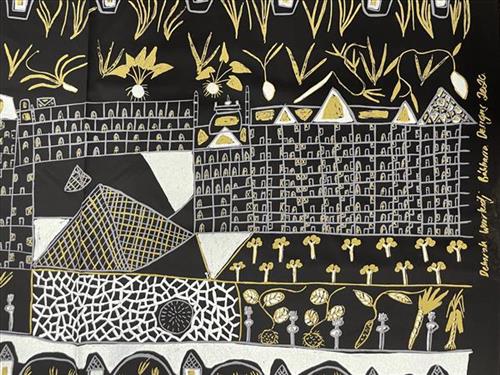
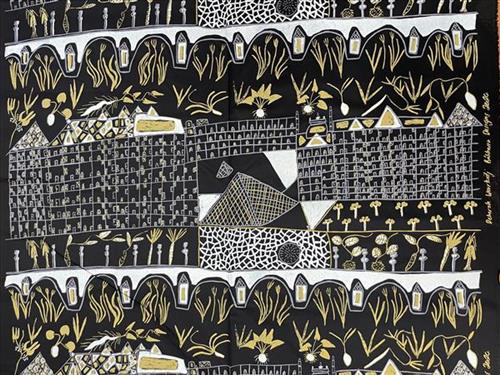
“This design is new and tells a different story of when I went to Paris. This building in the middle of my design is the Louvre. We went and saw that big building made of glass, and there were lots of people walking around. In Paris, there is a big creek made from bricks, with water flowing through the city. I have painted it here too, with the light poles next to it. There are so many tall buildings in Paris. When I see this design, I remember everything about my trip to Paris. For this design I had the idea of putting our Aboriginal bush tucker around the Louvre, so the plants here are kundayarr (pandanus), wayuk (water lily) and karrbarda (long yam). I painted some French trees too’.

In 2019 five artists from Babbarra Women’s Centre travelled to France for the opening of their exhibition Jarracharra: Dry Season Wind. Deborah Wurrkidj, Jennifer Wurrkidj, Janet Marawarr, Jacinta Lami Lami and Elizabeth Kala Kala danced at the opening of the exhibition to a packed embassy gallery, and hosted various public panels including at the Musee du Quai Branly. The artists featured in Vogue magazine, wearing garments featuring their own printed designs on the balcony of the Ambassador to France, with a panoramic view of the Eiffel Tower in the background.

Inspired by the same voyage, on return to Maningrida Deborah Wurrkidj wove a sculpture of the Eiffel Tower out of naturally dyed pandanus, titled Ngaye ngawam nganang kunred  kukimukken, kubba nakornamkuyeng karri (I travelled a long way away, to that place with the tall tower). The work was a finalist in the prestigious 2020 Telstra National Aboriginal & Torres Strait Islander Art Awards (NATSIAA).

Printed by Publisher Textiles, Sydney

377810582169806


Lorrkkon

The Lorrkkon or hollow-log coffin ceremony is the final ceremony in a sequence of mortuary rituals celebrated by the people of Arnhem Land. This ceremony might take place many years after the person has died, and involves the placing of the deceased’s bones into a hollow log that is decorated with painted clan designs and ceremonially placed into the ground where it slowly decays over many years.

The lorrkkon (hollow-log coffin) is made from the trunk of a termite-hollowed manbuluduk (stringybark tree, Eucalyptus tetradonta) and is decorated with totemic emblems. The western Arnhem Land version of the Lorrkkon ceremony involves the singing of sacred songs to the accompaniment of karlikarli, a pair of sacred boomerangs used as rhythm instruments. During the final evening of the ceremony, dancers decorate themselves with kapok down or, today, cotton wool, and conduct much of the final segments of the ceremony in the secrecy of a restricted men’s camp. The complete ceremony may stretch over a period of two weeks, but on the last night the bones of the deceased, which have been kept in a bark container, or today wrapped in cloth and kept in a suitcase, are taken out, and are painted with red ochre and placed inside the hollow-log coffin.

At first light on the final morning of the Lorrkkon ceremony, the men appear, coming out of their secret bush camp carrying the lorrkkon towards the women’s camp. The two groups call to each other using distinct ceremonial calls. The women have prepared a hole for the lorrkkon to be placed into, and when it is stood upright, women in particular kinship relationships to the deceased dance around the lorrkkon in a jumping/shuffling motion. It is then often covered with a tarpaulin and left to slowly decay.

377810582169833


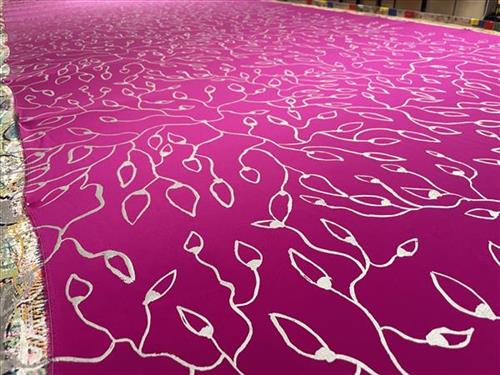
Mankotbe (Bush Onion)

Mankotbe (bush onion) grows under the ground, we follow the vine to dig it up. It is brown on the outside and white inside and we cook it on the fire, just like a potato. All the old people used to eat Mankotbe on my homeland. My grandmother showed me how to find that plant and the first time I ate so much my mouth got sore! You can’t be too greedy.

This design brings back good memories for me. I used to eat Mankotbe when I was young and living at my homeland Buluhkaduru. In those old times, my house was made of paper bark and sticks. If we wanted to come into town we had to walk, and it’s a long walk, so we would fill our dilly bags with sugar bag honey, Mankotbe and long yams to eat on the way. They were good times for me.

You can find Mankotbe any time of the year- the plant has big black leaves. When you find one onion, you know there is big mob around- they are always connected by a big long vine underground

377810582169832


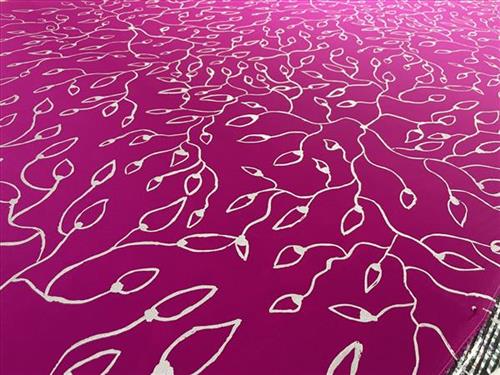
Mankotbe (Bush Onion)

Mankotbe (bush onion) grows under the ground, we follow the vine to dig it up. It is brown on the outside and white inside and we cook it on the fire, just like a potato. All the old people used to eat Mankotbe on my homeland. My grandmother showed me how to find that plant and the first time I ate so much my mouth got sore! You can’t be too greedy.

This design brings back good memories for me. I used to eat Mankotbe when I was young and living at my homeland Buluhkaduru. In those old times, my house was made of paper bark and sticks. If we wanted to come into town we had to walk, and it’s a long walk, so we would fill our dilly bags with sugar bag honey, Mankotbe and long yams to eat on the way. They were good times for me.

You can find Mankotbe any time of the year- the plant has big black leaves. When you find one onion, you know there is big mob around- they are always connected by a big long vine underground

377810582169831


Mankotbe (Bush Onion)

Mankotbe (bush onion) grows under the ground, we follow the vine to dig it up. It is brown on the outside and white inside and we cook it on the fire, just like a potato. All the old people used to eat Mankotbe on my homeland. My grandmother showed me how to find that plant and the first time I ate so much my mouth got sore! You can’t be too greedy.

This design brings back good memories for me. I used to eat Mankotbe when I was young and living at my homeland Buluhkaduru. In those old times, my house was made of paper bark and sticks. If we wanted to come into town we had to walk, and it’s a long walk, so we would fill our dilly bags with sugar bag honey, Mankotbe and long yams to eat on the way. They were good times for me.

You can find Mankotbe any time of the year- the plant has big black leaves. When you find one onion, you know there is big mob around- they are always connected by a big long vine underground

377810582169612


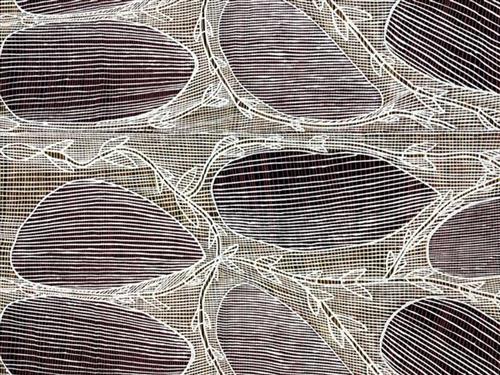
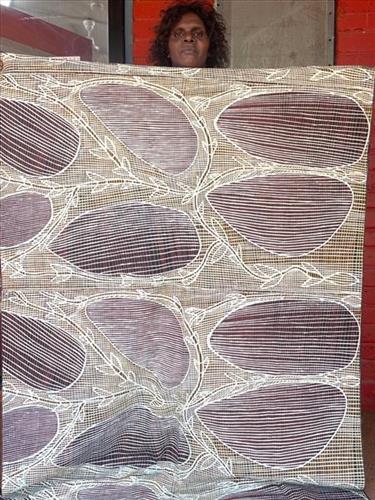
Kunwardde dja Karrbarda (Rocks and Yam Vine)

Susan Marawarr is a Kuninjku artist from the Kurulk clan whose country lies around the outstation of Mumeka in central Arnhem Land. In this design, she has depicted karrbarda (long yam) on her traditional country, the kunwardde (stone country).

The large stones represent the kunwardde rocky outcrops, which are elevated above the flat floodplains. The vines creeping around the large rocks are from the karrbarda. Women dig up karrbarda with kungarrndutj (digging sticks) and they are then cooked in the ashes of the fire to be eaten.

These yams are purple on the saltwater side of country and on inland freshwater country they are white. Karrbarda are an important manme (bush food) that are collected during the wet and dry seasons.

This fabric was printed by Publisher Textiles, Sydney. 

377810582169611


Wubbunj (Paperbark Canoe)

“Wubbunj is our traditional canoe. This design is the old history story of how people came to live in this place we call Maningrida. Two old people were staying on the other side of the saltwater, in Narlarrambarr area. The old people slept in a paper bark shelter and hunted on the water using their canoe.

A long time ago our people carved these canoes from the big paperbark trees. They had paddles with one person at the front, one at back, and other kids and passengers in the middle. Kunkot (paper bark) was used to make the sails which they would stand up and catch the wind.

One day these old people saw a new boat in their waters, which belonged to the Makassans (Indonesians). Those two old men saw the big Makassan boat coming in, and decided to paddle their canoe from Narlarrambarr to the other side (modern day Maningrida). We were scared of the Makassans, they gave us tobacco and tea, but they took many of our women.

When those two old people tasted that water at Maningrida from the Djomi spring, it was sweet freshwater and they decided to stay here. People here had no clothes in those time, we were just wearing string morkoi (loin cloths). Seven tribes were here then, but now in Maningrida there are lots more languages.” – Raylene Bonson

Note: There is a small blue paint mark in the middle of the fabric. We have discounted this fabric by $40.