377810582257080


Mandjabu

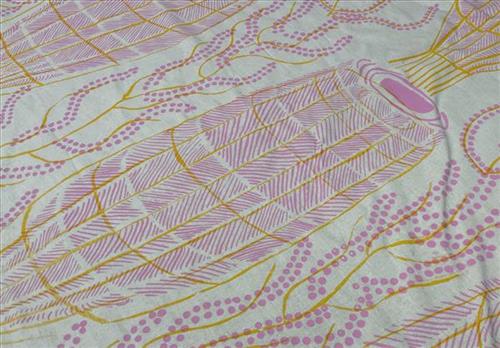
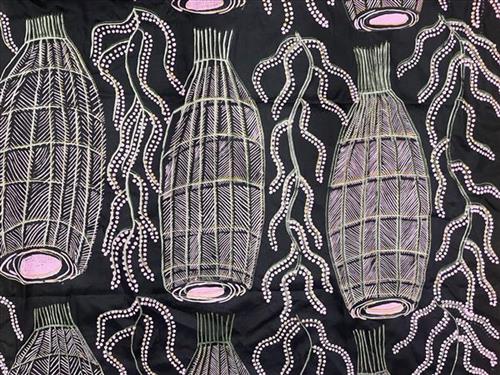
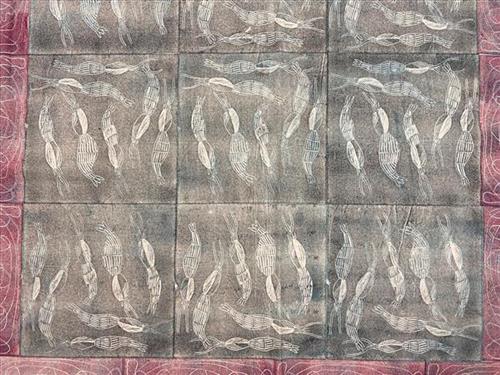
Kuninjku people traditionally make two sorts of conical fish traps. One is called mandjabu and is made from a strong, durable vine called milil, and a smaller one is called manylik mandjabu, and made from the grass manylik. The mandjabuconical fish trap is bigger and stronger and used in tidal reaches of creeks to catch large fish. The smaller, lighter manyliktrap is used in freshwater flowing creeks to catch smaller fish and freshwater prawns. In earlier times, only men were involved in the construction of the large fish traps, but children would often crawl inside and assist.

To make mandjabu, weavers firstly harvest milil (burney vine, Malaisia scandens) and put it in water overnight to make it soft. Then they start weaving it; they make rings for the inside to keep the fish trap’s shape. People also make string from the bark of burdaga (kurrajong) to attach the bardainy (hibiscus) rings and to tie the conical end of the fish trap. It’s hard work and it can take three or four weeks to make a fish trap. People also use fish-net fences called kunkarlewabe. They would put the kunkarlewabe  across rivers and creeks. In the middle they would place the mandjabu. They also used small things like sticks, rocks, mud and grass to block the fish from going through. This way we would catch fish such as saltwater barramundi rajarra, ngaldadmurrng (freshwater barramundi), small black freshwater catfish (buliya), bonefish (an-guwirrpiya), and sand bass (dalakan) in the mandjabu.

377810582254424


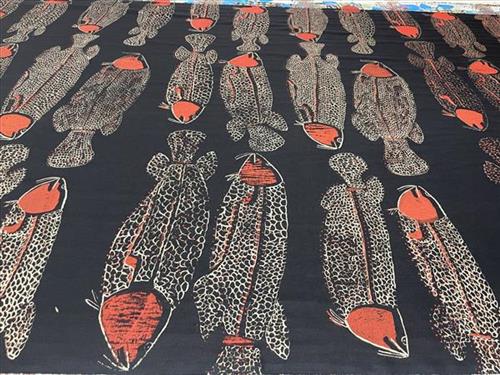
Ngaldadmurrng (Saratoga)

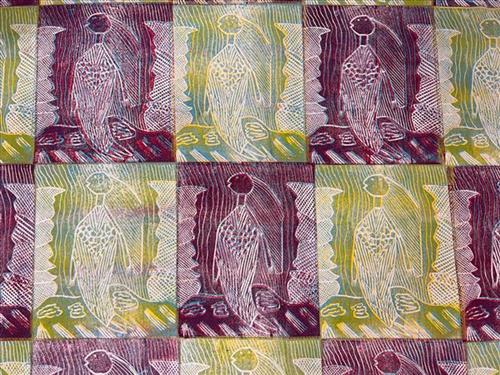
This design tells the story of Saratoga dreaming,  a freshwater fish that swims on the edge of creeks and rivers. This design is the Saratoga dreaming from the Mularra songline. Where the Saratoga we call Murdulngu, Danguny travelled from Malmyangarnak billabong to Mirrigatja.

This Billabong was owned by Murdulngu (Saratoga) before the water was taken over by shark Barlangu he came all the way from east to north then to west. He was travelling when that water level was high he went up the stream but he couldn’t make it. This Barlangu came from Murruggun clan but really this shark came from long way all the way south. This story is connected through Mularra songline it represents many clans.

With permission from clan elders, Carol is able to pass on this family knowledge through her passion in textile and art.


‘I am proud of my first design, I want to keep this design for future, for my children and grandchildren so they remember this story, this story is a big part of the mularra songline’ Carol Liyawanga Campion

377810582254423


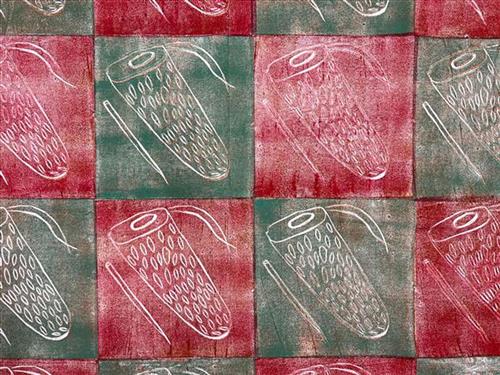
Au-gujechiya (fishtrap) Screen Print

TITLE                          Au-gujechiya

YEAR                          2022

MEDIUM                     Screen print

DETAILS                    2 screen

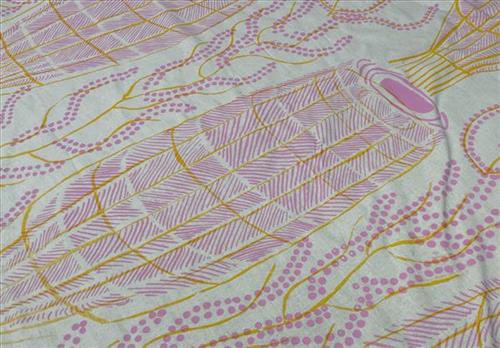
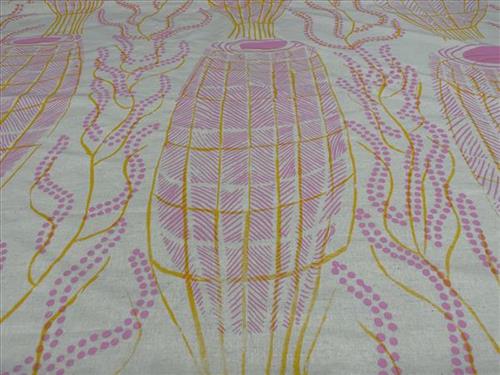
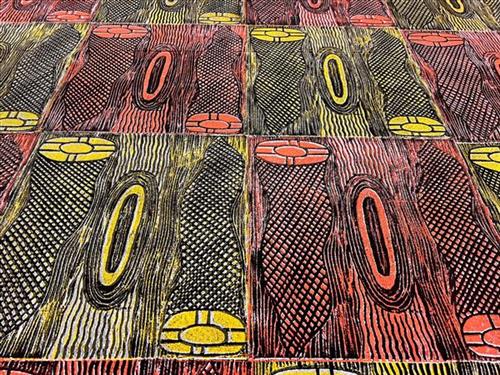
Au-gujechiya  means  fishtrap in the Burrarra language which is one of the traditional  languages spoken in the Maningrida region. Elizabeth’s homeland is Gupanga, Arnhem Land which located on a saltwater estuary, a great place for catching fish.

Elizabeth obtained permission from her djunkay to create a screen print design about a historic object traditionally used to trap fish in rivers, creeks, and estuaries. 

In the early wet season, fish swim upstream for breeding in creeks and billabongs, then downstream to spend the dry season in larger rivers. The traps would be set to face the oncoming fish, with woven fencing either side. Within the mouth of the trap is a woven funnel that guides the fish in and prevents their escape. The clever design ensures that only adult fish are caught as smaller fish can escape through the weaving or even through the funnel. The fish that are caught can survive in the trap for up to two months. Once the trap is removed, the end is untied to remove the fish. This sustainable design means the trap can be used again and again. 

377810582254413


Au-gujechiya (fishtrap) Screen Print

TITLE                          Au-gujechiya

YEAR                          2022

MEDIUM                     Screen print

DETAILS                    2 screen

Au-gujechiya  means  fishtrap in the Burrarra language which is one of the traditional  languages spoken in the Maningrida region. Elizabeth’s homeland is Gupanga, Arnhem Land which located on a saltwater estuary, a great place for catching fish.

Elizabeth obtained permission from her djunkay to create a screen print design about a historic object traditionally used to trap fish in rivers, creeks, and estuaries. 

In the early wet season, fish swim upstream for breeding in creeks and billabongs, then downstream to spend the dry season in larger rivers. The traps would be set to face the oncoming fish, with woven fencing either side. Within the mouth of the trap is a woven funnel that guides the fish in and prevents their escape. The clever design ensures that only adult fish are caught as smaller fish can escape through the weaving or even through the funnel. The fish that are caught can survive in the trap for up to two months. Once the trap is removed, the end is untied to remove the fish. This sustainable design means the trap can be used again and again. 

377810582254388


Au-gujechiya (fishtrap) Screen Print

TITLE                          Au-gujechiya

YEAR                          2022

MEDIUM                     Screen print

DETAILS                    2 screen

Au-gujechiya  means  fishtrap in the Burrarra language which is one of the traditional  languages spoken in the Maningrida region. Elizabeth’s homeland is Gupanga, Arnhem Land which located on a saltwater estuary, a great place for catching fish.

Elizabeth obtained permission from her djunkay to create a screen print design about a historic object traditionally used to trap fish in rivers, creeks, and estuaries. 

In the early wet season, fish swim upstream for breeding in creeks and billabongs, then downstream to spend the dry season in larger rivers. The traps would be set to face the oncoming fish, with woven fencing either side. Within the mouth of the trap is a woven funnel that guides the fish in and prevents their escape. The clever design ensures that only adult fish are caught as smaller fish can escape through the weaving or even through the funnel. The fish that are caught can survive in the trap for up to two months. Once the trap is removed, the end is untied to remove the fish. This sustainable design means the trap can be used again and again. 

377810582254376


Ngalng

Ngalng (fresh water yabby)

‘This is a story from Mankorlod. This is a djang story. This is the creation story about the fresh water yabby. Starting with the stone, that’s the raw one and the cooked one. The stone rock suddenly turned to ngalng, in a flash. Ngalng started growing and turned into a body. It’s a magic one and it can change from rock to ngalng to human and back to ngalng. Now it’s a ngalng. 

The country is near Mankorlod and Korlobididah. The ngalng is stuck there forever on the rock at Korlobididah,’ 

‘There is also duruk (camp dog) called ‘Djanbokkon’. This is a duruk that comes from water and no one has seen it. This is a true duruk, he goes everywhere in the country. His body is striped. He is a secret dog and he has a secret story.’ 

Janet Marawarr 2022