Djabayéna (conefish) and Turtle
A sawfish or ‘conefish’ in Ndjébbana.
The saw shaped snout of the fish is traditionally used as a rasp in working wood.

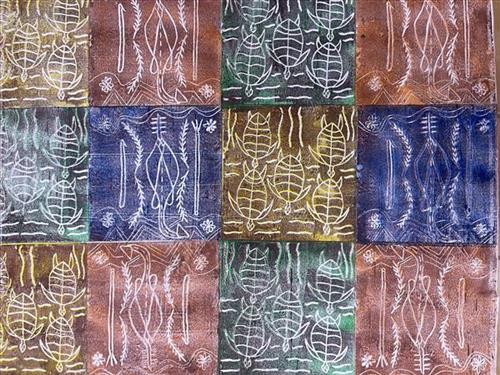
A sawfish or ‘conefish’ in Ndjébbana.
The saw shaped snout of the fish is traditionally used as a rasp in working wood.

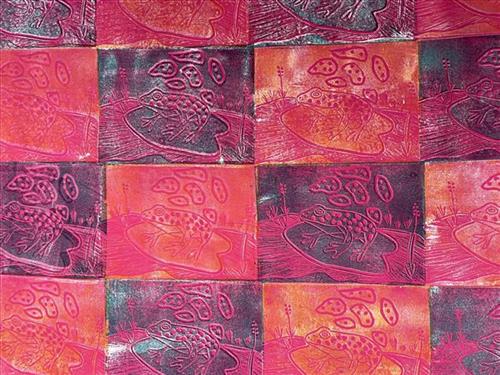
One of Lucy’s latest linocut designs, Romolo, green frog.
Lucy is an experienced textile artist at Bábbarra Women’s Centre. Lucy often references her ancestral stories in her textile work, including Bawaliba (Djinkarr spirit woman), with various lino and screen prints depicting this same narrative.
Lucy is from the Gurr.goni language group – one of the least commonly spoken languages in Arnhem Land. Lucy also speaks another eight Maningrida languages.

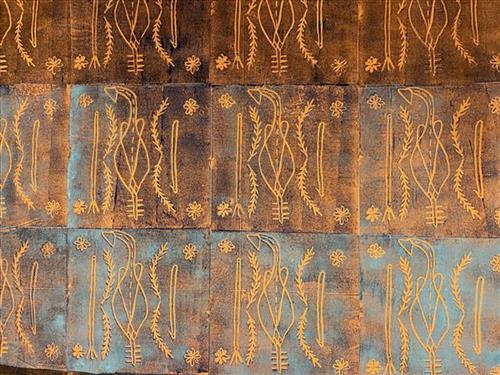
A sawfish or ‘conefish’ in Ndjébbana.
The saw shaped snout of the fish is traditionally used as a rasp in working wood.

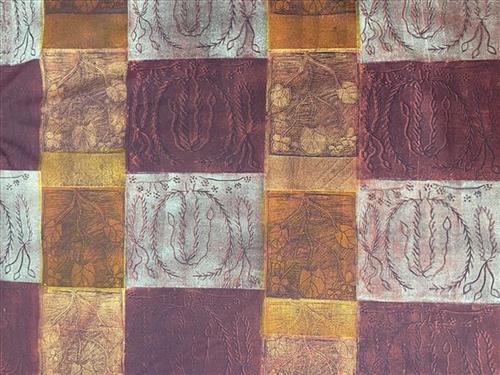

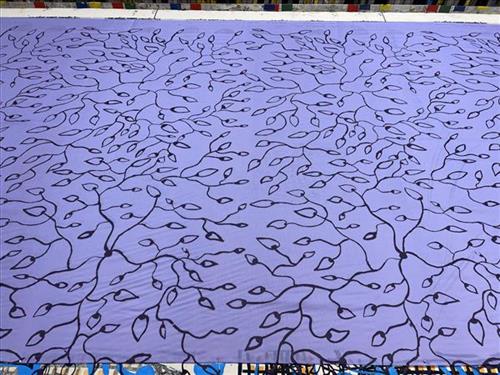
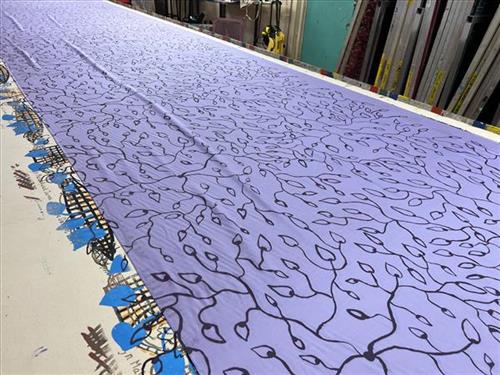
Mankotbe (bush onion) grows under the ground, we follow the vine to dig it up. It is brown on the outside and white inside and we cook it on the fire, just like a potato. All the old people used to eat Mankotbe on my homeland. My grandmother showed me how to find that plant and the first time I ate so much my mouth got sore! You can’t be too greedy.
This design brings back good memories for me. I used to eat Mankotbe when I was young and living at my homeland Buluhkaduru. In those old times, my house was made of paper bark and sticks. If we wanted to come into town we had to walk, and it’s a long walk, so we would fill our dilly bags with sugar bag honey, Mankotbe and long yams to eat on the way. They were good times for me.
You can find Mankotbe any time of the year- the plant has big black leaves. When you find one onion, you know there is big mob around- they are always connected by a big long vine underground.
Fine Chiffon Silk – semi-sheer.

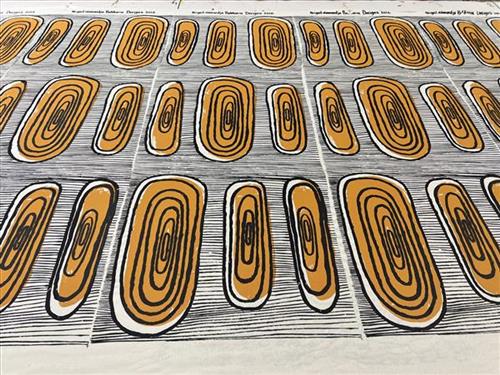
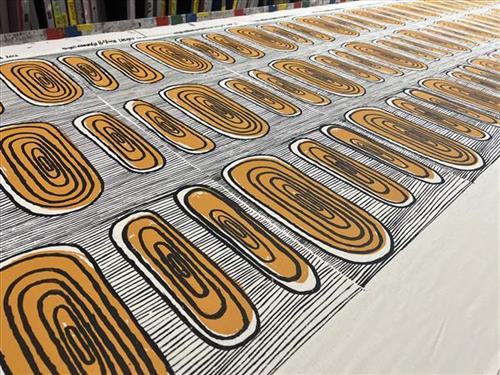
Abigail has depicted the waterholes or Kunwardde dja Kunronj (Sacred Rocks and Billabong) that lie on the plains near Mankorlod, the country for which she is a traditional owner.
The waterholes remain wet throughout the year, even during dry season. This site is connected to the artist’s djang (dreaming), the ngalng (freshwater yabbie) and stone country. Mankorlod homeland is a three-hour drive from Maningrida in the kunwardde (stone country).

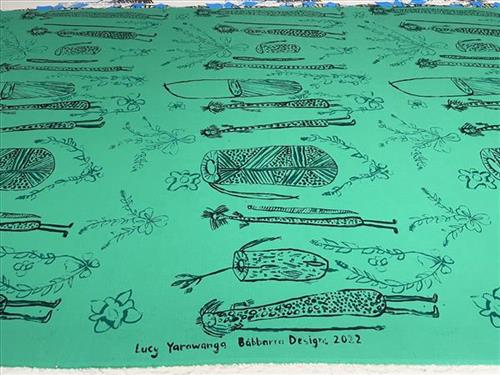
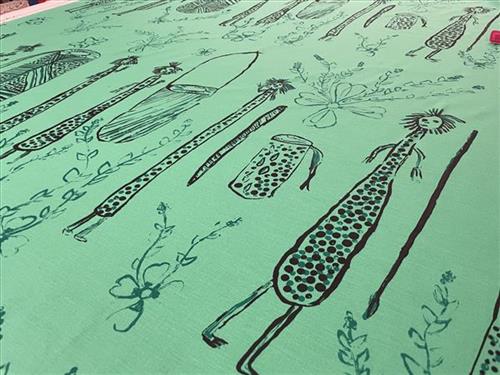
‘Starting back in the caves, before humans, in that place, my country Djinkarr, spirits lived. When Bawaliba (stone country spirit) were hungry, they picked up their dilly bags and went walking to collect food. They found fresh bush flowers and dug them up to plant back home and ate the fruit growing beneath them. On their way home, the Bawaliba came across a big rainbow serpent. Some Bawaliba ran back to the cave, the rest of them tried to fight the serpent with spears and distract it with their loud clap sticks and singing, but the rainbow serpent won and ate them.
When we go there to my country, we see the Bawaliba peeping at us every time. They are so cheeky and trick us. Sometimes I tell them ‘Hey leave us alone! We’re busy working on our country!’. They are good spirits they don’t make trouble.’ – Lucy Yarawanga 2023

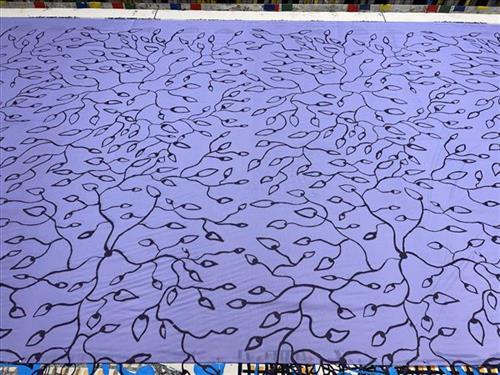
Mankotbe (bush onion) grows under the ground, we follow the vine to dig it up. It is brown on the outside and white inside and we cook it on the fire, just like a potato. All the old people used to eat Mankotbe on my homeland. My grandmother showed me how to find that plant and the first time I ate so much my mouth got sore! You can’t be too greedy.
This design brings back good memories for me. I used to eat Mankotbe when I was young and living at my homeland Buluhkaduru. In those old times, my house was made of paper bark and sticks. If we wanted to come into town we had to walk, and it’s a long walk, so we would fill our dilly bags with sugar bag honey, Mankotbe and long yams to eat on the way. They were good times for me.
You can find Mankotbe any time of the year- the plant has big black leaves. When you find one onion, you know there is big mob around- they are always connected by a big long vine underground

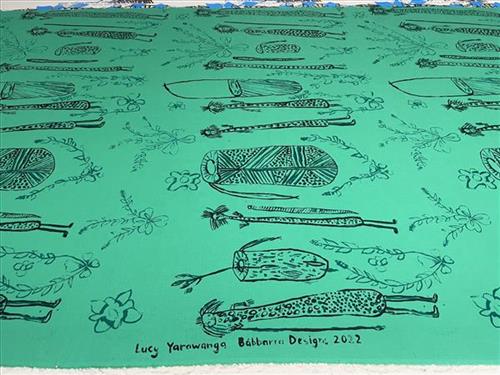
This new design from workshops held in 2022 depicts Bawáliba and dilly bags against a background of stylised bush flowers. Lucy has dressed her Bawaliba with skin textures using a spot technique fro the back of her paint brush.

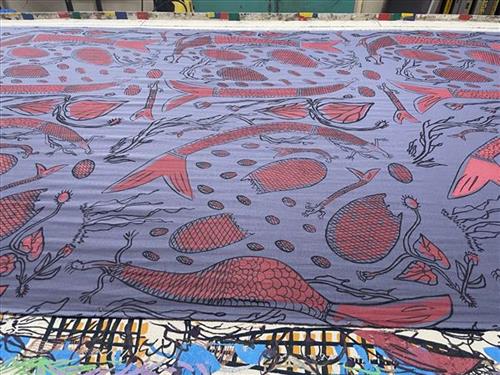
This design depicts the story of the artist’s ancestral dreaming, the Djomi fresh water spirit mermaid.
The Djomi figure is a mermaid like spirit with fish tail that lives in the fresh water stream that flows out to the sea cliff near Maningrida. Djomi is a known to be a very powerful fertility symbol.
‘If you go there you can get pregnant easily. Djomi has babies, and they can give others babies too. The Djomi spirit is so powerful, that women can end up with multiple babies at once, twins or sometimes even more. The Djomi spirits lay eggs near the sacred freshwater stream in Maningrida. Inside the eggs are human babies as well as young Djomi.
Men do not go near that swamp, because Djomi is so powerful that men might get pregnant there too. So men, they are too scared of that Djomi. When we visit the Djomi freshwater spring, we can hear young Djomi crying. They sound like normal babies crying, those Djomi spirits. They are looking for a mother.
This Djomi is my dreaming, I got permission from my djunguys to paint this Djomi design. For me I always ask my djunguy permission to paint, because that is our cultural way.
This design also depicts the fresh water lily leaves, and seaweed from the base of the sea floor.