377810582214259


Kunwardde dja Karrbarda (Rocks and Yam Vine)

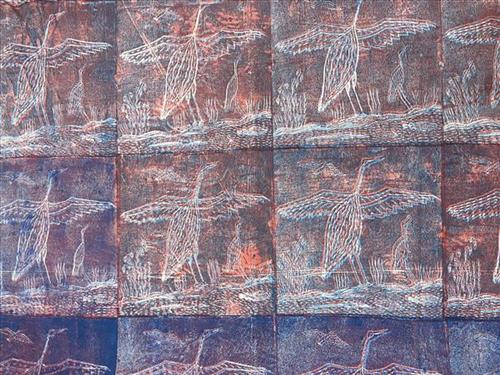
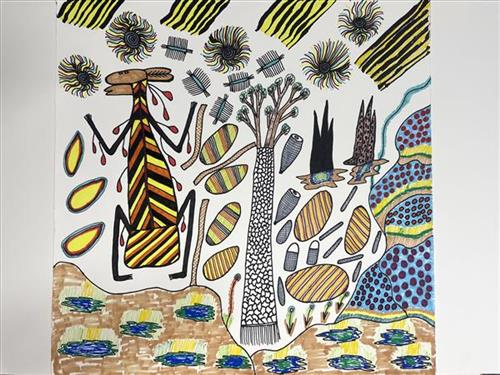
Susan Marawarr is a Kuninjku artist from the Kurulk clan whose country lies around the outstation of Mumeka in central Arnhem Land. In this design, she has depicted karrbarda (long yam) on her traditional country, the kunwardde (stone country).

The large stones represent the kunwardde rocky outcrops, which are elevated above the flat floodplains. The vines creeping around the large rocks are from the karrbarda. Women dig up karrbarda with kungarrndutj (digging sticks) and they are then cooked in the ashes of the fire to be eaten.

These yams are purple on the saltwater side of country and on inland freshwater country they are white. Karrbarda are an important manme (bush food) that are collected during the wet and dry seasons.

377810582214236


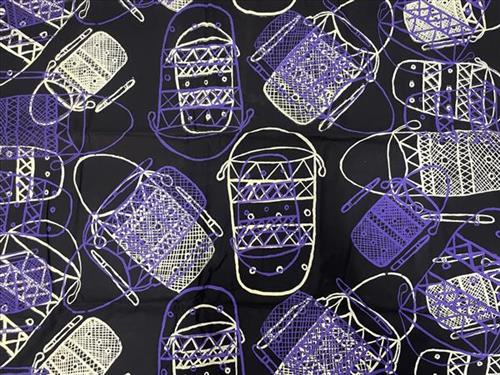
Dedded Wongkorr

This design depicts a ‘wongkorr’ sacred dilly bag woven with brightly coloured orange parrot feathers called ‘dedded’. It is depicted alongside a digging stick. Wongkorr are used in a number of public ceremonial contexts, and are sacred objects for the Bininj Kunwok speaking people of Western Arnhem Land.

‘This is a really special kind of dillybag for us, not like a normal dillybag.

This story was from a long time ago, when my great great grandfather was alive. He’s the one that was a medicine man for our people.
We are not supposed to see that sacred spirit dillybag that lives below the saltwater. If we ever see that site, it might drag us under and drown us. When the tide goes out he floats and when the tide comes in he goes under to hide.

This story is about fresh water and salt water mixing and our ancient law. There are strings of the Wongkorr hold it under the water. The Wongkorr is made with lorikeet parrot feathers and Kurrajong bark string.

I remember having a ceremony at that outstation Bolkjam when I was only 16 years old, near Ji Bal-bal homeland, and my father would tell me the story of the Wongkorr sacred site. My two sisters taught me to paint, and my Dad was a famous painter. Some balanda (non-Indigneous) know my father’s painting, it is about digging sticks, sharks and wongkorr.

This story links to mixed water, plant life and animals living at the artist’s country, and following the lessons and knowledge of the ancestors.’ Elizabeth Kala Kala

377810582214594


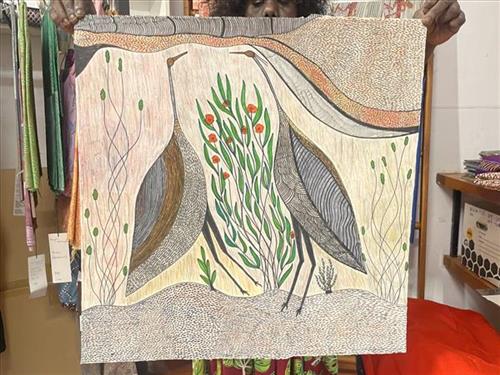
Ngalkordow (Brolga) and Kawk (heron)

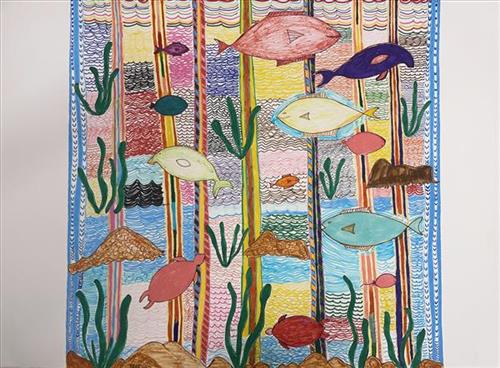
This drawing was made with fibre tipped texta and coloured pencil. One of the birds is Ngalkordow (on the left) the bird on the other side we call Kawk (rufus night heron). 

Both birds live on fresh water country. The come in black, brown and white. They are pictured beside their food – dikkala which is bush potato. 

Jay Jurrupula Rostron 2023

377810582214595


Dakarra (cockle) – Helen Kaminski

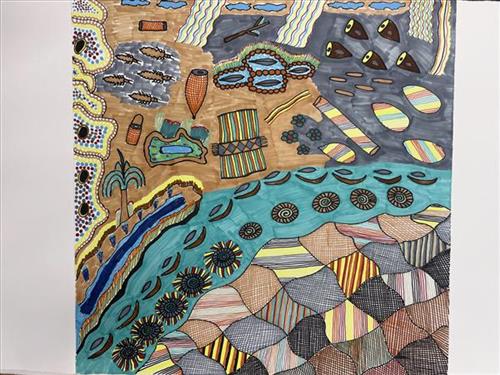
Dakarra is the Burrara Gun-nartpa word for a type of cockle shell with prominant scaled ribs and an orange colour. This is part of a diet of shellfish which has been enjoyed by people whose country lies on the saltwater estuaries at the opening of  rivers throughout Arnhem Land.

Elizabeth Wullunmingu’s mother country is Djunawunya, near Gupunga on the Bligh river. This is saltwater country. Her design Dakarra represents a songline for this particular type of edible shellfish and the fishing lifestyle that is enjoyed by her people. 

Elizabeth’s grandfather Frank Gurrmanamana was seen in the documentary ‘Waiting For harry’  1978  by Ronin films which is filmed on Elizabeth’s mother country, Djunawunya. In this documentary, the late Frank Gurrmanamana is preparing the final mortuary ceremonies for his brother who died six years before. Central to the ceremonies is Harry Diama, the senior blood-relative of the deceased man, but Harry lives in Maningrida and is pre-occupied with a pending court-case there involving his son.

https://www.sbs.com.au/topics/video/1068702275809/Waiting-For-Harry


377810582214549


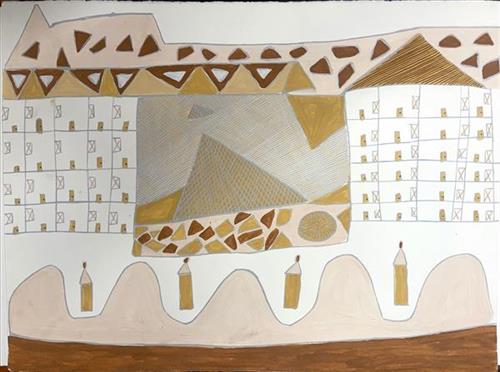
Kunred Kodbarre (The Louvre)

“This design is new and tells a different story of when I went to Paris. This building in the middle of my design is the Louvre. We went and saw that big building made of glass, and there were lots of people walking around. In Paris, there is a big creek made from bricks, with water flowing through the city. I have painted it here too, with the light poles next to it. There are so many tall buildings in Paris. When I see this design, I remember everything about my trip to Paris. For this design I had the idea of putting our Aboriginal bush tucker around the Louvre, so the plants here are kundayarr (pandanus), wayuk (water lily) and karrbarda (long yam). I painted some French trees too’.

In 2019 five artists from Babbarra Women’s Centre travelled to France for the opening of their exhibition Jarracharra: Dry Season Wind. Deborah Wurrkidj, Jennifer Wurrkidj, Janet Marawarr, Jacinta Lami Lami and Elizabeth Kala Kala danced at the opening of the exhibition to a packed embassy gallery, and hosted various public panels including at the Musee du Quai Branly. The artists featured in Vogue magazine, wearing garments featuring their own printed designs on the balcony of the Ambassador to France, with a panoramic view of the Eiffel Tower in the background.

Inspired by the same voyage, on return to Maningrida Deborah Wurrkidj wove a sculpture of the Eiffel Tower out of naturally dyed pandanus, titled Ngaye ngawam nganang kunred  kukimukken, kubba nakornamkuyeng karri (I travelled a long way away, to that place with the tall tower). The work was a finalist in the prestigious 2020 Telstra National Aboriginal & Torres Strait Islander Art Awards (NATSIAA).

377810582214545


Ngalng

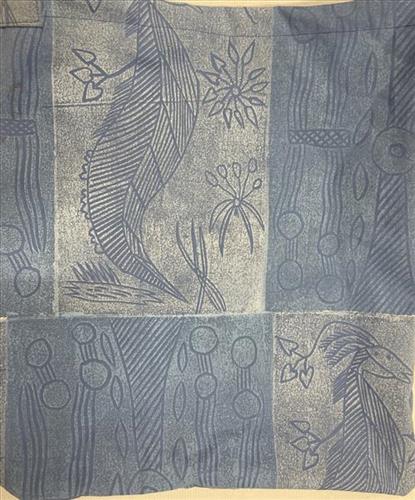
Ngalng (fresh water yabby)

‘This is a story from Mankorlod. This is a djang story. This is the creation story about the fresh water yabby. Starting with the stone, that’s the raw one and the cooked one. The stone rock suddenly turned to ngalng, in a flash. Ngalng started growing and turned into a body. It’s a magic one and it can change from rock to ngalng to human and back to ngalng. Now it’s a ngalng. 

The country is near Mankorlod and Korlobididah. The ngalng is stuck there forever on the rock at Korlobididah,’ 

‘There is also duruk (camp dog) called ‘Djanbokkon’. This is a duruk that comes from water and no one has seen it. This is a true duruk, he goes everywhere in the country. His body is striped. He is a secret dog and he has a secret story.’ 

Janet Marawarr 2022

377810582214518


Yokkarra (fish)

‘Hi it’s me Marilyn! I’m the age of 52. I like working at the women centre and doing lino printing but I prefer screen printing. I have one design, that’s lorrkkon (hollow log). My great grandfather used to make lorrkkon and do bark paining. I never met him but I heard a lot of stories about him. My mother used to tell me history stories. When I was 16 my parents passed away. I’m was on my own but now I’ve got my own family and my partner who helps me. I’ve got 6 grandchildren.

My homeland is Entrance island, Haulround island and Juda point. I really like Haulround island and that’s where we collect barruar (seagull egg). Entrance island is my favourite camping area, I go across with boat. Balanda (non-Aboriginal or European people) can’t go into those islands or Juda point without permission from me.

Come and chat to me if you want to go to any of those places. We have a sacred totem ngaduma (palm tree) at those places and if people destroy it, we will have a strong wind and maybe a cyclone.’

Marilyn James 2021

377810582214511


Namorrorddo Part 3

Mythical creatures of a malevolent nature, namorrorddo are shooting star spirits. They have long claws and trails of white light coming from their heads. They also carry a long club called miyarrurl which they use to beat victims.Yiman kabenerohrok nakidjkidj ya nakka wanjh kabenerohrok namorrorddo. Namorrorddo kabirlikan, bidngalnjkuyeng yoh.

Namorrorddo is similar to the spirit called ‘Nakidjkidj’, the same as Nakidjkidj. Namorrorddo however carries light (ie. the shooting star) and has really long claws, yes.

Source: https://www.njamed.com/

377810582214505


Namorrorddo Part 2

Mythical creatures of a malevolent nature, namorrorddo are shooting star spirits. They have long claws and trails of white light coming from their heads. They also carry a long club called miyarrurl which they use to beat victims.Yiman kabenerohrok nakidjkidj ya nakka wanjh kabenerohrok namorrorddo. Namorrorddo kabirlikan, bidngalnjkuyeng yoh.

Namorrorddo is similar to the spirit called ‘Nakidjkidj’, the same as Nakidjkidj. Namorrorddo however carries light (ie. the shooting star) and has really long claws, yes.

Source: https://www.njamed.com/