377810582382067


Woodblock Sari by Bábbarra X Tharangini

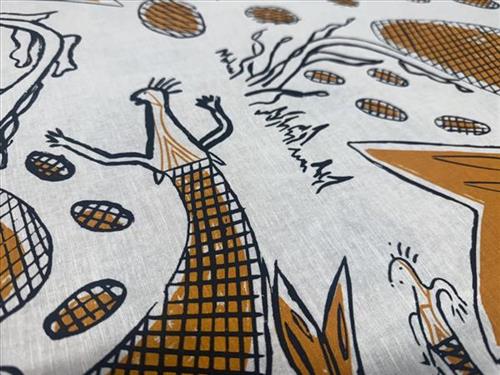
Woodblock print on handwoven silk, extract print with organic dyes, 100% Silk

Co-created by Bábbarra Women’s Centre, Maningrida and Tharangini Studio, India

Printed by artisans at Tharangini Studio 

Design brief by Bábbarra Women’s Centre Artists

Woodblock carving by Shri C.H. Sreeram and Shri S.K. Rajak

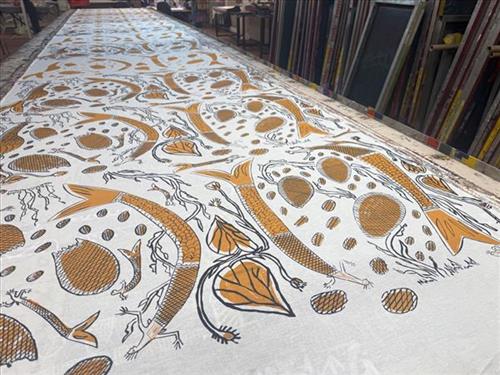
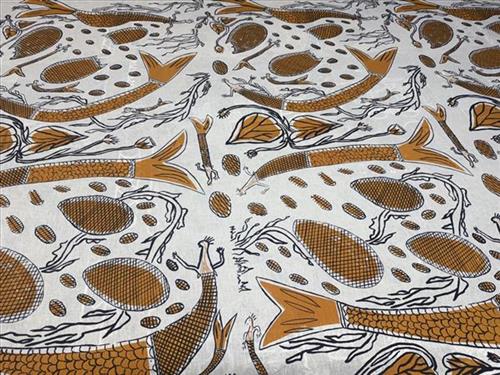
This fabric may feature the following woodblock designs. 

  • LORRKON (Hollow logs) by raylene Bonson and Joy Garlbin
  • MANDJABU (FISH TRAP) by Raylene Bonson
  • RAINBOW SERPENT AND BAWALIBA by Verity Bangarra


BACKGROUND

Bábbarra Women’s Centre is located in the Djelk area of Arnhem Land, in a town known as Maningrida and was established in 1987. We represent over 50 women artists from 12 languages and operate under the First Nations-owned Bawinanga Homelands Aboriginal Corporation. The artists at Bábbarra Women’s Centre design screen printed and lino print textiles that illustrate the djang or rich cultural narratives, histories and powerful creation stories of West Arnhem Land. The tradition of lino printing began in the mid-1990s as a way for women to become economically empowered.

Tharangini Studio was established in 1977 in Bangalore by artist and textile enthusiast Lakshmi Srivathsa. Today, it is managed by Srivathsa’s daughter, Padmini Govind, whose global corporate career in technology and defence has led to ingenious eco-friendly printing practices within the lush tropical locale. Under Padmini’s leadership, Tharangini is the only artisan studio with a NEST Ethical Seal of Compliance (fair trade). As the last surviving heritage block print studio in Bangalore, Tharangini is home to one of the largest private archives of vintage woodblocks in India

“Karri-djarrk-durrkmirri means “We work together” in the Kuninjku language of West Arnhem Land and it’s more than cultural exchange with India, it is two way learning.

Tharangini’s skilled artisans worked closely with Babbarra in 2023-2025 to hand-carve some of Babbarra’s old linocut designs into woodblocks. This initiative was supported by the Centre for Australia-India Relations, Maitri Cultural Partnerships Fund 2023.

The creative relationship not only serves art but it also informs a practical and critical archival outcome for Babbarra Women’s Centre. The walls of Tharangini Studio were neatly lined with boxes of durable woodblocks and many over 200 years old and still being printed. At Bábbarra, we house cupboards and shelves of historic and vulnerable lino tiles, some 30 years old but no longer able to be printed. Tharangini Studio specialises in woodblocks carved out of teak by master artisans, creating a solid medium for textile printing. For Bábbarra Women’s Centre artists, this had the added benefit of preserving the original lino designs. Many lino sheets are crumbling and decaying, a process hastened by the kudjewk (wet season) and humid kurrung (build up).

Combining the cultural authority to share djang and print-making practices at Bábbarra Women’s Centre with the tradition of woodblock printing in India, the project exchanges many thousands of years of knowledge across the globe. The Bábbarra artists, as custodians of these designs, must receive permission from their djungkays (ritual manager through the maternal line) to share their stories.

This connection will undoubtedly sustain a lasting and significant impact on the legacy and longevity of Bábbarra Women’s Centre. The story doesn’t end here in honour of the generosity shown by Tharangini Studio, Padmini Govind will join Babbarra Women’s Centre artists in Maningrida for a workshop in June 2025.” 

Extract taken from Karri-djarrk-durrkmirri catalogue essay, Jessica Stalenberg 2025

377810582382518


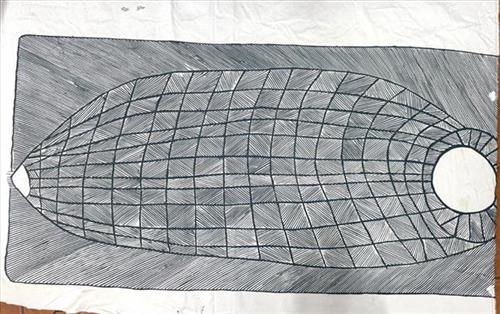
Mandjabu (Fish Trap) – Susan Marawarr

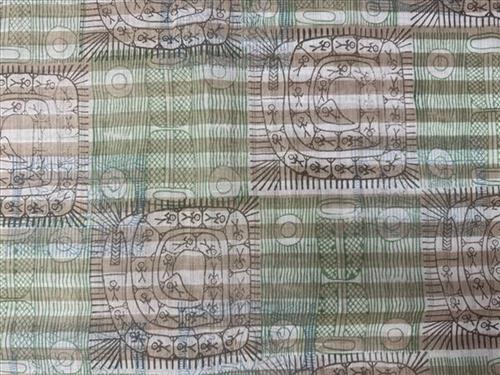
“In old times people would make these mandjabu (fish traps) to go fishing. They are made with vine we find in the jungle. That old man, Anchor Gulunba, he showed me how to make these fish traps. I would sit there and watch him making them. We catch barramundi, catfish, all kinds of fish.” – Helen Lanyinwanga

Kuninjku people traditionally make two sorts of conical fish traps. One called mandjabu made from a vine called milil, and another smaller one called manylik mandjabu, made from the grass manylik. The mandjabu conical fish trap is bigger and stronger and used in tidal reaches of creeks to catch large fish. The smaller, lighter manylik trap is used in freshwater flowing creeks to catch smaller fish and freshwater prawns. Traditionally, only men were involved in the construction of the large fish traps, but children would often crawl inside and assist.

To make fish traps and fish net fences artists firstly get vine (milil) from the jungle and they put it in water for one night to make it soft. Next they start weaving it; they make rings for the inside to keep the fish trap’s shape. Artists work for three or four weeks on the fish trap. They also make string from kurrajong (burdaga) to attach the hibiscus (bardainy) rings and to tie the conical end of the fish trap. This fish trap is used in saltwater and freshwater. People also use fish net fences called mun-dirra. A long time ago they would put the mun-dirra across rivers and creeks. In the middle they would place the an-gujechiya. They also used small things like sticks, rocks, mud and grass to block the fish from going through. People would then catch fish like saltwater barramundi rajarra, freshwater barramundi (janambal), small black freshwater catfish (buliya), bonefish (an-guwirrpiya), and sand bass (dalakan) in these fish traps.

377810582382517


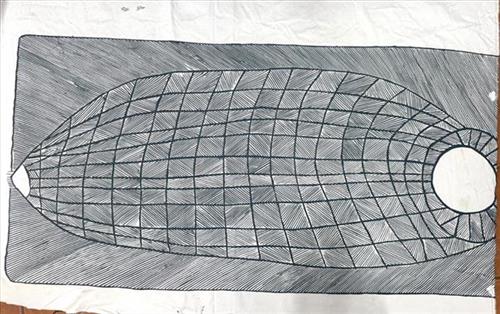
Mandjabu (Fish Trap) – Susan Marawarr

“In old times people would make these mandjabu (fish traps) to go fishing. They are made with vine we find in the jungle. That old man, Anchor Gulunba, he showed me how to make these fish traps. I would sit there and watch him making them. We catch barramundi, catfish, all kinds of fish.” – Helen Lanyinwanga

Kuninjku people traditionally make two sorts of conical fish traps. One called mandjabu made from a vine called milil, and another smaller one called manylik mandjabu, made from the grass manylik. The mandjabu conical fish trap is bigger and stronger and used in tidal reaches of creeks to catch large fish. The smaller, lighter manylik trap is used in freshwater flowing creeks to catch smaller fish and freshwater prawns. Traditionally, only men were involved in the construction of the large fish traps, but children would often crawl inside and assist.

To make fish traps and fish net fences artists firstly get vine (milil) from the jungle and they put it in water for one night to make it soft. Next they start weaving it; they make rings for the inside to keep the fish trap’s shape. Artists work for three or four weeks on the fish trap. They also make string from kurrajong (burdaga) to attach the hibiscus (bardainy) rings and to tie the conical end of the fish trap. This fish trap is used in saltwater and freshwater. People also use fish net fences called mun-dirra. A long time ago they would put the mun-dirra across rivers and creeks. In the middle they would place the an-gujechiya. They also used small things like sticks, rocks, mud and grass to block the fish from going through. People would then catch fish like saltwater barramundi rajarra, freshwater barramundi (janambal), small black freshwater catfish (buliya), bonefish (an-guwirrpiya), and sand bass (dalakan) in these fish traps.

377810582382484


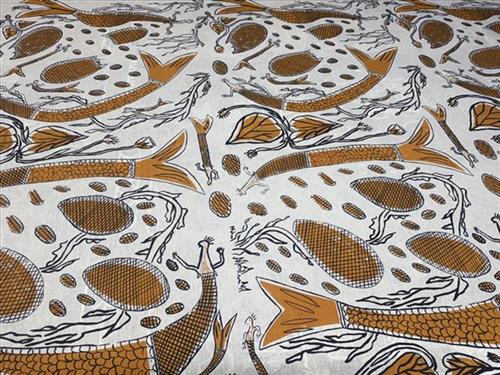
Djomi (Fresh Water Spirit)

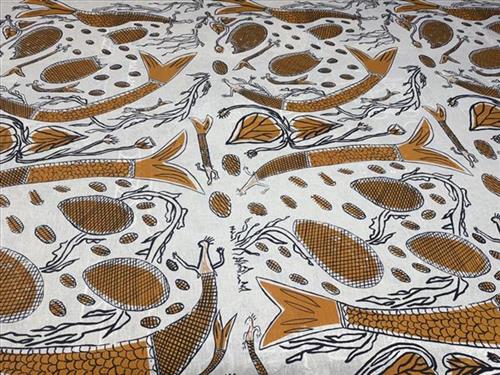
This design depicts the story of the artist’s ancestral dreaming, the Djómi (Fresh Water Spirit).

The Djómi figure is a mermaid-like spirit with fish tail that lives in the freshwater stream that flows out to the sea cliff near Maningrida. Djómi is known to be a very powerful fertility symbol.

“If you go there, you can get pregnant easily. Djómi has babies, and they can give other babies too. The Djómi spirit is so powerful, that women can end up with multiple babies at once, twins or sometimes even more. The Djómi spirits lay eggs near the sacred freshwater stream in Maningrida. Inside the eggs are human babies as well as young Djómi. Men do not go near that swamp, because Djomi is so powerful that men might get pregnant there too. So men are too scared of that Djómi. When we visit the Djómi freshwater spring, we can hear young Djómi  crying. They sound like normal babies crying, those Djómi spirits. They are looking for a mother. This Djómi is my dreaming, I got permission from my djungkay (ritual manager) to paint this Djómi design. For me I always ask my djunguy permission to paint, because that is our cultural way. This design also depicts the freshwater lily leaves and seaweed from the base of the sea floor.” Joy Galrbin

377810582382469


Djomi (Fresh Water Spirit)

This design depicts the story of the artist’s ancestral dreaming, the Djómi (Fresh Water Spirit).

The Djómi figure is a mermaid-like spirit with fish tail that lives in the freshwater stream that flows out to the sea cliff near Maningrida. Djómi is known to be a very powerful fertility symbol.

“If you go there, you can get pregnant easily. Djómi has babies, and they can give other babies too. The Djómi spirit is so powerful, that women can end up with multiple babies at once, twins or sometimes even more. The Djómi spirits lay eggs near the sacred freshwater stream in Maningrida. Inside the eggs are human babies as well as young Djómi. Men do not go near that swamp, because Djomi is so powerful that men might get pregnant there too. So men are too scared of that Djómi. When we visit the Djómi freshwater spring, we can hear young Djómi  crying. They sound like normal babies crying, those Djómi spirits. They are looking for a mother. This Djómi is my dreaming, I got permission from my djungkay (ritual manager) to paint this Djómi design. For me I always ask my djunguy permission to paint, because that is our cultural way. This design also depicts the freshwater lily leaves and seaweed from the base of the sea floor.” Joy Galrbin

377810582382467


Djomi (Fresh Water Spirit)

This design depicts the story of the artist’s ancestral dreaming, the Djómi (Fresh Water Spirit).

The Djómi figure is a mermaid-like spirit with fish tail that lives in the freshwater stream that flows out to the sea cliff near Maningrida. Djómi is known to be a very powerful fertility symbol.

“If you go there, you can get pregnant easily. Djómi has babies, and they can give other babies too. The Djómi spirit is so powerful, that women can end up with multiple babies at once, twins or sometimes even more. The Djómi spirits lay eggs near the sacred freshwater stream in Maningrida. Inside the eggs are human babies as well as young Djómi. Men do not go near that swamp, because Djomi is so powerful that men might get pregnant there too. So men are too scared of that Djómi. When we visit the Djómi freshwater spring, we can hear young Djómi  crying. They sound like normal babies crying, those Djómi spirits. They are looking for a mother. This Djómi is my dreaming, I got permission from my djungkay (ritual manager) to paint this Djómi design. For me I always ask my djunguy permission to paint, because that is our cultural way. This design also depicts the freshwater lily leaves and seaweed from the base of the sea floor.” Joy Galrbin

377810582382442


Djomi (Fresh Water Spirit)

This design depicts the story of the artist’s ancestral dreaming, the Djómi (Fresh Water Spirit).

The Djómi figure is a mermaid-like spirit with fish tail that lives in the freshwater stream that flows out to the sea cliff near Maningrida. Djómi is known to be a very powerful fertility symbol.

“If you go there, you can get pregnant easily. Djómi has babies, and they can give other babies too. The Djómi spirit is so powerful, that women can end up with multiple babies at once, twins or sometimes even more. The Djómi spirits lay eggs near the sacred freshwater stream in Maningrida. Inside the eggs are human babies as well as young Djómi. Men do not go near that swamp, because Djomi is so powerful that men might get pregnant there too. So men are too scared of that Djómi. When we visit the Djómi freshwater spring, we can hear young Djómi  crying. They sound like normal babies crying, those Djómi spirits. They are looking for a mother. This Djómi is my dreaming, I got permission from my djungkay (ritual manager) to paint this Djómi design. For me I always ask my djunguy permission to paint, because that is our cultural way. This design also depicts the freshwater lily leaves and seaweed from the base of the sea floor.” Joy Galrbin

377810582382439


Mankotbe (Bush Onion)

Mankotbe (bush onion) grows under the ground, we follow the vine to dig it up. It is brown on the outside and white inside and we cook it on the fire, just like a potato. All the old people used to eat Mankotbe on my homeland. My grandmother showed me how to find that plant and the first time I ate so much my mouth got sore! You can’t be too greedy.

This design brings back good memories for me. I used to eat Mankotbe when I was young and living at my homeland Buluhkaduru. In those old times, my house was made of paper bark and sticks. If we wanted to come into town we had to walk, and it’s a long walk, so we would fill our dilly bags with sugar bag honey, Mankotbe and long yams to eat on the way. They were good times for me.

You can find Mankotbe any time of the year- the plant has big black leaves. When you find one onion, you know there is big mob around- they are always connected by a big long vine underground

377810582382429


Bawáliba (Stone Country Mimih)

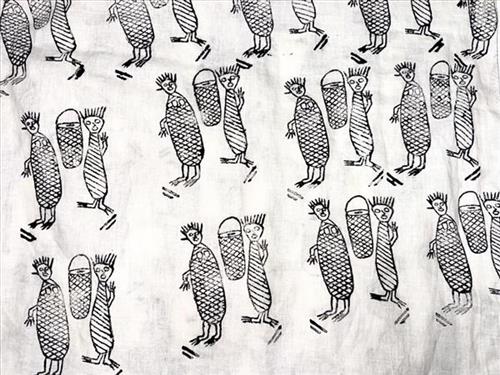
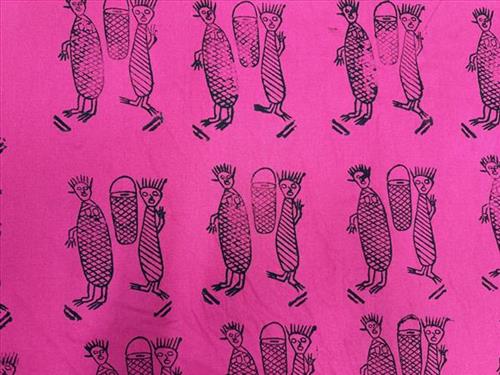
“Bawáliba is the djang (Dreaming) of my mother and my uncles. They are good spirits, they protect us and they recognise families. They are really tall- just like human beings, like us. They dance late at night and have a lot of hair. In olden times, long long long time ago Bawáliba were here, before people were on the land. Bawáliba used to go out hunting and care for Country. They hunt carrying fish traps and digging sticks, near the homeland ,Djinkarr. They go out hunting on the floodplains with dilly bags and digging sticks. They collect a lot of bush foods, and sleep together with one bark shelter.
Sometimes now they still come alive when we sleep, they might come to our houses and peep through the window. At night, they cover themselves with white clay and red cloth tied around their waist. If we hear them, we jump out of bed and get up to look -but they have disappeared, they’re just too quick. Bawáliba might knock on the window to remind us they are there looking out for us.If you listen deeply, you can hear them whisper, sometimes they talk about us and might say, ‘why are those people making camp here?’ then they realise ‘Oh they are family from here, it’s ok, they are just sleeping here for the night’.

During the day they always turn into stone and they sleep. We still know that green rock covered in moss near Djinkarr, that’s Bawáliba sleeping. Some of my ancestors used to speak the same language as the Bawáliba, but all those old people have passed away now. It’s a little bit sad for us, because no one can speak that Bawáliba language anymore.”

Lucy Yarawanga 2019

377810582382427


Bawáliba (Stone Country Mimih)

“Bawáliba is the djang (Dreaming) of my mother and my uncles. They are good spirits, they protect us and they recognise families. They are really tall- just like human beings, like us. They dance late at night and have a lot of hair. In olden times, long long long time ago Bawáliba were here, before people were on the land. Bawáliba used to go out hunting and care for Country. They hunt carrying fish traps and digging sticks, near the homeland ,Djinkarr. They go out hunting on the floodplains with dilly bags and digging sticks. They collect a lot of bush foods, and sleep together with one bark shelter.
Sometimes now they still come alive when we sleep, they might come to our houses and peep through the window. At night, they cover themselves with white clay and red cloth tied around their waist. If we hear them, we jump out of bed and get up to look -but they have disappeared, they’re just too quick. Bawáliba might knock on the window to remind us they are there looking out for us.If you listen deeply, you can hear them whisper, sometimes they talk about us and might say, ‘why are those people making camp here?’ then they realise ‘Oh they are family from here, it’s ok, they are just sleeping here for the night’.

During the day they always turn into stone and they sleep. We still know that green rock covered in moss near Djinkarr, that’s Bawáliba sleeping. Some of my ancestors used to speak the same language as the Bawáliba, but all those old people have passed away now. It’s a little bit sad for us, because no one can speak that Bawáliba language anymore.”

Lucy Yarawanga 2019