377810582360775


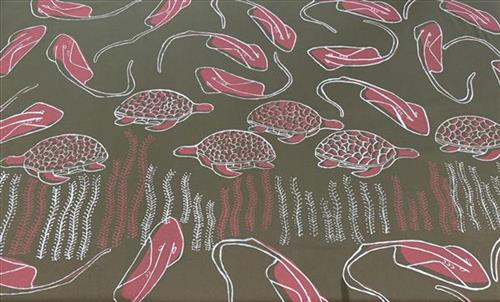
Mabbúlarr (Calm Still Water)

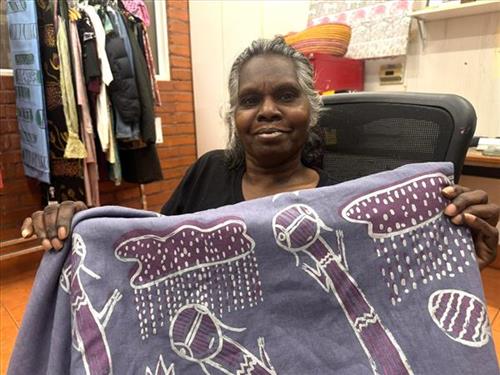
Mabbúlarr is the Ndjébbana word describing calm and stillness – both regarding people and the ocean.

This design tells the story of underwater life in the shallows. The turtle we call marláddja (green turtle, Chelonia mydas) and the stingray we call marnandjúbba (Cowtail Stingray, Pastinachus sephen).

‘When strong wind blows the sea is rough, when there’s no wind the sea is calm. We call that mábbularr. You can see through the water and look at the turtle and stingray eating karlómerr (sea grass) and dancing underwater to find their mate. When we go on the boat hunting, we go at times of mábbularr.

In the old days men used to hunt with a canoe and with traditional made harpoon.  Guided by our ancestors’ spirits they would paddle all day to find sea turtle and dugongs in the right places. The men had to be smart for the tide and know the weather to balance their canoes. They would go at times of mábbularr (calm), early morning in daytime or at night-time when there is no moon and the water glows. We call the night-time glimmer of phosphorescence mílarrng-milarrng. Today people still go hunting, it brings a lot of families together and they share eating down the beach.

We have songline for sea turtle, also men paint turtle on their back and dance turtle in the Míddjarn the same way turtle dance underwater. It is very important we look after our country and songline passed on from many generations’. Josephine James 2021

377810582360767


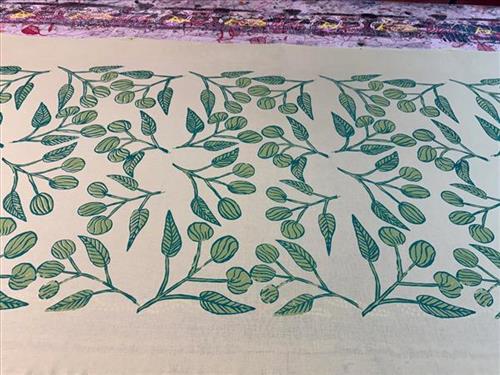
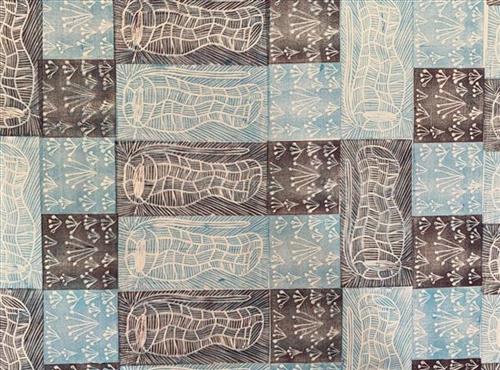
Kunmadj (dilly bag) and Kundalk (grass) – Temika

There are two distinct Lino print designs in this fabric. 

The first depicts a kunmadj (dillybag) made with Kundayarr (pandanus fibre). The second tile depicts Kundalk ( grass). 

This is Temika’s first Lino print design. She is the granddaughter of internationally acclaimed fibre and textile artist, Deborah Wurrkidj.

Works in fibre from the Maningrida region are widely recognised as some of the finest in Australia. Artists confidently push the boundaries of fibre craft and cultural expression, adapting traditional techniques and forms to produce strikingly inventive and aesthetically exquisite artworks.  Artists usually use kundayarr, pandanus spiralis, to weave decorative round or oblong mats, as well as the less common triangular and conical shapes. Weaving is physically hard work, now done only by women. They colour the pandanus using natural dyes made from the roots, leaves or flowers of plants within the weaver’s clan estate. 

377810582359797


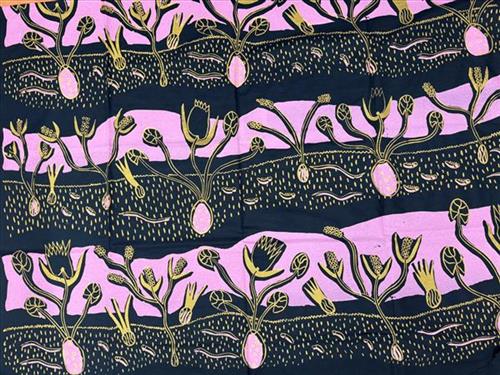
Kukurlk Kare (Going Underground)

Karrinung kukurlk kare, karrijare manme (we are going underground looking for food).

“This is my country. In this painting, I’m looking at her little bit different way. This is what we see when we’re kukurlk kare (going underground)

Man-kurndalh (Black plum) I call mother. It is my mother’s Djang/Dreaming. The bush onion (kulumuduk) is white, the same as onions you buy at the store. We don’t eat this one though, it’s poison.

Wayuk is the water lily, with the big root growing in the earth. This is when that water is drying up a bit. There are worms and beetles- this is what we see underground, when we are digging for manme.”

-Jennifer Wurrkidj


377810582359792


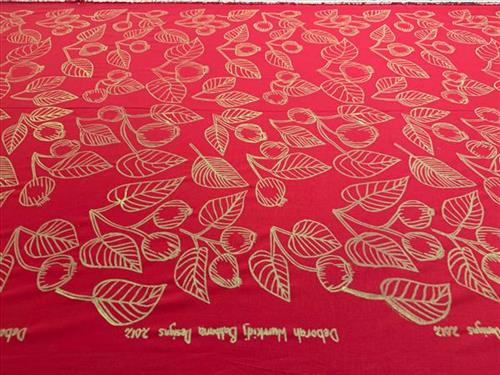
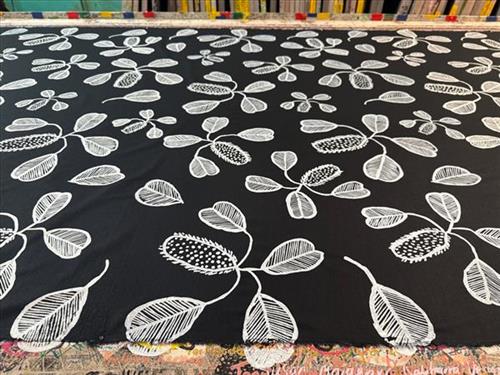
Man-djarduk (Red Bush Apples)

Deborah Wurrkidj is a Kuninjku artist from the Kurulk clan whose country lies around the outstation of Mumeka in central Arnhem Land.

In this design she has depicted man-djarduk (red bush apples) – a sweet, crisp bush food that is a favourite to collect.

Man-djarduk fruits in kurrung and kunumeleng seasons, the build-up and first rains seasons.

377810582359733


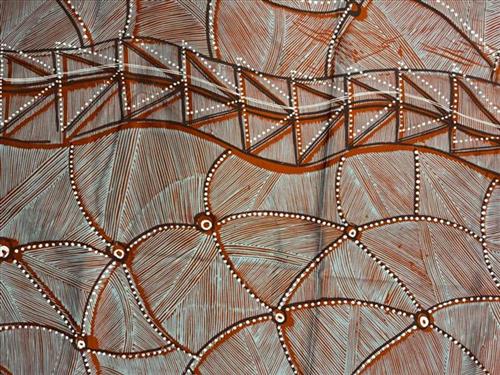
Kunkurra (Spiral Wind)

‘My designs, they are all alive living up in my head’- Janet Marawarr

Janet Marawarr has depicted kunkurra, the spiralling wind associated with several sites in the Kardbam clan. On one level, this design can be interpreted as a depiction of the kinds of mini-cyclones common during the wet season in Arnhem Land, where the artist lives. Kunkurra also relates specifically to a site called Bilwoyinj, near Mankorlod, on the artist’s clan estate.

At this site, two of the most important Kuninjku creation beings, a father and son known as na-korrkko, are believed to have hunted and eaten a goanna. They left some of the goanna fat behind at the site, which turned into the rock that still stands there today.

Bilwoyinj site is also a ceremonial ground for a ceremony called Yabbaduruwa, a major ceremony owned by the Yirridja patrimoiety. The Yabbaduruwa ceremony is primarily concerned with initiation, land ownership and promoting the cyclical regeneration of the human and natural worlds.

377810582359727


Man-djarduk (Red Bush Apples)

Deborah Wurrkidj is a Kuninjku artist from the Kurulk clan whose country lies around the outstation of Mumeka in central Arnhem Land.

In this design she has depicted man-djarduk (red bush apples) – a sweet, crisp bush food that is a favourite to collect.

Man-djarduk fruits in kurrung and kunumeleng seasons, the build-up and first rains seasons.

377810582359696


Yawkyawk la Kunronj (freshwater mermaid) 2005

This screen print was created by the young Jennifer Wurrkidj, one of the most prolific artists at Bábbarra Women’s Centre. This design was re exposed onto screen after Kamanj passed away. Her sister Deborah Wurrkidj talks about this design.


At that time the children were all going to homelands school. The design shows too many yawkyawk in the billabong at Barridjowkeng a very sacred Yirridjidja site for Kuninjku people.

The design shows  kundayarr (pandanus) and wayuk (waterlily) around the billabong.

Our grandfather on our mothers side used to live at this site and they used to drink the water from this billabong. There is now an Outstation located at this site. 

This scene shows wet season as we can see by the mandjewk – (heavy rainclouds). The yawkyawk love the sound of the rain. 

Yawkyawk are young girls but they are spirits from kunred (country) that have fish tails. 

377810582360156


Manyawok (Cheeky Yam)

This design depicts the cheeky yam, which is found on the artist’s country, near the outstation of Mumeka in central Arnhem Land. Yams are an important bush food that are collected during the wet season.

Unlike other yams that can be eaten roasted, the cheeky yam can be poisonous if not properly prepared. The preparation process of the yam traditionally takes two days. Firstly, the yams are dug up with a digging stick and boiled over a fire. They are then peeled and sliced into thin strips, which are placed in a special dillybag woven by women from pandanus leaves. The yam-laden dillybag is then strung from an overhanging branch into a river, so the bag just touches the flowing fresh water. The cheeky yams are left like this overnight to allow the running water to remove the toxins. The next morning, people return and collect the dillybag, and leave the yam pieces in full sunlight to dry out. Finally, when the yam pieces have dried in the sun for a day, they are ready to eat.

377810582360648


Kunwardde dja Karrbarda (Rocks and Yam Vine)

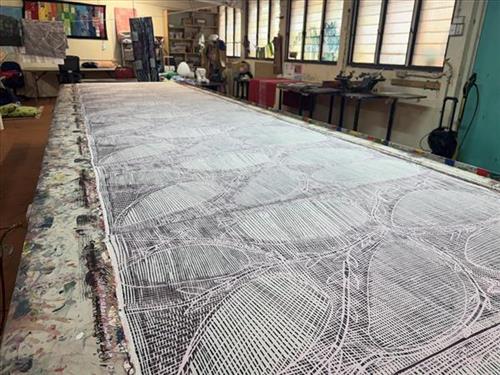
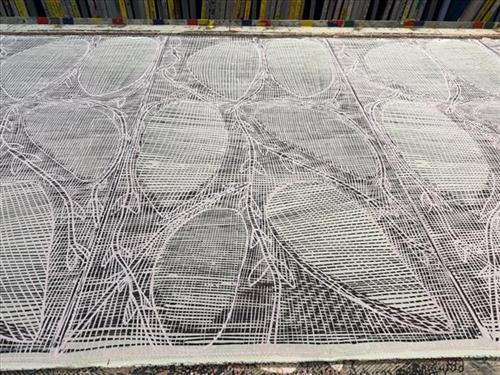
Susan Marawarr is a Kuninjku artist from the Kurulk clan whose country lies around the outstation of Mumeka in central Arnhem Land. In this design, she has depicted karrbarda (long yam) on her traditional country, the kunwardde (stone country).

The large stones represent the kunwardde rocky outcrops, which are elevated above the flat floodplains. The vines creeping around the large rocks are from the karrbarda. Women dig up karrbarda with kungarrndutj (digging sticks) and they are then cooked in the ashes of the fire to be eaten.

These yams are purple on the saltwater side of country and on inland freshwater country they are white. Karrbarda are an important manme (bush food) that are collected during the wet and dry seasons.

377810582360647


Kunwardde dja Karrbarda (Rocks and Yam Vine)

Susan Marawarr is a Kuninjku artist from the Kurulk clan whose country lies around the outstation of Mumeka in central Arnhem Land. In this design, she has depicted karrbarda (long yam) on her traditional country, the kunwardde (stone country).

The large stones represent the kunwardde rocky outcrops, which are elevated above the flat floodplains. The vines creeping around the large rocks are from the karrbarda. Women dig up karrbarda with kungarrndutj (digging sticks) and they are then cooked in the ashes of the fire to be eaten.

These yams are purple on the saltwater side of country and on inland freshwater country they are white. Karrbarda are an important manme (bush food) that are collected during the wet and dry seasons.