Mandudjmi (green plum)
*Green Plum –

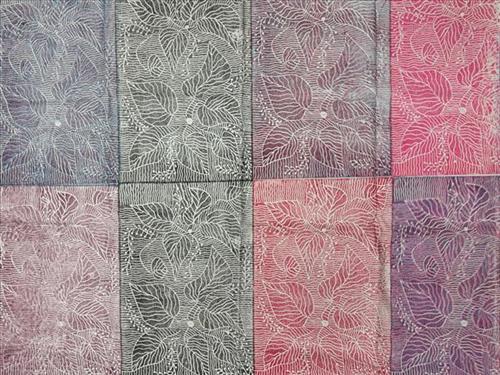
*Green Plum –

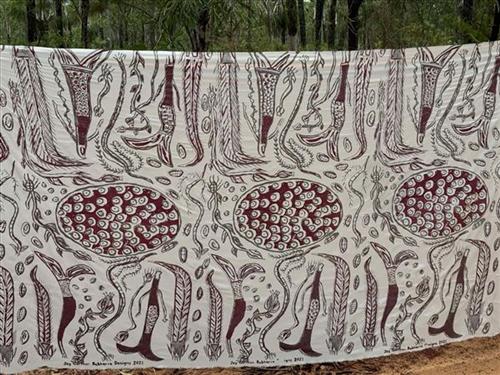


This design depicts the story of Blulandjan Joy’s ancestral dreaming, the Djomi freshwater spirit mermaid. In this design, the Djomi egg is also depicted in the centre.
‘The Djomi figure is a mermaid like spirit with fish tail that lives in the freshwater stream that flows out to the sea cliff near Maningrida. Djomi is a known to be a very powerful fertility symbol.
‘There is a swamp by the ocean, near my home, where all the Djomi live and come to lay their eggs, they lay them here to grow more and more Djomi. When the wet season comes, the cyclones, storms, and big rain, brings enough water for the Djomi to swim out and into the water ways surrounding Maningrida. Anyone wanting to have a baby can go to that place and Djomi will give them a baby. This is a real story; we have lots of Djomi babies here in Maningrida.When the big rains of wet season are too strong, Djomi swim up into the pipes to hide and keep safe. Sometimes they will keep swimming further up the pipes and into pipes of people’s homes, they can travel everywhere. The Djomi carries human babies with them and will sometimes put babies into the water that people in Maningrida drink, that’s why we see many young women expecting babies.’

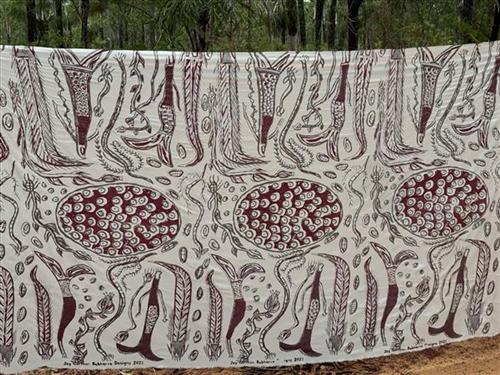
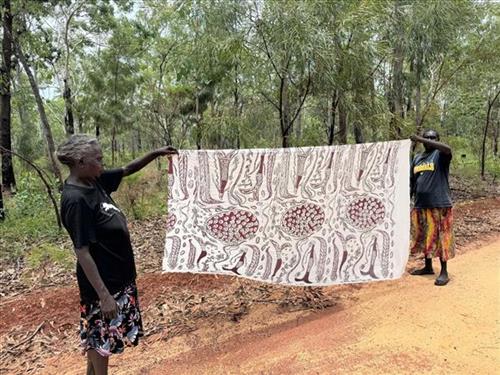
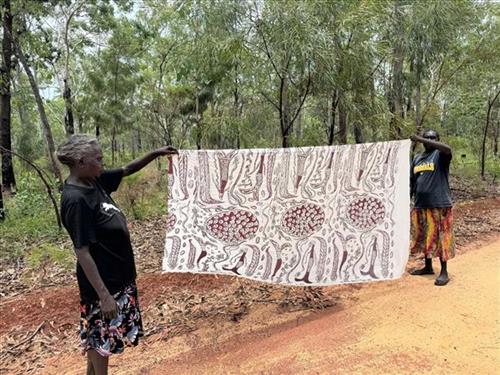
This design depicts the story of Blulandjan Joy’s ancestral dreaming, the Djomi freshwater spirit mermaid. In this design, the Djomi egg is also depicted in the centre.
‘The Djomi figure is a mermaid like spirit with fish tail that lives in the freshwater stream that flows out to the sea cliff near Maningrida. Djomi is a known to be a very powerful fertility symbol.
‘There is a swamp by the ocean, near my home, where all the Djomi live and come to lay their eggs, they lay them here to grow more and more Djomi. When the wet season comes, the cyclones, storms, and big rain, brings enough water for the Djomi to swim out and into the water ways surrounding Maningrida. Anyone wanting to have a baby can go to that place and Djomi will give them a baby. This is a real story; we have lots of Djomi babies here in Maningrida.When the big rains of wet season are too strong, Djomi swim up into the pipes to hide and keep safe. Sometimes they will keep swimming further up the pipes and into pipes of people’s homes, they can travel everywhere. The Djomi carries human babies with them and will sometimes put babies into the water that people in Maningrida drink, that’s why we see many young women expecting babies.’



A two colour screen print design from 2022. Jay’s first large format design to join the Bábbarra Designs Collection.
‘This is my first one, I’m really happy, I’m proud. It’s just a songline for everybody. This story is from my great great grandfather on my fathers side. The songline was made by my second father. The mimihs tell the story. The painting took a long time, a few weeks to finish.’ Jay Jurrupula Rostron
‘Bini-murreko means two brothers – big brother and little brother.
Two brothers were really strong leaders and good hunters, sharing animals with different tribes.
With those different tribe there were jealousy going on.
Little brother went walkabout and heard the different tribe was talking about his tribe.
They said ngarribin manre djed-djedme bokko
Meaning: will make spear for them
Ngarrbin danj-bun, ngarrbinbun
Meaning: will spear them kill them
little brother turn around went back tell his brother
Namurre bokko kadi marne djed-djedme Karre wonens, kardi-djal danjbun
Meaning: they making spear for us, they gonna spear us
Couple of months they saw different tribe
They changed their attitude
They been bringing lots of animals to them and start asking for women
And that tribe realise that’s how those brothers died.
They kill them
This Why? They got jealous because two brothers was a good hunter.
This story written on the rock art and it stays forever.’

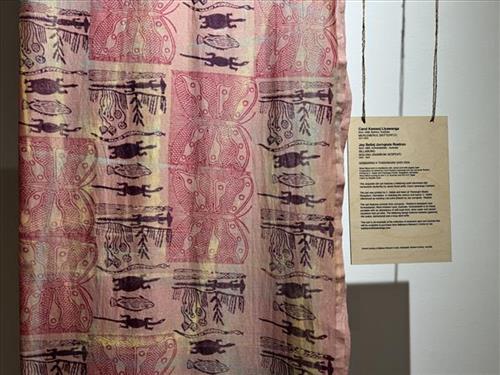
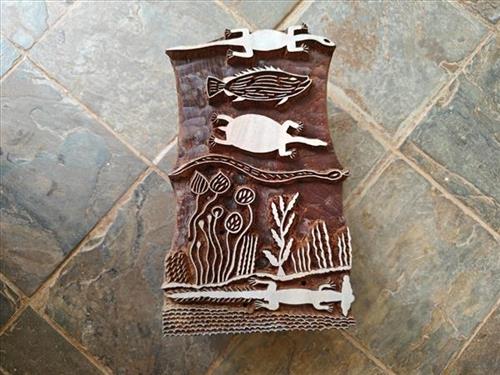
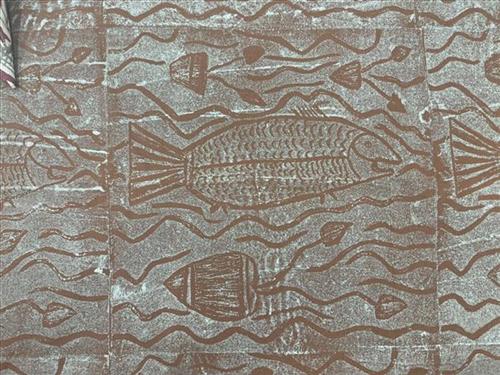
Wood Block print on handwoven silk, extract print with organic dyes Composition as briefed by Carol Kamanj Liyawanga and Jay Jurrupula Rostron Printed by C. Satish and Tharangini Studio, Bangalore, Karnataka Wood Block carving by Shri C.H. Sreeram and Shri S.K. Rajak Fabric by Nandita Sulur. This exquisite silk sari features a billabong motif intermixed with merlemerle (butterfly) by senior Kune artist, Carol Liyawanga Campion. The sari was printed by C. Satish and team at Tharangini Studio, Bangalore, Karnataka. In selecting the colours and layout, C. Satish referenced an existing Lino print artwork by Jay Jurrupula – Rostron. The sari features animals from Jurrupula – Rostron’s homeland near Korlobidadah, West Arnhem Land, Australia. Korlobidadah is an inland paradise with an abundance of wild bush food, clean water and sacred ancestral rock art sites. The billabong design features kalawan (goanna), vile snake, barramundi and a long neck turtle.

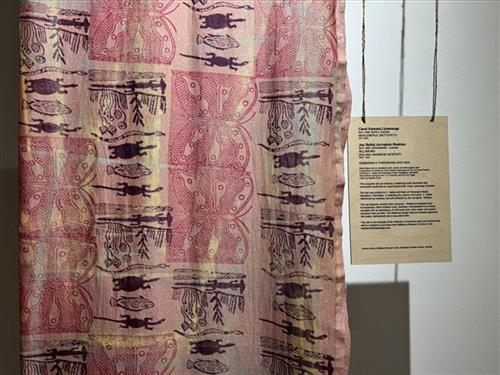
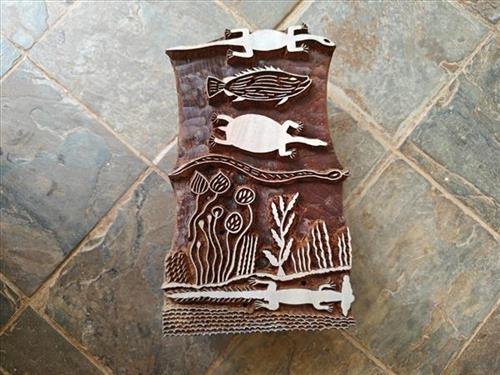
Wood Block print on handwoven silk, extract print with organic dyes Composition as briefed by Carol Kamanj Liyawanga and Jay Jurrupula Rostron Printed by C. Satish and Tharangini Studio, Bangalore, Karnataka Wood Block carving by Shri C.H. Sreeram and Shri S.K. Rajak Fabric by Nandita Sulur.
This exquisite silk sari features a billabong motif intermixed with merlemerle (butterfly) by senior Kune artist, Carol Liyawanga Campion. The sari was printed by C. Satish and team at Tharangini Studio, Bangalore, Karnataka.
In selecting the colours and layout, C. Satish referenced an existing Lino print artwork by Jay Jurrupula – Rostron. The sari features animals from Jurrupula – Rostron’s homeland near Korlobidadah, West Arnhem Land, Australia.
Korlobidadah is an inland paradise with an abundance of wild bush food, clean water and sacred ancestral rock art sites. The billabong design features kalawan (goanna), vile snake, barramundi and a long neck turtle.

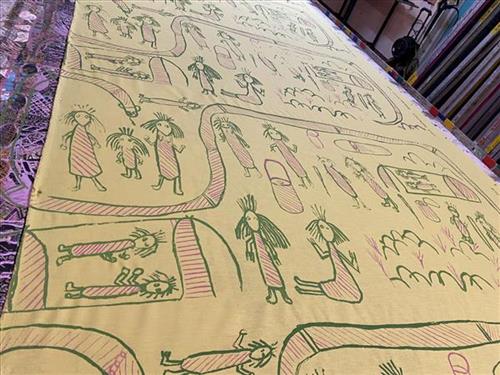
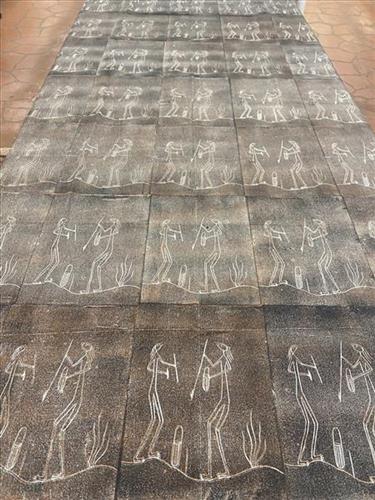
This new design from workshops held in 2022 depicting Bawáliba (stone country mimihs) and dilly bags against a background of loosely placed bush flowers. Lucy has depicted her Bawáliba with werrkno (skin) textures.
‘Bawáliba is the djang (Dreaming) of my mother and my uncles. They are good spirits, they protect us and they recognise families. They are really tall- just like human beings, like us. They dance late at night and have a lot of hair.
In olden times, long long long time ago Bawáliba were here, before people were on the land. Bawáliba used to go out hunting and care for country. They hunt carrying fish traps and digging sticks, near the homeland Djinkarr. They go out hunting on the floodplains with dilly bags and digging sticks. They collect a lot of bush foods, and sleep together with one bark shelter.
Sometimes now they still come alive when we sleep, they might come to our houses and peep through the window. At night, they cover themselves with white clay and red cloth tied around their waist. If we hear them, we jump out of bed and get up to look -but they have disappeared, they’re just too quick. Bawáliba might knock on the window to remind us they are there looking out for us.If you listen deeply you can hear them whisper, sometimes they talk about us and might say, ‘why are those people making camp here?’ then they realise ‘Oh they are family from here, it’s ok, they are just sleeping here for the night’.
During the day they always turn into stone and they sleep. We still know that green rock covered in moss near Djinkarr, that’s Bawáliba sleeping.
Some of my ancestors used to speak the same language as the Bawaliba, but all those old people are passed away now. It’s a little bit sad for us, because no one now can speak that Bawaliba language anymore.’ Lucy Yarawanga 2019

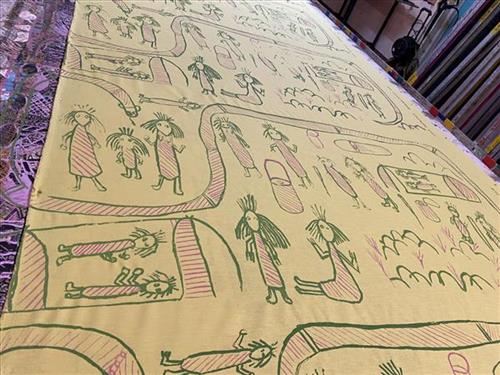
This new design from workshops held in 2022 depicting Bawáliba (stone country mimihs) and dilly bags against a background of loosely placed bush flowers. Lucy has depicted her Bawáliba with werrkno (skin) textures.
‘Bawáliba is the djang (Dreaming) of my mother and my uncles. They are good spirits, they protect us and they recognise families. They are really tall- just like human beings, like us. They dance late at night and have a lot of hair.
In olden times, long long long time ago Bawáliba were here, before people were on the land. Bawáliba used to go out hunting and care for country. They hunt carrying fish traps and digging sticks, near the homeland Djinkarr. They go out hunting on the floodplains with dilly bags and digging sticks. They collect a lot of bush foods, and sleep together with one bark shelter.
Sometimes now they still come alive when we sleep, they might come to our houses and peep through the window. At night, they cover themselves with white clay and red cloth tied around their waist. If we hear them, we jump out of bed and get up to look -but they have disappeared, they’re just too quick. Bawáliba might knock on the window to remind us they are there looking out for us.If you listen deeply you can hear them whisper, sometimes they talk about us and might say, ‘why are those people making camp here?’ then they realise ‘Oh they are family from here, it’s ok, they are just sleeping here for the night’.
During the day they always turn into stone and they sleep. We still know that green rock covered in moss near Djinkarr, that’s Bawáliba sleeping.
Some of my ancestors used to speak the same language as the Bawaliba, but all those old people are passed away now. It’s a little bit sad for us, because no one now can speak that Bawaliba language anymore.’ Lucy Yarawanga 2019