221382302045


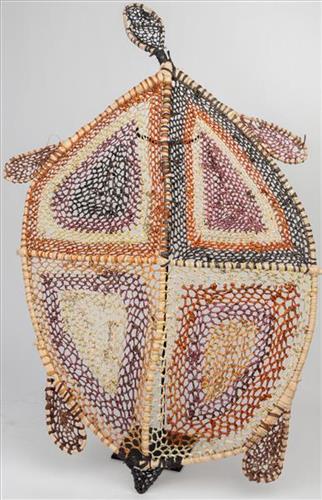
Woven Turtle

Fibre Art is an ancient Aboriginal women’s craft that is still made today using the same techniques as their ancestors. Making fibre art is labour intensive and much care and fine needlework is required to ensure the finished object is both functional and beautiful. Fibre art from the Ghunmarn Culture Centre includes dilly bags, floor mats, bush fans, woven creatures found in the landscape, plants such as yams (bush potato), baskets, place mats, and spirit figures such as mermaids and Mukuy’s.Natural pandanus fibre (Mukarra), is used to make much of the fibre art produced by the artists of Djilpin Arts. Women collect the pandaus by pulling from the top of the pandanus tree, then stripping and drying the leaves before they are dyed with natural bush colour collected from the Beswick surrounds.
221382302053


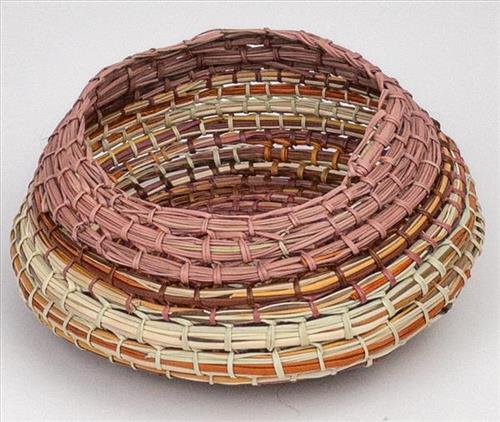
Woven Basket

Fibre Art is an ancient Aboriginal women’s craft that is still made today using the same techniques as their ancestors. Making fibre art is labour intensive and much care and fine needlework is required to ensure the finished object is both functional and beautiful. Fibre art from the Ghunmarn Culture Centre includes dilly bags, floor mats, bush fans, woven creatures found in the landscape, plants such as yams (bush potato), baskets, place mats, and spirit figures such as mermaids and Mukuy’s.Natural pandanus fibre (Mukarra), is used to make much of the fibre art produced by the artists of Djilpin Arts. Women collect the pandaus by pulling from the top of the pandanus tree, then stripping and drying the leaves before they are dyed with natural bush colour collected from the Beswick surrounds.
221382175019


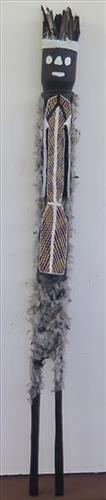
Wyadda Spirit Figure

This finely crafted figure represents a Whyadda or Mukuy Spirit creatures. The Mukuy belong in Yirritja country called Galanbirni. At night you might hear them playing the Didjeridu. The Mukuy travel around a lot and are often found in sacred places. They are mysterious, sometimes playful and sometimes cheeky characters, often referred to as Devil Devil. Mukuy figures tell the stories of country, culture and spiritual beliefs.

This Whyadda is crafted from Kurrajong with Lorikeet and Pigeon feathers.

221382184953


Wagilak Man

This striking piece depicts the Wagilak Man, carved from a Kapok tree sourced locally, and detail finished in acrylic paints. The Wagilak Man is an important story for James’s clan and is depicted with a removable spear, bondok or woomera, and dimbooka or dilly bag. Naga or loin cloth has also been constructed from the Kapok inner-bark. This same material (Kapok inner-bark) has traditionally been used to create bush string, and in this instance has been used to secure Laarda or spear blade to the spear, bondock to its tip, and dimbooka to hang from the shoulder.

Raark or fine line work has been completed using a handmade Jarlk reed brush harvested from local billabongs and wet areas.

221382198326


Dilly Bag

Fibre Art is an ancient Aboriginal women’s craft that is still made today using the same techniques as their ancestors. Making fibre art is labour intensive and much care and fine needlework is required to ensure the finished object is both functional and beautiful. Fibre art from the Ghunmarn Culture Centre includes dilly bags, floor mats, bush fans, woven creatures found in the landscape, plants such as yams (bush potato), baskets, place mats, and spirit figures such as mermaids and Mukuy’s.Natural pandanus fibre (Mukarra), is used to make much of the fibre art produced by the artists of Djilpin Arts. Women collect the pandaus by pulling from the top of the pandanus tree, then stripping and drying the leaves before they are dyed with natural bush colour collected from the Beswick surrounds.
221382200324


Pukumani Pole

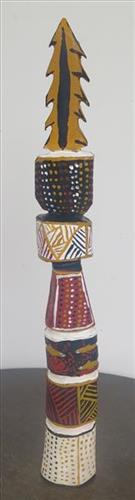
Pukumani Poles are part of Tiwi Island culture which honour those who have passed. These poles are placed on a grave during ceremony and left until they too are reclaimed by country. The poles reflect Tiwi culture, and this miniature version features a fish spear blade at the top. Halfway down are representations of the four Tiwi moieties; Sun, Mullet, Pandanus & Rock. This is a miniature version of the Pukumani Pole which the artists made, presented to and is proudly displayed at Batchelor Institute.

221382219812


Fishing In A Canoe

Wood carving has always been part of Aboriginal culture and Djilpin artists continue this tradition. Wood was carved for many purposes – tools for hunting or gathering food, axes and knives for building shelters, spears and clubs for protection of their lives and territory, objects for ceremony and to mark sacred sites.

Hunting implements include the boomerang, woomera and spear. The woomera is a lever which helps to increase the speed and distance the spear travels. Clapsticks are used as percussion instruments by the Songmen to accompany dancing along with the didgeridoo (mago).

As well as the more functional carvings, artists portray animals and birds in wood, and these carvings are often painted. Ceremonial carvings include spirit creatures including mukuy (devil devils) and mimi.

221382258058


Fish & Turtle

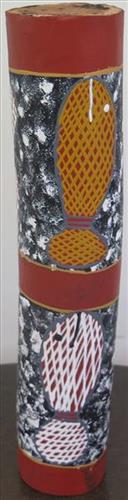
Bernadette’s painted logs are often offcuts from mako or didjeridu manufacture. Rather than wasting the pieces or relegating them to the fire, Bernadette collects these, sands them smooth and then experiments with different painting techniques.

Painted using a combination of brushes; handmade traditional Jarlk grass reed brush harvested from local billabongs and wet areas, along with modern paintbrushes. Bernadette sometimes paints using a stippling effect (modern paintbrush), a modern panting style (fish using a modern brush for example), raark (fine line work using a jarlk brush), or dots (using the end of a jarlk brush).

Painted entirely using modern acrylic paints.

221382273324


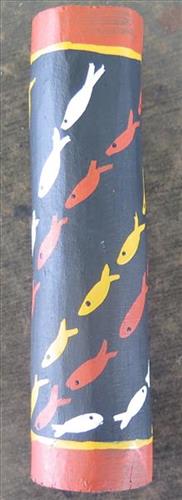
Fish

Bernadette’s painted logs are often offcuts from mako or didjeridu manufacture. Rather than wasting the pieces or relegating them to the fire, Bernadette collects these, sands them smooth and then experiments with different painting techniques.

Painted using a combination of brushes; handmade traditional Jarlk grass reed brush harvested from local billabongs and wet areas, along with modern paintbrushes. Bernadette sometimes paints using a stippling effect (modern paintbrush), a modern panting style (fish using a modern brush for example), raark (fine line work using a jarlk brush), or dots (using the end of a jarlk brush).

Painted entirely using modern acrylic paints.

221382273318


Fish

Bernadette’s painted logs are often offcuts from mako or didjeridu manufacture. Rather than wasting the pieces or relegating them to the fire, Bernadette collects these, sands them smooth and then experiments with different painting techniques.

Painted using a combination of brushes; handmade traditional Jarlk grass reed brush harvested from local billabongs and wet areas, along with modern paintbrushes. Bernadette sometimes paints using a stippling effect (modern paintbrush), a modern panting style (fish using a modern brush for example), raark (fine line work using a jarlk brush), or dots (using the end of a jarlk brush).

Painted entirely using modern acrylic paints.