221382283513


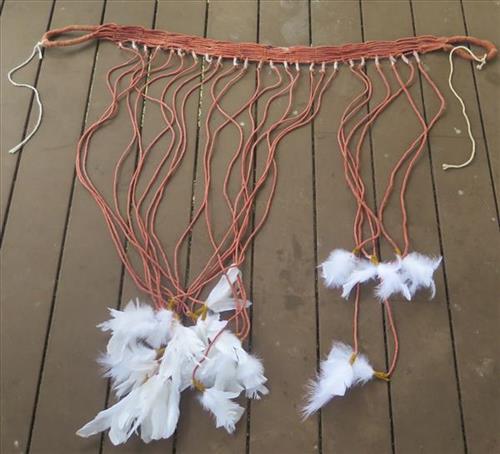
Dance Belt

Dance belts are an important cultural component of ceremony. This belt has been made predominantly from cotton string, along with kurrajong bush string details on the belt component. This can be seen on the wrap around the two end loops, the detailing holding the dangle components, along with the ties holding the belt bands together. Cotton string has been used for the dangling components, with white cockatoo feathers forming the end detail.

Bush String is incredibly labour intensive to construct. Artists collect Anputput (Kurrajong, pronounced “but but”), and then steam the logs in a fire. Bark is peeled off and the outer darker skin discarded. The softer inner fibre is mashed and separated into usable strips which has a lace-like visual look. From here the strips are rolled – usually on a leg or thigh – and spun into the string form. This alone is very time consuming as the artist needs to create the material from which she weaves. For thicker ropes, this process is repeated so each strand is actually constructed from two pre-constructed strands (four or even more strands in total).

At this point, with a functional material to start with, the artist begins to construct the belt; wrapping, weaving and tying. Raw rope can be colour dyed, or painted using ochre or modern acrylic paint. White cockatoo feathers are often used, along with biddih, or sugar bag bee wax.
221382283477


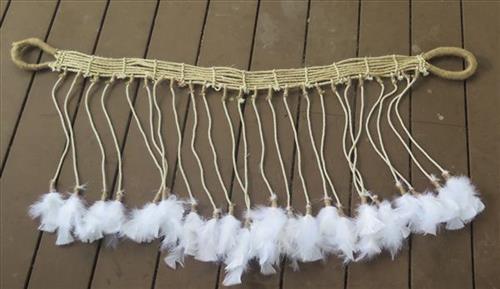
Dance Belt

Dance belts are an important cultural component of ceremony. This belt has been made from a mix of bush string, double twisted to form the belt component, along with cotton string for the dangling components. White cockatoo feathers are used at the end of the dangle.

Bush String is incredibly labour intensive to construct. Artists collect Anputput (Kurrajong, pronounced “but but”), and then steam the logs in a fire. Bark is peeled off and the outer darker skin discarded. The softer inner fibre is mashed and separated into usable strips which has a lace-like visual look. From here the strips are rolled – usually on a leg or thigh – and spun into the string form. This alone is very time consuming as the artist needs to create the material from which she weaves. For thicker ropes, this process is repeated so each strand is actually constructed from two pre-constructed strands (four or even more strands in total).

At this point, with a functional material to start with, the artist begins to construct the belt; wrapping, weaving and tying. Raw rope can be colour dyed, or painted using ochre or modern acrylic paint. White cockatoo feathers are often used, along with biddih, or sugar bag bee wax.
221382291115


Ceremonial Spear

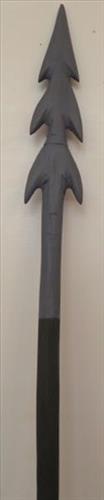
This is a ceremonial spear, carved from a single piece of wood. Featuring multiple barbs and finished in acrylic paint. It is not deadly sharp, and for use in ceremony.

221382301048


Mako (Key F, Toot A#)

Key: F
Toot: A#

Didjeridus from this region are made in the West Arnhem style. Called Mago, they’re different and special and follow the tradition made famous by Beswick’s Mago Master, elder David Blanasi.

Ghunmarn didjeridus are sourced on country, and hand cut from Woolybutt trees. Artists travel considerable distances on foot to find the right woolybutt tree naturally hollowed out by termites. Good instruments are hand-cut and taken back to camp to be worked, shaped, sanded, tuned and then finally painted.

These are top quality musical instruments, highly regarded worldwide, and still used in ceremony and performance today. Featuring traditional designs handed painted with a Jarlk grass brush.


Most Ghunamrn didjeridus are high pitch D, low pitch D, F, C or G. The longer the dij the lower the pitch, a shorter didj will give a higher sound.

221382301040


Mako (Key F, Toot A#)

Key: F
Toot: A#

Didjeridus from this region are made in the West Arnhem style. Called Mago, they’re different and special and follow the tradition made famous by Beswick’s Mago Master, elder David Blanasi.

Ghunmarn didjeridus are sourced on country, and hand cut from Woolybutt trees. Artists travel considerable distances on foot to find the right woolybutt tree naturally hollowed out by termites. Good instruments are hand-cut and taken back to camp to be worked, shaped, sanded, tuned and then finally painted.

These are top quality musical instruments, highly regarded worldwide, and still used in ceremony and performance today. Featuring traditional designs handed painted with a Jarlk grass brush.


Most Ghunamrn didjeridus are high pitch D, low pitch D, F, C or G. The longer the dij the lower the pitch, a shorter didj will give a higher sound.

221382301037


Mako (Key E, Toot A)

Key: E
Toot: A

Didjeridus from this region are made in the West Arnhem style. Called Mago, they’re different and special and follow the tradition made famous by Beswick’s Mago Master, elder David Blanasi.

Ghunmarn didjeridus are sourced on country, and hand cut from Woolybutt trees. Artists travel considerable distances on foot to find the right woolybutt tree naturally hollowed out by termites. Good instruments are hand-cut and taken back to camp to be worked, shaped, sanded, tuned and then finally painted.

These are top quality musical instruments, highly regarded worldwide, and still used in ceremony and performance today. Featuring traditional designs handed painted with a Jarlk grass brush.


Most Ghunamrn didjeridus are high pitch D, low pitch D, F, C or G. The longer the dij the lower the pitch, a shorter didj will give a higher sound.

221381251601


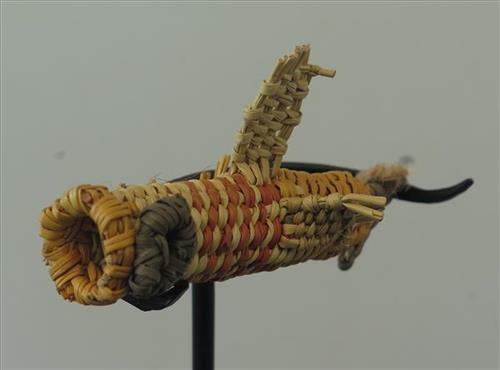
Woven Fish

This finely crafted hand woven fish represents species found both in blue water and local billabongs surrounding Beswick / Wugularr.

Djilpin’s super talented pandanus artists have been busy pushing their skills and techniques. This fun little fish is a prime example of this and a step away from traditional baskets, mats and dilly bags. Each fish is unique, hand woven and feature natural bush dye colouring.

Pandanus fibre art is labour intensive requiring a high level of care and fine needlework. Finished works are both functional and beautiful. Women collect pandanus by pulling from the top of a pandanus tree, stripping then dying the leaves using natural bush colour.

221382194571


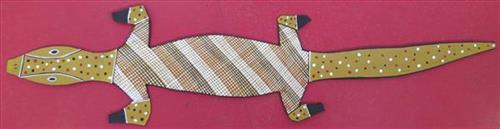
Goanna

This piece by Clinton Brian depicts a goanna. It is painted with acrylic paint on locally harvested stringy bark. The goanna’s body is finished with traditional rarrk (fine cross-hatch style painting).

221382194569


Goanna

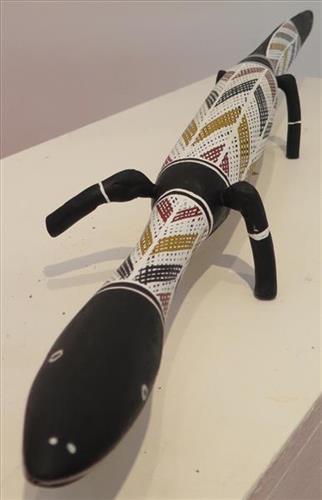
This finely crafted piece by James Malibirr depicts a goanna mid-stride. Goanna is considered to be prized bush tucker, but is less commonly found in modern times. The carving is finished with traditional rarrk (fine cross-hatching style painting).

221382198323


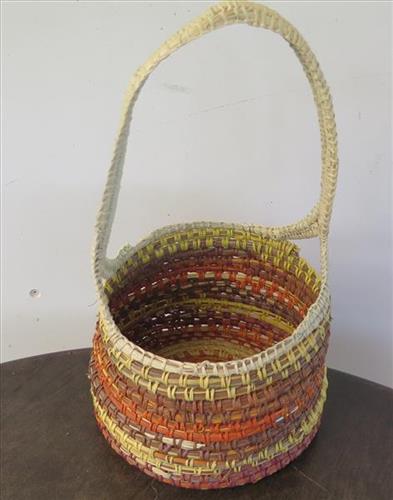
Woven Basket

Fibre Art is an ancient Aboriginal women’s craft that is still made today using the same techniques as their ancestors. Making fibre art is labour intensive and much care and fine needlework is required to ensure the finished object is both functional and beautiful. Fibre art from the Ghunmarn Culture Centre includes dilly bags, floor mats, bush fans, woven creatures found in the landscape, plants such as yams (bush potato), baskets, place mats, and spirit figures such as mermaids and Mukuy’s.Natural pandanus fibre (Mukarra), is used to make much of the fibre art produced by the artists of Djilpin Arts. Women collect the pandaus by pulling from the top of the pandanus tree, then stripping and drying the leaves before they are dyed with natural bush colour collected from the Beswick surrounds.