221382275126


Bondock

Wood carving has always been part of Aboriginal culture and Djilpin artists continue this tradition. Men carved wood for many purposes – tools for hunting or gathering food, axes and knives for building shelters, spears and clubs for protection of their lives and territory, objects for ceremony and to mark sacred sites.

Hunting implements include the boomerang, woomera and spear. The woomera is a lever which helps to increase the speed and distance the spear travels. Clapsticks are used as percussion instruments by the Songmen to accompany dancing along with the didgeridoo (mago).

As well as the more functional carvings, artists portray animals and birds in wood, and these carvings are often painted. Ceremonial carvings include spirit creatures including mukuy (devil devils) and mimi.

Some fine mimi figures have been cast in bronze.

221382275059


Painted Log

Bernadette’s painted logs are often offcuts from mako or didjeridu manufacture. Rather than wasting the pieces or relegating them to the fire, Bernadette collects these, sands them smooth and then experiments with different painting techniques.

Painted using a combination of brushes; handmade traditional Jarlk grass reed brush harvested from local billabongs and wet areas, along with modern paintbrushes. Bernadette sometimes paints using a stippling effect (modern paintbrush), a modern panting style (fish using a modern brush for example), raark (fine line work using a jarlk brush), or dots (using the end of a jarlk brush).

Painted entirely using modern acrylic paints.

221382280157


Clapsticks

Wood carving has always been part of Aboriginal culture. Men carved wood for many purposes – tools for hunting or gathering food, axes and knives for building shelters, spears and clubs for protection of their lives and territory, objects for ceremony and to mark sacred sites.

Artists source the timber on country, walking from tree to tree to find the right piece for the desired functional outcome. Once found, it is cut and then brought back to camp to be worked, shaped, sanded and finally finished.

Clapsticks are used in traditional ceremony and dance as a percussion instrument to accompany Mako (didjeridu). Denser woods such as Ironwood or Kerosene wood are preferred due to their crisper clap sound. Clapsticks can be left raw or painted and decorated. Straight timber from younger trees is preferred as it requires less work to make functional.

221382282659


Painted log

Painted logs are often offcuts from mako or didjeridu manufacture. Rather than wasting the pieces or relegating them to the fire, artists collect these, sand them smooth and then experiments with different painting techniques and styles.

Painted using a combination of brushes; handmade traditional Jarlk grass reed brush harvested from local billabongs and wet areas, along with modern paintbrushes. Raark or fine line work has been completed using a Jarlk grass reed brush. Painted entirely using modern acrylic paints.

221382283478


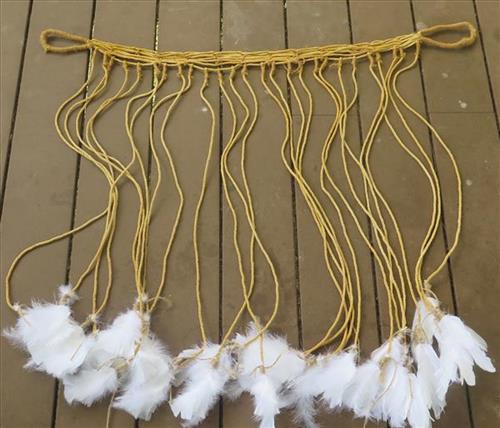
Dance Belt

Dance belts are an important cultural component of ceremony. This belt has been made predominantly from cotton string, along with kurrajong bush string details on the belt component. This can be seen on the wrap around the two end loops, the detailing holding the dangle components, along with the ties holding the belt bands together. Cotton string has been used for the dangling components, with white cockatoo feathers forming the end detail.

Bush String is incredibly labour intensive to construct. Artists collect Anputput (Kurrajong, pronounced “but but”), and then steam the logs in a fire. Bark is peeled off and the outer darker skin discarded. The softer inner fibre is mashed and separated into usable strips which has a lace-like visual look. From here the strips are rolled – usually on a leg or thigh – and spun into the string form. This alone is very time consuming as the artist needs to create the material from which she weaves. For thicker ropes, this process is repeated so each strand is actually constructed from two pre-constructed strands (four or even more strands in total).

At this point, with a functional material to start with, the artist begins to construct the belt; wrapping, weaving and tying. Raw rope can be colour dyed, or painted using ochre or modern acrylic paint. White cockatoo feathers are often used, along with biddih, or sugar bag bee wax.

221382283457


Mimi Spirit

“Mimi go through rock country. Hide in cracks. May be cheeky. Mimi look after and renew country.”

This stunning Mimi Spirit has been hand crafted from native beach hibiscus sourced in Darwin. Carved using a mix of sharp hand tools it has then been finished in modern acrylic paints.

Painting has been completed using a handmade Jarlk grass reed brush harvested from local billabongs and wet areas. Raark or fine line work has been completed using this brush and is in Yirritja style. This style consists of multiple lines before alternating colour.

221382283435


Mimi Spirit

“Mimi go through rock country. Hide in cracks. May be cheeky. Mimi look after and renew country.”

This stunning Mimi Spirit has been hand crafted from native beach hibiscus sourced in Darwin. Carved using a mix of sharp hand tools it has then been finished in modern acrylic paints.

Painting has been completed using a handmade Jarlk grass reed brush harvested from local billabongs and wet areas. Raark or fine line work has been completed using this brush and is in Yirritja style. This style consists of multiple lines before alternating colour.

221382283419


Woven Dragonfly

This finely crafted hand woven dragonfly is a cheerful reminder of the real dry season dragonflies.

Signalling in the dry season, dragonflies are ubiquitous with dry winds, cool nights and saying goodbye to the wet season! Our ridiculously talented pandanus artists are continuing to push their skills and techniques with these cute dragonflies a fine example of this. Each are unique, hand woven and coloured using natural bush dyes.

Pandanus fibre art is labour intensive requiring a high level of care and fine needlework. Finished works are both functional and beautiful. Women collect pandanus by pulling from the top of a pandanus tree, stripping then dying the leaves using natural bush colour.

221382287983


Woven Basket

Fibre Art is an ancient Aboriginal women’s craft that is still made today using the same techniques as their ancestors. Making fibre art is labour intensive and much care and fine needlework is required to ensure the finished object is both functional and beautiful. Fibre art from the Ghunmarn Culture Centre includes dilly bags, floor mats, bush fans, woven creatures found in the landscape, plants such as yams (bush potato), baskets, place mats, and spirit figures such as mermaids and Mukuy’s.Natural pandanus fibre (Mukarra), is used to make much of the fibre art produced by the artists of Djilpin Arts. Women collect the pandaus by pulling from the top of the pandanus tree, then stripping and drying the leaves before they are dyed with natural bush colour collected from the Beswick surrounds.

221382289744


Billabong Fish

This painting depicts multiple fish and animal species found at a billabong. Included are barramundi, diving ducks, catfish and eel-tail catfish, freshwater crocodile,  file snakes, cherabin and water spiders.

Painting has been completed using a handmade grass reed brush called Jarlk which is harvested from local billabongs and wet areas. Raark or fine line work is in a mix of Yirritja and Dhuwa style. Dhuwa style can be seen on any of the four water spiders (two roughly in the centre of the canvas) and consists of a single line before alternating colour. Yirritja style has multiple lines before alternating colour and can easily be seen on all the remaining animals.

Modern acrylic paint has been used.