Status: Stock
Gum Nut Necklace
These were painted and also collected by Barbara Bear.
Status: Stock
These were painted and also collected by Barbara Bear.
Status: Stock
These are hand-collected and painted Gum nuts from Barbara Bear.
Status: Stock
This are a variety of earrings, done by different artists in different styles.
Status: Stock
Status: Stock
Status: Stock
Barbara Bear is a dedicated jewellery maker. She picks the nuts from the tree in front of her house.
Status: Stock
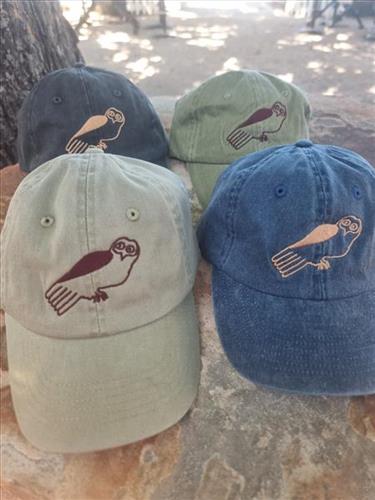
Dumbi is an owl which resides in Ngarinyin country. Two boys teased Dumbi after they found his tree knocked over by the wind. Dumbi could not fly away because he was Mayanki oni (cold) and the Wilmi (dew) was sticking his feathers together. The boys plucked out his feathers and threw him in the air three times. Dumbi flew to the Wandjina named Wanalirri who said he would create a large Ngarlu mindi (flood) to punish the tribe where the boys came from. At a place called Djunbai mindi, the Wandjina gathered a large flock of Karroongkarli/ Kurranda Nyindi (brolgas) who stomped on a huge Nyalgoorro (black soil plain) to create quicksand. The Ngarlu Mindi came and drowned many people and those who tried to escape were lost in the quicksand. The boys were safe because they were on high ground. They were taken there by Mangarra Djirri (Ungud kangaroo) and they traveled on the kangaroo’s tail. Margurrigurri (tata lizard) warned the Wandjina that the boys had escaped. The rain and lightning started to chase the boys and they ran to a hollowed out Latcurry (boab tree). Once they were in the tree, the Wandjina closed it up and they were lost forever. In another version of the story the children are a boy and girl who survive the flood and mate to produce a new tribe.
Status: Stock
Ngarinyin, Woddorda (Worrorra) and Wunambal are the three main languages of the North Kimberley language families. The Boab Tree is known by Wurnambal people as Jungurri, in Woddorda as Jungurim and in Ngarinyin as Jungulan jirri, Larrgari jirri and Malawudi jirri.
Boab or Larrgardi Trees (lt.: Adansonia Gregorii) – is an Australian native species only found in the Kimberley region of Western Australia. They are very recognisable due to their unusual shape – reminding one of a full-bodied bottle. Some trees are more then 1500 years old and can hold more than 100,000 litres of water in their trunks.
Every part of the tree is used either as a food-resource, as medicine or otherwise. Almost every part of the tree is edible from the young leaves and tubers to the internal fruit pods and seeds.
The tree produces beautiful large fragrant yellow flowers. Inside the fruit pod the fruit is naturally dried on the tree itself. This is the only fruit in the world that does this.
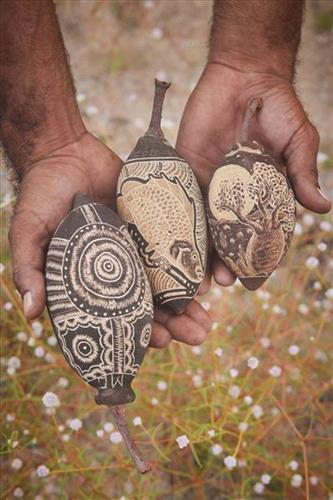
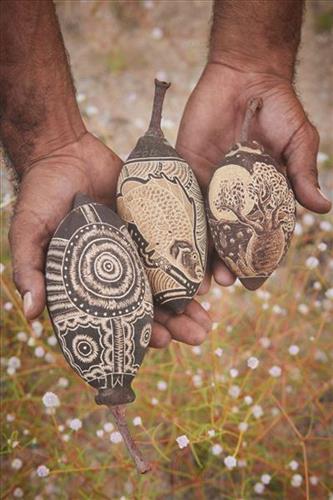
Indigenous artists carve designs into shell of the boab nut or paint it with different designs and children use it as a rattle. The designs on the nuts vary from Wandjina’s to different animals, like the Brolga, turtles, and fish to people’s faces and landscapes.
“Boab nut Carving was a way of expressing ones artistic skills. Aboriginal people across the Kimberley Region of Western Australia was carving along time ago it started with our ancestors.”
Status: Stock
Ngarinyin, Woddorda (Worrorra) and Wunambal are the three main languages of the North Kimberley language families. The Boab Tree is known by Wurnambal people as Jungurri, in Woddorda as Jungurim and in Ngarinyin as Jungulan jirri, Larrgari jirri and Malawudi jirri.
Boab or Larrgardi Trees (lt.: Adansonia Gregorii) – is an Australian native species only found in the Kimberley region of Western Australia. They are very recognisable due to their unusual shape – reminding one of a full-bodied bottle. Some trees are more then 1500 years old and can hold more than 100,000 litres of water in their trunks.
Every part of the tree is used either as a food-resource, as medicine or otherwise. Almost every part of the tree is edible from the young leaves and tubers to the internal fruit pods and seeds.
The tree produces beautiful large fragrant yellow flowers. Inside the fruit pod the fruit is naturally dried on the tree itself. This is the only fruit in the world that does this.
Indigenous artists carve designs into shell of the boab nut or paint it with different designs and children use it as a rattle. The designs on the nuts vary from Wandjina’s to different animals, like the Brolga, turtles, and fish to people’s faces and landscapes.
“Boab nut Carving was a way of expressing ones artistic skills. Aboriginal people across the Kimberley Region of Western Australia was carving along time ago it started with our ancestors.”
Status: Stock
Ngarinyin, Woddorda (Worrorra) and Wunambal are the three main languages of the North Kimberley language families. The Boab Tree is known by Wurnambal people as Jungurri, in Woddorda as Jungurim and in Ngarinyin as Jungulan jirri, Larrgari jirri and Malawudi jirri.
Boab or Larrgardi Trees (lt.: Adansonia Gregorii) – is an Australian native species only found in the Kimberley region of Western Australia. They are very recognisable due to their unusual shape – reminding one of a full-bodied bottle. Some trees are more then 1500 years old and can hold more than 100,000 litres of water in their trunks.
Every part of the tree is used either as a food-resource, as medicine or otherwise. Almost every part of the tree is edible from the young leaves and tubers to the internal fruit pods and seeds.
The tree produces beautiful large fragrant yellow flowers. Inside the fruit pod the fruit is naturally dried on the tree itself. This is the only fruit in the world that does this.
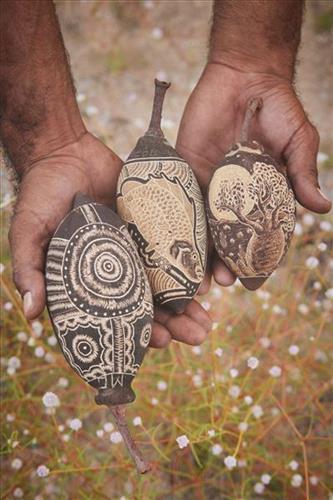
Indigenous artists carve designs into shell of the boab nut or paint it with different designs and children use it as a rattle. The designs on the nuts vary from Wandjina’s to different animals, like the Brolga, turtles, and fish to people’s faces and landscapes.
“Boab nut Carving was a way of expressing ones artistic skills. Aboriginal people across the Kimberley Region of Western Australia was carving along time ago it started with our ancestors.”