111582448428


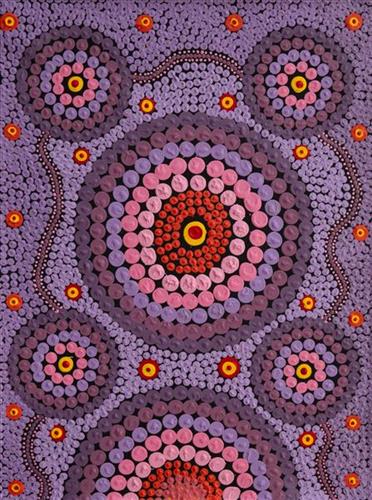
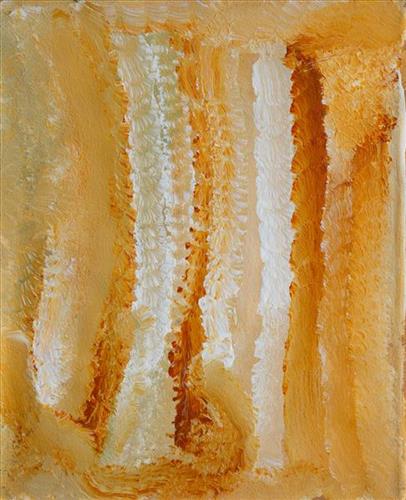
Mulla-Mulla

This work depicts the remarkably diverse flora found through Martu Country. These plants are not only vital as significant food sources, but also celebrated for their aesthetic splendour. In the context of the often harsh and arid environments in which desert flowers bloom, their vibrancy, delicacy, and variation become even more spectacular. 

111582448427


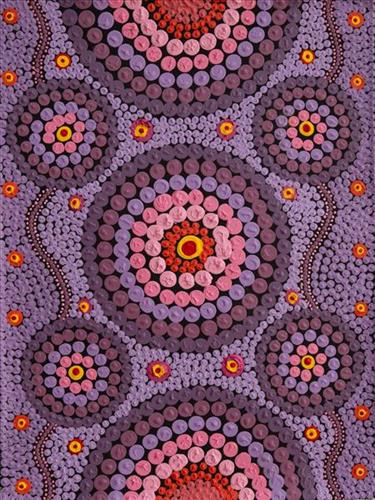
Mulla-Mulla

This work depicts the remarkably diverse flora found through Martu Country. These plants are not only vital as significant food sources, but also celebrated for their aesthetic splendour. In the context of the often harsh and arid environments in which desert flowers bloom, their vibrancy, delicacy, and variation become even more spectacular. 

111582448426


Mulla-Mulla

This work depicts the remarkably diverse flora found through Martu Country. These plants are not only vital as significant food sources, but also celebrated for their aesthetic splendour. In the context of the often harsh and arid environments in which desert flowers bloom, their vibrancy, delicacy, and variation become even more spectacular. 

111582448419


Untitled

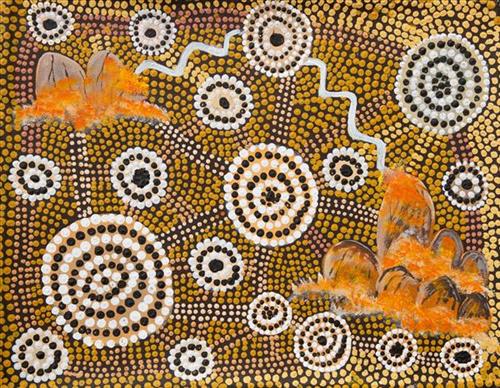
This is Bugai’s Country- her ‘ngurra’ (home Country, camp). People identify with their ngurra in terms of specific rights and responsibilities, and the possession of intimate knowledge of the physical and cultural properties of one’s Country. Painting ngurra, and in so doing sharing the Jukurrpa (Dreaming) stories and physical characteristics of that place, has today become an important means of cultural maintenance. 

Bugai’s ngurra encompasses the Country that she and her family walked in the pujiman (traditional, desert-dwelling) era. At this time Bugai travelled nomadically with her own and other family groups, most notably the Bidu family. The Country they traversed encompassed an enormous tract of land, with an aerial distance of more than 600 kilometres, from present day Balfour Downs Station to Kunawarritji (Canning Stock Route Well 33). Bugai was born at Pulkinya. She grew up, walked and hunted primarily around Parnngurr, Punmu, Kun Kun (Kuny-kuny) and Kunawarritji. As a young woman Bugai travelled with her husband through the Karlamilyi (Rudall River) region and up and down the Canning Stock Route, where she first met cattle drovers. She continued to live nomadically before eventually deciding to move to Jigalong Mission along with many other relatives following an extreme and prolonged drought in the 1960s. 

Portrayed in this work are features of Bugai’s ngurra, such as the striking salt lakes, dominant permanent red tali (sandhills), warta (trees, vegetation), and the individually named water sources Bugai and her family camped at. These include Parnngurr, Martilirri, Wangkakalu, Kurta-kurta (Camel Rock), Pimurlu, Jilkupuka (Canning Stock Route Well 21), Kaalpa (Canning Stock Route Well 23), Kartarru (Canning Stock Route Well 24), Wantili (Warntili, Canning Stock Route Well 25), Tiwa (Canning Stock Route Well 26), Partujarrapirri, Raarki (Canning Stock Route Well 27), Wuranu (Canning Stock Route Well 29), Juntu- juntu (Canning Stock Route Well 30), and Kunawarritji. Rock holes, waterholes, soaks and springs were all extremely important sites for Martu people during the pujiman period, and are generally depicted with circular forms. 

The encyclopaedic knowledge of the location, quality and seasonal availability of the hundreds of water bodies found in one’s Country sustained Martu as they travelled across their Country, hunting and gathering, visiting family, and fulfilling ceremonial obligations. They would traverse very large distances annually, visiting specific areas in the dry and wet season depending on the availability of water and the corresponding cycles of plant and animal life on which hunting and gathering bush tucker was reliant. As they travelled and hunted they would also burn areas of Country, generating a greater diversity of plant and animal life.
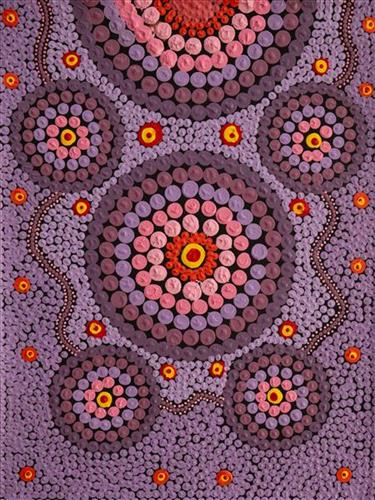
111582448407


Lighting and Rock

“Kiwirrkurra road. That’s where the Kataputa (thorny devil) is. Two Wati (men) Kujarra there. They were fighting and they striked each other. That’s why they turned into rock. Kumpaya told me this story.


Tingarri [is a] man who hold the lore and the land. Man who holds knowledge. Tingarri look after the land. I was showing young man how to carve the boomerang and the shield. Tingarri is the name of the man who controls the lore, looks after the people, and the country, the waterholes. It’s a person, and three rockholes. Not far from 33 [Kunawarritji], just further East. Tingarri is more of a story – man who holds knowledge and holds law. Lighting strikes turned the human into rocks. On Manyjilyjarra land. Right up to east of Wiluna. That old fella, he was the last one holding the Tingarri but know he’s finished, in 33”
–           Kennedy Finlay


The term Jukurrpa is often translated in English as the ‘dreaming’, or ‘dreamtime’. It refers generally to the period in which the world was created by ancestral beings, who assumed both human and nonhuman forms. These beings shaped what had been a formless landscape; creating waters, plants, animals, and people. At the same time they provided cultural protocols for the people they created, as well as rules for interacting with the natural environment. At their journey’s end, the ancestral beings transformed themselves into important waters, hills, rocks, and even constellations.


Kunawarritji (33) is an important site in the Great Sandy Desert where multiple stories and histories intersect. Originally a spring water and major Martu pujiman (traditional, desert dwelling) camping site, at the turn of the 20th century Kunawarritji was converted into a well along the Canning Stock Route. Each year throughout the 1930-50s, the well became a site of contact between the drovers, their cattle, and desert families. 

11154009813


Status: Stock


Make it Real Tea Towel by Ngamaru Bidu

Make it Real
Make it Real is a project delivered through the Aboriginal Art Centre Hub of Western Australia (AACHWA). As a not-for-profit Aboriginal organisation, our profit story ensures the artist receives the economic benefits of their shared generational stories and culture. When an artist thrives, their community also benefits.

The profits generated from this product go directly back to the Artist and Art Centre.

*The way profits are distributed can vary, and we ask consumers to be mindful of this when buying Authentic Indigenous Art or products.

11154009812


Status: Stock


Make it Real Tea Towel by Beverley Rogers

Make it Real
Make it Real is a project delivered through the Aboriginal Art Centre Hub of Western Australia (AACHWA). As a not-for-profit Aboriginal organisation, our profit story ensures the artist receives the economic benefits of their shared generational stories and culture. When an artist thrives, their community also benefits.

The profits generated from this product go directly back to the Artist and Art Centre.

*The way profits are distributed can vary, and we ask consumers to be mindful of this when buying Authentic Indigenous Art or products.

11154009811


Status: Stock


Make it Real Tea Towel by Derrick Butt Africa

Make it Real
Make it Real is a project delivered through the Aboriginal Art Centre Hub of Western Australia (AACHWA). As a not-for-profit Aboriginal organisation, our profit story ensures the artist receives the economic benefits of their shared generational stories and culture. When an artist thrives, their community also benefits.

The profits generated from this product go directly back to the Artist and Art Centre.

*The way profits are distributed can vary, and we ask consumers to be mindful of this when buying Authentic Indigenous Art or products.

11154009810


Status: Stock


Make it Real Bag Charm by Kathleen Maree Sorensen

Make it Real
Make it Real is a project delivered through the Aboriginal Art Centre Hub of Western Australia (AACHWA). As a not-for-profit Aboriginal organisation, our profit story ensures the artist receives the economic benefits of their shared generational stories and culture. When an artist thrives, their community also benefits.

The profits generated from this product go directly back to the Artist and Art Centre.

*The way profits are distributed can vary, and we ask consumers to be mindful of this when buying Authentic Indigenous Art or products.