111582444497


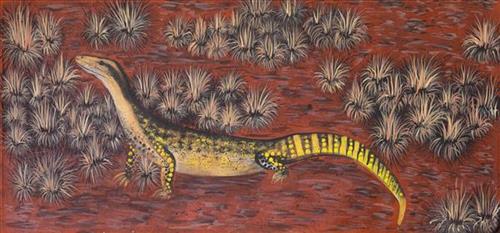
Parnka

Parnajarrpa (sand goanna) are one of the most prized and reliable food sources hunted by Martu, found throughout Australia in sand plain and dune habitats. They are hunted by both men and women, though more often women working either alone or in pairs. Parnajarrpa hibernate in the cool months, emerging seasonally as temperatures warm in tuulparra (spring). When parnajarrpa are active they are tracked and dug from their burrows. When they are hibernating their burrows are ‘sounded’ by tapping wana (digging-sticks) on the ground, and then excavated. Traditional carved wana have been replaced with metal bars, though burning and tracking techniques continue to be practiced in the hunting of parnajarrpa.  Targeted waru (fire) clears vegetation and exposes burrows, whilst simultaneously providing diverse regenerating habitats for future parnajarrpa. When consumed, they are singed and then cooked in a coal and ash bed. 

During the pujiman (traditional, desert dwelling) period, Martu would traverse very large distances annually in small family groups, moving seasonally from water source to water source, and hunting and gathering bush tucker as they went. Whilst desert life has moved away from mobile hunter-gatherer subsistence throughout the course of the twentieth century, bush tucker continues to be a significant component of the modern Martu diet. Hunting and gathering bush tucker remains equally valuable as an important cultural practice that is passed on intergenerationally. Though hunting and gathering implements have been modernised, methods of harvesting, tracking and the use of fire burning to drive animals from their retreats are still commonly practiced today.
111582444458


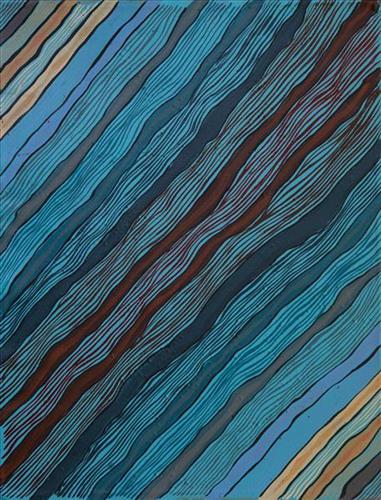
Water and Wet Sand

“When I paint with these colours and in this style, it reminds me of when I was back in Bidgydanga, watching the water and currents flow.”

– Ciarn Dean-Bullen


“When Martu paint, it’s like a map. Martu draw story on the ground and on the canvas, and all the circle and line there are the hunting areas and different waters and tracks where people used to walk, and [some you] can’t cross, like boundaries. So nowadays you see a colourful painting and wonder what it is, but that’s how Martu tell story long ago. It’s not just a lovely painting, it’s a story and a songline and a history and everything that goes with it.” 

– Ngalangka Nola Taylor and Joshua Booth

This work portrays an area of Country that can be interpreted in multiple ways. Firstly, the image may be read as an aerial representation of a particular location known to the artist- either land that they or their family travelled, from the pujiman (traditional, desert dwelling) era to now. During the pujiman period, Martu would traverse very large distances annually in small family groups, moving seasonally from water source to water source, and hunting and gathering bush tucker as they went. At this time, one’s survival depended on their intimate knowledge of the location of resources; thus physical elements of Country, such as sources of kapi (water), tali (sandhills), different varieties of warta (trees, vegetation), ngarrini (camps), and jina (tracks) are typically recorded with the use of a use of a system of iconographic forms universally shared across the desert. 

An additional layer of meaning in the work relates to more intangible concepts; life cycles based around kalyu (rain, water) and waru (fire) are also often evident. A thousands of year old practice, fire burning continues to be carried out as both an aid for hunting and a means of land management today. As the Martu travelled and hunted they would burn tracts of land, ensuring plant and animal biodiversity and reducing the risk of unmanageable, spontaneous bush fires. The patchwork nature of regrowth is evident in many landscape works, with each of the five distinctive phases of fire burning visually described with respect to the cycle of burning and regrowth.  

Finally, metaphysical information relating to a location may also be recorded; Jukurrpa (Dreaming) narratives chronicle the creation of physical landmarks, and can be referenced through depictions of ceremonial sites, songlines, and markers left in the land. Very often, however, information relating to Jukurrpa is censored by omission, or alternatively painted over with dotted patterns.

111582444453


Bush Medicine

Traditional Martu knowledge of plant properties was encyclopedic, and saw plants used for purposes as diverse as food resources, carving implements, tobacco, firewood, shelter construction, and bush medicines. Depicted in this work are types of bush medicines, their habitats, and the processes used in their preparation. 

Physical ailments treated with plant based poltices, body washes, drinks, rubs and pastes included fever, congestion, headache, skin sores, aching limbs, and digestive problems. More serious health issues were often treated with a combination of bush medicine and maparn (magic healing/ healer).

Plants still prepared to make bush medicines today include warlji (desert bloodwood), kalpari (Dysphania Kalpari) and nayju (green crumbweed), which can be soaked in a water solution to make a skin wash. One of the most popular types of bush medicine still used today is wanta (red sap), collected from the mijarrpa (bloodwood) tree and brewed as a tea to ease heart pains and other body aches.

111582444446


Untitled

“When Martu paint, it’s like a map. Martu draw story on the ground and on the canvas, and all the circle and line there are the hunting areas and different waters and tracks where people used to walk, and [some you] can’t cross, like boundaries. So nowadays you see a colourful painting and wonder what it is, but that’s how Martu tell story long ago. It’s not just a lovely painting, it’s a story and a songline and a history and everything that goes with it.” 

– Ngalangka Nola Taylor and Joshua Booth

This work portrays an area of Country that can be interpreted in multiple ways. Firstly, the image may be read as an aerial representation of a particular location known to the artist- either land that they or their family travelled, from the pujiman (traditional, desert dwelling) era to now. During the pujiman period, Martu would traverse very large distances annually in small family groups, moving seasonally from water source to water source, and hunting and gathering bush tucker as they went. At this time, one’s survival depended on their intimate knowledge of the location of resources; thus physical elements of Country, such as sources of kapi (water), tali (sandhills), different varieties of warta (trees, vegetation), ngarrini (camps), and jina (tracks) are typically recorded with the use of a use of a system of iconographic forms universally shared across the desert. 

An additional layer of meaning in the work relates to more intangible concepts; life cycles based around kalyu (rain, water) and waru (fire) are also often evident. A thousands of year old practice, fire burning continues to be carried out as both an aid for hunting and a means of land management today. As the Martu travelled and hunted they would burn tracts of land, ensuring plant and animal biodiversity and reducing the risk of unmanageable, spontaneous bush fires. The patchwork nature of regrowth is evident in many landscape works, with each of the five distinctive phases of fire burning visually described with respect to the cycle of burning and regrowth.  

Finally, metaphysical information relating to a location may also be recorded; Jukurrpa (Dreaming) narratives chronicle the creation of physical landmarks, and can be referenced through depictions of ceremonial sites, songlines, and markers left in the land. Very often, however, information relating to Jukurrpa is censored by omission, or alternatively painted over with dotted patterns.

111582444444


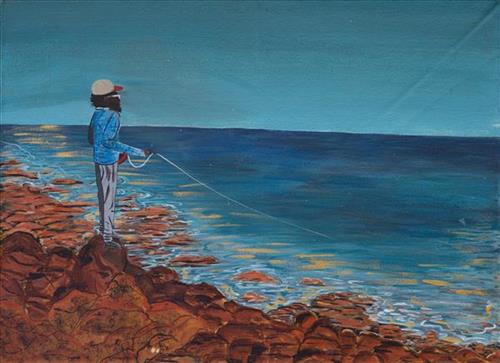
Fishing at the lighthouse

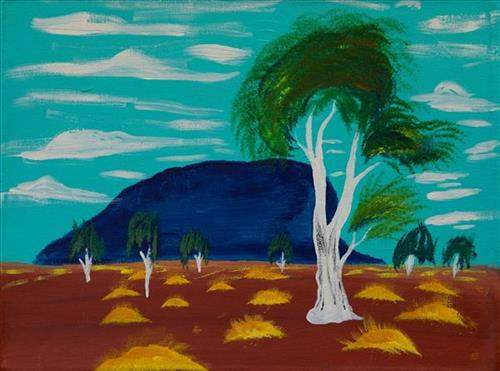
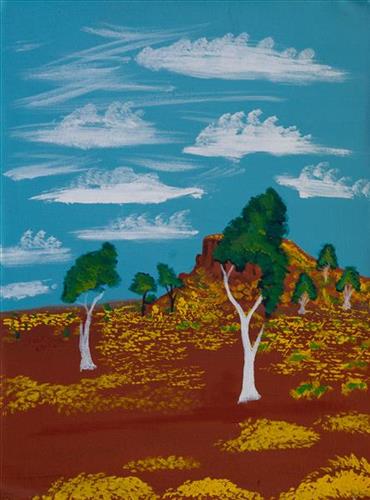
This work portrays an area known to the artist, painted here from memory. During the pujiman (traditional, desert dwelling) era one’s survival depended on their intimate knowledge of the location of resources; thus physical elements of Country, such as sources of kapi (water), tali (sandhills), and different varieties of warta (trees, vegetation) were carefully observed and remembered. Today, this relationship with Country remains equally strong, despite the movement of Martu out of the desert and into remote Aboriginal communities, towns and cities.

Also visible may be traces of life cycles based around kalyu (rain, water) and waru (fire). A thousands of year old practice, fire burning continues to be carried out as both an aid for hunting and a means of land management today. As the Martu travelled and hunted they would burn tracts of land, ensuring plant and animal biodiversity and reducing the risk of unmanageable, spontaneous bush fires. The patchwork nature of regrowth is visible in many landscape works, with each of the five distinctive phases of fire burning visually described with respect to the cycle of burning and regrowth.  

Finally, metaphysical information relating to a location may also be recorded; Jukurrpa (Dreaming) narratives chronicle the creation of physical landmarks, and can be referenced through depictions of ceremonial sites, songlines, and markers left in the land. 

111582444434


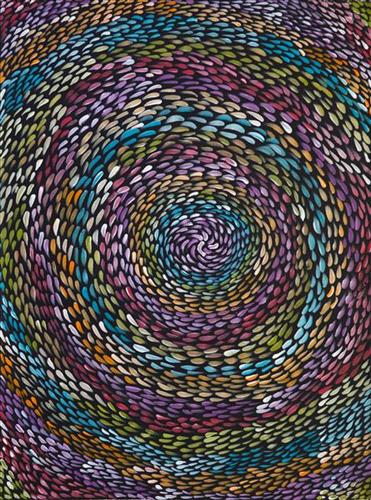
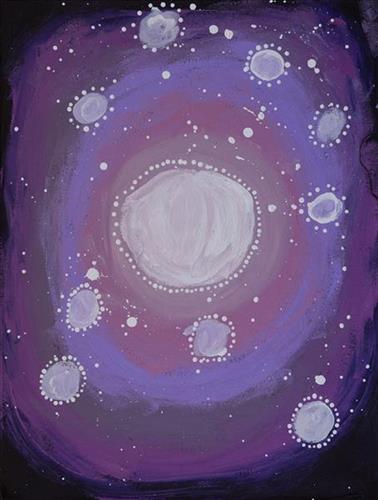
Purple Light

Martumili Artists work with over three hundred artists from remote Martu Aboriginal communities, including Punmu, Parnngurr, Kunawarritji, Jigalong, Irrungadji (Nullagine), and Warralong, as well as from the Parnpajinya (Newman) gallery and studio spaces. Known for their diverse, energetic, and unmediated painting styles, their works reflect the dramatic geography and scale of their homelands. Each artist, however, brings a unique approach to their craft.

Younger Martu artists often start painting alongside their parents, grandparents, and extended family, which fosters an organic learning process. This not only involves mastering painting techniques but also understanding specific locations, family histories, traditional ways of life, bush tucker, and Jukurrpa (Dreaming). Over time, with encouragement from their peers, they develop their own distinct styles and explore unique painting techniques and subject matter. In this work the artist brings a contemporary, evolving perspective to their work.

111582444431


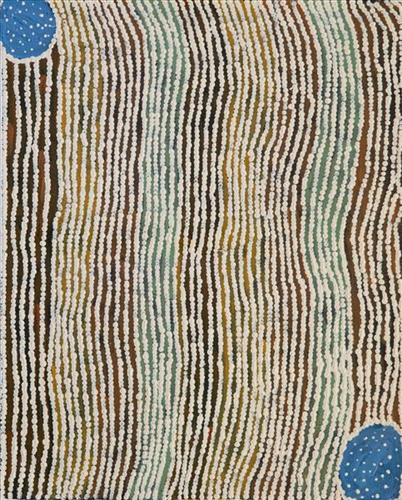
Untitled

This site forms part of Blake Wilberforce’s ngurra (home Country, camp). People identify with their ngurra in terms of specific rights and responsibilities, and the possession of intimate knowledge of the physical and cultural properties of one’s Country. Painting ngurra, and in so doing sharing the Jukurrpa (Dreaming) stories and physical characteristics of that place, has today become an important means of cultural maintenance.

Blake enjoys painting at night to relax before bed and is family to fellow Martumili Artists Jason Tinker (dec.) and Peter Tinker Pija. As a young child, Blake travelled all the way from Kalgoorlie to Irrungadji, and remembers going gold detecting in the early morning with family before the heat set in.

Younger Martu artists often start painting alongside their parents, grandparents, and extended family, which fosters an organic learning process. This not only involves mastering painting techniques but also understanding specific locations, family histories, traditional ways of life, bush tucker, and Jukurrpa (Dreaming). Over time, with encouragement from their peers, they develop their own distinct styles and explore unique painting techniques and subject matter. In this work Blake brings a contemporary, evolving perspective to their work.

111582444430


Untitled

This site forms part of Blake Wilberforce’s ngurra (home Country, camp). People identify with their ngurra in terms of specific rights and responsibilities, and the possession of intimate knowledge of the physical and cultural properties of one’s Country. Painting ngurra, and in so doing sharing the Jukurrpa (Dreaming) stories and physical characteristics of that place, has today become an important means of cultural maintenance.

Blake enjoys painting at night to relax before bed and is family to fellow Martumili Artists Jason Tinker (dec.) and Peter Tinker Pija. As a young child, Blake travelled all the way from Kalgoorlie to Irrungadji, and remembers going gold detecting in the early morning with family before the heat set in.

Younger Martu artists often start painting alongside their parents, grandparents, and extended family, which fosters an organic learning process. This not only involves mastering painting techniques but also understanding specific locations, family histories, traditional ways of life, bush tucker, and Jukurrpa (Dreaming). Over time, with encouragement from their peers, they develop their own distinct styles and explore unique painting techniques and subject matter. In this work Blake brings a contemporary, evolving perspective to their work.

111582444426


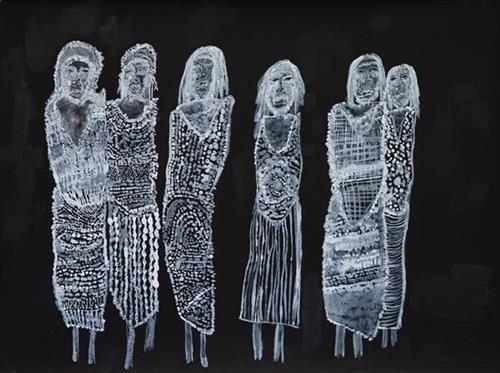
Wanti Yuu (Women, Yeah!) – Sylvia Wilson

“Wanti Yuu (Woman Yeah!) is a story of resilience and of women coming together. It is about the strength of the women in our community who put themselves last and take on a lot. She [Wanti Yuu] is someone who looks after her family, putting the grand kids and everyone around her first. The word Matriarch comes to mind. They are the matriarch of the family. The Boss Lady. Always helping everyone else out and leaving herself to the end. She paints, she teaches us her knowledge, like basket weaving and honey ant collecting. She is the top lore woman and her story of Pujiman (traditional, desert dwelling) is so important. She is a leader of the Martu women and a senior artist. That’s all I can say about these women. These women; you give her the bread if you know what I mean. It’s a true story. Anything in my pockets. Because when you look at her, her stance, her energy and her vibe, you can feel it. You don’t muck around with Wanti Yuu.”

-Silvia Wilson

Wanti Yuu celebrates women’s resilience, matriarchal relationships, and Sylvia’s place in this story.

As Sylvia explains, the work is both a depiction of, and attribute to, the women in her life. “I follow my great grandmother’s guidance and direction in life. These women in my life carry so much on their shoulders, as well as the responsibility and future of our culture.”


111582444423


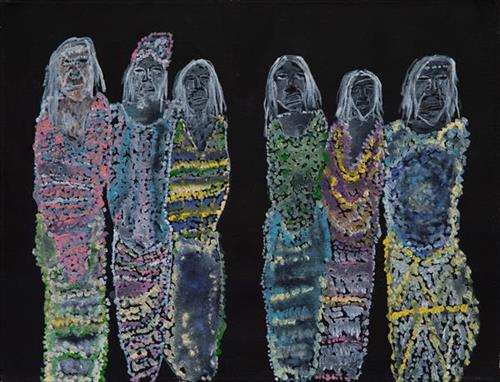
Wanti Yuu (Women, Yeah!) – Sylvia Wilson

“Wanti Yuu (Woman Yeah!) is a story of resilience and of women coming together. It is about the strength of the women in our community who put themselves last and take on a lot. She [Wanti Yuu] is someone who looks after her family, putting the grand kids and everyone around her first. The word Matriarch comes to mind. They are the matriarch of the family. The Boss Lady. Always helping everyone else out and leaving herself to the end. She paints, she teaches us her knowledge, like basket weaving and honey ant collecting. She is the top lore woman and her story of Pujiman (traditional, desert dwelling) is so important. She is a leader of the Martu women and a senior artist. That’s all I can say about these women. These women; you give her the bread if you know what I mean. It’s a true story. Anything in my pockets. Because when you look at her, her stance, her energy and her vibe, you can feel it. You don’t muck around with Wanti Yuu.”

-Silvia Wilson

Wanti Yuu celebrates women’s resilience, matriarchal relationships, and Sylvia’s place in this story.

As Sylvia explains, the work is both a depiction of, and attribute to, the women in her life. “I follow my great grandmother’s guidance and direction in life. These women in my life carry so much on their shoulders, as well as the responsibility and future of our culture.”