11153999580


Status: Stock


Mulyatingki Marney – Silk Satin Scarf

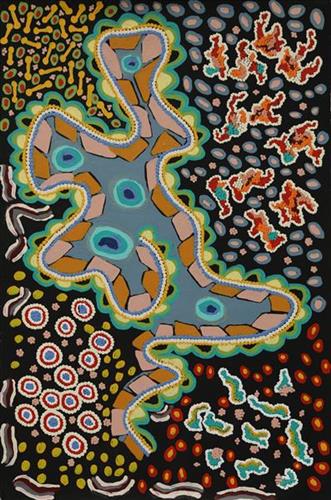
Wilarra is the word for moon in Manyjiljarra, and also the name of the site depicted in this work. A cluster of saltwater pools known for their healing properties are found at the site, and Martu people still frequent them to bathe cuts and sores. Mulyatingki Marney and her sisters often camped at Wilarra where a wungkurr (windbreak) provided shelter. Of this ethereal work, Marney says:

“The moon and the lake. The moon is taking care of the dingo pups, it’s looking after them. This here is the salt lake [and the] dingo pups here laying down, they’re laying there with their mum. [The] father is here, [the] father of the pups with his wife. They are talking to each other, laying down next to each other. They sang out, kept howling. The pups listened and ran away. The moon is laying down taking care of the pups.”

In Jukurrpa (Dreaming) times, the moon called a family of dingoes to Wilarra where she cared for them, creating a windbreak for the family to shelter. The dingoes then continued their travels, following the moon to the east, stopping at various sites along the way.

87cm x 115cm 14mm 100% silk satin with hand rolled edges.

11153974870


Status: Stock


Wokka Taylor Satin Silk Tie

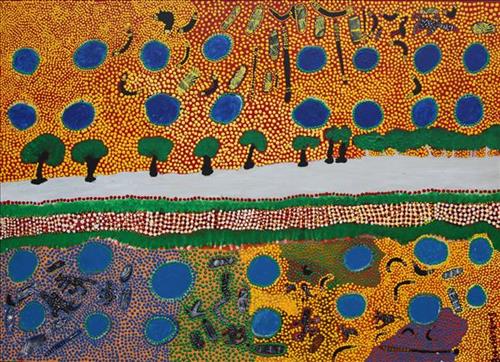
This work depicts Kulyakartu, a significant site in the far north of the Martu homelands. During pujiman (traditional, desert dwelling) times, Taylor and his family travelled to Kulyakartu in the wet season to take advantage of the vast grassy planes that made for excellent hunting.

Wokka and his brother Muuki, also an artist, are highly regarded senior Martu men. Together, they hold an encyclopaedic knowledge of Martu Country, including a deep understanding of the ecology and biodiversity of their land. In collaborative works, the brothers have been known to chart the intricate network of underground waters sustaining their Country.

Taylor’s signature style features densely layered dot work that flows rhythmically across the canvas, suggesting warm winds moving gently over sandhills or soft desert grasses. In this work, Taylor lovingly traces sinuous blue lines that snake their way across the plush grasslands of Kulyakartu, conjuring images of subterranean waters that support the fragile biodiversity of this site.

100% SILK SATIN WITH COTTON PADDING AND SILK LINING.
ALL OF OUR TIES COME IN A BEAUTIFUL GIFTBOX AND INCLUDE AN ARTIST’S CARD, DETAILING THE ARTIST’S WORK AND PRACTICE.

11153974869


Status: Stock


Muuki Taylor – Satin Silk Tie

“My Country, Kulyakartu. I grew up there, from little boy to big boy grew up there.” – Muuki Taylor

In this exquisite landscape study, Muuki Taylor depicts the grass country around Kulyakartu, in the north of the Great Sandy Desert. There is very good hunting at Kulyakartu, but no permanent water. During pujiman (traditional, desert dwelling) times, Taylor’s family walked there each year following the wet season.

Taylor paints his Country in all its seasonal stages, paying close attention to the after-effects of waru (fire burning). Controlled burns play a crucial role in encouraging greater diversity in plant and animal life, regenerating growth and assisting with hunting. In this work, the artist leaves us to consider what seasonal shifts may be at play. Taylor’s richly layered dot work and blazing colour palette seem to evoke nyurnma (burnt ground) – smouldering embers still aglow after a recent burn.

100% SILK SATIN WITH COTTON PADDING AND SILK LINING.
ALL OF OUR TIES COME IN A BEAUTIFUL GIFTBOX AND INCLUDE AN ARTIST’S CARD, DETAILING THE ARTIST’S WORK AND PRACTICE.

11153974868


Status: Stock


Minyawe Miller – Satin Silk Tie

The rhythmic linear dotting in this work represents the tali (sandhills) of Minyawe’s warran (Country), his ngurra (home Country, camp). 

Miller travelled vast stretches of Martu Country with his family during pujiman (traditional, bush dwelling) times. They traversed the expansive sandhill country between water sources, hunting and gathering bush foods along the way. Rock holes, soaks, springs and waterholes were of vital importance to Martu people in the pujiman era; knowledge of their whereabouts being essential to survival. Specific sites were visited according to the wet or dry seasons and the availability of resources.

In this work, Miller’s use of negative space evokes the long, sharp shadows that announce the days end in the desert. Miller’s restricted colour palette and sparing dot work conjures what could as easily be a starry night sky as a series of shifting sandhills, glinting in the dying light.

100% SILK SATIN WITH COTTON PADDING AND SILK LINING.
ALL OF OUR TIES COME IN A BEAUTIFUL GIFTBOX AND INCLUDE AN ARTIST’S CARD, DETAILING THE ARTIST’S WORK AND PRACTICE.


11153974865


Status: Stock


Nancy Nyanjilpayi Chapman – Silk Satin Scarf

“You got to get that kalaru, grind it and make a damper. Get him up and wash him, wash him, wash him then grind him into flour for a damper.” – Nancy Nyanjilpayi Chapman

In this work, Chapman depicts the edible native succulent kalaru (samphire). Kalaru grows in abundance around the warla (salt lakes) and lyinji (clay pans) of Chapman’s Country. The plant sheds edible black seeds that are collected, rinsed many times over, ground into a flour, then used to make damper. It is a time consuming dish that is still created for special occasions today.

Chapman’s painting practice is defined by a similar commitment to process. In this work, the delicate fanning of kalaru fronds gently frame Chapman’s meticulously fine dot work, representing a cache of jewel-like seeds. Chapman’s masterful use of colour and layering add a depth and movement to the work that seems to ripple with the motion of winnowing.

110CM X 110CM 12MM 100% SILK SATIN WITH HAND ROLLED EDGES.
ALL OF OUR SCARES COME IN A BEAUTIFUL GIFTBOX AND INCLUDE AN ARTIST’S CARD, DETAILING THE ARTIST’S WORK AND PRACTICE.

11153974864


Status: Stock


Jakayu Biljabu – Silk Scarf

In this work, Jakayu Biljabu transports the viewer into the desert Country traversed by seven sisters as they are chased by a lustful old man.

The epic Minyipuru Jukurrpa (Seven Sisters Story) follows the travels of seven sisters as they are chased across the desert of Martu Country by an amorous old man named Yurla.

Yurla followed the sisters from Roebourne on the coast of Western Australia. At one point in the story, Yurla snatches one of the women, but her sisters trick him and manage to rescue her. Eventually they escape into the sky, taking the form of the seven stars comprising the Pleiades constellation.

67 X 133CM 12MM 100% SILK SATIN WITH HAND ROLLED EDGES.
ALL OF OUR SCARES COME IN A BEAUTIFUL GIFTBOX AND INCLUDE AN ARTIST’S CARD, DETAILING THE ARTIST’S WORK AND PRACTICE.


11153974863


Status: Stock


Jakayu Biljabu – Silk Scarf

The electrifying work Parnngurr Area relates to the landscape surrounding the Martu community of Parnngurr in the Eastern Pilbara. Significant sites Yalpu, Wangkakarlu, Parnkurrl and Kurran Kurran are depicted – water sources that were crucial to the survival of Biljabu and her family during pujiman. Biljabu’s family travelled from place to place depending on the availability of food and water at these sites, and to fulfil social and ritual obligations.

The epic Minyipuru Jukurrpa (Seven Sisters Story) follows the travels of an amorous old man named Yurla as he chases seven sisters across the desert of Martu Country. The yellow arc-like shapes in this work represent the sisters dancing near Parnngurr.

Yurla followed the sisters from Roebourne on the coast of Western Australia. At one point in the story, Yurla snatches one of the women, but her sisters trick him and manage to rescue her. Eventually they escape into the sky, taking the form of the seven stars comprising the Pleiades constellation.

87cm x 125cm 14mm 100% silk satin with hand rolled edges.

ALL OF OUR SCARES COME IN A BEAUTIFUL GIFTBOX AND INCLUDE AN ARTIST’S CARD, DETAILING THE ARTIST’S WORK AND PRACTICE.

11151031740


Puntawarri Country

“This is Puntawarri country. That Nyiyaparli creek, Kupayiyura (Savory Creek), coming into putijarra country. Kupayiyura goes to kumpupirntily (Lake Disappointment). All the jurnu (soakwaters0 are along the side of the creek: how many… 1,2,3,4,5,6,7,8,9,10,11,12,13,14,15,16,17,18,191,20,21,22,23,24,25,26,27,28,29,30! Big mob. Ngayurnangalku (cannibal beings) travelled through this country going to Kumpupirntily. They got weapons- tjara (sheild), yirlilli (boomerang), kara (spear) and jurna (club) – they leave them on ground where they camp. They make that country . That country got everything-pangarra (goanna), karlaya (emu), dog,kangaroo all there. And Ngayurnanglaku… they’re there too.”

111582434714


Untitled

This is Mayiwalku’s Country- her ‘ngurra’ (home Country, camp). People identify with their ngurra in terms of specific rights and responsibilities, and the possession of intimate knowledge of the physical and cultural properties of one’s Country. Painting ngurra, and in so doing sharing the Jukurrpa (Dreaming) stories and physical characteristics of that place, has today become an important means of cultural maintenance. 

Mayiwalku’s ngurra encompasses the Country that she and her family walked in the pujiman (traditional, desert-dwelling) era. Mayiwalku was born at Yirnangarri. She grew up, walked and hunted primarily around the Country extending across the Punmu, Kunawarritji (Canning Stock Route Well 33) and Karlamilyi (Rudall River) regions. Following the death of both their parents, Mayiwalku and her sisters travelled alone between Punmu and Kunawarritji, occasionally meeting with other family groups. They continued to live nomadically before eventually deciding to move to Jigalong Mission along with many other relatives following an extreme and prolonged drought in the 1960s. 

Portrayed in this work are features of Mayiwalku’s ngurra, such as the dominant permanent red tali (sandhills), warta (trees, vegetation), and the individually named water sources she and her family camped at. These include Januwa, Jilankujarra, Karlajarntu, Kartungu, Kularti, Kumpupajanu, Kunalimpi, Kunarra, Marnakarti, Pangkapirni, Wilunganinya, Wurur-wururna, Yilyara, and Yirrajarra Rock holes, waterholes, soaks and springs were all extremely important sites for Martu people during the pujiman period, and are generally depicted with circular forms. 

The encyclopaedic knowledge of the location, quality and seasonal availability of the hundreds of water bodies found in one’s Country sustained Martu as they travelled across their Country, hunting and gathering, visiting family, and fulfilling ceremonial obligations. They would traverse very large distances annually, visiting specific areas in the dry and wet season depending on the availability of water and the corresponding cycles of plant and animal life on which hunting and gathering bush tucker was reliant. As they travelled and hunted they would also burn areas of Country, generating a greater diversity of plant and animal life.

111582434705


Coongan Waters

“This is that place where the water stops and has pools in the dry season.  You can see that gold across there and the gemstones, all gemstones, these ones next to the gold, and this is the coongan marble, you know how it’s named marble bar? Thats the marble there, down at Coongan. This is like the stones…the garnets, and the other ones which we havn’t got a name. This is that part of the coongan, when it doesnt run and it’s got pools.”

– Joan Lever


This work portrays an area of Country that can be interpreted in multiple ways. Firstly, the image may be read as an aerial representation of a particular location known to the artist- either land that they or their family travelled, from the 
pujiman (traditional, desert dwelling) era to now. During the pujiman period, Martu would traverse very large distances annually in small family groups, moving seasonally from water source to water source, and hunting and gathering bush tucker as they went. At this time, one’s survival depended on their intimate knowledge of the location of resources; thus physical elements of Country, such as sources of kapi (water), tali (sandhills), different varieties of warta (trees, vegetation), ngarrini (camps), and jina (tracks) are typically recorded with the use of a use of a system of iconographic forms universally shared across the desert. 

An additional layer of meaning in the work relates to more intangible concepts; life cycles based around kalyu (rain, water) and waru (fire) are also often evident. A thousands of year old practice, fire burning continues to be carried out as both an aid for hunting and a means of land management today. As the Martu travelled and hunted they would burn tracts of land, ensuring plant and animal biodiversity and reducing the risk of unmanageable, spontaneous bush fires. The patchwork nature of regrowth is evident in many landscape works, with each of the five distinctive phases of fire burning visually described with respect to the cycle of burning and regrowth.  

Finally, metaphysical information relating to a location may also be recorded; Jukurrpa (Dreaming) narratives chronicle the creation of physical landmarks, and can be referenced through depictions of ceremonial sites, songlines, and markers left in the land. Very often, however, information relating to Jukurrpa is censored by omission, or alternatively painted over with dotted patterns.