111582214075


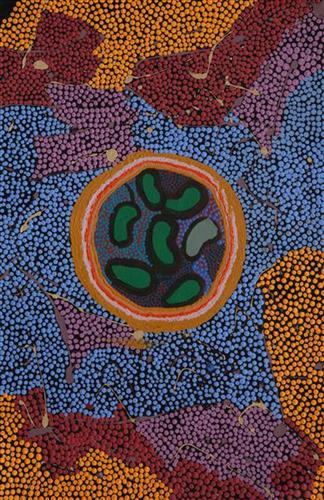
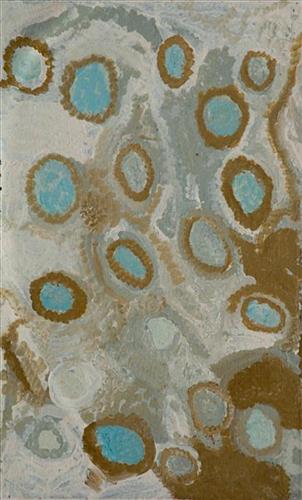
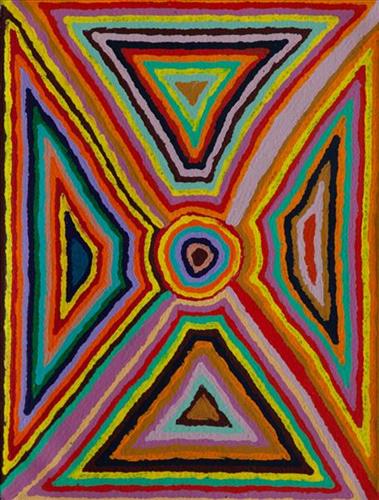
Nyinyiri

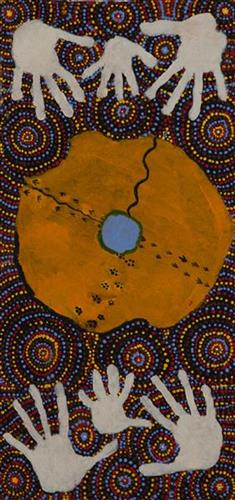
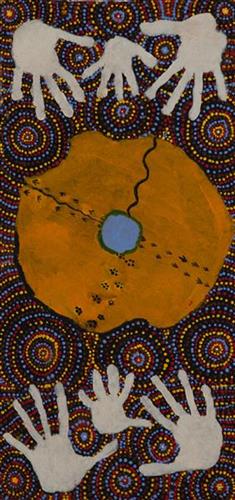
Nyinyiri is a small soak yulparirra (south) of Juntu-juntu (Canning Stock Route Well 30). This area is Mulyatingki’s birthplace; her ngurra (home Country, camp), and forms part of the area which she knew intimately and travelled extensively with her family in her youth. 

During the pujiman (traditional, desert dwelling) period, Martu would traverse very large distances annually in small family groups, moving seasonally from water source to water source, and hunting and gathering bush tucker as they went. At this time knowledge of water sources was critical for survival, and today Martu Country is still defined in terms of the location and type of water. Each of the hundreds of claypans, rockholes, waterholes, soaks and springs found in the Martu desert homelands is known by name, location, quality and seasonal availability through real life experience and the recounting of Jukurrpa (Dreaming) narratives. 

Soaks, or soakwaters, derive their name from the manner in which their waters generally seep into the sand from below stores, sometimes as part of an ephemeral river or creek. Soaks were an especially important source of water during the pujiman era, being the most dependable water source in times of drought. Water was obtained from soaks by scooping away the sand with a piti (timber bowls used for carrying food and water) until clear water gathered at the base of the hole, sometimes at a depth of several metres.

111582214074


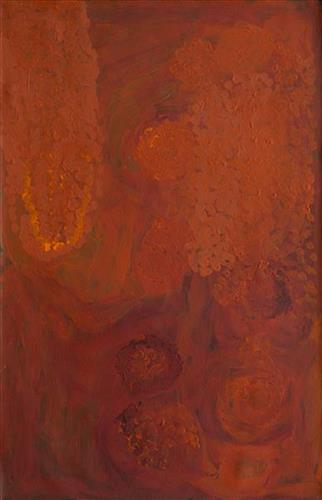
Bush tucker and wild flower

“I make a painting and it’s a wild bush flower, desert flower! And bush tucker. I do painting for bush tucker and wild flower.”

– Danita Wise

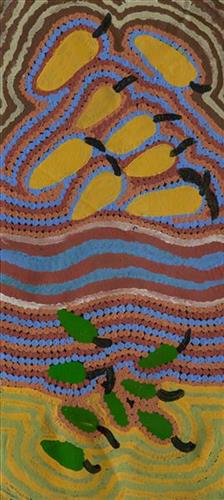
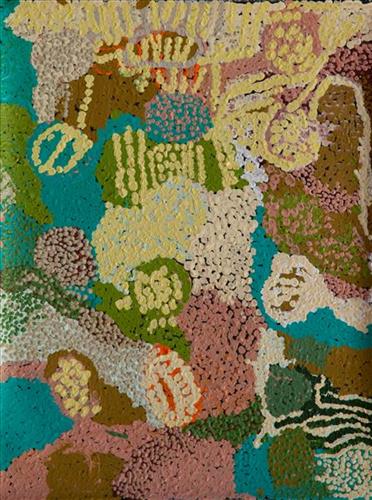
Depicted in this work are traditional types of bush tucker, their floral habitats, and their related hunting and gathering methods. During the pujiman (traditional, desert dwelling) period, Martu would traverse very large distances annually in small family groups, moving seasonally from water source to water source, and hunting and gathering bush tucker as they went. Whilst desert life has moved away from mobile hunter-gatherer subsistence throughout the course of the twentieth century, bush tucker continues to be a significant component of the modern Martu diet. Hunting and gathering bush tucker remains equally valuable as an important cultural practice that is passed on intergenerationally. Though hunting and gathering implements have been modernised, methods of harvesting, tracking and the use of fire burning to drive animals from their retreats are still commonly practiced today. 

Typically, animals hunted for their kuwiyi (meat) include kirti-kirti (euro kangaroo) and marlu (plains kangaroo), parnajarrpa (sand goanna), kipara (Australian bustard, bush turkey) and karlaya (emu). Lunki (witchetty grub) and wuukurta (honey ants) are dug from tree and bush trunks, or from underground nests. Popular mayi (plant food) includes minyarra (bush onion), collected from small, grass like plants; root vegetables dug from underground such as kulyu and mata (types of bush potato); and seeds such as kalaru (samphire, salt bush), yuwinyji, and marnkalpa (spinifex species). Jawirli (quondong), wamurla (bush tomatoes), jinyjiwirrily (wild gooseberry), ngaputa (melon), and karlkula (bush banana) are some of the most popular bush fruits. These are often collected in the wantajarra (cool season) and tuulpara (spring) months, along with juri (sweet) botanical gums and wama (nectar), obtained from various plant species. 

Traditional tools used for hunting and gathering bush tucker were carved from wanari (mulga), mulunturu (desert oak), yurungkura (river red gum) and mijarrpa (bloodwoods), and included kurlata (spears), jurna (hitting stick), karli (boomerangs), wana (digging-sticks), piti (timber bowls used for carrying food and water), and jiwa (grinding stones for grinding seeds into flour). While carved objects retain enormous social and ceremonial importance in Martu life, they are no longer used for hunting and gathering.

Over half a million square kilometres of mangroves, off shore islands, deep gorges, mountain ranges, desert sand dunes and river pools ensure the Pilbara’s flora is as diverse as the landscape. Plants and flowers in the Pilbara have evolved unique adaptations to survive in an arid climate that receives most of its rainfall during summer by way of tropical cyclones. Watercourses are lined with river red gums, coolibah, silver cadjeput and desert bloodwood trees. Gorges contain permanent water supplies to support moisture loving plants like the common rock fig and rock kurrajong. From July to September wildflowers of all colours, sizes and shapes, like the unmistakeable Sturt’s desert pea, fluffy mulla mulla, the tall majestic Ashburton pea or any number of the 65 species of Acacia (wattle) can be seen throughout the region.
111582214072


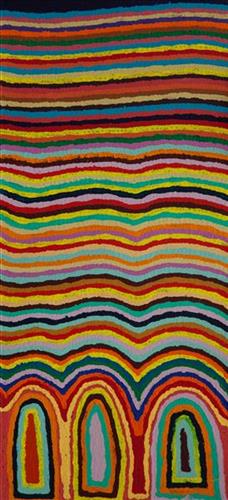
Jartuti

“Jartuti water place east of Parnngurr. In pujiman (traditional, desert dwelling) days old people walked and hunted there, we went there recently with KJ (Kanyirninpa Jukurrpa) ranger mob, lovely place.” 

 – Beverley Rogers

Jartuti is a water source located close to Parnngurr Aboriginal Community (otherwise known as Cotton Creek), and is part of Beverley’s father’s ngurra (home Country, camp). The site is near to the home of the jangara (cannibal devil), spiritual beings from the Jukurrpa (Dreaming) era.

111582214070


Jina (tracks, footprints)

Depicted in this work are jina (tracks, footprints), used by Martu people when tracking bush tucker. Distinctive are the jina of the marlu (kangaroo), parnajarrpa (sand goanna), kipara (bustard), karlaya (emu), jila (snake) and man, though tracks of much smaller animals and even insects are also well known by Martu young and old. This acute skills in track observation and identification has developed directly in relation to the hunter-gatherer existence of the Martu during the pujiman (traditional, desert dwelling) era, when their survival depended in large part on the successful tracking of hunted animals. In the absence of an actual animal sighting, tracks act as an identifier that an animal was present, which can then be followed to the animal’s present location. Besides providing information on location, Martu are able to interpret from tracks the passage of time since the tracks were imprinted, as well as the corresponding animal species and its size.

The softer and more extensive the ground surface, the easier it is to locate and follow tracks, thus certain conditions are favoured for tracking. Tuulparra (spring) and yalijarra (hot time) are preferred over wantajarra (winter), when southeasterly tradewinds blow strongly to obscure tracks. Tracks and burrows are also more readily visible in early growth lands, such as nyurnma (freshly burnt Country) and waru-waru (growth of new shoots and young plants). For this reason, fire burning is an important tool in animal tracking. Small burns are lit to clear vegetation, expose burrows, and to allow for access to walk and track readily in exposed sands, while simultaneously providing diverse regenerating habitats.  

Whilst desert life has moved away from mobile hunter-gatherer subsistence throughout the course of the twentieth century, bush tucker continues to be a significant component of the modern Martu diet, ensuring the continued relevance of tracking skills. Tracking remains equally valuable as an important cultural practice that is passed on intergenerationally.

111582214069


Jina (tracks, footprints)

Depicted in this work are jina (tracks, footprints), used by Martu people when tracking bush tucker. Distinctive are the jina of the marlu (kangaroo), parnajarrpa (sand goanna), kipara (bustard), karlaya (emu), jila (snake) and man, though tracks of much smaller animals and even insects are also well known by Martu young and old. This acute skills in track observation and identification has developed directly in relation to the hunter-gatherer existence of the Martu during the pujiman (traditional, desert dwelling) era, when their survival depended in large part on the successful tracking of hunted animals. In the absence of an actual animal sighting, tracks act as an identifier that an animal was present, which can then be followed to the animal’s present location. Besides providing information on location, Martu are able to interpret from tracks the passage of time since the tracks were imprinted, as well as the corresponding animal species and its size.

The softer and more extensive the ground surface, the easier it is to locate and follow tracks, thus certain conditions are favoured for tracking. Tuulparra (spring) and yalijarra (hot time) are preferred over wantajarra (winter), when southeasterly tradewinds blow strongly to obscure tracks. Tracks and burrows are also more readily visible in early growth lands, such as nyurnma (freshly burnt Country) and waru-waru (growth of new shoots and young plants). For this reason, fire burning is an important tool in animal tracking. Small burns are lit to clear vegetation, expose burrows, and to allow for access to walk and track readily in exposed sands, while simultaneously providing diverse regenerating habitats.  

Whilst desert life has moved away from mobile hunter-gatherer subsistence throughout the course of the twentieth century, bush tucker continues to be a significant component of the modern Martu diet, ensuring the continued relevance of tracking skills. Tracking remains equally valuable as an important cultural practice that is passed on intergenerationally.

111582214067


Bush tucker and wild flower

“I make a painting and it’s a wild bush flower, desert flower! And bush tucker. I do painting for bush tucker and wild flower.”

– Danita Wise

Depicted in this work are traditional types of bush tucker, their floral habitats, and their related hunting and gathering methods. During the pujiman (traditional, desert dwelling) period, Martu would traverse very large distances annually in small family groups, moving seasonally from water source to water source, and hunting and gathering bush tucker as they went. Whilst desert life has moved away from mobile hunter-gatherer subsistence throughout the course of the twentieth century, bush tucker continues to be a significant component of the modern Martu diet. Hunting and gathering bush tucker remains equally valuable as an important cultural practice that is passed on intergenerationally. Though hunting and gathering implements have been modernised, methods of harvesting, tracking and the use of fire burning to drive animals from their retreats are still commonly practiced today. 

Typically, animals hunted for their kuwiyi (meat) include kirti-kirti (euro kangaroo) and marlu (plains kangaroo), parnajarrpa (sand goanna), kipara (Australian bustard, bush turkey) and karlaya (emu). Lunki (witchetty grub) and wuukurta (honey ants) are dug from tree and bush trunks, or from underground nests. Popular mayi (plant food) includes minyarra (bush onion), collected from small, grass like plants; root vegetables dug from underground such as kulyu and mata (types of bush potato); and seeds such as kalaru (samphire, salt bush), yuwinyji, and marnkalpa (spinifex species). Jawirli (quondong), wamurla (bush tomatoes), jinyjiwirrily (wild gooseberry), ngaputa (melon), and karlkula (bush banana) are some of the most popular bush fruits. These are often collected in the wantajarra (cool season) and tuulpara (spring) months, along with juri (sweet) botanical gums and wama (nectar), obtained from various plant species. 

Traditional tools used for hunting and gathering bush tucker were carved from wanari (mulga), mulunturu (desert oak), yurungkura (river red gum) and mijarrpa (bloodwoods), and included kurlata (spears), jurna (hitting stick), karli (boomerangs), wana (digging-sticks), piti (timber bowls used for carrying food and water), and jiwa (grinding stones for grinding seeds into flour). While carved objects retain enormous social and ceremonial importance in Martu life, they are no longer used for hunting and gathering.

Over half a million square kilometres of mangroves, off shore islands, deep gorges, mountain ranges, desert sand dunes and river pools ensure the Pilbara’s flora is as diverse as the landscape. Plants and flowers in the Pilbara have evolved unique adaptations to survive in an arid climate that receives most of its rainfall during summer by way of tropical cyclones. Watercourses are lined with river red gums, coolibah, silver cadjeput and desert bloodwood trees. Gorges contain permanent water supplies to support moisture loving plants like the common rock fig and rock kurrajong. From July to September wildflowers of all colours, sizes and shapes, like the unmistakeable Sturt’s desert pea, fluffy mulla mulla, the tall majestic Ashburton pea or any number of the 65 species of Acacia (wattle) can be seen throughout the region.
111582214063


Nyayartakujarra (Ngayarta Kujarra, Lake Dora)

“This painting shows Nyayartakujarra (Lake Dora) and the waterholes. In pujiman (traditional, desert dwelling) days we all walked from waterhole to waterhole. We were travelling around for a long time; we were all naked! We grew up walking all around these waterholes. This painting is a map from that time. All of these waterholes are still here, with all of the songs and all of the dances. We are still singing and dancing for this Country.”

 – Mantararr (Muntararr) Rosie Williams (dec.), Jakayu Biljabu, Yikartu Bumba, Nyanjilpayi (Ngarnjapayi) Nancy Chapman, Mulyatingki Marney, Mayiwalku May Chapman, and Reena Rogers

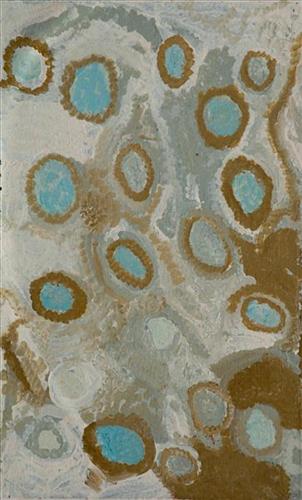
Nyayartakujarra is a vast and culturally significant salt lake located in the north east section of the Karlamilyi River region. Surrounding Nyayartakujarra are numerous fresh water soaks and the red tali (sandhills) typical of the area. Punmu Aboriginal Community, where Nyanjilpayi lives today, lies on the eastern edge of the lake. Nyayartakujarra lies within Nyanjilpayi’s ngurra (home Country, camp), the area which she knew intimately and travelled extensively with her family in her youth. 

Nyayartakujarra is an important site in the Jila Kujarra (Two Snakes) Jukurrpa (Dreaming) narrative. Though the story belongs to Warnman people, it is shared across the Western Desert with several other language groups. The narrative centres on the travels of two snakes as they are pursued by the Niminjarra, spiritual ancestors of the Warnman people.

Before transforming themselves into snakes, the Jila Kujarra were young brothers. As snakes, they began travelling home to their mother, but were intercepted by the Niminjarra, who tracked the Jila Kujarra to Paji, east of Nyayartakujarra. Here they eluded the Niminjarra, but the Jila Kujarra were soon after speared and injured at Nyayartakujarra by two Pukurti (initiates with bundled hair), who returned with the Niminjarra to cook the snakes at the site of Kumpupirntily (Kumpupintily, Lake Disappointment). As the Niminjarra cut down the length of the Jila Kujarra, the snake’s bladders were pierced, causing an explosion of scalding hot urine in which the Niminjarra all perished and became black rocks at the site. At the same time, the urine of the Jila Kujarra formed the lake at Kumpupirntily, which translates to ‘bladder burst’. The spirits of the Jila Kujarra returned to their mother at Nyayartakujarra, where the mother and her sons entered the ground below the lake and remain to this day.

111582214061


Nyayartakujarra (Ngayarta Kujarra, Lake Dora)

“This painting shows Nyayartakujarra (Lake Dora) and the waterholes. In pujiman (traditional, desert dwelling) days we all walked from waterhole to waterhole. We were travelling around for a long time; we were all naked! We grew up walking all around these waterholes. This painting is a map from that time. All of these waterholes are still here, with all of the songs and all of the dances. We are still singing and dancing for this Country.”

 – Mantararr (Muntararr) Rosie Williams (dec.), Jakayu Biljabu, Yikartu Bumba, Nyanjilpayi (Ngarnjapayi) Nancy Chapman, Mulyatingki Marney, Mayiwalku May Chapman, and Reena Rogers

Nyayartakujarra is a vast and culturally significant salt lake located in the north east section of the Karlamilyi River region. Surrounding Nyayartakujarra are numerous fresh water soaks and the red tali (sandhills) typical of the area. Punmu Aboriginal Community, where Nyanjilpayi lives today, lies on the eastern edge of the lake. Nyayartakujarra lies within Nyanjilpayi’s ngurra (home Country, camp), the area which she knew intimately and travelled extensively with her family in her youth. 

Nyayartakujarra is an important site in the Jila Kujarra (Two Snakes) Jukurrpa (Dreaming) narrative. Though the story belongs to Warnman people, it is shared across the Western Desert with several other language groups. The narrative centres on the travels of two snakes as they are pursued by the Niminjarra, spiritual ancestors of the Warnman people.

Before transforming themselves into snakes, the Jila Kujarra were young brothers. As snakes, they began travelling home to their mother, but were intercepted by the Niminjarra, who tracked the Jila Kujarra to Paji, east of Nyayartakujarra. Here they eluded the Niminjarra, but the Jila Kujarra were soon after speared and injured at Nyayartakujarra by two Pukurti (initiates with bundled hair), who returned with the Niminjarra to cook the snakes at the site of Kumpupirntily (Kumpupintily, Lake Disappointment). As the Niminjarra cut down the length of the Jila Kujarra, the snake’s bladders were pierced, causing an explosion of scalding hot urine in which the Niminjarra all perished and became black rocks at the site. At the same time, the urine of the Jila Kujarra formed the lake at Kumpupirntily, which translates to ‘bladder burst’. The spirits of the Jila Kujarra returned to their mother at Nyayartakujarra, where the mother and her sons entered the ground below the lake and remain to this day.

111582214053


Pitu (Separation Well)

“Pitu, soak, big one. Water there all the time. Pitu, the place for our whole family. [As a young girl] I walked around and went east back to my dad’s area, to Pitu and Kulilu, Nakaly and Kunapila. Then I was a teenager. My Country is Pitu and Nakaly, that’s my Country.

This man here, he came through here in the Dreamtime, walking right up through here and then he flew. Other one, a man and a woman, coming behind him, following him right up through here and then finish, I don’t know where they’ve gone. There is one more woman, going across here. Those three people walked through this Country and disappeared when they flew somewhere. They went forever. That was in the Dreamtime when they were walking around.”

 – Ngamaru Bidu, as translated by Ngalangka Nola Taylor

Pitu (Separation Well) is an important cultural site and large soak located yulparirra (south) of Wuranu (Canning Stock Route Well 29) and Kulilu rockhole and soak. As a site where fresh water was available all year, Pitu was an important camp and a meeting place for Kartujarra and Manyjilyjarra people during the pujiman (traditional, desert dwelling) era. At this time, knowledge of water sources was critical for survival, and today Martu Country is still defined in terms of the location and type of water. Each of the hundreds of claypans, rockholes, waterholes, soaks and springs found in the Martu desert homelands is known by name, location, quality and seasonal availability through real life experience and the recounting of Jukurrpa (Dreaming) narratives. 

Pitu lies within Ngamaru’s ngurra (home Country, camp), the area which she knew intimately and travelled extensively with her family in her youth. Ngamaru’s family name, ‘Bidu’, derives from this place name. In her account of the area, Ngamaru relates a Jukurrpa narrative that occurred in and around Pitu. The term Jukurrpa is often translated in English as the ‘Dreaming’, or ‘Dreamtime’. It refers generally to the period in which the world was created by ancestral beings, who assumed both human and nonhuman forms. These beings shaped what had been a formless landscape; creating waters, plants, animals, and people. At the same time they provided cultural protocols for the people they created, as well as rules for interacting with the natural environment. At their journey’s end, the ancestral beings transformed themselves into important waters, hills, rocks, and even constellations.

111582214052


Kurturarra

“Kurturarra is my Grandmother’s Country. Warla (lake) with a spring. Tali (sandhills) all around.”

 – Beverley Rogers

This site lies within Beverley’s ngurra (home Country, camp) through her grandmother. Kurturarra is a yinta (permanent spring) located within the largest of the salt lakes in the Percival Lakes region, and surrounded by acacia trees. The Percival Lakes form a string of ephemeral salt lakes in the north of Western Australia, extending across a distance of 350km. They lie at the southern region of the Great Sandy Desert and east of the Karlamilyi (Rudall River) region.

The region surrounding Kurturarra was formed by Wirnpa, one of the most powerful of the ancestral jila (snake) men and the last to travel the desert during the Jukurrpa (Dreaming). Wirnpa is a rainmaking jila who lived and hunted in the Percival Lakes area. His travels are described in the songs and stories of many language groups across the Western Desert, even those far removed from his home site. In his epic travels, Wirnpa met and feasted with many other ancestral beings, exchanged ceremonial objects, and created a series of different laws and ceremonies. When he finally returned home, he searched for his many children only to discover that they had already died. They had laid down and become the salt springs of the Percival Lakes. Wirnpa wept for his children before himself transforming into a snake and entering the soak where he still resides.