116182370717


Watiyawarnu

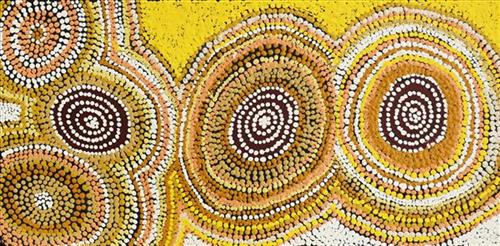
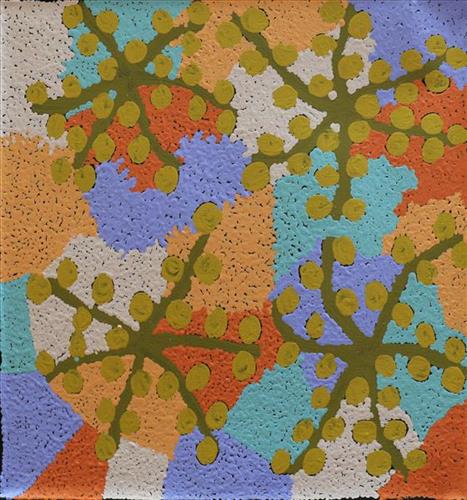
Women collecting Watiyawarnu (Acacia tenuissima). Back at camp after collecting the seeds they make large windbreaks for shelter and winnow the seed in the late afternoon. Immature watiyawarnu seed is ground into a paste and can be used to treat upset stomachs. There is an important ceremony for this Tjukurrpa. 

116182371766


Wardapi Jukurrpa

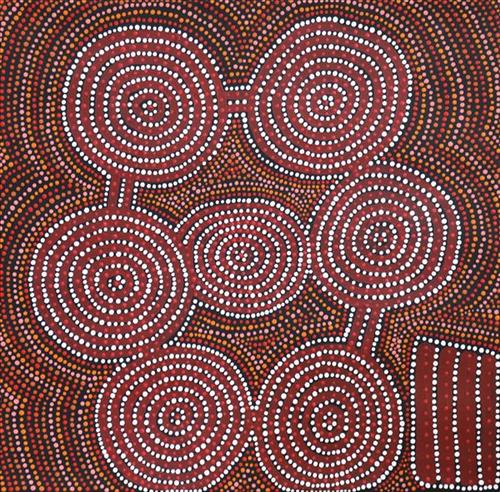
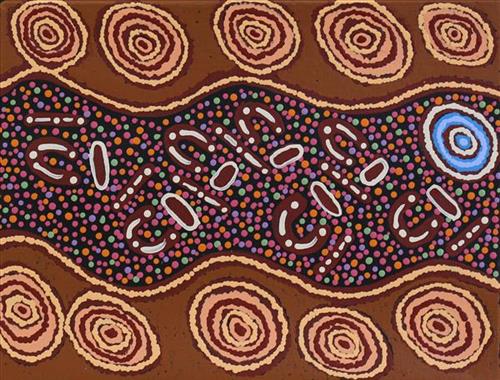
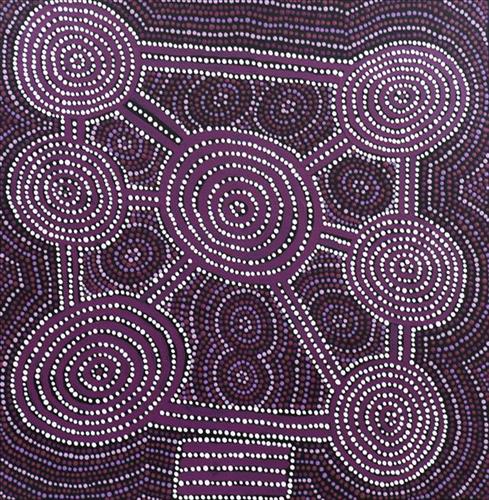
‘This painting is about the way women hunt Wardapi – that sand goanna. He digs holes in the dunes, makes his nest deep inside. Many of the holes all join up. Women hunt Wardapi in the dunes by digging out the holes. Sometimes cover one, and Wardapi runs out other one. Need to hunt him together. Find all the holes. Dig them at the same time. Someone going to get him that way.’

The Wardapi Jukurrpa [Varanus Gouldii Goanna] belongs to the Spencer Sisters. It comes from Yarripilangku [aka Yinyiripalangu], south-west of Yuendumu. A group of Warlpiri Karnta [women] are sitting down in a circle when a Japangardi Wati [man] from Puturlu [Mt Theo], called Wamaru came upon them. He wants to take one of them, named Yurlkurinyi, of Nungarrayi skin, which is the wrong skin for him. He takes the Nungarrayi woman up a hill, where they make love. In response, the earth on top of the hill turns to Ngunjungunju [white ochre], and yellow and red ochre. The yellow is for Karnta and the red for Wati. The ochre is used by Warlpiri people for love magic and ceremonial decoration. The Wati turns all the Karnta and himself into Wardapi, aka Varanus Gouldii goannas. This Jukurrpa belongs to the Napaljarri/Japaljarri and Nungarrayi /Jungarrayi subsections, and the Japanangka/Napanangka, Japangardi/Napangardi subsections of Puturlu. The women are often represented by ‘U’ shapes. Concentric circles may illustrate Wardapi holes, or their droppings left behind them, and Wardapi tracks are usually represented by ‘W’ shapes and wavy lines.

116182372756


Pura

Pura. We call him Pura. Bush Tomato (Solanum chippendalei) you call him. Got lot of little black seed… got to dig him out and throw away. Rubbish one, that seed. We use punu, a little tool from wood. He is called Karriti.

116182374930


Bush Flower

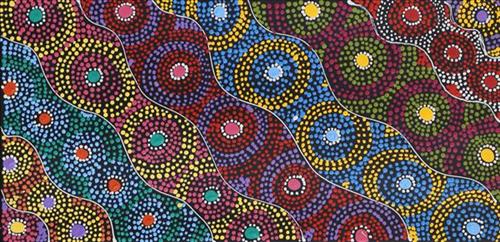
‘When I paint Bush Flower, my painting means all the seasons as they change, and the landscape views, about the Country, and about the place, where the bush tucker and bush medicine can be found. It’s about people going hunting, and about people telling their stories about that’s the time where to find new bush tucker, everything growing. It is like a map and a calendar, and history, genealogy, Everything! I see it like a very BIG picture. In my mind making lots of pictures sharing these stories with others so they can understand. It’s not just a leaf that I’m doing. The painting is the big picture in my mind, spreading everything out before me like a landscape view, and the seasons, and the calendar, and the history, and genealogy, and stories… It’s everything to me. All of what I know. That’s what I’m painting when I paint bush flowers.’

116182378222


Wardapi Jukurrpa

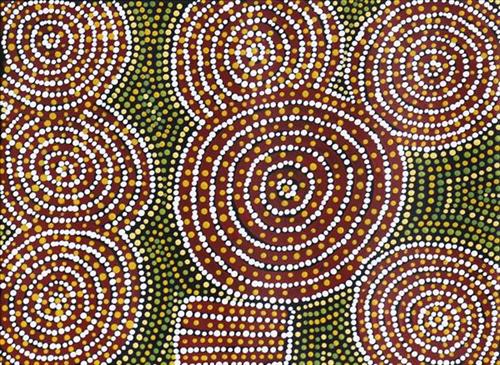
‘This painting is about the way women hunt Wardapi – that sand goanna. He digs holes in the dunes, makes his nest deep inside. Many of the holes all join up. Women hunt Wardapi in the dunes by digging out the holes. Sometimes cover one, and Wardapi runs out other one. Need to hunt him together. Find all the holes. Dig them at the same time. Someone going to get him that way.’

The Wardapi Jukurrpa [Varanus Gouldii Goanna] belongs to the Spencer Sisters. It comes from Yarripilangku [aka Yinyiripalangu], south-west of Yuendumu. A group of Warlpiri Karnta [women] are sitting down in a circle when a Japangardi Wati [man] from Puturlu [Mt Theo], called Wamaru came upon them. He wants to take one of them, named Yurlkurinyi, of Nungarrayi skin, which is the wrong skin for him. He takes the Nungarrayi woman up a hill, where they make love. In response, the earth on top of the hill turns to Ngunjungunju [white ochre], and yellow and red ochre. The yellow is for Karnta and the red for Wati. The ochre is used by Warlpiri people for love magic and ceremonial decoration. The Wati turns all the Karnta and himself into Wardapi, aka Varanus Gouldii goannas. This Jukurrpa belongs to the Napaljarri/Japaljarri and Nungarrayi /Jungarrayi subsections, and the Japanangka/Napanangka, Japangardi/Napangardi subsections of Puturlu. The women are often represented by ‘U’ shapes. Concentric circles may illustrate Wardapi holes, or their droppings left behind them, and Wardapi tracks are usually represented by ‘W’ shapes and wavy lines.

116182378220


Women Collecting Bush Food

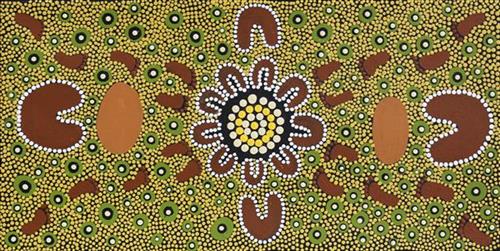
Women talking about collecting bush food – where the best places are and the best times, whether seasonal or dependent on rain events – All the women sit with their digging sticks and piti’s [coolamons] around the hearth to talk about these aspects of collecting bush food.

116182379693


Mount Allen

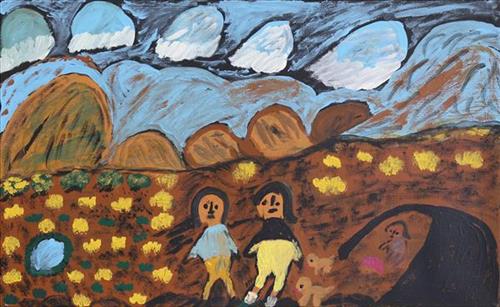
Mount Allen Station, long time ago. A man and woman and their two dogs near Mount Allen station, other side of Yuendumu. There is a waterhole there and a man sitting down in a humpy by the fire. This is from the old days, from when I was a girl we lived here near the station.

116182379688


Kungkarangkalpa

Seven Sisters’ travels of Central Australia. Wati Nyiru is a lust-filled shape shifting man who seeks to seduce the Seven Sisters and take them as his wives. But he is an untrustworthy tricky man and all the sisters are deeply afraid of him. They travel across the country locked in a battle of wits. Wati Nyiru is smart, but so is the eldest Sister. They each have their stories, their songs, and their dances. Each knows how to read the country they move through, their bush tucker, their Law.  The Sisters flee with Wati Nyiru in perpetual pursuit. Wati Nyiru is a master of disguise and uses magic to try to trick the sisters, transforming into highly valued food: the most tempting Bush tomatoes, and the most beautiful Ili (Wild Fig) tree and delicious Wayanu (Quandong tree). The sisters pluck the fruit, but when they taste it they realise that it Nyiru tricking them again. They forever travel through sand hill country hoping they have left him behind. However, Wati Nyiru uses his shape shifting so he is ahead of them, anticipating his next opportunity to seduce and steal one of the younger sisters away.

Eventually, so desperate to escape him, the Sisters transform into fire and flee into the Milky Way, where they are the Constellation Pleiades, now safely watching over all the women on earth. Wati-Nyiru follows them north, the lone star Orion, still pursuing, but unable to harm the Kungkarrakalpa. You will find them in the night sky, a small cluster of seven stars next to the Milky Way and Nyiru is the Morning Star that gets up early each morning to look for them. The Kungkarrakalpa Tjukurrpa creates links between all Australian women’s secret knowledge and Law about sacred places, knowledge about hunting and bush tucker species, and about creating and using various Punu [wooden artefacts]. The Minyma [mature women] often sing and dance the section of the Inma cycle specific to the Tjukurrpa of the place where they camp. When they meet other women at ceremony they paint ritualised patterns on their bodies with ochres and perform the epic Inma cycles [ceremonial song and dance] associated with these Tjukurrpa, each group holding a different section of the long and complex narrative.

116182380652


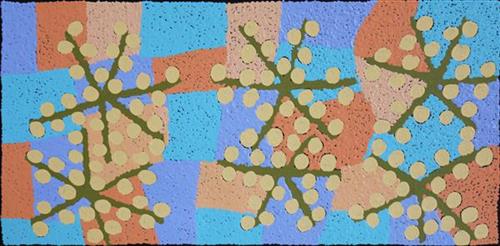
Watiyawarnu (Isobelle Spencer)

Women collecting Watiyawarnu (Acacia tenuissima). Back at camp after collecting the seeds they make large windbreaks for shelter and winnow the seed in the late afternoon. Immature watiyawarnu seed is ground into a paste and can be used to treat upset stomachs. There is an important ceremony for this Tjukurrpa. 

116182380857


Wardapi Jukurrpa

‘This painting is about the way women hunt Wardapi – that sand goanna. He digs holes in the dunes, makes his nest deep inside. Many of the holes all join up. Women hunt Wardapi in the dunes by digging out the holes. Sometimes cover one, and Wardapi runs out other one. Need to hunt him together. Find all the holes. Dig them at the same time. Someone going to get him that way.’

The Wardapi Jukurrpa [Varanus Gouldii Goanna] belongs to the Spencer Sisters. It comes from Yarripilangku [aka Yinyiripalangu], south-west of Yuendumu. A group of Warlpiri Karnta [women] are sitting down in a circle when a Japangardi Wati [man] from Puturlu [Mt Theo], called Wamaru came upon them. He wants to take one of them, named Yurlkurinyi, of Nungarrayi skin, which is the wrong skin for him. He takes the Nungarrayi woman up a hill, where they make love. In response, the earth on top of the hill turns to Ngunjungunju [white ochre], and yellow and red ochre. The yellow is for Karnta and the red for Wati. The ochre is used by Warlpiri people for love magic and ceremonial decoration. The Wati turns all the Karnta and himself into Wardapi, aka Varanus Gouldii goannas. This Jukurrpa belongs to the Napaljarri/Japaljarri and Nungarrayi /Jungarrayi subsections, and the Japanangka/Napanangka, Japangardi/Napangardi subsections of Puturlu. The women are often represented by ‘U’ shapes. Concentric circles may illustrate Wardapi holes, or their droppings left behind them, and Wardapi tracks are usually represented by ‘W’ shapes and wavy lines.