11191254067
Wak Wak
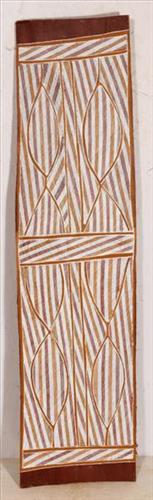
This painting depicts a sacred site at ‘Kurrurldul’, an outstation south of Maningrida.
The ‘rarrk’, or abstract crosshatching, on this work represents the design for the crow totem ancestor called ‘Djimarr’. Today this being exists in the form of a rock, which is permanently submerged at the bottom of Kurrurldul Creek. The ‘Djimarr’ rock in the stream at Kurrurldul is said to move around and call out in a soft hooting tone at night. Both the stone itself and the area around it are considered sacred.
The imagery represents the rock mentioned above at the bottom of Kurrurldul creek, which is the final transmutation of the dreaming ancestor ‘Djimarr’. Finally, the pattern used here is also the crow design used in the sacred ‘Mardayin’ ceremony, which is a large regional patri-moiety ceremony now rarely conducted in central and eastern Arnhem Land.
11191254017
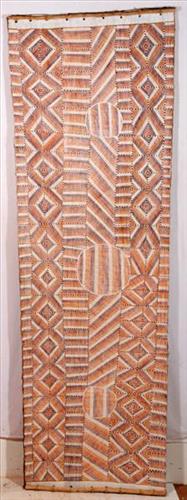
Waterhole at Barlparnmarra
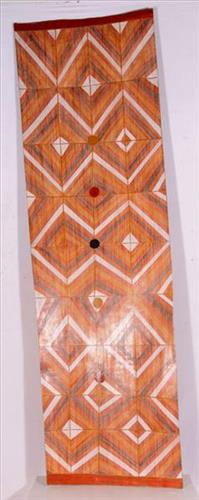
The artist has depicted gachalan – Merten’s Water Goannas [Varanus mertensi] – at a waterhole in the large swamp called Barlparnarra. The swamp lies to the north-west of Gochan Jiny-jirra, where Ngamandara lives. Ngamandara is a senior custodian for Barlparnarra, which is a complex of important sacred sites for the Jowunga moiety group throughout central Arnhem Land. It is associated with the creation myth of the two sisters, which has a number of versions celebrated throughout Arnhem Land. The sisters are commonly known as Djangkawu, but in the Barlparnarra version they are called Murlurlu. Many dreaming tracks of mythological beings associated with the two sisters converge at this site and ceremonies which celebrate their journeys are still held there.
The water goanna ancestral creator being is deeply associated with the two sisters story. There are a number of sacred sites, which are attributed to the water goanna dotted throughout Arnhem Land, including Barlparnarra, Miwirnbi, Ngarla Ji-bama and Ji-marda. The goanna’s route from place to place is said to link people belonging to different clan groups across wide tracts of country. Here the artist is painting a story, which proves his custodianship of a particular estate and simultaneously flags his membership of a wider network of kinship links, which share a common dreaming in the water goanna.
Barlparnarra
is also a major hunting and gathering site providing many vegetable foods such as spike rush corms and waterlilies. Game animals are also hunted at Barlpanarra as they are attracted to the waterhole to drink. Fishing is also an activity very popular in this area.
11191254143
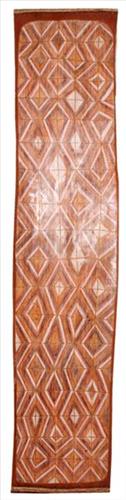
Wak Wak
This painting depicts a sacred site at ‘Kurrurldul’, an outstation south of Maningrida.
The ‘rarrk’, or abstract crosshatching, on this work represents the design for the crow totem ancestor called ‘Djimarr’. Today this being exists in the form of a rock, which is permanently submerged at the bottom of Kurrurldul Creek. The ‘Djimarr’ rock in the stream at Kurrurldul is said to move around and call out in a soft hooting tone at night. Both the stone itself and the area around it are considered sacred.
The imagery represents the rock mentioned above at the bottom of Kurrurldul creek, which is the final transmutation of the dreaming ancestor ‘Djimarr’. Finally, the pattern used here is also the crow design used in the sacred ‘Mardayin’ ceremony, which is a large regional patri-moiety ceremony now rarely conducted in central and eastern Arnhem Land.
11191254135
Wak Wak
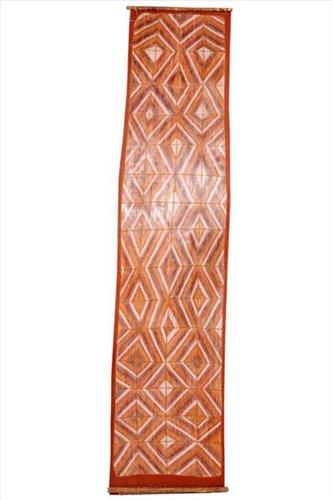
This painting depicts a sacred site at ‘Kurrurldul’, an outstation south of Maningrida.
The ‘rarrk’, or abstract crosshatching, on this work represents the design for the crow totem ancestor called ‘Djimarr’. Today this being exists in the form of a rock, which is permanently submerged at the bottom of Kurrurldul Creek. The ‘Djimarr’ rock in the stream at Kurrurldul is said to move around and call out in a soft hooting tone at night. Both the stone itself and the area around it are considered sacred.
The imagery represents the rock mentioned above at the bottom of Kurrurldul creek, which is the final transmutation of the dreaming ancestor ‘Djimarr’. Finally, the pattern used here is also the crow design used in the sacred ‘Mardayin’ ceremony, which is a large regional patri-moiety ceremony now rarely conducted in central and eastern Arnhem Land.
11152117472
Nungabar (Nyangapa) Nora
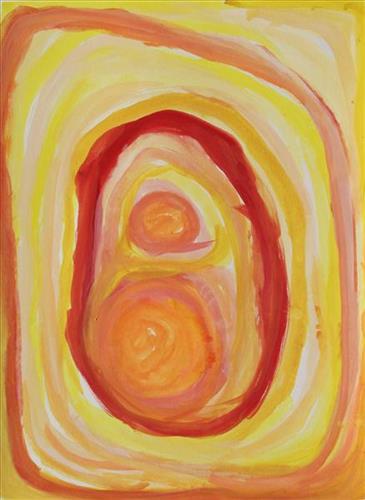
This is Nungabar’s Country- her ‘ngurra’ (home Country, camp). People identify with their ngurra in terms of specific rights and responsibilities, and the possession of intimate knowledge of the physical and cultural properties of one’s Country. Painting ngurra, and in so doing sharing the Jukurrpa (Dreaming) stories and physical characteristics of that place, has today become an important means of cultural maintenance. Nungabar’s ngurra encompasses her birthplace, near Lipuru well (Libral Well, Canning Stock Route Well 37) and the Country that became Wells 33 through to 38 along the Canning Stock Route, where her family walked in the pujiman (traditional, desert-dwelling) era. From an early age Nungabar and her family had encounters with the white men who drove cattle along the route. As a young woman, together with her close friend Nora Wompi, Nungabar followed the drovers north to Balgo Mission, where she settled and raised a family.
Portrayed in this work are features of Nungabar’s family’s ngurra, such as the striking salt lakes, permanent red tali (sandhills), warta (trees, vegetation), and the individually named water sources they camped at. Rock holes, waterholes, soaks and springs were all extremely important sites for Martu people during the pujiman period, and are generally depicted with circular forms.
The encyclopaedic knowledge of the location, quality and seasonal availability of the hundreds of water bodies found in one’s Country sustained Martu as they travelled across their Country, hunting and gathering, visiting family, and fulfilling ceremonial obligations. They would traverse very large distances annually, visiting specific areas in the dry and wet season depending on the availability of water and the corresponding cycles of plant and animal life on which hunting and gathering bush tucker was reliant. As they travelled and hunted they would also burn areas of Country, generating a greater diversity of plant and animal life.
11152117958
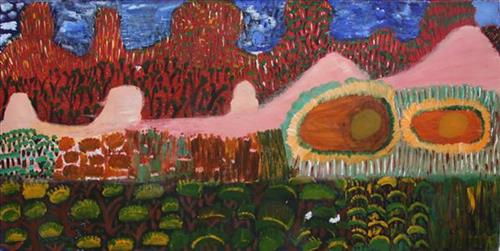
Puntawarri and Pimpi
This painting depicts the country around Pimpi and Puntawarri, an area in the artist’s country. Puntawarri, a now abandoned community is in-between Jigalong and the Canning Stock Route, Pimpi is an area near here. This place is an important cultural area, east of the Jigalong Aboriginal Community, where the artist now lives with her family. The old people used to live here and work here. The road goes from Jigalong past Puntawarri and onto Pimpi, then continues to the Middle stretch of the Canning Stock Route near Well 17 also known as Durba Springs. There is a waterhole here where the old bush people used to go to in the pujiman (bush) days while they were still walking around that country.
221776317544
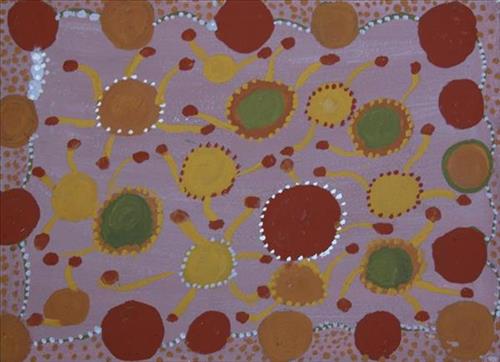
Woomarri
Woomarri (King George Country)
221776329475
Wanalirri
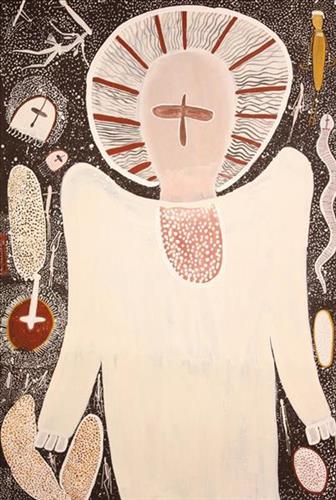
Wanalirri (Wandjina) with Kira Kiro (Bradshaw) figures, Lu (Snake). The Wandjina are ancestral spirits who created country, people and animals in the North West Kimberley before turning themselves into rock paintings. They are sometimes called “lightning man” or “rain maker” and every year they replenish water holes, creeks and rivers through making the wet season. The Wandjina can be vengeful if people break the law, by making savage storms and cyclones. The predominant white colouring and shape of the Wandjina’s body represent water and clouds which are sometimes offset by the use of a red pigment, used to paint the Tili (heart), representing blood that shows us that the Wandjina are partly alive.
221776329461
Aru
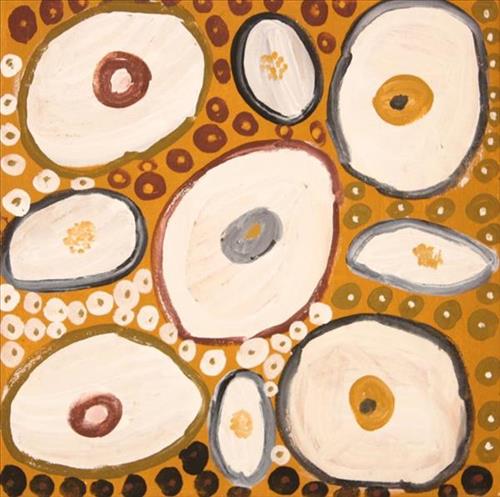
Aru (Rocks) – Berkley Coloured Rocks – Berkley River Country