111981615131


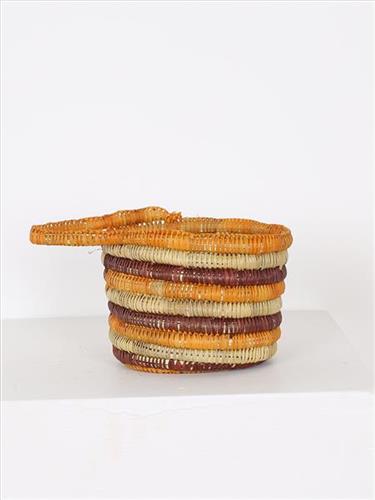
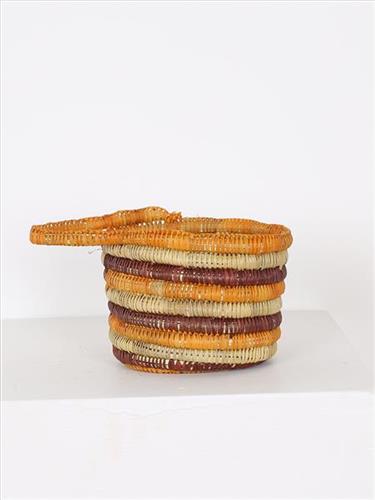
Coil Basket

Coiling technique was introduced in the 1920s at Goulburn Island to the Maung people by missionaries and quickly spread to the mainland. Many artists produce coiled baskets of varied shapes, ranging from small round baskets to large oval baby baskets made from dyed pandanus. Artists combine colours and patterns to obtain intricate new graphic patterns.

111981614932


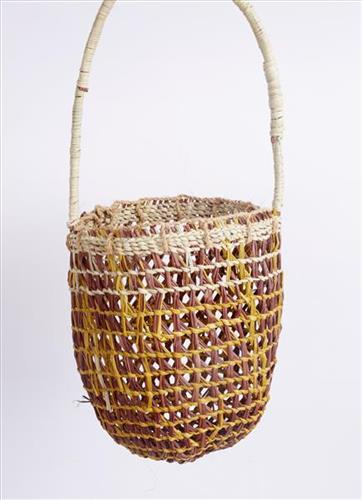
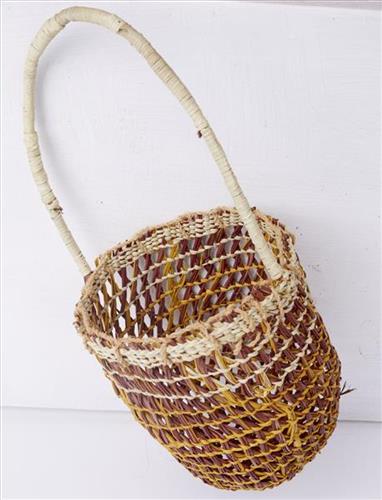
Burlupurr (Dilly Bag)

Burlupurr, or dilly bag, is a large woven collecting basket. These large bags are often made from the vine ‘Malasia scandens’, a strong pliable plant which grows along the floor and into the canopy of monsoon vine thickets. The bags are used to collect any kind of large numbers of heavy foods such as fish caught in conical fish traps or large collections of yams.

They can also be made from Pandanus spiralis, a plant which grows in many areas of Arnhem Land. These dilly bags are a tightly woven collecting basket, very finely made. These dilly bags are often used to collect sugarbag, the native honey 

As well as being of practical use, dilly bags are also of religious significance to Arnhem Land people. Dilly bags are said to be totemic objects and associated with particular sites in the landscape.

111581615589


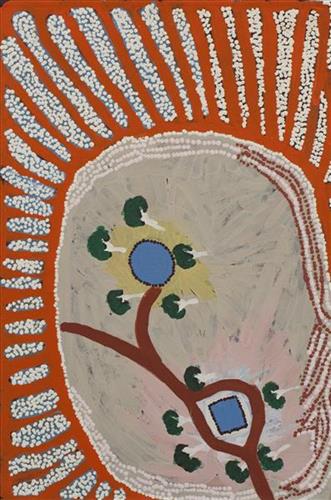
Kaalpa (Well 23)

“Kaalpa is my grandfather ngurra (home) where they walked, hunting bush tuckers. I went there for the first time this year [2018] on a Martumili KJ (Kanyirninpa Jukurrpa) trip. I went hunting there, got a parnajalpa (sand goanna).

When I went there I was pukurlpa (happy). It made you open up your spirt, it feels like home.

It’s got kapi (water) there, a well, jurnu (soak) and tuwa (sandhills)”

– Corban Clause Williams

Kaalpa is a place of great cultural significance, is also referred to as Well 23 on the Canning Stock Route. It is a good hunting place as there is permanent kapi.

111581615587


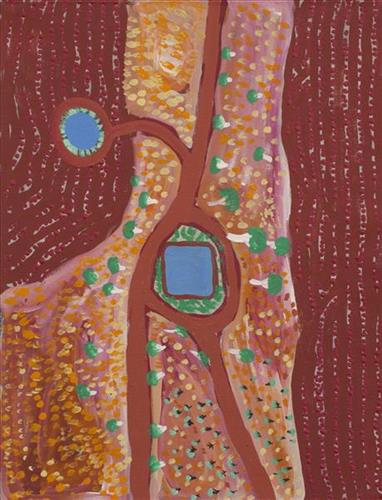
Kaalpa (Well 23)

“Kaalpa is my grandfather ngurra (home) where they walked, hunting bush tuckers. I went there for the first time this year [2018] on a Martumili KJ (Kanyirninpa Jukurrpa) trip. I went hunting there, got a parnajalpa (sand goanna).

When I went there I was pukurlpa (happy). It made you open up your spirt, it feels like home.

It’s got kapi (water) there, a well, jurnu (soak) and tuwa (sandhills)”

– Corban Clause Williams

Kaalpa is a place of great cultural significance, is also referred to as Well 23 on the Canning Stock Route. It is a good hunting place as there is permanent kapi.

111581615793


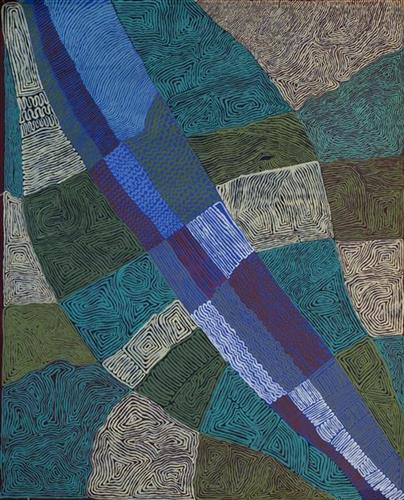
Karlamilyi- Desmond Taylor

“This is in the Karlamilyi River (Rudall River) area. The sand dunes run from the East to the West and stop at the river’s edge on each side. Where the sand dunes stop, the river was created by the Jila Kujarra (Two Snakes) that went east to Nyayartakujarra (Ngayarta Kujarra, Lake Dora). 

North of Karlamilyi River there’s a series of claypans in that Country, big claypans and small claypans. After it’s rained they all get filled up. Walyji (white gum) grows around the claypans. It’s a camping area for Warnman people. They used to get water there and also from the Karlamilyi River area. 

You can see that blue water along the Karlamilyi River, and the red tuwa (sandhills). As you fly over that Country you will see the designs on the ground in the different formations and colours. That’s the land of my family who are the ancestral owners of Karlamilyi.” 

 – Desmond Taylor 

Karlamilyi is Warnman Country, located in the very heart of the Martu homelands. The Karlamilyi region is Desmond’s ngurra (home Country, camp) through his parents and grandparents, and he possesses a great deal of knowledge of the region’s physical elements, resource distribution, and Jukurrpa (Dreaming) narratives.

The region is situated southwest of the Great Sandy Desert and northeast of the Little Sandy Desert. Spanning through the region is the epic Karlamilyi River, which runs north into Nyayartakujarra, a large salt lake. The Broadhurst and Fingoon Ranges extend diagonally across the river’s path. The landscape is striking for its abundance of gorges and valleys carved by ice age glaciers, rugged cliffs, red tali (sand dunes), grasslands, sandstone and quartz rocky outcrops, and salt lakes. 

Across the whole region are hundreds of water sources; including waterholes, creeks, soaks, lakes, pools and rockholes. Lining the rivers are coolabah, walyji (river gum), yulbah (bats wing coral tree), and several species of acacia and hakea. Jalkuran (paperbark), kurrulyu/ mijarrpa (bloodwood) and jawirli (quandong) are found in the region’s valleys, and wikirrpa (desert oaks) and grasses in the sandplains. The area is abundant with bird species, jila (snakes), maruntu (goannas), red kangaroos and warlpaju (rock wallabies). The region is also home to remote aboriginal communities Punmu and Parnngurr.

According to two of the central Martu Jukurrpa narratives, the Karlamilyi River and its surrounds were created by the ancestral beings Jila Kujarra and the Wati Kujarra (Two Goanna Men) as they travelled across the lands.
111581617601


Untitled

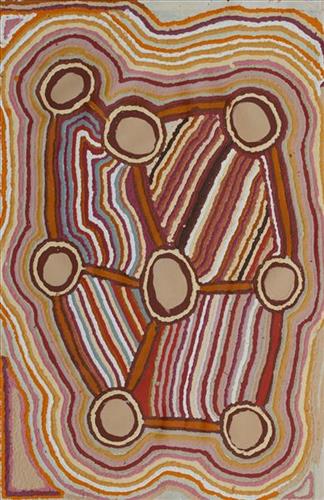
This is Kumpaya’s Country- her ‘ngurra’ (home Country, camp). People identify with their ngurra in terms of specific rights and responsibilities, and the possession of intimate knowledge of the physical and cultural properties of one’s Country. Painting ngurra, and in so doing sharing the Jukurrpa (Dreaming) stories and physical characteristics of that place, has today become an important means of cultural maintenance. 

Kumpaya’s ngurra encompasses the Country that she and her family walked in the pujiman (traditional, desert-dwelling) era. At this time she travelled nomadically with her own and other family groups, traversing an enormous tract of land around the middle section of the Canning Stock Route, and between Punmu Aboriginal community and Kiwirrkura, more than 500 kilometres eastward. 

Kumpaya was born close to Kiwirrkurra, a rockhole located in the Gibson Desert and to the south west of Lake McKay. She grew up, walked and hunted primarily around this area. As a young woman Kumpaya travelled westward, through to Kunawarritji (Canning Stock Route Well 33). She continued to live nomadically before eventually deciding to move to Jigalong Mission along with many other relatives following an extreme and prolonged drought in the 1960s. 

Portrayed in this work are features of Kumpaya’s ngurra, such as the striking salt lakes, dominant permanent red tali (sandhills), warta (trees, vegetation), and the individually named water sources she and her family camped at. These include Luurnkurangu, Karingkarra , Katarta, Pinkari, Pintu-pintu, Yanjiwara, Kunalimpi, Juntu-juntu (Canning Stock Route Well 30), Warla-warla (Canning Stock Route Well 31), Kunawarritji, Kinyu (Canning Stock Route Well 35), Natawalu (Canning Stock Route Well 40), and Kupankurlu. Rock holes, waterholes, soaks and springs were all extremely important sites for Martu people during the pujiman period, and are generally depicted with circular forms. 

The encyclopaedic knowledge of the location, quality and seasonal availability of the hundreds of water bodies found in one’s Country sustained Martu as they travelled across their Country, hunting and gathering, visiting family, and fulfilling ceremonial obligations. They would traverse very large distances annually, visiting specific areas in the dry and wet season depending on the availability of water and the corresponding cycles of plant and animal life on which hunting and gathering bush tucker was reliant. As they travelled and hunted they would also burn areas of Country, generating a greater diversity of plant and animal life.

111981618841


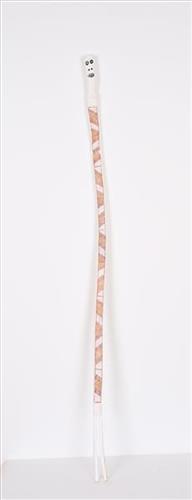
Wyarra

Wayarra/Wyarra is a spirit in the darkness that makes people very frightened. It is unseen but you feel scared when he is near you. It is something that you can’t normally see; but you can see skeleton shapes of the Wayarra/Wyarra if you are a witch doctor. It floats around at night and can appear as a floating white skeleton. They take their skin off to wash. These spirits can be frightening in appearance, however they usually stay away from humans.
A result of being a ‘clever man’ or a traditional healer, is they can commune with the Wayarra/Wyarra. It is also believed that the Wayarra/Wyarra can endow humans with the power to heal.

The ghost-like spirits are an integral part of Aboriginal cosmology in the western and central parts of Arnhem land. Some of the clans have the Wayarra/Wyarra as their clan totem and there are also dreaming sites for Wayarra/Wyarras and if you break or move rocks on those sites, there will be Wayarra/Wyarras everywhere. Wayarra/Wyarras prefer darkness.
Arnhem land is divided into clans or moieties. All living things, lands, clans, people, the natural and supernatural are classed as either one or the other of two moieties in Kununjku. duwa or yirridjdja. The duwa patrimony Wayarra cant walk around if the moon is shining. If they see the thin crescent just after the new moon, they have to put their heads down so they cant see the moon or their necks break. The yirridjdja patrimoiety Wayarra behave differently, they can walk about anytime.

You can hear them calling at night sometimes, they sound like the Curlew or they may even visit you! They look after you if you are lost by yourself. They can even follow you home until you are close to your home before they let you go.

111981618832


Wyarra

Wayarra/Wyarra is a spirit in the darkness that makes people very frightened. It is unseen but you feel scared when he is near you. It is something that you can’t normally see; but you can see skeleton shapes of the Wayarra/Wyarra if you are a witch doctor. It floats around at night and can appear as a floating white skeleton. They take their skin off to wash. These spirits can be frightening in appearance, however they usually stay away from humans.A result of being a ‘clever man’ or a traditional healer, is they can commune with the Wayarra/Wyarra. It is also believed that the Wayarra/Wyarra can endow humans with the power to heal. The ghost-like spirits are an integral part of Aboriginal cosmology in the western and central parts of Arnhem land. Some of the clans have the Wayarra/Wyarra as their clan totem and there are also dreaming sites for Wayarra/Wyarras and if you break or move rocks on those sites, there will be Wayarra/Wyarras everywhere. Wayarra/Wyarras prefer darkness. Arnhem land is divided into clans or moieties. All living things, lands, clans, people, the natural and supernatural are classed as either one or the other of two moieties in Kununjku. duwa or yirridjdja. The duwa patrimony Wayarra cant walk around if the moon is shining. If they see the thin crescent just after the new moon, they have to put their heads down so they cant see the moon or their necks break. The yirridjdja patrimoiety Wayarra behave differently, they can walk about anytime.You can hear them calling at night sometimes, they sound like the Curlew or they may even visit you! They look after you if you are lost by yourself. They can even follow you home until you are close to your home before they let you go.