111981944849
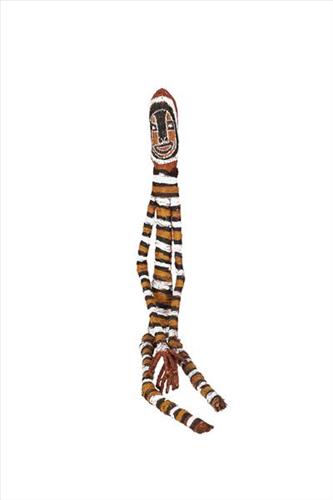
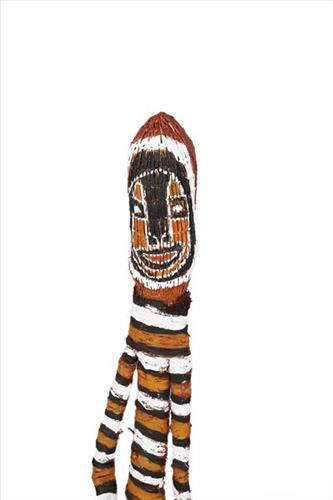
singer
111981944848
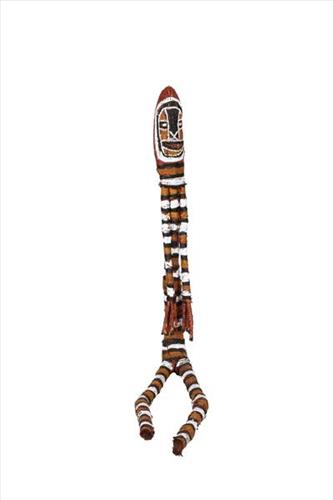
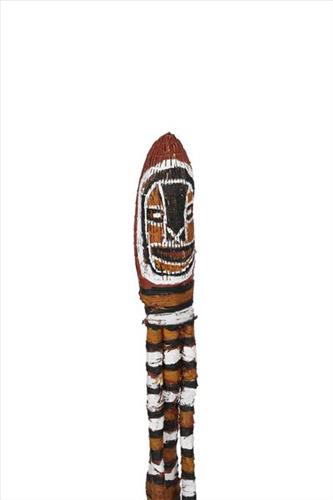
Singer
111981981954
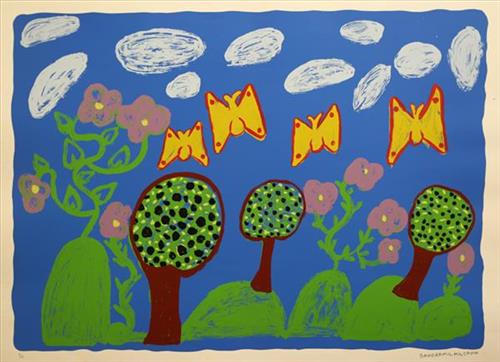
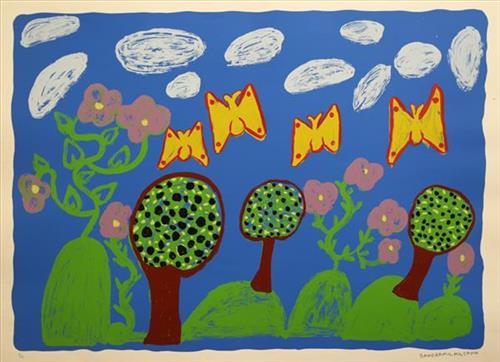
Kun-red merlemerle karralkan (bush with butterflies)- Seasons Folio
Butterflies, or merlemerle, are associated with the change in season from wet to dry. They thrive in the areas where yams grow, as the caterpillars eat the leaves of the yam while the tuber grows during the wet. When the tuber is ready for harvesting, in the dry season, the caterpillars have grown into butterflies. The butterflies and yam plants shown in Sandra Milmilkama’s print identify it as an interpretation of this time of year, when many bush foods are ready for harvesting.
This series of nine silkscreen prints is inspired by the cycle of six seasons in the tropical climate of north central Arnhem Land where the artists live. The prints are depictions of specific places at specific times of year, showing the vegetation and animals which are associated with that time and place. The names of the seasons and the places, plants and animals given here are in Kuninjku, which is spoken by most of the artists; a few speak Kune, a closely related dialect. Burarra is used when discussing Vicky Brown’s work as that is her language.
111981982229
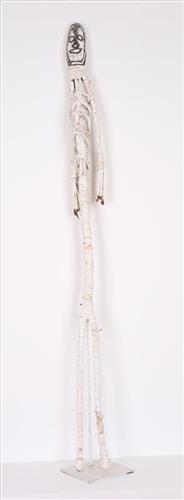
Wyarra
Wayarra/Wyarra is a spirit in the darkness that makes people very frightened. It is unseen but you feel scared when he is near you. It is something that you can’t normally see; but you can see skeleton shapes of the Wayarra/Wyarra if you are a witch doctor. It floats around at night and can appear as a floating white skeleton. They take their skin off to wash. These spirits can be frightening in appearance, however they usually stay away from humans.
A result of being a ‘clever man’ or a traditional healer, is they can commune with the Wayarra/Wyarra. It is also believed that the Wayarra/Wyarra can endow humans with the power to heal.
The ghost-like spirits are an integral part of Aboriginal cosmology in the western and central parts of Arnhem land. Some of the clans have the Wayarra/Wyarra as their clan totem and there are also dreaming sites for Wayarra/Wyarras and if you break or move rocks on those sites, there will be Wayarra/Wyarras everywhere. Wayarra/Wyarras prefer darkness.
Arnhem land is divided into clans or moieties. All living things, lands, clans, people, the natural and supernatural are classed as either one or the other of two moieties in Kununjku. duwa or yirridjdja. The duwa patrimony Wayarra cant walk around if the moon is shining. If they see the thin crescent just after the new moon, they have to put their heads down so they cant see the moon or their necks break. The yirridjdja patrimoiety Wayarra behave differently, they can walk about anytime.
You can hear them calling at night sometimes, they sound like the Curlew or they may even visit you! They look after you if you are lost by yourself. They can even follow you home until you are close to your home before they let you go.
111981981966
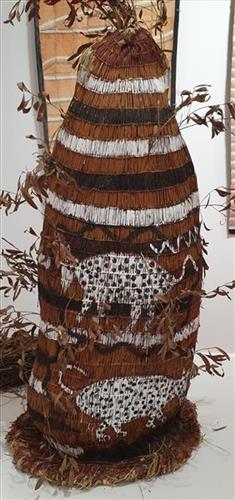
Yok (Ceremonial Object)
Used in ceremony to increase Yok (bandicoot numbers)
111981982182
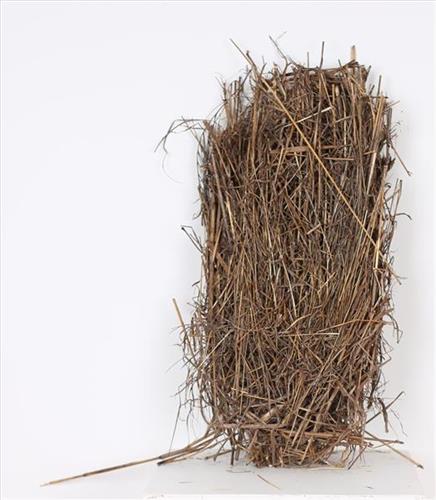
Yok nest
111981987461
Barramundi
Maningrida Arts & Culture logo
111981987779
Wak Wak
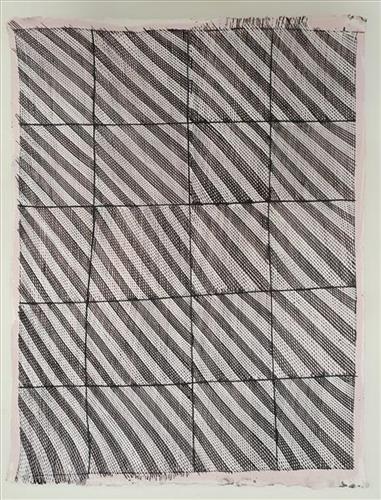
This painting depicts a sacred site at ‘Kurrurldul’, an outstation south of Maningrida.
The ‘rarrk’, or abstract crosshatching, on this work represents the design for the crow totem ancestor called ‘Djimarr’. Today this being exists in the form of a rock, which is permanently submerged at the bottom of Kurrurldul Creek. The ‘Djimarr’ rock in the stream at Kurrurldul is said to move around and call out in a soft hooting tone at night. Both the stone itself and the area around it are considered sacred.
The imagery represents the rock mentioned above at the bottom of Kurrurldul creek, which is the final transmutation of the dreaming ancestor ‘Djimarr’. Finally, the pattern used here is also the crow design used in the sacred ‘Mardayin’ ceremony, which is a large regional patri-moiety ceremony now rarely conducted in central and eastern Arnhem Land.
111981987771

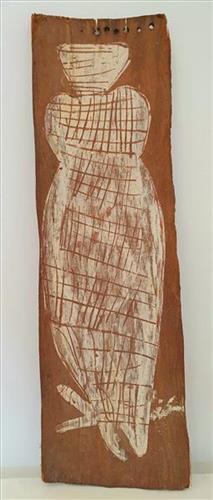
Birlmu or Namarnkorl (Barramundi)
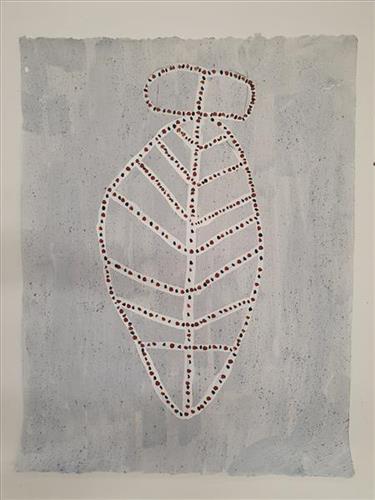
It is well known that Aboriginal art often depicts images of sacred totems or dreamings of Aboriginal culture. However, the world of the non-sacred also provides a rich source of subject matter for Aboriginal art. Much of the rock art of western Arnhem Land for example features secular topics such as common food animals and plants, depicted because of their economic importance but also merely because of their existence in the environment. The artist has painted ‘birlmu’ or ‘namarnkorl’ (Barramundi [Lates calcarifer]). During the dry season the barramundi is an important food source for inland Aboriginal people. These fish are caught throughout the artist’s clan estate, either in fishtraps woven from pandanus or sedge grass, or else hunted with spears and fishing lines in billabongs and streams where they shelter from the sun under fallen logs or amongst the leaves of water plants.