111981989075


Mandjabu (Fish Trap)

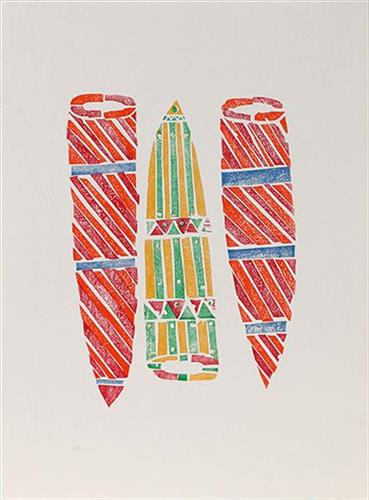
This design talks about my old man used to go fishing with mandjabu and come around to our camp with big mob fish from that freshwater river. We didn’t have any nets in the old days, and my father was taught make mandjabu by his old people. When I’m printing this design, I’m thinking of my father and the old times before balanda (non-indigenous) people arrived in my country. I did drawing first, then I cut it out with a thing like a really sharp spoon. I cut the lines right around the design, following the lines I’ve drawn When I see my design printed, I’m feeling really good. I choose the really bright colours- pink, orange and yellow, that mandjabu looks really nice one with bright colours.

111982004226


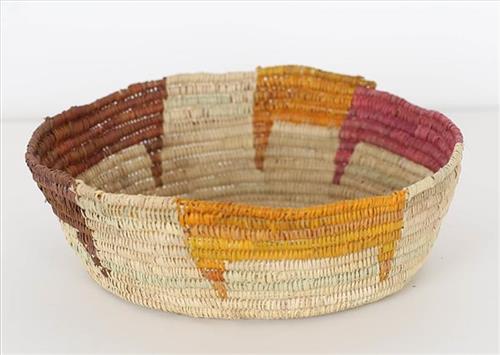
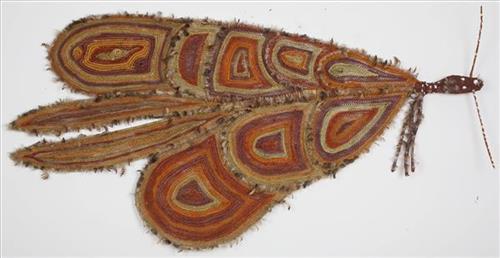
Coil Basket

Coiling technique was introduced in the 1920s at Goulburn Island to the Maung people by missionaries and quickly spread to the mainland. Many artists produce coiled baskets of varied shapes, ranging from small round baskets to large oval baby baskets made from dyed pandanus. Artists combine colours and patterns to obtain intricate new graphic patterns.

111982064286


Nirriwan (Oyster) at Rabuma Island

Whilst traveling towards the sunset the Djan’kawu Sisters hear dhurubarrpa, the rushing sounds of salt and fresh water meeting. Feeling curious, the Sisters walk towards it until they arrive at Baygita, a beach on the western side of Rabuma Island. Here they stop and enjoy a feed of nirriwan (oysters). They then fall asleep on the beach but wake up thirsty. Using their dhorna (digging sticks) they strike the earth in search of drinking water, but each time they pierce the ground they are surprised that the water is brackish.

To this day Baygita only has salty water. Despite the lack of fresh water the artist’s family lived and thrived there for many generations. He explains that the dhurubarrpa heard by the Djan’kawu Sisters was from a Gapirra site on Gorriyindi sea country fresh water is Dhuwa moiety and the salt water Yirritja. Gapirra  are places where Yirritja ga Dhuwa (the two sides of Yolŋu moiety system) waters meet. Gapirra are sacred sites and symbolise the coming together of Walamaŋgu, Gorriyindi and Gamalanga tribal groups.

In this work the nirriwan are depicted on the left side, and the footsteps of the Djan’kawu Sisters on the right.

Text by Milingimbi Art and Culture

111982081113


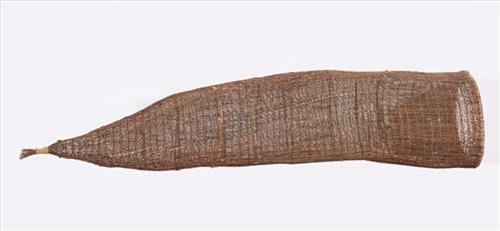
An-gujechiya (Fish Trap)

To make fish traps and fish net fences artists firstly get vine (mirlarl) from the jungle and they put it in water for one night to make it soft. Next they start weaving it; they make rings for the inside to keep the fish trap’s shape. Artists work for three or four weeks on the fish trap. They also make string from kurrajong (burdaga) to attach the hibiscus (bardainy) rings and to tie the conical end of the fish trap. This fish trap is used in saltwater and freshwater. People also use fish net fences called mun-dirra. A long time ago they would put the mun-dirra across rivers and creeks. In the middle they would place the an-gujechiya. They also used small things like sticks, rocks, mud and grass to block the fish from going through. People would then catch fish like saltwater barramundi rajarra, freshwater barramundi (janambal), small black freshwater catfish (buliya), bonefish (an-guwirrpiya), and sand bass (dalakan) in these fish traps.

111982091484


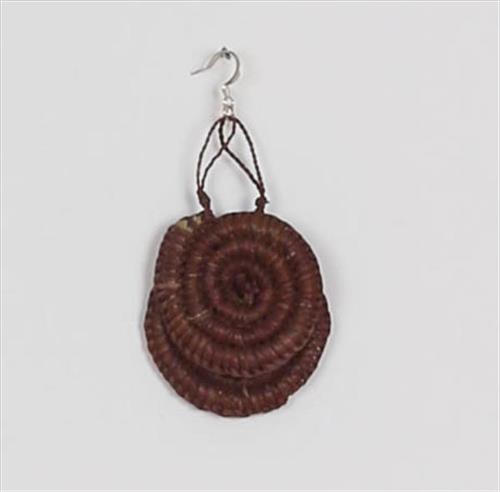
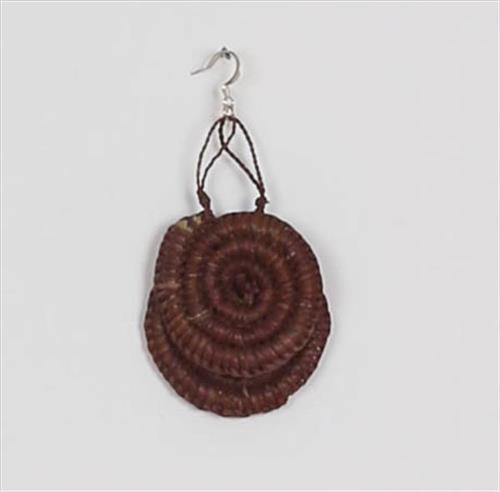
Bush Jewellery – Earrings

The women of Maningrida and surrounding homelands use a combination of locally found seeds, bone and shells to make a variety of jewellery including necklaces. earrings and bracelets.  Many of the artists use complex patterns and designs to make their beautiful creations.

111982091480


Warraburnburn

In Burarra and Gun-nartpa languages the figure represented in this artwork is generally known as a wangarra ‘ghost spirit’. For the Warrawarra clan ghost spirits have their own particular characteristics and their own name – Warraburnburn.

The Warraburnburn and the closely related Galabarrbarr spirit (owned by the Balkarranga clan) are also manikay song topics.  The spirits are related to each other as maternal grandparent and grandchild, just as the people of Warrawarra and Balkarranga are. The dancing of the two ghost spirit figures forms the finale performance for funerals, and is the final goodbye to a deceased family member.

In many ways the Warraburnburn and Galabarrbarr ghost spirits are like people. They emerge from the patches of jungle on Warrawarra and Balkarranga country in the late afternoon and go hunting in family groups of men, women and children. They stay in contact with each other by calling out as the men hunt for fish and the women walk with their dillybags looking for vegetable food. 

The ghost spirits are associated closely with white ochre and artists commonly paint the bodies of carved figures in white. Different types of ghost spirit wear different patterns. Warraburnburn is decorated with uniform white dots while others are painted white all over. Some ghost spirits are shown with a design painted on their chest infilled with rarrk ‘cross-hatching’, the same designs that are painted onto japi an-guyinda ‘male initiations’. 

They also have supernatural characteristics including superhuman size (jarra anbaykarda ‘super tall’). They know the country intimately – some are malevolent towards humans and will lead people astray, taking them to unfamiliar and dangerous places. These malevolent spirits are likened to an-muburda ‘sorcerers’ and can conduct dangerous rituals that cause harm to people. Others are benign and will lead humans back to familiar paths and their own camps.
 

111982093122


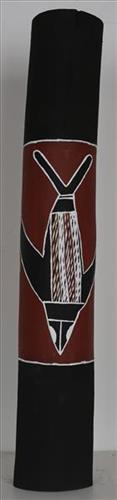
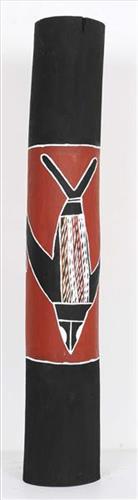
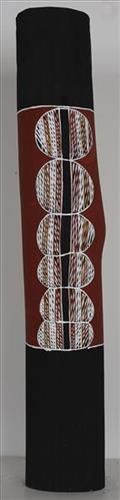
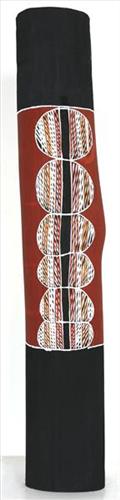
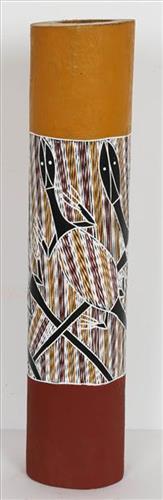
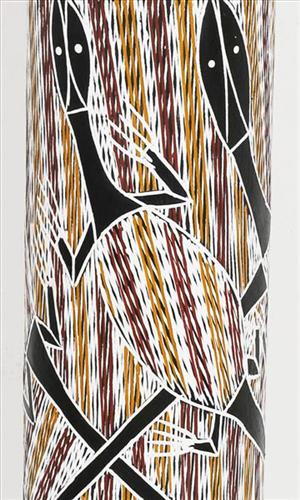
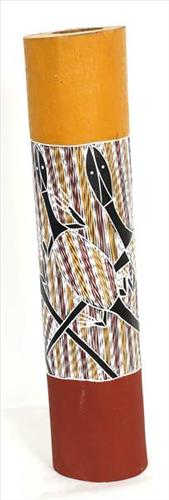
Lorrkon (Hollow Log)

The Lorrkon or bone pole coffin ceremony was the final ceremony in a sequence of mortuary rituals celebrated by the people of Arnhem Land. This ceremony involves the placing of the deceased’s bones into a hollow log which was decorated with painted clan designs and ceremonially placed into the ground where it remained until it slowly decayed over many years.

The log is made from a termite hollowed Stringybark tree (Eucalyptus tetradonta) and is decorated with totemic emblems. The western Arnhem Land version of the Lorrkon ceremony involves the singing of sacred songs to the accompaniment of karlikarli, a pair of sacred boomerangs used as rhythm instruments. During the final evening of the ceremony, dancers decorate themselves with kapok down, or today, cotton wool and conduct much of the final segments of the ceremony in the secrecy of a restricted mens’ camp. The complete ceremony may stretch over a period of two weeks, but on the last night the bones of the deceased, which have been kept in a bark container or today wrapped in cloth and kept in a suitcase are taken out, are painted with red ochre and placed inside the hollow log. This ceremony may take place many years after the person has died.

At first light on the final morning of the Lorrkon ceremony, the men appear, coming out of their secret bush camp carrying the pole towards the women’s camp. The two groups call to each other using distinct ceremonial calls. The women have prepared a hole for the pole to be placed into and when it is stood upright, women in particular kinship relationships to the deceased dance around the pole in a jumping/shuffling motion. The Lorrkon is then often covered with a tarpaulin and left to slowly decay.